August 26, 2026
When Chokepoints Become Battlegrounds: Understanding the Hormuz Transit Collapse
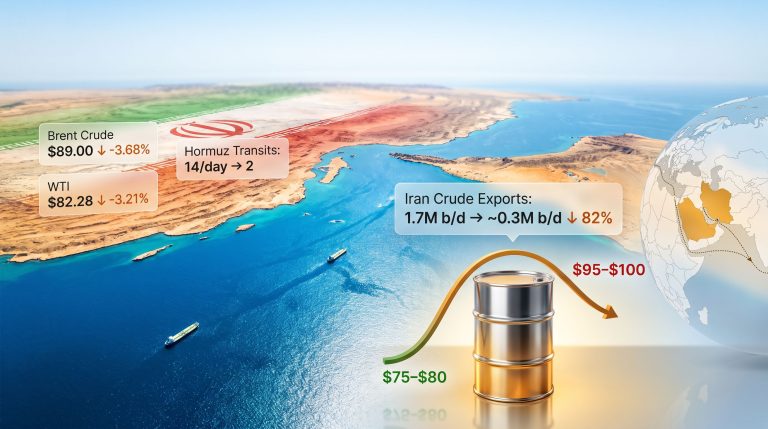
Energy markets operate on the assumption that the world's critical maritime corridors remain open, even during periods of geopolitical tension. That assumption has been under sustained assault in the Persian Gulf since late February 2026, when conflict transformed the Strait of Hormuz from a heavily monitored shipping lane into an actively contested military and regulatory battleground. The consequences are no longer theoretical. On 24 August 2026, outbound Hormuz transits dropped to zero, a data point that crystallises months of accelerating deterioration into a single, unmistakable signal for global energy markets.
When big ASX news breaks, our subscribers know first
Why the Strait of Hormuz Remains the World's Most Consequential Energy Chokepoint
No other geographic feature in the global energy system concentrates so much risk into so little physical space. The strait's navigable width of approximately 21 miles funnels a disproportionate share of the world's hydrocarbon trade through a corridor where geography, geopolitics, and military capability intersect with maximum friction.
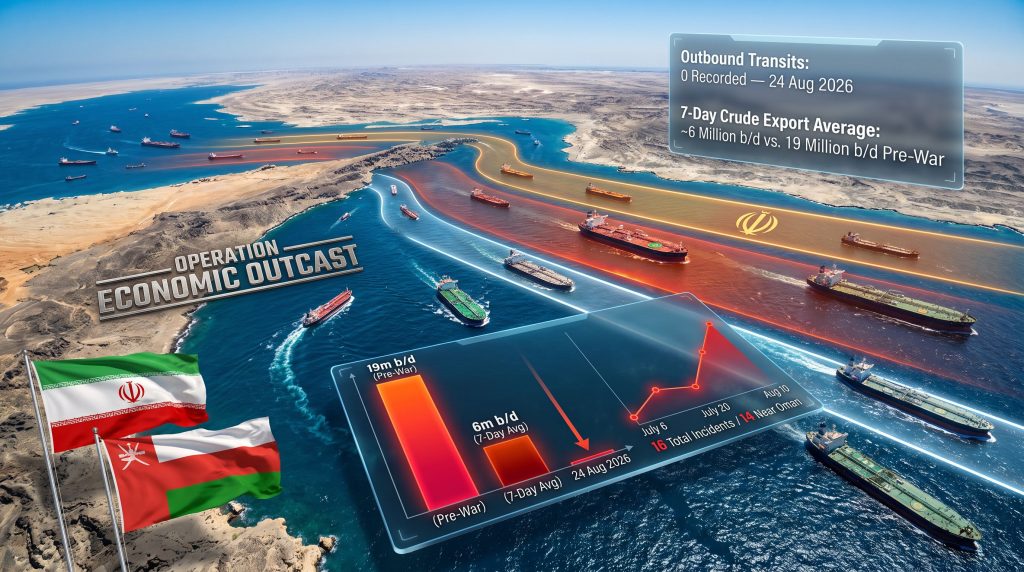
Before the conflict escalated in late February 2026, the strait handled roughly 19 million barrels per day (b/d) of crude exports. By the week of 24 August, a seven-day rolling average compiled by vessel information firm TankerTrackers.com placed Mideast Gulf crude exports via the US Navy blockade line at approximately 6 million b/d — about one-third of the pre-war baseline. On the most disrupted individual days, overall vessel traffic has fallen to roughly 3% of pre-war figures.
Three Structural Reasons No Alternative Route Fully Replaces Hormuz
Unlike the Suez Canal, where cargo can be rerouted around the Cape of Good Hope at elevated cost, the Strait of Hormuz offers no functionally equivalent bypass for the volume of trade it handles. Furthermore, three structural constraints define this irreplaceability:
-
Pipeline bypass capacity is severely limited. The Abu Dhabi Crude Oil Pipeline, the most significant overland alternative, handles only a fraction of peak Gulf export volumes and has no equivalent for other commodity classes.
-
LNG and LPG infrastructure in the Persian Gulf has been built exclusively around seaborne export. Qatar's Ras Laffan facility, one of the world's largest LNG and LPG export hubs, has no viable non-Hormuz maritime or overland export route for its full output capacity.
-
Refinery and petrochemical integration across the Mideast Gulf is architecturally designed for seaborne distribution, not land-based logistics. Reconfiguring that infrastructure is a multi-decade undertaking, not a crisis response option.
Key Insight: A sustained Hormuz disruption cannot be rerouted in the way that Suez Canal blockages can. The only available responses are demand destruction, strategic reserve drawdowns, or a negotiated framework to restore passage. All three carry significant market costs.
What "Outbound Hormuz Transits Drop to Zero" Actually Means
A Corridor-Level Breakdown, Not a Universal Shutdown
The phrase captures a real and significant event, but precision matters for market interpretation. The zero-transit figure recorded on 24 August is a corridor-specific and day-specific measurement, not a declaration that the strait is physically sealed to all vessel types simultaneously. That distinction matters for pricing models, but it does not diminish the severity of the underlying trend.
| Metric | Detail |
|---|---|
| Outbound transits on 24 August 2026 | 0 recorded (per Windward maritime security data) |
| Inbound transits on 24 August 2026 | 4 vessels (3 northern lane, 1 southern lane) |
| Traffic as % of pre-war baseline | Approximately 3% |
| 7-day rolling crude export average (week of 24 Aug) | ~6 million b/d vs. 19 million b/d pre-war |
| Outbound transits on 23 August (prior day) | 10 outbound, predominantly southern lane |
| Previous zero-transit episodes in August | Recorded on approximately 5 and 7 August |
The frequency of zero-transit episodes is itself the critical signal. Isolated disruptions are a feature of any high-risk waterway. Recurring, escalating episodes of near-complete outbound cessation reflect a structural deterioration in passage reliability, not a temporary anomaly. These developments also have far-reaching oil market impacts that extend well beyond the Persian Gulf region.
The Three-Corridor Architecture: How the Strait Now Operates
Traffic through the strait has bifurcated into a fragmented, corridor-based system that bears little resemblance to pre-conflict operations:
-
Northern lane: Under Iranian administrative control. Accessible primarily to vessels that comply with Iranian transit authority directives, meaning operators must effectively accept Iranian regulatory oversight.
-
Southern lane: Operating near the Omani coastline with US assistance. This corridor has become the primary target of Iranian enforcement strikes, precisely because it allows vessels to avoid Iranian oversight.
-
Central lane: The standard pre-conflict route. Widely regarded by commercial operators as mined and therefore commercially unusable. US President Donald Trump stated publicly that mines had been removed or detonated from international waters of the strait, but commercial shipping operators have not treated this as a definitive clearance signal.
Even if the central lane were fully verified as demined, vessels transiting it would still operate within drone and missile range of Iranian launch sites along the northern coastline. The geographic proximity advantage enjoyed by Iranian enforcement assets means that lane demarcation alone does not resolve the threat environment.
How Iranian Enforcement Mechanics Are Reshaping Transit Behaviour
The Persian Gulf Strait Authority: A Regulatory Claim with Coercive Enforcement
Iran's establishment of the Persian Gulf Strait Authority (PGSA) earlier in 2026 represents something qualitatively different from wartime disruption. It is an institutional claim over the administrative management of the strait, constructed to persist beyond any individual enforcement episode. The PGSA has designated 46 vessels as non-compliant with its transit framework, with consequences including fines, seizure, or confiscation of the vessel itself.
On 25 August 2026, the PGSA issued further warnings that vessels breaching its transit rules would face restrictions on future passage rights. This escalation in regulatory language, combined with kinetic enforcement actions, is designed to make non-compliance economically and operationally untenable for commercial operators. Indeed, OPEC's market influence is being compounded by these enforcement mechanisms in ways that are reshaping the broader energy pricing environment.
Strike Pattern Analysis: Iranian Enforcement by the Numbers
| Metric | Data Point |
|---|---|
| Total projectile strike incidents on commercial vessels since 6 July 2026 | 16 incidents |
| Strikes near the Omani coastline | 14 out of 16 (87.5%) |
| Geographic concentration | Vessels on the southern (US-assisted) transit lane |
| Operational objective (assessed) | Force commercial operators onto the northern Iranian-controlled lane |
The geographic concentration of strikes near Oman is not incidental. Iranian strike operations are specifically calibrated to raise the risk premium on southern-lane transits, which represent the primary commercial alternative to accepting PGSA oversight. The UKMTO confirmed at least one oil tanker was struck and disabled near the Omani coast during the period of reported mine clearance activity, leaving the crew uninjured but effectively aborting the transit.
Critical Distinction: Iran's enforcement strategy is not simply about closing the strait. It is about forcing compliance with a new regulatory architecture that gives Tehran administrative authority over all commercial vessel traffic through the waterway, regardless of the flag state or cargo origin.
Why the Southern Lane Is the Primary Battleground
Vessels seeking to avoid PGSA oversight naturally default to the southern lane due to its proximity to the Omani coastline and greater distance from Iranian administrative reach. Iran's concentrated strike activity in this zone is a direct response to that avoidance behaviour. The operational logic is straightforward: make the alternative to compliance too costly to sustain.
This dynamic creates a compliance dilemma that sits at the intersection of maritime law, US sanctions policy, and Iranian regulatory enforcement — a trilemma with no clean resolution for most commercial operators. Consequently, the geopolitical mining landscape is also feeling downstream effects as supply chain disruptions cascade across multiple commodity sectors.
The Oman-Iran Diplomatic Track: Scenario Modelling for a Negotiated Corridor
What the Joint Statement of 25 August 2026 Actually Proposes
Oman's Foreign Minister Badr Albusaidi arrived in Tehran on 24 August to advance bilateral negotiations. A joint communiqué issued on 25 August outlined a proposed framework covering four interconnected elements:
- Establishment of a temporary joint maritime corridor through the strait
- A joint mine clearance project to address the navigability of the central lane
- Ongoing technical negotiations aimed at a permanent maritime corridor agreement
- Mechanisms for traffic management, information exchange, and maritime security services
The Oman channel is currently the only active diplomatic track with Iranian participation. Its significance extends beyond the specific technical proposals it contains: it represents Iran's willingness to engage in a managed reopening framework rather than a total closure posture.
Scenario Matrix: Three Diplomatic Outcomes and Their Market Implications
| Scenario | Probability Assessment | Key Trigger | Market Impact |
|---|---|---|---|
| Temporary corridor agreed | Moderate | Iran accepts Omani mediation framework | Partial traffic restoration; elevated risk premium persists |
| Negotiations collapse | Elevated | US sanctions pressure reduces Iranian flexibility | Extended near-zero transit environment; oil price spike risk |
| Permanent corridor framework | Low (near-term) | Full geopolitical de-escalation | Normalisation of transit volumes; freight rate compression |
Strategic Note: The failure of the Oman diplomatic track would not merely delay a resolution. It would eliminate the only off-ramp currently available for a negotiated commercial reopening, leaving market participants with no credible near-term restoration scenario to price against.
How US Policy Is Complicating the Diplomatic Equation
Operation Economic Outcast: Pressure Campaign Architecture
The US Treasury announced Operation Economic Outcast on 25 August 2026 as a new economic isolation strategy targeting Iran's financial connectivity to global markets. Treasury Secretary Scott Bessent described the measures as targeting the full breadth of Iran's economic relationships with international partners.
The specific measures include:
- Sanctions against shippers based in the UAE, Singapore, and Hong Kong
- Designation of six tankers owned by sanctioned entities
- Sanctions on French biofuels plant La Nivernaise De Raffinage and its parent company Wellbred, accused of operating under the control of an Iranian-linked businessman
- New OFAC guidance warning entities against cooperating with Iran across aviation, digital assets, gold, shipping, and technology sectors
- Cancellation of sanctions waivers covering Iranian participation in international athletic tournaments and US-Iranian academic exchanges
- Additional specific warnings against cooperating with the Persian Gulf Strait Authority
The Sanctions-Diplomacy Tension: A Structural Contradiction
The simultaneous pursuit of US maximum pressure sanctions and Omani-mediated corridor negotiations creates a structural contradiction that neither track has resolved. Treasury's escalation of economic isolation reduces Iran's incentive to offer transit concessions, while Oman's engagement attempts to construct a functional transit architecture that requires Iranian cooperation.
China's role adds a further complicating dimension. Beijing held diplomatic talks with Tehran on the Mideast Gulf situation on 24 August, signalling continued support for Iran despite the US announcement. China has been the primary destination for Iranian crude exports since the imposition of US sanctions in 2019, and its ongoing economic relationship with Tehran materially reduces the coercive impact of US pressure campaigns.
Bessent acknowledged the potential for broader financial system disruption if the US were to fully enforce its stated intention to penalise all entities dealing with Iran — an implicit recognition that the maximalist version of Operation Economic Outcast carries risks that extend well beyond the Persian Gulf.
Analytical Framing: US maximum pressure and Omani-mediated diplomacy are not complementary strategies operating in parallel. They are structurally incompatible approaches that pull Iranian decision-making in opposite directions. One must yield for the other to succeed.
The next major ASX story will hit our subscribers first
What Zero Transits Mean for Global Commodity Markets: Sector-by-Sector Impact
Crude Oil: The Headline Exposure
The Mideast Gulf region is one of the world's highest-concentration crude export zones. A sustained near-zero transit environment forces buyers to source from alternative origins at structurally higher freight costs, compressing refinery margins and pushing up landed crude prices in Asia and Europe. Understanding crude oil price trends is therefore essential context for any market participant assessing their exposure to this disruption. Strategic petroleum reserve drawdowns represent a buffer mechanism, not a structural solution.
LNG and LPG: The Underreported Vulnerability
The LNG and LPG disruption risk is analytically underweighted relative to crude in most market commentary, but it may carry more severe near-term consequences for specific import-dependent economies. Qatar's Ras Laffan facility exports LNG and LPG volumes that have no viable non-Hormuz seaborne routing. Even partial transit disruption forces Asian and European LNG buyers to compete for non-Qatari supply at premium prices.
Vessel tracking data from the weekend of 22–23 August illustrates this exposure in specific terms. LPG tankers Gas Marakua and Olympios Gas were scheduled to load approximately 500,000 barrels and 300,000 barrels of LPG respectively at Ras Laffan. The LPG tankers Delma and Gas Warich were both scheduled to load around 500,000 barrels each at ADNOC's Ruwais refinery. These individual vessel movements represent the granular reality of a market that remains partially functional but is operating under sustained coercive pressure.
Refined Products and Petrochemicals: Secondary Cascade Effects
Refinery feedstock disruptions in Asia, particularly in South Korea, Japan, and India, transmit into refined product markets within weeks rather than months. Petrochemical plant utilisation rates decline as naphtha and LPG feedstock availability tightens. Furthermore, freight rate volatility on alternative routes via the Cape of Good Hope and Suez Canal increases as demand for non-Hormuz routing competes with existing capacity. The global crude steel outlook is also under pressure as downstream industrial activity responds to tightening energy feedstock availability.
How Shipowners Are Responding: Behavioural Shifts Under Geopolitical Stress
The Compliance Calculus: A Three-Way Dilemma
The PGSA's designation of 46 vessels as non-compliant has crystallised a three-way operational dilemma for shipowners:
- Comply with PGSA directives and accept Iranian oversight, potentially triggering US sanctions exposure under OFAC guidance
- Refuse compliance and risk Iranian enforcement action including strikes, seizure, or vessel confiscation on non-preferred transit lanes
- Exit the trade entirely and absorb significantly higher voyage costs through alternative routing via the Cape of Good Hope
Emerging Behavioural Patterns Among Commercial Operators
-
Trade avoidance: A growing cohort of shipowners is withdrawing from Mideast Gulf trade routes entirely, reducing available tonnage and pushing freight rates higher on remaining vessels willing to transit.
-
Cargo substitution: Buyers are redirecting procurement toward West African, North American, and North Sea origins where supply security is not contingent on Hormuz passage.
-
Insurance premium escalation: War risk insurance rates for Hormuz transits have risen substantially since the conflict began, adding a structural cost layer that persists even on days when physical transits occur.
-
Ownership opacity: Some operators are restructuring vessel ownership arrangements to reduce their sanctions exposure profile, a pattern familiar from earlier Iran sanctions cycles.
Scenario Modelling: If outbound Hormuz transits remained at or near zero for 30 consecutive days, global crude supply would face a structural shortfall of approximately 180 to 200 million barrels based on the gap between the current 6 million b/d throughput and the 19 million b/d pre-war baseline. IEA member nation strategic reserves could cover an estimated 60 to 90 days of the shortfall at coordinated release rates, but Asian refinery run rates would begin declining within two to three weeks as spot cargo availability tightens.
The Long-Term Strategic Question: Is the Hormuz Chokepoint Structurally Broken?
Three Indicators That Suggest Structural, Not Cyclical, Disruption
-
Institutional entrenchment: The PGSA is not a temporary wartime instrument. It represents a permanent Iranian administrative claim over strait management that will outlast any individual enforcement episode.
-
Bifurcated lane architecture: The division of the strait into competing Iranian-controlled and US-assisted corridors has created a structurally fragmented transit environment that cannot be resolved simply by a ceasefire.
-
Diplomatic divergence: The simultaneous pursuit of US maximum pressure and Omani-mediated corridor negotiations reflects a geopolitical deadlock without a clear resolution pathway, and both tracks are escalating rather than converging. The WTO's Strait of Hormuz trade tracker provides ongoing quantitative monitoring of how these disruptions are translating into measurable shifts in global trade flows.
What Energy Markets Must Price In Going Forward
The current episode is not a temporary spike event that will revert to pre-crisis norms once diplomatic resolution is achieved. Even a successful Oman-Iran corridor agreement would leave the PGSA's institutional framework intact, the bifurcated lane architecture in place, and US sanctions pressure as a background constraint on Iranian cooperation.
Energy markets must incorporate the following as baseline operating assumptions rather than tail-risk scenarios:
- A persistent geopolitical risk premium on Mideast Gulf crude, LNG, and LPG that reflects the new enforcement architecture rather than temporary disruption
- Structural rerouting costs as a permanent feature of supply chain economics for Hormuz-dependent buyers
- Insurance and compliance complexity that adds a non-trivial cost layer to every Hormuz-dependent cargo movement
- Optionality value in non-Hormuz supply sources, including the US, West Africa, the North Sea, and Australia, that is now being systematically repriced upward by buyers seeking supply security
Summary: Key Data Points at a Glance
| Indicator | Current Status |
|---|---|
| Outbound transits (24 Aug 2026) | 0 recorded |
| Total inbound transits (24 Aug 2026) | 4 vessels |
| Traffic as % of pre-war baseline | ~3% |
| Iranian strike incidents since 6 July 2026 | 16 total; 14 near Oman |
| PGSA non-compliant vessel designations | 46 vessels |
| 7-day crude export average | ~6 million b/d |
| Pre-conflict baseline | ~19 million b/d |
| Active diplomatic track | Iran-Oman bilateral negotiations |
| US counter-strategy | Operation Economic Outcast (sanctions) |
This article contains forward-looking scenario analysis and market projections based on publicly available data and independent assessments as of August 2026. Energy market conditions are subject to rapid change. Nothing in this article constitutes financial or investment advice. Readers should conduct independent due diligence before making any trading or investment decisions based on geopolitical risk scenarios.
For ongoing updates on Strait of Hormuz shipping dynamics and Mideast Gulf energy commodity flows, Argus Media provides continuous market intelligence coverage at argusmedia.com.
Want to Stay Ahead of the Commodity Disruptions Reshaping Global Markets?
When geopolitical shocks like the Hormuz transit collapse ripple through energy and commodity markets, the investors best positioned to respond are those with real-time intelligence. Discovery Alert's proprietary Discovery IQ model instantly identifies significant ASX mineral discoveries across more than 30 commodities — including those directly influenced by supply chain disruptions and shifting global trade flows — delivering actionable alerts the moment opportunities emerge. Explore how major discoveries have historically generated substantial returns on Discovery Alert's dedicated discoveries page, and begin your 14-day free trial today to secure your market-leading edge.