August 26, 2026
The Hidden Mechanism Behind Crude Oil Price Swings
Crude oil markets are not driven purely by supply and demand fundamentals. They are driven by probability. At any given moment, the price of a barrel of Brent crude reflects not just what is being produced and consumed today, but what traders collectively believe will happen tomorrow. This distinction matters enormously when geopolitical crises enter the picture, because it means that prices can move sharply on signals alone, long before any policy change, military development, or sanctions agreement is formally confirmed.
Understanding crude oil price trends requires grasping this forward-pricing dynamic, which is precisely why oil prices fall as Iran negotiation hopes return to global markets, even when Iranian crude exports remain near historic lows and the Strait of Hormuz continues to operate under severe stress. Understanding this mechanism is essential for anyone trying to make sense of crude price behaviour in the current environment.
When big ASX news breaks, our subscribers know first
Where Crude Prices Stood on August 25, 2026
The following benchmark snapshot captures the market response to diplomatic signals emerging from Pakistan's mediation efforts, which offset the bullish momentum that had been building following U.S. Treasury Secretary Scott Bessent's Monday press conference announcing sweeping secondary sanctions:
| Benchmark | Price (USD/bbl) | Daily Change | % Move |
|---|---|---|---|
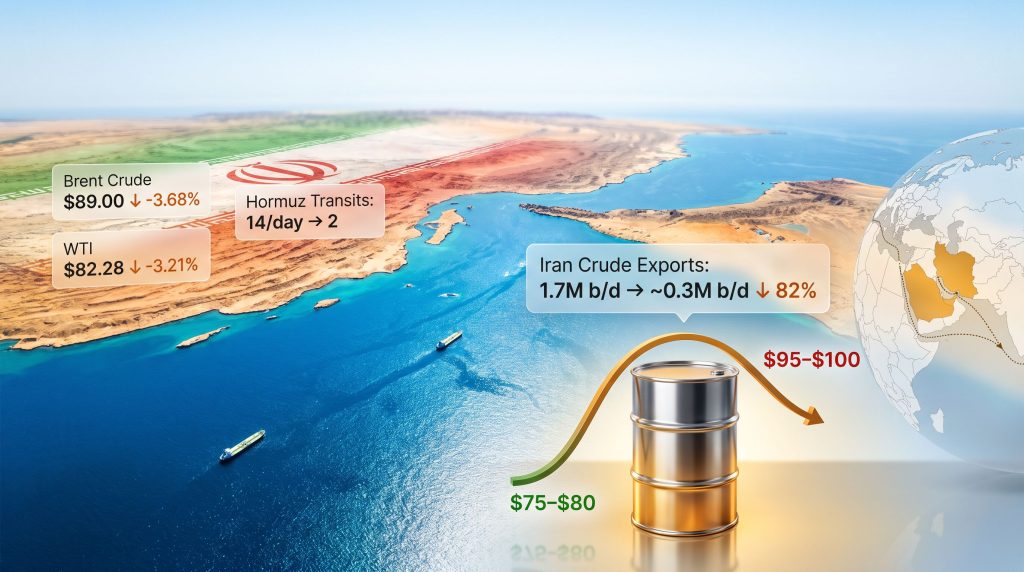
| Brent Crude | $88.78 | ↓ $3.39 | -3.68% |
| WTI Crude | $82.28 | ↓ $2.73 | -3.21% |
| Murban Crude | $93.30 | ↓ $8.14 | -8.02% |
| Iran Light vs. ICE Brent | +$4.00 premium | N/A | Scarcity signal |
The outsized decline in Murban crude, the Abu Dhabi benchmark grade, reflects the outsized exposure of Gulf-produced barrels to Hormuz transit risk. When diplomatic signals soften that risk perception, Gulf-origin grades reprice more aggressively than their North Sea or U.S. counterparts.
What the Iran Light Premium Reveals About Structural Scarcity
Under normal market conditions, sanctioned crude grades trade at a discount to global benchmarks. Buyers demand price concessions to compensate for the legal risk and logistical complexity of handling restricted barrels. The fact that Iran Light is currently commanding a $4 per barrel premium over ICE Brent inverts this logic entirely.
"When a heavily sanctioned crude grade trades above the global benchmark rather than below it, the market is communicating that the remaining accessible supply is being aggressively competed for by a shrinking pool of buyers. This is a structural scarcity condition, not a temporary pricing anomaly."
This premium reflects the reality that Chinese independent refiners, known in the industry as teapot refiners, have been drawing down floating storage inventories at an accelerating pace. Iranian floating storage outside the Gulf has contracted to approximately 24 million barrels, down 7 million barrels since the start of August 2026, with Chinese buyers absorbing the final available volumes.
How the U.S. Sanctions Architecture Created This Market Environment
The Trump administration's escalating pressure campaign against Iran has been constructed in layers, each designed to progressively isolate Tehran from global trade infrastructure. The announcement of what has been termed the "Economic D-Day" sanctions framework represents the broadest expansion of this campaign to date. Furthermore, the tariff and trade war impact on energy markets has added a further layer of complexity to an already volatile pricing environment.
Key structural features of the sanctions architecture include:
- Dollar system exclusion threats: Trading partners that continue commercial dealings with Iran face the risk of being cut off from U.S. dollar clearing infrastructure, a threat with profound implications for cross-border trade financing
- Secondary sanctions reach: The measures extend beyond Iran itself to target any commercial entity that continues to facilitate Iranian trade, regardless of nationality
- Deliberate omission of major Chinese banks: U.S. Treasury stopped short of directly sanctioning China's largest financial institutions in the initial announcement, a calculated diplomatic manoeuvre ahead of the September 24 Trump-Xi Summit
- No wind-down deadlines specified: Trading partners were not given specific timelines to comply, creating maximum legal ambiguity and market uncertainty
This deliberate ambiguity serves a strategic purpose. By threatening severe consequences without defining the compliance timeline, the administration maximises pressure on intermediary trading networks while preserving diplomatic flexibility with Beijing.
Iran's Export Collapse: The Numbers Behind the Crisis
The scale of Iran's crude export contraction is difficult to overstate. The U.S. Navy's maritime blockade in the Gulf of Oman has effectively severed Tehran's primary revenue stream.
| Metric | 2025 Average | August 2026 | Change |
|---|---|---|---|
| Iran crude exports | ~1.7 million b/d | ~0.3 million b/d | ↓ approximately 82% |
| Confirmed Kharg Island loadings | Multiple per month | 1 confirmed | Near halt |
| Iranian floating storage (outside Gulf) | ~31 million bbl | ~24 million bbl | ↓ 7 million bbl |
| Chinese imports of Iranian crude | Elevated | ~800,000 b/d | Drawing on stored stocks |
Kharg Island processes the overwhelming majority of Iran's crude export capacity, making it the single most critical piece of energy infrastructure in the country. With only one confirmed loading recorded during August 2026, the island's throughput has collapsed to a fraction of its operational potential.
China's Iranian Oil Lifeline Is Running Out
Chinese imports of Iranian crude are currently running at approximately 800,000 barrels per day, a figure that exceeds Iran's actual loading pace of roughly 300,000 barrels per day. The gap is being bridged by drawing down the floating storage inventories that were accumulated during a brief period of free navigation in June and July 2026.
"Analysts tracking tanker movements suggest that if the naval blockade persists without interruption, China's accessible pipeline of Iranian crude could be effectively exhausted as early as October 2026. This represents a hard supply cliff with no immediate like-for-like replacement source at equivalent pricing."
China's teapot refining sector, which has become structurally dependent on discounted Iranian barrels, is already exploring alternative crude sources in response to this pressure. This shift is itself significant, because it signals that even China's most price-sensitive refiners are beginning to accept that Iranian supply continuity cannot be relied upon. The broader US-China trade war dynamics are, consequently, adding further strain to these already fragile energy supply arrangements.
The Hormuz Chokepoint: Why Transit Volumes Matter So Much
The Strait of Hormuz is a navigational channel approximately 33 kilometres wide at its narrowest point, connecting the Persian Gulf to the Gulf of Oman. Roughly 20% of global oil supply transits through this waterway daily under normal conditions. There is no fully adequate alternative for the volume of energy that passes through it.
The scale of the transit collapse underway is striking:
- Prior 10-day average: 14 commodity vessels per day
- August 25, 2026 crossing count: 2 vessels
- Iranian tanker blacklist: 45 vessels designated non-compliant for dark transits
- Contagion risk: vessels conducting ship-to-ship transfers with blacklisted tankers face secondary listing
Understanding Dark Transits and Iran's Tanker Blacklisting Strategy
A dark transit refers to a vessel passage conducted with the Automatic Identification System (AIS) transponder disabled or manipulated, rendering the ship invisible to commercial tracking networks. Iran has designated 45 tankers as non-compliant for conducting such transits through the strait, a legal manoeuvre that effectively weaponises shipping insurance and port access.
The contagion element is particularly significant. Any vessel that conducts a ship-to-ship transfer with a blacklisted tanker faces the risk of secondary listing. This creates a chilling effect that extends well beyond the 45 directly targeted vessels, as counterparties throughout the global tanker fleet reassess their exposure.
Qatar's LNG Crisis: A Shipping Constraint, Not a Production Problem
QatarEnergy's Ras Laffan liquefaction facility, which operates at a capacity of 77 million tonnes per annum, is not facing a gas supply shortage. It is facing a vessel shortage. With Hormuz transits effectively halted for Qatari carriers, approximately 1.2 million metric tonnes of LNG is currently stranded afloat in the Gulf. The prospect of production curtailments driven entirely by insufficient available carriers represents an unusual and underappreciated dimension of the Hormuz crisis.
Saudi Arabia's Bypass Route Runs Into New Vulnerability
Saudi Arabia's East-West pipeline was widely regarded as the kingdom's primary mechanism for bypassing Hormuz during periods of strait disruption. The pipeline runs from the Eastern Province oil fields to the port of Yanbu on the Red Sea coast, theoretically enabling Saudi crude to reach Mediterranean markets without passing through the strait.
That bypass route was exposed as structurally vulnerable when a Houthi attack struck the Bahri-owned tanker Amzan near Yanbu, Saudi Arabia's only operational Mediterranean-facing loading port. The attack forced all tanker traffic to redirect toward the Suez Canal, effectively neutralising the bypass advantage.
TotalEnergies has responded to the broader infrastructure vulnerability by backing two separate pipeline projects designed to reduce Hormuz dependency. The $42 billion Tanzania LNG project has simultaneously gained renewed strategic attention as a non-Gulf liquefaction alternative capable of serving Asian markets through a Hormuz-independent shipping corridor.
The next major ASX story will hit our subscribers first
Strategic Reserve Management and the IEA's Calculated Restraint
Following the deployment of 400 million barrels of strategic reserves in March 2026, IEA Executive Director Fatih Birol confirmed in late August that no second emergency release is currently under discussion. Approximately 80% of IEA strategic stockpiles remain intact, a reserve position the agency appears content to preserve as a deterrent rather than deploy into a still-evolving crisis.
Japan has similarly declined to release additional national reserves despite a projected decline in September import volumes, a decision that reflects institutional confidence that diplomatic channels remain viable.
Other supply-side pressures compounding the market environment include:
- Norway: Production running nearly 200,000 barrels per day below capacity
- Russia: Diesel export ban potentially extended through October following continued Ukrainian drone strikes on southern refineries
- Iraq: Ambitions to double output constrained by OPEC production ceiling obligations
The China-U.S. Diplomatic Dimension: September's Inflection Point
The most consequential variable in the near-term oil price outlook may not be military or logistical. It may be diplomatic. The scheduled Trump-Xi Summit on September 24 represents the single most important near-term inflection point for both crude pricing and geopolitical risk premiums. In addition, the trade war impact on oil markets is amplifying these pressures considerably.
The context surrounding that meeting is highly charged. The U.S. is preparing to impose an additional 7.5% tariff on Chinese goods over excess manufacturing capacity allegations, which would restore second-term White House duties on Chinese imports to 20%. This move arrives less than one month before the bilateral summit, creating a compressed diplomatic timeline.
"China's strategic calculus on Iran is not simply about crude oil access. It involves the architecture of dollar-system participation, trade tariff leverage across multiple sectors, and long-term energy security planning. The September summit is therefore not just a trade negotiation, it is a multi-variable geopolitical settlement where Iranian oil policy is one element of a much larger equation."
Scenario Framework: Where Crude Prices Could Go From Here
| Scenario | Market Signal Probability | Brent Price Implication |
|---|---|---|
| Full diplomatic breakthrough and sanctions rollback | Low to moderate | Potential decline toward $75-$80/bbl |
| Interim ceasefire with partial Hormuz reopening | Moderate | Stabilisation near $85-$88/bbl |
| Talks collapse and blockade intensifies | Moderate to high | Potential surge toward $95-$100/bbl |
| Status quo maintained near-term | High | Range-bound $88-$93/bbl |
Key Bullish Risk Factors
- Iranian rejection of Pakistani mediation or U.S. preconditions
- Additional tanker blacklistings or military incidents in the strait
- Iranian floating storage exhaustion triggering an October supply cliff
- Further Houthi attacks on Saudi bypass infrastructure at Yanbu
- Extension of Russian diesel export restrictions beyond October
Key Bearish Risk Factors
- Any confirmed U.S.-Iran diplomatic channel opening
- A second IEA emergency reserve release if prices spike toward $100
- Voluntary OPEC production ceiling increases by Iraq, UAE, or Saudi Arabia; OPEC's market influence remains a critical variable in determining whether those ceiling adjustments materialise
- Demand destruction emerging from sustained elevated prices in Asian import markets
FAQ: Oil Prices, Iran Negotiations, and the Hormuz Crisis
Why Do Oil Prices Fall When Iran Talks Are Reported?
Traders reduce the geopolitical risk premium embedded in crude prices when diplomatic signals emerge. This premium reflects the probability of supply disruption, and even unconfirmed negotiation reports can trigger price corrections of 3-5% as that probability is partially priced out. For instance, recent reporting from The Guardian illustrates precisely how swiftly markets repriced on diplomatic optimism alone.
How Much Iranian Oil Is Currently Reaching Global Markets?
As of August 2026, Iranian crude exports have contracted to approximately 300,000 barrels per day, down from a 2025 average of 1.7 million barrels per day, primarily as a result of the U.S. Navy's maritime blockade in the Gulf of Oman.
What Happens to Oil Prices If Iran and the U.S. Reach a Deal?
A confirmed diplomatic breakthrough that includes sanctions relief and restored Iranian export access could reduce Brent crude by $10 to $15 per barrel by eliminating the war risk premium and potentially returning up to 1.4 million barrels per day of supply to global markets. However, as analysts at Business Insider note, the timing and credibility of any deal will heavily influence how quickly markets reprice.
Is the IEA Planning Another Emergency Oil Reserve Release?
As of August 25, 2026, IEA Executive Director Fatih Birol confirmed that no second emergency release is under discussion. The agency deployed 400 million barrels in March 2026 and retains approximately 80% of its strategic stockpile.
Why Is Iran Blacklisting Tankers?
Iran has designated 45 vessels as non-compliant for conducting dark transits through the Strait of Hormuz. The blacklisting strategy extends its reach through contagion risk, penalising any vessel that subsequently conducts ship-to-ship transfers with listed tankers.
The Probability Market: What Crude Prices Are Really Telling You
The current oil price environment is best understood not as a market responding to present supply conditions, but as a market continuously recalibrating around a distribution of future outcomes. Iranian export capacity has been structurally impaired, yet oil prices fall as Iran negotiation hopes re-emerge, because traders are not pricing today's barrels — they are pricing tomorrow's scenarios.
The dominant variables to monitor in the weeks ahead are:
- The progress of Pakistan's mediation efforts and whether formal U.S.-Iran communication channels open
- The trajectory of Iranian floating storage depletion and the October supply cliff risk
- China's diplomatic positioning ahead of the September 24 Trump-Xi Summit
- Hormuz transit volumes as a real-time indicator of shipping confidence
- The IEA's decision on whether to hold or deploy its remaining strategic reserve capacity
Each of these variables carries the potential to shift the probability distribution meaningfully in either direction. In a market where perception is as powerful as physical reality, tracking the signal is often more important than tracking the barrel.
This article is for informational purposes only and does not constitute financial or investment advice. Commodity price forecasts and scenario projections involve significant uncertainty and should not be relied upon as the basis for investment decisions.
Want to Stay Ahead of the Next Major Commodity Discovery?
While crude oil markets reprice on geopolitical signals in real time, Discovery Alert's proprietary Discovery IQ model delivers instant notifications on significant ASX mineral discoveries — turning complex commodity data into clear, actionable insights across more than 30 resource sectors. Explore how historic mineral discoveries have generated substantial returns on Discovery Alert's dedicated discoveries page, and begin your 14-day free trial today to position yourself ahead of the broader market.