August 26, 2026
The Invisible Arms Race: How Pentagon Mineral Procurement Is Redrawing Global Supply Chain Strategy
Long before a fighter jet lifts off a runway or a soldier peers through a night-vision scope, the real competition has already begun. It plays out not in theaters of conflict but in mineral processing facilities, mine permitting offices, and federal funding committees. The US expands search for minerals projects to supply defense gear has quietly become one of the most consequential industrial policy battles of the 2020s, and the latest move from the US Department of Defense signals that this competition is accelerating fast.
When big ASX news breaks, our subscribers know first
What the Pentagon's New DIBC Solicitation Actually Covers
The Defense Industrial Base Consortium, better known as the DIBC, has issued a new solicitation targeting domestic producers of four specific metals: indium, manganese, magnesium, and titanium. The September 17 deadline for initial submissions marks the third time since mid-2025 that the DIBC has gone to market seeking critical mineral project proposals, a frequency that reveals how deeply Pentagon planners have embedded mineral supply security into their broader acquisition architecture.
What makes this solicitation structurally significant is its end-to-end eligibility framework. Projects do not need to be mining-stage ventures to qualify. The DIBC has opened the door to proposals spanning the full material lifecycle:
- Primary mining and extraction operations
- Processing and chemical refining stages
- Alloying and material compounding
- Recycling and secondary recovery pathways
The application process itself is deliberately staged to lower the barrier for initial engagement. In the first round, applicants submit a single-page slide divided into four quadrants summarising their project concept. Only those who advance are required to produce a detailed project execution plan. Funding amounts have not been specified, with final figures expected to align with the fiscal year 2027 defence budget once it is resolved.
DIBC Solicitation Process Overview:
| Stage | Requirement | Detail |
|---|---|---|
| Stage 1 | One-page slide submission | Four-quadrant project overview |
| Stage 2 | Full project execution plan | Advanced applicants only |
| Deadline | September 17 | Submissions close |
| Funding clarity | Post-FY2027 budget | Amounts to be confirmed |
| Supply chain scope | End-to-end eligible | Mining through recycling |
Why These Four Metals? Understanding the Defense Logic Behind Each Mineral
Each of the four targeted metals carries a distinct and non-substitutable role within defence manufacturing systems. Their selection is not arbitrary. All four carry formal USGS critical mineral classifications, meaning US geological authorities have formally assessed them as economically essential and simultaneously vulnerable to supply disruption.
Indium: The Invisible Enabler of Night-Vision and Semiconductor Technology
Indium is a byproduct metal recovered primarily during zinc smelting, and its obscurity in mainstream commodity markets belies its strategic importance. It is a core input in indium tin oxide, the transparent conductive coating found in flat-panel displays, touchscreens, and, critically, the infrared optical coatings used in thermal night-vision systems deployed across military platforms. Furthermore, the importance of critical minerals for semiconductors makes indium doubly strategic in the current environment. Global indium production is heavily concentrated in China, which accounts for the majority of world refining capacity, making domestic US supply an acute vulnerability.
Manganese: The Alloying Agent Behind Armored Vehicle Steel
Manganese is essential to steel production at a fundamental chemical level. Without it, steel cannot be deoxidised or desulfurised effectively, and high-strength armour-grade steels used in Bradley Fighting Vehicles and Abrams tanks require manganese content for their ballistic properties. The United States currently imports virtually all of its manganese, with no significant domestic mining production, creating a single-point vulnerability that defence planners have flagged repeatedly.
Magnesium: The Lightweight Structural Choice for Aerospace Platforms
Magnesium is roughly one-third lighter than aluminium and is used extensively in aerospace-grade structural components, helicopter gearbox housings, and airframe parts where weight reduction has direct performance consequences. China dominates global magnesium production with an estimated market share exceeding 85%, a concentration that has already demonstrated real-world consequences during supply disruptions in recent years.
Titanium: The High-Performance Metal at the Heart of Fighter Jet Airframes
Titanium combines exceptional strength-to-weight ratio with corrosion resistance and heat tolerance, making it irreplaceable in jet engine components, airframe structural members, and naval vessel applications. The F-22 and F-35 programmes both consume significant titanium volumes, and US reliance on Russian and Chinese titanium feedstock has been a persistent point of strategic concern within Pentagon supply chain assessments.
All four metals carry formal USGS critical mineral classifications, signalling that Washington has formally assessed them as both economically essential and supply-chain vulnerable. Their simultaneous targeting in a single solicitation reflects a coordinated gap-filling strategy rather than opportunistic procurement.
The Broader Federal Mineral Investment Architecture: $3 Billion and Counting
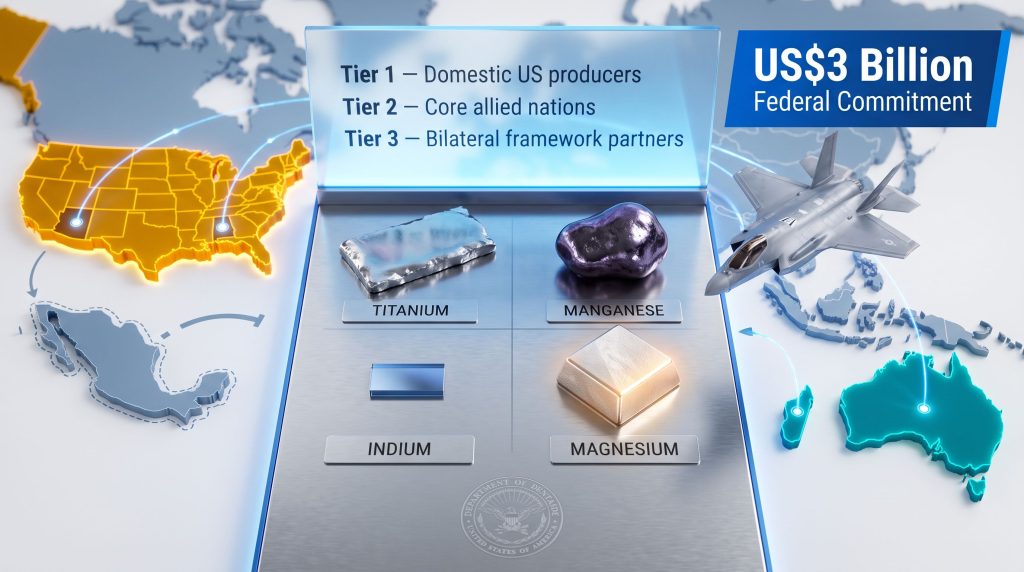
The DIBC solicitation does not exist in isolation. It sits within a much larger federal investment posture that crystallised in early August 2026, when Washington committed close to $3 billion in federal loans, equity stakes, and grants directed at critical minerals, battery technology, and mining workforce development. The US critical minerals order issued earlier in the administration laid important groundwork for this funding architecture. The geographic reach of that commitment was notable:
August 2026 Federal Critical Minerals Funding: Recipient Geography
| Region | Included | Notes |
|---|---|---|
| Domestic US (Arizona, Alabama, others) | Yes | Primary investment focus |
| Australia | Yes | Allied-nation strategic inclusion |
| Madagascar | Yes | Strategic partner resource access |
| Mexico | No | Excluded despite bilateral framework |
The inclusion of Australia and Madagascar while excluding Mexico is not merely a logistical footnote. It reflects a deliberate hierarchy within US critical minerals policy that distinguishes between formally allied producing nations and bilateral framework partners still in early negotiation phases.
The US-Mexico Minerals Gap: Diplomatic Agreement vs. Capital Reality
In February 2026, the United States and Mexico signed a US-Mexico Critical Minerals Action Plan, a bilateral framework that committed both governments to developing coordinated trade policies, establishing price floor mechanisms, and building joint investment frameworks within 60 days. The minerals targeted under that agreement span categories directly relevant to AI chip manufacturing, EV battery supply chains, semiconductor fabrication, and defence systems.
Yet the August 2026 federal funding round produced no investment flows to Mexican mineral assets. This gap between signed diplomatic commitments and actual capital deployment is arguably the most strategically revealing data point in the current US minerals landscape.
Despite a formal bilateral action plan requiring coordinated trade policy and joint investment frameworks within 60 days of signing, no Mexican mineral projects received funding in the August 2026 federal commitment round. This structural disconnect between diplomatic agreement and capital flow represents a live policy tension that neither government has publicly resolved.
Mexico's mineral endowment makes this exclusion particularly striking from a resource logic perspective:
Mexico's Critical Mineral Position Relative to US Classification:
| Mineral | Mexico's Status | US Critical Mineral Classification |
|---|---|---|
| Silver | Top global producer | Classified |
| Copper | Major producer | Classified |
| Antimony | Top global producer | Classified |
| Zinc | Major producer | Classified |
| Fluorite | Significant reserves | Classified |
| Graphite | Development potential | Classified |
| Lithium | Emerging potential | Classified |
| Titanium | Development potential | Classified |
| Manganese | Development potential | Classified |
Economy Minister Marcelo Ebrard has articulated a framework under which Mexico is pursuing negotiated access to 13 minerals it currently lacks or produces only in limited quantities, including titanium, through both World Trade Organization dialogue and US-led alliance structures. Simultaneously, Mexico holds the 2026 pro tempore presidency of the Pacific Alliance, a platform it has indicated it intends to leverage for regional semiconductor and battery supply chain positioning.
Understanding the US Policy Hierarchy: Why Domestic and Allied Assets Come First
Washington's approach to critical mineral investment is not geographically neutral. A clear prioritisation framework has emerged from policy actions taken throughout 2025 and 2026, with the critical minerals demand surge driving much of the urgency behind these decisions:
US Critical Minerals Funding Priority Framework (2025-2026):
- Tier 1: Domestic US producers – Highest priority, directly Pentagon-linked capital deployment
- Tier 2: Core allied nations – Australia, Canada, and select African strategic partners with formalised agreements
- Tier 3: Bilateral framework partners – Mexico, where formal agreement is signed but capital flows remain pending
- Tier 4: Broader global market – Commercial procurement with no preferential access mechanisms
This hierarchy is partly a product of the "mined, refined, and made in the USA" framing that has defined the current administration's public posture on mineral supply chains. However, it is also a response to the structural reality of China's dominance in critical mineral refining. China controls upstream production or downstream processing capacity across a wide range of the USGS classified minerals list, creating a systemic dependency that the Pentagon is working to reduce across multiple simultaneous vectors.
A less commonly discussed dynamic is the refining bottleneck problem. Even where the US or its allies hold primary mining assets, refining and chemical processing capacity for many critical minerals remains heavily concentrated in China. This means that simply expanding domestic mining output does not automatically translate into defence-ready material supply. The DIBC's explicit inclusion of processing and refining within eligible project types directly addresses this gap, signalling that the Pentagon understands the supply chain problem extends well beyond the mine gate. According to analysis from the Center for Strategic and International Studies, this refining vulnerability represents one of the most structurally difficult challenges in US defence supply chain reform.
The next major ASX story will hit our subscribers first
Recycling and Secondary Processing: The Underappreciated Supply Chain Lever
One of the more forward-looking dimensions of the DIBC solicitation is its inclusion of recycling and secondary recovery as eligible supply pathways. This is not a peripheral consideration. In the case of indium, for example, a meaningful portion of global supply already comes from secondary recovery streams, given the metal's dispersed occurrence and the economic incentive to reclaim it from end-of-life electronics.
The DIBC's explicit inclusion of recycling and alloying alongside primary mining signals that the Pentagon is pursuing supply chain resilience across the full material lifecycle, not just upstream extraction. This broadens the addressable market for downstream processors and secondary material handlers.
For titanium, scrap recycling from aerospace manufacturing offcuts represents a significant and underutilised domestic resource. Defence-grade titanium sponge is expensive to produce domestically, but titanium scrap from aircraft manufacturing has metallurgical properties that, with appropriate processing, can re-enter the defence supply chain. Investors and companies operating in this space may find the DIBC framework increasingly relevant to their business case.
Three Scenarios for Mexico's Path Forward
The trajectory of US-Mexico critical minerals cooperation remains genuinely uncertain. Several distinct scenarios are plausible over the medium term:
Scenario Modelling: US-Mexico Critical Minerals Cooperation Trajectories
| Scenario | Trigger Conditions | Likely Outcome |
|---|---|---|
| Accelerated Integration | FY2027 budget includes binational mineral provisions | Mexican projects access Pentagon-linked capital flows |
| Stalled Framework | Tariff disputes and domestic-first doctrine persist | Bilateral plan remains symbolic; investment gap widens |
| Selective Engagement | US funds specific Mexican assets in antimony or copper | Partial integration; titanium and manganese remain excluded |
The selective engagement scenario is arguably the most probable near-term pathway. Mexico's exceptional position in antimony — a metal with wide-ranging antimony in defence applications including flame retardants, ammunition primers, and semiconductors — and its copper reserves give Washington a commercially and strategically compelling entry point for targeted cooperation that does not require abandoning the domestic-first framing.
Frequently Asked Questions: US Defense Minerals Procurement
What minerals is the Pentagon currently seeking domestic supply for?
The September 2026 DIBC solicitation targets four metals: indium, manganese, magnesium, and titanium. All four carry USGS critical mineral classifications and are actively used in defence systems including fighter jet airframes, armoured vehicle steel, night-vision optics, and aerospace structural components.
Who is eligible to apply to the DIBC critical minerals solicitation?
Eligible applicants include US-based companies operating at any stage of the relevant supply chains, from primary mining and processing through to alloying, refining, and recycling of the four target minerals.
How does the DIBC solicitation differ from standard defense procurement contracts?
Standard defence procurement typically acquires finished goods or components. The DIBC solicitation targets upstream industrial capacity, seeking to build the foundational production infrastructure from which defence-grade materials are derived, rather than purchasing end products directly.
Why has Mexico been excluded from US critical mineral investment rounds despite a bilateral agreement?
The exclusion appears to reflect the current policy hierarchy prioritising domestic and formally allied nation production, combined with the early-stage nature of the US-Mexico Critical Minerals Action Plan signed in February 2026. A gap exists between the diplomatic framework and the operational capital deployment mechanisms needed to direct investment to Mexican assets.
What is the USGS critical minerals classification and why does it matter for defense procurement?
The USGS critical minerals list formally identifies materials that are both economically essential to US industry and national security, and vulnerable to supply disruption. Inclusion on the list effectively signals federal investment priority and creates the regulatory and policy foundation for preferential procurement and industrial support mechanisms.
Can recycled or secondary-source minerals qualify under the DIBC solicitation?
Yes. The DIBC solicitation explicitly includes recycling and secondary processing as eligible supply chain pathways, reflecting the Pentagon's recognition that supply chain resilience must extend across the full material lifecycle.
What Mining Companies and Investors Should Monitor Through Q4 2026
For those tracking this space from an investment or corporate strategy perspective, several indicators will define how the landscape evolves in the coming months. In addition, Australia's defence critical materials strategy provides a useful allied-nation reference point for how aligned governments are structuring their own responses. Consequently, the US expands search for minerals projects to supply defense gear creates knock-on implications for allied producers as well. Notably, recent reporting highlights how defence-driven demand is powering a surge in US listings by mining firms, underscoring the commercial momentum building behind these policy shifts.
Key indicators to watch include:
- FY2027 defence budget finalisation and whether it includes specific appropriations for DIBC mineral programmes, which will determine actual funding scale
- US-Mexico bilateral framework progress, including whether any Mexican mineral assets appear in subsequent federal investment rounds
- DIBC solicitation outcomes, particularly whether Stage 2 applicants in titanium and manganese categories receive commitments that signal pricing and volume benchmarks for those markets
- Indium supply chain developments, given China's refining dominance and the metal's criticality to both defence optics and commercial semiconductor manufacturing
- Magnesium production capacity announcements, as any domestic US magnesium smelting investments would represent a structural market shift given China's current near-total production dominance
Disclaimer: This article is intended for informational purposes only and does not constitute financial or investment advice. Forecasts, scenario analysis, and forward-looking statements involve uncertainty and should not be relied upon as predictions of actual outcomes. Readers should conduct independent research and consult qualified advisors before making investment decisions.
Want to Stay Ahead of the Next Major Mineral Discovery Driving Defence Supply Chains?
Discovery Alert's proprietary Discovery IQ model delivers real-time alerts on significant ASX mineral discoveries — including the critical metals reshaping defence procurement strategies — instantly translating complex geological data into actionable investment opportunities for subscribers at every experience level. Explore Discovery Alert's discoveries page to understand why major mineral discoveries can generate substantial market returns, and begin your 14-day free trial at discoveryalert.com.au to position yourself ahead of the market.