August 26, 2026
The Escalation Ladder: How Ontario Is Weaponizing Energy and Minerals Against Washington
Resource geopolitics has historically operated in the background of trade disputes, quietly influencing negotiations without ever becoming the primary instrument of leverage. That convention is now being dismantled in real time across North America. Ontario to cut electricity and critical minerals to the US represents something qualitatively different from the tariff countermeasures and diplomatic protests that typically characterise trade conflicts between allies. It marks the deliberate activation of physical supply chain dependency as a negotiating weapon, a shift with consequences that extend well beyond the immediate US-Canada dispute.
Understanding why this matters requires looking past the political rhetoric and examining the underlying architecture: what has actually been enacted, what remains as threat, and what the mineral and energy geography of Ontario means for American industrial competitiveness.
When big ASX news breaks, our subscribers know first
What Ontario Has Done vs. What It Has Threatened
There is an important distinction between enacted policy and political signalling that tends to get lost in coverage of this dispute. Ontario has not yet imposed a full cutoff of electricity or critical mineral exports to the United States. What has occurred is more strategically precise.
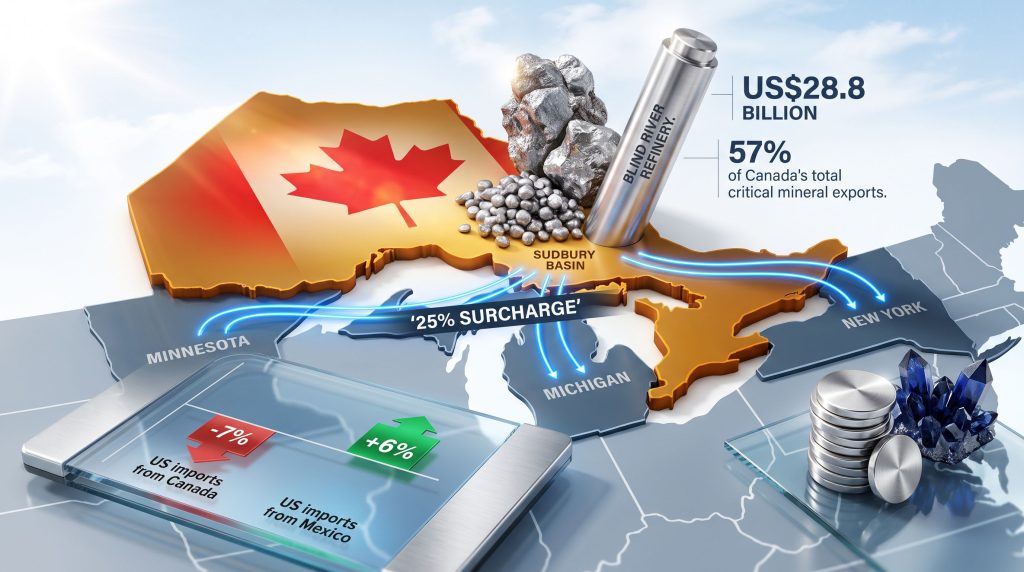
In March 2025, Ontario enacted a 25% surcharge on electricity exports to three US border states: New York, Michigan, and Minnesota. The province subsequently suspended the surcharge, effectively setting it to zero, while explicitly preserving the legal mechanism that allows it to be reinstated or escalated at any point. Premier Doug Ford has publicly stated that a complete export cutoff remains on the table if Washington continues intensifying its trade posture against Canada.
Critical minerals remain in the threat phase. No formal export restrictions have been implemented, but the political signal has been transmitted clearly and repeatedly.
| Date | Policy Action | Status |
|---|---|---|
| March 2025 | 25% electricity surcharge on NY, MI, MN exports | Enacted |
| Mid-2025 | Surcharge suspended, set to zero | Suspended (reversible) |
| August 2026 | Threat to cut electricity and critical minerals entirely | Threat (not enacted) |
| September 8, 2026 | Canada's dollar-for-dollar retaliation | Announced |
| January 1, 2027 | US 50% tariffs on Canadian autos, parts, steel | Scheduled |
The surcharge-and-suspend sequence is not indecision. It is a deliberate demonstration of capability and willingness, designed to establish credibility without triggering the irreversible economic consequences a full cutoff would produce for both sides.
This graduated escalation model gives Ontario maximum negotiating flexibility. Each step up the ladder, from surcharge to suspension to reinstatement to full cutoff, preserves the option to de-escalate while intensifying pressure. It is, in policy terms, a remarkably sophisticated instrument for a provincial government to deploy in a federal trade dispute.
Why Ontario Has the Jurisdictional Authority to Do This
A dimension of this situation that receives insufficient attention is the constitutional basis underpinning Ontario's actions. Canada's constitutional framework grants provinces primary jurisdiction over natural resources within their borders, including electricity generation, mineral rights, and export decisions. This is not a legal grey area. The provincial authority over resources is well-established, and Ford has invoked it explicitly, arguing that Ontario holds the right to determine who buys its critical minerals based on whether those buyers can be considered genuine trading partners.
This creates a structurally unusual negotiating environment for Washington. The US federal government must effectively manage trade relations on two fronts simultaneously: with Prime Minister Mark Carney's federal government on tariff and macroeconomic policy, and with provincial governments that independently control the physical resource levers. There is no single Canadian counterparty who can offer resource access concessions without provincial agreement. The broader US-Canada trade war context makes this constitutional dynamic even more consequential.
How Ontario's Electricity Export Infrastructure Works
Ontario's electricity exports to the United States flow through four cross-border transmission lines with a combined capacity of 2,000 megawatts. The province supplies approximately 6% of Michigan's total electricity, and Ford has described Ontario as powering roughly 1.5 million US homes and businesses through these cross-border connections.
That 6% figure is worth contextualising. In a grid system, marginal supply disruptions can produce disproportionate effects on pricing and stability. A 6% reduction in supply during peak demand periods does not produce a 6% reduction in reliability. Depending on grid conditions and available reserve margins, it can produce cascading price spikes and force utilities into emergency procurement from more expensive alternative sources, with costs ultimately passed to consumers and industrial users.
Ontario's Critical Mineral Portfolio: Why It Is Genuinely Irreplaceable
The leverage Ontario holds in electricity is significant. Its leverage in critical minerals is potentially more consequential, and considerably harder for the United States to replace through alternative sourcing. Furthermore, the critical minerals and energy security relationship means that any disruption carries implications far beyond simple trade economics.
| Mineral | Key Ontario Asset | Primary US Industrial Application |
|---|---|---|
| Nickel | Sudbury Basin (Vale, Glencore operations) | EV batteries, stainless steel, defense manufacturing |
| Uranium | Cameco's Blind River refinery | Nuclear energy, defense applications |
| Chromite | Ring of Fire deposit | Specialty steel alloys, aerospace components |
| Cobalt | Ring of Fire deposit | EV battery cathodes, aerospace |
| Copper | Ring of Fire deposit | Electrical infrastructure, clean energy systems |
| Platinum-Group Elements | Ring of Fire deposit | Automotive catalysts, hydrogen fuel cells |
| Titanium | Ring of Fire deposit | Aerospace, medical devices |
The Sudbury Basin is one of the world's largest and highest-grade nickel-producing regions. Vale and Glencore both operate significant processing infrastructure there, meaning Ontario's nickel export capacity is not just raw ore but refined and semi-refined product ready for downstream industrial use. That level of processing integration is particularly difficult to replicate quickly elsewhere.
Cameco's Blind River facility in northern Ontario is the world's largest commercial uranium refinery. It occupies a structurally critical position in the global nuclear fuel supply chain. Disruption to Blind River's output would not simply inconvenience US utilities; it would create upstream processing bottlenecks affecting nuclear power generation and, potentially, defence-related applications. These concerns align closely with broader defence critical materials strategies being developed across allied nations.
The Ring of Fire deposit in the James Bay Lowlands represents one of North America's largest known concentrations of chromite, alongside substantial cobalt, copper, platinum-group elements, and titanium resources. While this deposit remains in development stages and is not yet a major active export source, its strategic importance is factored into long-term supply security calculations on both sides of the border.
Canada exported US$28.8 billion worth of critical minerals to the United States in 2025, representing approximately 57% of Canada's total critical mineral export volume, according to Natural Resources Canada. The United States is by an enormous margin the dominant buyer of Canadian critical minerals, which means any sustained restriction would simultaneously damage both supply security in Washington and export revenue in Ottawa — a mutual vulnerability that actually reinforces the negotiating dynamic rather than weakening it.
The strategic paradox at the heart of Washington's tariff policy is this: the same administration escalating tariffs against Canada has separately identified Canadian-sourced nickel, uranium, and cobalt as essential to domestic clean energy manufacturing and national defense supply chain security. These two policy positions are in direct contradiction.
The Tariff Escalation That Triggered Ontario's Response
To understand the proportionality of Ontario's response, the scale of Washington's tariff escalation needs to be clearly established. US-Canada trade talks broke down on August 21, 2026, when Prime Minister Carney withdrew from negotiations. Washington responded by imposing 50% tariffs on approximately US$20 billion worth of Canadian goods, including automobiles, parts, and steel.
On August 24, President Trump announced via Truth Social that tariffs on all Canadian cars, trucks, auto parts, and steel would rise to 50% effective January 1, 2027, with goods manufactured in the United States facing zero duties. Canada announced a dollar-for-dollar retaliation package effective September 8, 2026. The trade war impacts observed in other geopolitical contexts suggest these escalation patterns can persist far longer than either party initially anticipates.
The negotiating framework that collapsed before implementation would have reduced US auto tariffs on Canada from 25% to 15% and steel and aluminium duties from 50% to 25%. Financial markets validated the economic significance of the breakdown: shares in Ford Motor Company and Stellantis fell approximately 4% following the announcement, while Canadian steelmaker Algoma Steel dropped more than 8%. These moves reflect investor recognition that deeply integrated North American automotive and steel supply chains cannot simply be re-routed without substantial cost and disruption.
Ontario vs. Mexico: Two Entirely Different Retaliatory Philosophies
The Ontario-Washington confrontation becomes particularly instructive when set against Mexico's simultaneous approach to the same tariff pressures. The contrast illuminates how different responses to identical pressures can produce measurably different trade outcomes.
| Policy Dimension | Ontario / Canada | Mexico |
|---|---|---|
| Primary strategy | Graduated retaliation and resource leverage | Cooperative negotiation, no direct retaliation |
| Electricity exports | Surcharge enacted; full cutoff threatened | Not applicable |
| Critical minerals | Cutoff threatened as bargaining chip | Seeking negotiated access to 13 minerals it lacks |
| Trade volume trend (Jan-Nov 2025) | US imports from Canada fell 7% to US$351.2 billion | US imports from Mexico grew 6% to US$492.5 billion |
| Government posture | Retaliatory; dollar-for-dollar response announced | Cooperative; optimistic about comprehensive deal |
US purchases from Mexico grew 6% year-on-year between January and November 2025 to US$492.5 billion, while imports from Canada fell 7% to US$351.2 billion, even though Mexican exporters faced a somewhat higher effective tariff rate than their Canadian counterparts. The divergence is largely attributable to Mexico's deliberate avoidance of direct retaliation, a posture that has translated into more favourable treatment from Washington on steel, auto, and mineral export negotiations.
Mexican President Claudia Sheinbaum has maintained that her government is optimistic about reaching a comprehensive deal with Washington. Economy Minister Marcelo Ebrard has been actively pursuing negotiations to eliminate tariffs entirely on vehicles and industrial inputs as part of the ongoing USMCA review. Rather than threatening to restrict mineral exports, Mexico is pursuing a cooperative minerals framework embedded within the USMCA process, seeking negotiated access to 13 strategic minerals it lacks or produces in limited volumes — including lithium, nickel, cobalt, and platinum — while simultaneously promoting its position as a major global producer of silver, copper, fluorite, and zinc.
The trade volume divergence between Canada and Mexico illustrates a fundamental tension in Ontario's strategy: retaliation signals resolve but may also consolidate Washington's preference for the more accommodating USMCA partner.
The next major ASX story will hit our subscribers first
Scenario Analysis: What Happens If Ontario Follows Through?
Scenario A: Surcharge Reinstatement (Near-Term Base Case)
- Ontario reinstates the 25% electricity export surcharge on New York, Michigan, and Minnesota
- US utilities absorb higher wholesale power costs, passing increases to industrial and residential consumers
- Grid operators activate contingency sourcing from alternative suppliers at higher cost
- Diplomatic pressure intensifies but no permanent supply disruption occurs
- Most likely near-term outcome given Ford's stated preference for continued negotiation
Scenario B: Partial Electricity Cutoff (Escalation Scenario)
- Ontario reduces electricity exports by 50% across the four transmission lines
- Michigan faces the greatest exposure given Ontario's approximately 6% share of state electricity supply
- Industrial facilities dependent on stable baseload power, including automotive plants and data centres, face operational risk
- US grid operators declare supply emergencies and federal intervention becomes probable
Scenario C: Full Cutoff and Critical Mineral Restrictions (Maximum Leverage)
- Ontario to cut electricity and halt all critical mineral shipments including nickel and uranium
- US EV battery supply chains face upstream nickel shortages affecting manufacturing throughput
- Nuclear fuel processing disruption at Blind River creates downstream energy sector risk across multiple states
- Washington faces a direct contradiction between its tariff policy and its own energy security objectives
- Return to the negotiating table becomes the most politically and economically rational response
The Broader Precedent: Resource Weaponisation in North American Trade
Ontario's approach represents more than a bilateral trade dispute tactic. It signals a potential structural shift in how resource-rich jurisdictions within federated systems conceive of and exercise their economic leverage during trade conflicts. In addition, the critical minerals tariff landscape is rapidly evolving in ways that make these resource leverage dynamics increasingly consequential.
The post-NAFTA assumption that resource flows between integrated North American economies were effectively depoliticised — governed by market logic and treaty frameworks rather than political discretion — is being actively tested. If Ontario's graduated escalation strategy proves effective in extracting tariff concessions, it establishes a template that other resource-rich Canadian provinces could rationally adopt in future disputes.
- Alberta controls oil and gas exports with pipeline infrastructure connecting to US markets
- British Columbia operates major hydroelectric export capacity feeding Pacific Northwest grids
- Quebec supplies significant hydroelectric power to New England states and holds emerging lithium resources
The USMCA framework, notably, contains no explicit provisions preventing provinces from restricting resource exports as retaliatory measures. This legal gap represents a structural vulnerability in the trade architecture that Ontario is now actively exploiting, and that future negotiations will almost certainly need to address.
For US policymakers, the deeper strategic problem is this: the country's parallel push to reduce dependence on Chinese-processed critical minerals depends heavily on Canadian supply continuity. Any sustained disruption to Ontario's nickel, uranium, and cobalt exports would likely accelerate Chinese market share in precisely those processed mineral categories that Washington has identified as strategic priorities. Ontario's government is explicitly aware of this contradiction, and it forms the core of the province's negotiating leverage in the ongoing Ontario to cut electricity and critical minerals to the US standoff.
Disclaimer: This article is intended for informational purposes only and does not constitute financial or investment advice. Trade policy developments, tariff schedules, and geopolitical dynamics are subject to rapid change. Readers should conduct independent research and consult qualified advisors before making any investment or business decisions based on the information presented here.
Want to Stay Ahead of the Critical Minerals Reshaping Global Markets?
Discovery Alert's proprietary Discovery IQ model delivers real-time alerts on significant ASX mineral discoveries — including the nickel, uranium, and cobalt deposits central to today's shifting resource geopolitics — transforming complex mineral data into actionable investment insights. Explore how historic mineral discoveries have generated substantial returns on Discovery Alert's dedicated discoveries page, and begin your 14-day free trial to position yourself ahead of the market.