August 26, 2026
The World's Most Fragile Energy Corridor Is Being Stress-Tested in Real Time
When energy analysts model supply disruption scenarios, they typically frame the Strait of Hormuz as a low-probability, extreme-consequence risk. For decades, that framing held. Tanker traffic moved with reliable predictability, war risk insurance premiums remained modest, and the 33-kilometre passage between Iran and Oman functioned as the circulatory system of global hydrocarbon trade. That analytical comfort zone no longer exists.
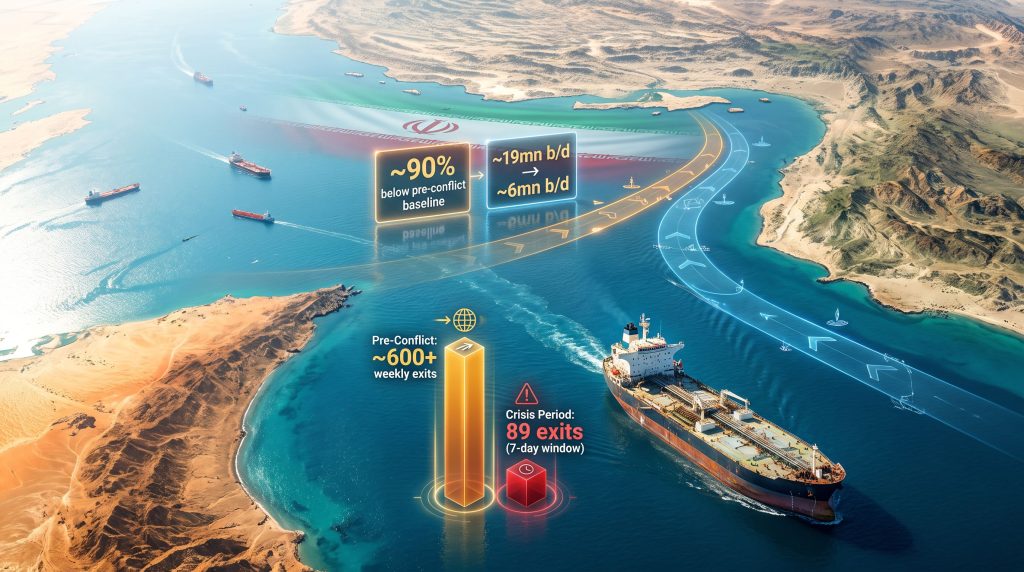
The events of August 2026 have transformed what was once a theoretical chokepoint vulnerability into an operational market reality. Outbound Hormuz transits dropped to zero on multiple individual days, vessel traffic ran roughly 90% below pre-conflict baseline levels, and a formal Iranian regulatory architecture emerged to assert sovereignty over one of the most consequential waterways in the world. Understanding what this means for energy markets requires moving beyond the headlines and examining the structural mechanics beneath the crisis.
When big ASX news breaks, our subscribers know first
Why the Strait of Hormuz Has No Peer Among Global Energy Chokepoints
The strategic importance of the Strait of Hormuz is not a matter of debate. Approximately 20% of the world's total oil supply and close to 30% of global LNG supply move through this narrow passage. Prior to the conflict that erupted at the end of February 2026, the Middle East was exporting roughly 19 million barrels per day (b/d) of crude through the strait, according to vessel tracking data cited by TankerTrackers.com.
What distinguishes Hormuz from other maritime chokepoints is the near-complete absence of viable alternatives at comparable volume and cost:
- The Saudi East-West Pipeline and Egypt's SUMED pipeline can absorb some crude rerouting, but their combined capacity falls far short of Hormuz throughput.
- Overland pipeline routes require infrastructure investment measured in years and hundreds of billions of dollars.
- Rerouting tankers around the Arabian Peninsula adds substantial transit time and freight costs, reducing the commercial viability of many cargo movements.
- Qatar's LNG exports have no bypass option at all. Qatar is geographically landlocked within the Arabian Gulf, making the strait its only export corridor for what is the world's single largest LNG supply source.
Unlike the Suez Canal or the Bab-el-Mandeb strait, the Strait of Hormuz carries volumes for which no commercially scalable alternative exists. A sustained disruption here is categorically different from any other maritime chokepoint crisis in modern energy history.
Outbound Hormuz Transits Drop to Zero: Unpacking What the Data Actually Shows
The phrase outbound Hormuz transits drop to zero requires careful interpretation. The strait has not experienced a permanent, total closure. What has occurred is a severe, episodic suppression of traffic that has fundamentally altered the operating baseline for global energy logistics.
According to maritime security data from Windward, on August 24, 2026, only four vessels entered the strait and zero departed. This followed a similarly constrained period earlier in August, with confirmed zero-transit events recorded on August 5 and August 7. Over the seven-day window ending August 24, approximately 89 vessels exited and 103 entered the strait. Set against pre-conflict weekly volumes that would have exceeded 600 transits across all vessel categories, these figures represent a collapse of historic proportions.
Transit Volume Comparison: Pre-Conflict vs. Crisis Period
| Metric | Pre-Conflict Baseline (Feb 2026) | Crisis Period (Aug 2026) |
|---|---|---|
| Crude exports via Hormuz | ~19mn b/d | ~6mn b/d (est.) |
| Weekly vessel exits | ~600+ transits (est.) | ~89 exits (7-day window) |
| Southern lane activity | Active, mixed traffic | Intermittent to zero |
| Northern lane activity | Limited use | Primary route for compliant vessels |
| Zero-transit days recorded | None | Multiple (Aug 5, Aug 7 confirmed) |
The highest single-day volume recorded in over a month occurred on August 22, when 34 vessels transited the waterway. Yet even this relative spike included only 11 tanker transits, split between inbound and outbound movements across both lanes. The following day, August 23, transits fell back to 16.
Notable cargo movements still attempting transit during this period included:
- The VLCC Grit, projected to load approximately 2 million barrels of crude in the Dubai lightering area.
- LPG tankers Delma and Gas Warich, each scheduled to load around 500,000 barrels at Adnoc's Ruwais refinery.
- The tanker Alfonso, loading approximately 250,000 barrels of fuel oil from an Iraqi terminal.
- Inbound LPG tankers Gas Marakua and Olympios Gas, loading 500,000 barrels and 300,000 barrels respectively at Qatar's Ras Laffan facility.
Even at near-crisis lows, the cargo composition reveals a critical insight: commercial necessity continues to override risk aversion for specific commodity types. LPG, crude, and refined products flows are still moving because their buyers have no alternative supply pathway at comparable cost or speed.
The Three-Lane Problem: How Hormuz Became a Geopolitical Battleground
To understand why outbound Hormuz transits dropped to zero, it is essential to understand the lane bifurcation that defines current traffic architecture through the strait.
Before the conflict, vessel traffic used a centrally managed two-lane system for inbound and outbound transit. That configuration has been replaced by three de facto zones with entirely different risk profiles:
1. The former centre lane: Previously the primary commercial corridor, now widely believed by shipping operators to be mined. US President Donald Trump stated via social media that all mines had been cleared from Hormuz's international waters, with a declared zero tolerance policy on new mine placement. However, this claim has not been independently verified at the level of confidence required to alter commercial insurance underwriting.
2. The northern Iranian-controlled lane: Now functioning as Iran's preferred routing mechanism. Vessels that use this lane are effectively acknowledging Iranian regulatory oversight, which creates separate exposure to US sanctions designations.
3. The southern US-assisted corridor: Established as an alternative for vessels seeking to bypass Iranian oversight, this lane has become the primary target of Iranian enforcement action. Of 16 projectile strike incidents on commercial vessels recorded since July 6, 2026, according to UKMTO data, 14 occurred near the Omani coastline — the geographic zone associated with southern lane transits.
This enforcement pattern reveals a deliberate strategic logic. By making the southern lane operationally hazardous, Iranian actions force vessels toward the northern corridor where Tehran exercises de facto regulatory control. These oil market impacts extend well beyond the strait itself, reshaping freight economics and insurance frameworks across the broader region.
Iran's Institutional Architecture: The Persian Gulf Strait Authority
One of the least widely appreciated dimensions of the current crisis is the degree to which Iran has formalised its sovereignty claim through institutional means. The Persian Gulf Strait Authority (PGSA) represents a significant escalation beyond ad hoc enforcement. It is a declared regulatory body, not simply a military posture.
The PGSA's operational impact has been tangible:
- It has formally designated 46 vessels as non-compliant with its transit rules.
- Declared consequences for non-compliance include financial penalties, vessel seizure, and cargo confiscation.
- On the same day Oman's Foreign Minister arrived in Tehran for diplomatic talks (August 24), the PGSA issued strengthened transit rules, signalling that enforcement and diplomacy are proceeding simultaneously.
The PGSA transforms the Strait of Hormuz from a disputed international waterway governed by UNCLOS principles into a corridor subject to unilateral Iranian regulatory control. This institutional framing has profound long-term implications for freedom of navigation doctrine and the legal architecture of global maritime trade.
The non-compliance list alone functions as a powerful deterrent. Shipowners facing designation must weigh not just immediate enforcement risk but the long-term commercial consequences of operating vessels that Iranian authorities have flagged. For many smaller operators and independent tanker owners, that calculation points toward avoiding Mideast Gulf trades entirely.
The US Counter-Architecture: Operation Economic Outcast
The US response to Iran's tightening grip has taken the form of an expanded sanctions campaign rather than direct military intervention to force the strait open. Treasury Secretary Scott Bessent announced Operation Economic Outcast in late August 2026, framing it as a comprehensive effort to sever Iran's financial connections to global markets.
Key elements of the campaign include:
- Sanctions against shipping entities based in the UAE, Singapore, and Hong Kong, along with six specific tankers.
- Designation of the French biofuels facility La Nivernaise De Raffinage and its Singapore-headquartered parent company Wellbred, accused of operating under the control of an Iranian businessman with alleged connections to Tehran's oil trade.
- Expanded OFAC guidance covering potential sanctions exposure across aviation, digital assets, gold, shipping, and technology sectors.
- Cancellation of sanctions waivers that had previously allowed Iranian participation in international athletic tournaments and academic exchanges.
Notably absent from the announcement was any explicit new action targeting Chinese financial institutions or oil buyers, despite China remaining the dominant destination for Iranian crude exports since 2019. Bessent indicated that a major financial institution sanction was imminent, while simultaneously acknowledging the risks of aggressive enforcement. China and Iran held separate diplomatic talks on the same weekend the US unveiled its new campaign, signalling Beijing's continued engagement with Tehran regardless of US pressure escalation.
The next major ASX story will hit our subscribers first
Commodity Vulnerability: Who Bears the Greatest Risk?
Not all commodities face equal exposure to Hormuz disruption. The risk profile varies significantly by commodity type, alternative routing availability, and geographic dependency.
Commodity Vulnerability Matrix
| Commodity | Hormuz Dependency | Alternative Supply Routes | Short-Term Price Risk |
|---|---|---|---|
| Middle East crude oil | Very High | Limited (SUMED, East-West Pipeline) | High |
| LNG (Qatar exports) | Very High | Minimal — Qatar landlocked to Gulf | Very High |
| LPG/NGL | High | Moderate (US, Australia alternatives) | High |
| Refined oil products | Moderate-High | Some rerouting possible | Moderate |
| Petrochemical feedstocks | Moderate | Partial substitution available | Moderate |
Furthermore, among importing nations, the vulnerability hierarchy is similarly unequal:
- Japan and South Korea face the highest structural exposure due to minimal domestic production and near-total import dependency on Middle Eastern crude and LNG.
- China occupies a dual position: it is the largest buyer of Iranian crude under sanctions arrangements, yet also depends on Hormuz for substantial volumes of non-Iranian Gulf supply.
- India has been accelerating diversification toward US, Russian, and West African crude as Hormuz risk escalates, providing partial but incomplete insulation.
Consequently, the pressure on WTI and Brent futures has intensified markedly, with benchmark pricing increasingly reflecting geopolitical risk premiums rather than fundamental supply-demand balances alone.
Three Scenarios for What Comes Next
Market participants need to model Hormuz disruption across a probability-weighted range rather than anchoring to a single outcome. Three strategic scenarios bracket the realistic possibility space:
Scenario 1 — Managed Disruption (Base Case)
Traffic remains suppressed at 10–30% of pre-conflict baseline volumes. Spot crude premiums stay elevated but within a range that major importers can manage through strategic reserve drawdowns and demand adjustments. Resolution timeline: weeks to months, contingent on diplomatic progress in the Iran-Oman talks.
Scenario 2 — Prolonged Partial Closure (Elevated Risk)
The southern lane remains effectively closed while northern lane usage is constrained by the competing risks of Iranian enforcement and US sanctions exposure. Middle East crude exports remain below 5 million b/d for an extended period. LPG and LNG supply chains serving Asian importers experience acute stress. Any prospect of an oil price rally driven by tightening supply becomes structurally supported under this scenario.
Scenario 3 — Full Closure Escalation (Tail Risk)
PGSA enforcement extends to the northern lane. A US military response triggers a complete transit halt. Short-term futures markets price in a potential $30–50 per barrel spike. IEA member nations execute coordinated strategic petroleum reserve releases. Long-term capital flows accelerate toward non-Gulf supply infrastructure, pipeline alternatives, and regional LNG diversification.
Disclaimer: Scenario price projections represent analytical estimates based on historical disruption precedents and current market conditions. They do not constitute financial advice and carry significant uncertainty.
Forward-Looking Signals: What to Watch
For energy market participants and investors, the following indicators will determine which scenario materialises:
Escalation signals:
- PGSA enforcement actions targeting northern lane vessels.
- Additional Iranian strike incidents outside the southern Omani coastline corridor.
- US designation of a major Chinese financial institution (flagged by Treasury officials as a near-term possibility).
- Breakdown of Iran-Oman diplomatic talks without a framework agreement.
De-escalation signals:
- A negotiated Hormuz management framework that preserves commercial access while accommodating Iranian regulatory interests.
- Reduction in PGSA non-compliance vessel designations.
- Sustained southern lane traffic recovering above 10 vessels per day.
- Multilateral diplomatic engagement involving Washington, Tehran, and Gulf state intermediaries.
In addition, crude oil price volatility is likely to remain elevated across all three scenarios until a durable transit framework is established, given the structural uncertainty now embedded in Hormuz passage risk.
FAQ: Strait of Hormuz Transit Crisis
Why did outbound Hormuz transits drop to zero?
Zero-transit events on specific days in August 2026 resulted from the convergence of Iranian enforcement strikes targeting vessels on the southern lane, the PGSA's non-compliance designations, and widespread risk aversion among shipowners following the disabling of a tanker off the Omani coast.
Is the Strait of Hormuz completely closed?
No. The strait has not experienced a total, sustained closure. Traffic has been severely suppressed at approximately 90% below pre-conflict baselines, with zero-transit events occurring on specific dates and the southern lane experiencing extended inactivity. Real-time vessel movements can be tracked via the Hormuz Strait Monitor for the most current transit data.
What is the PGSA?
The Persian Gulf Strait Authority is an Iranian regulatory body established in 2026 to formalise Tehran's control over vessel traffic through the Strait of Hormuz, with powers including fines, vessel seizure, and cargo confiscation for non-compliant operators.
Which nations are most exposed?
Japan, South Korea, China, and India collectively account for the vast majority of Hormuz-dependent energy imports. Japan and South Korea face the deepest structural vulnerability given their limited domestic production capacity.
What is Operation Economic Outcast?
A US Treasury-led sanctions campaign announced in August 2026 targeting Iranian financial networks, shipping entities in multiple jurisdictions, and entities alleged to facilitate Iranian oil trade.
The Structural Shift That Markets Cannot Ignore
The transit collapse unfolding through the Strait of Hormuz is not a temporary dislocation awaiting a return to normalcy. It is a symptom of a deeper contest over who controls the governance architecture of the world's most consequential energy corridor. The bifurcation of the strait into competing lanes controlled by opposing geopolitical actors has no close historical precedent in the post-WWII energy order.
For market participants, the strategic takeaway is uncomfortable but clear: elevated freight and insurance costs, episodic days when outbound Hormuz transits drop to zero, and suppressed throughput should be modelled as the new operating baseline, not as aberrations from which a rapid recovery is likely. The Iran-Oman diplomatic track represents the most credible near-term pathway toward normalisation, but the conditions under which any agreement could be reached remain deeply contested.
Long-term, the crisis is accelerating capital allocation toward non-Gulf supply infrastructure, alternative pipeline capacity, and strategic reserve expansion among the nations most exposed to Hormuz dependency. That structural response, once underway, will reshape energy trade flows for decades regardless of how the immediate diplomatic situation resolves.
Want to Stay Ahead of the Resource Opportunities Emerging From Global Energy Disruptions?
As Hormuz transit volatility reshapes commodity markets and accelerates capital flows toward alternative energy and resource infrastructure, Discovery Alert's proprietary Discovery IQ model delivers real-time alerts on significant ASX mineral discoveries — transforming complex market shifts into actionable investment opportunities the moment they're announced. Explore how historic discoveries have generated substantial returns on Discovery Alert's discoveries page, and begin your 14-day free trial today to position yourself ahead of the market.