August 26, 2026
The Geopolitical Anatomy of a Resource Threat: What Happens If Ontario Cuts Off Critical Minerals to the U.S.
Critical mineral supply chains have quietly become one of the most consequential battlegrounds in modern geopolitics. For decades, the assumption embedded in U.S. industrial and defence planning was that Canadian resources were effectively an extension of domestic supply — a reliable backstop sitting just across a border defined more by habit than strategic caution. That assumption is now being stress-tested in real time, as Ontario's provincial government has positioned its mineral wealth not as a commercial asset but as a geopolitical instrument.
The question of whether Ontario will cut off critical minerals to the U.S. is no longer purely theoretical. Understanding the mechanics of how this could happen, the legal architecture that makes it possible, and the industrial consequences that would follow is essential context for anyone tracking the intersection of trade policy, resource sovereignty, and industrial security in 2026. The broader critical minerals demand picture only amplifies what is at stake.
When big ASX news breaks, our subscribers know first
Ontario's Constitutional Lever: Why a Province Can Act Independently
Most trade disputes play out between national governments. What makes the current Canada-U.S. friction unusual is that Ontario's provincial government has its own independent legal basis for action — one that does not require federal authorisation to execute.
Under Canada's constitutional framework, provinces hold primary jurisdiction over natural resources located within their borders. This is not a procedural technicality. It represents a structurally distinct form of resource sovereignty that gives subnational governments in Canada a degree of autonomous trade leverage rarely available to regional governments in other federated systems.
Ontario's Premier does not need Ottawa's permission to restrict who can purchase provincial minerals or under what conditions those minerals are exported. This constitutional reality creates a layered negotiating architecture for Canada as a whole. The federal government pursues its own retaliatory tariff doctrine while the provincial government simultaneously threatens resource access restrictions, each operating on separate legal tracks.
For U.S. trade negotiators accustomed to dealing with a single counterparty, this two-track pressure system is structurally difficult to neutralise through conventional diplomatic channels.
What Is Actually at Stake: Ontario's Critical Mineral Portfolio
When assessing the potential consequences of Ontario moving to cut off critical minerals to the U.S., it is worth mapping the specific assets involved. Ontario's resource geography is not uniform — it contains several distinct producing regions, each with its own strategic profile.
| Mineral | Primary Ontario Source | Key U.S. Applications | Strategic Risk Level |
|---|---|---|---|
| Nickel (high-grade) | Sudbury Basin | EV batteries, defence alloys, naval vessels | Critical |
| Uranium | Northern Ontario (Blind River) | Nuclear energy, defence procurement | Critical |
| Chromite | Ring of Fire | Stainless steel, industrial manufacturing | High |
| Cobalt | Ring of Fire | Battery cathodes, aerospace components | High |
| Copper | Ring of Fire | Electrical infrastructure, defence electronics | High |
| Platinum Group Elements | Ring of Fire | Catalytic converters, hydrogen fuel cells | Moderate-High |
| Titanium | Ring of Fire | Aerospace and military hardware | High |
The Sudbury Basin: A Non-Replicable Supply Node
The Sudbury Basin in northern Ontario is not simply a large nickel deposit. It is one of the highest-grade nickel-producing regions on Earth, formed by an ancient meteorite impact that created an unusually concentrated mineralised structure. This geological distinction matters enormously from a supply chain perspective.
High-grade nickel ore yields more refined metal per tonne processed, which translates directly into lower production costs and higher output volumes per unit of infrastructure investment. Vale (NYSE: VALE) and Glencore (LSE: GLEN) both operate major extraction and processing facilities in the Sudbury Basin.
The nickel produced here feeds U.S. manufacturing pipelines for electric vehicle battery cathodes, defence-grade steel alloys used in military aircraft and naval vessel construction, and industrial stainless steel production. Furthermore, there is no domestic U.S. nickel deposit currently capable of producing at equivalent grade or volume. The substitution gap is not a matter of policy preference but of geological reality. Concerns around global nickel supply make this dependency even more pronounced.
Blind River: The Uranium Refinery the U.S. Cannot Replace
Cameco's (TSX: CCO; NYSE: CCJ) Blind River facility in northern Ontario holds the distinction of being the world's largest commercial uranium refining operation. This is not merely a scale achievement — it represents a concentration of specialised technical infrastructure and processing expertise that took decades to develop and cannot be replicated quickly regardless of capital availability.
U.S. nuclear energy utilities operate on procurement cycles that depend on reliable access to refined uranium. Any disruption to Blind River's export flows would force U.S. buyers to seek alternative supply from Kazakhstan, Australian producers, or other sources — all of which involve longer lead times, higher logistics costs, and in some cases, proximity to geopolitical risk vectors. The uranium supply challenges already facing the sector would be severely compounded by any restriction from Ontario.
The Ring of Fire: Enormous Potential, Enormous Leverage
Ontario's Ring of Fire region in the James Bay Lowlands represents one of the most significant undeveloped mineral deposits in North America, containing large concentrations of chromite, cobalt, nickel, copper, titanium, and platinum group elements. While Ring of Fire production remains in development stages compared to Sudbury Basin output, its long-term strategic importance to U.S. industrial supply chains is already being factored into planning horizons.
Any political signal that access to this resource corridor could be conditioned on trade behaviour carries significant weight in forward-looking industrial policy discussions.
The Escalation Timeline: How Both Sides Arrived at This Point
The current standoff did not emerge suddenly. It is the product of a structured escalation sequence that began in early 2025 and has intensified with each retaliatory cycle.
- March 2025 — Ontario imposed a 25% surcharge on electricity exports to Michigan, Minnesota, and New York as an initial retaliatory signal. The U.S. threatened to double tariffs on Canadian steel and aluminium. Both sides stepped back from the edge.
- October 2025 — Ontario's Premier publicly articulated the province's constitutional right to determine who purchases its critical minerals, explicitly framing resource access as a geopolitical instrument rather than a purely commercial arrangement.
- Early August 2026 — U.S. President Donald Trump imposed 50% tariffs on approximately $20 billion worth of Canadian goods, targeting automobiles, auto parts, and steel.
- Mid-August 2026 — Canadian Prime Minister Mark Carney ended active trade negotiations. Canada announced dollar-for-dollar retaliatory tariffs scheduled to take effect on September 8, 2026.
- August 24, 2026 — Ontario's Premier escalated his public position, explicitly threatening to cut off both electricity and critical mineral exports to the U.S. if the dispute continued to intensify.
Each step in this sequence has been more consequential than the last. The March 2025 electricity surcharge demonstrated operational willingness to restrict energy flows. The August 2026 statements represent an extension of that same logic to a far more strategically significant category of assets.
The critical minerals tariff landscape has been shifting rapidly throughout this period, with each retaliatory measure raising the stakes considerably. Moreover, the US-China trade war has complicated matters further, influencing how both Canada and the U.S. assess their respective strategic options.
The Trade Exposure in Numbers
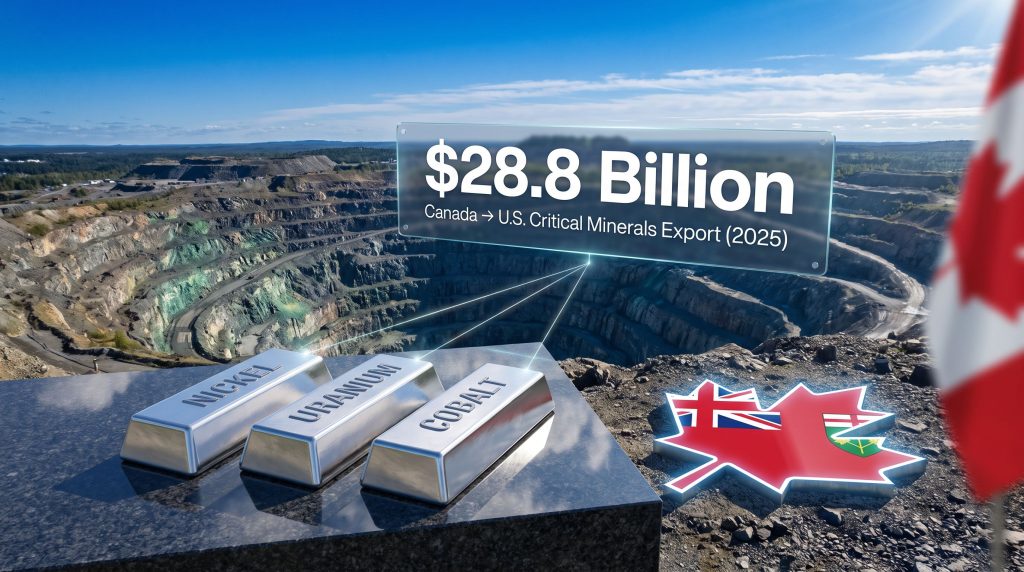
Canada exported approximately $28.8 billion worth of critical minerals to the United States in 2025. This figure situates the bilateral relationship as one of the most significant critical mineral trade partnerships globally, surpassing many relationships that receive considerably more diplomatic and media attention.
The scale of this number matters for several reasons. It signals that any restriction — even a partial one targeting a single mineral category — would generate immediate price volatility across nickel, uranium, cobalt, and platinum group element markets. Commodity traders, industrial procurement teams, and defence logistics planners would all feel the effect within weeks, even if physical supply disruptions took longer to materialise in full.
According to reporting from The Globe and Mail, Ontario's position has been framed explicitly as a response to U.S. tariff escalation, with the province making clear it views resource access as a legitimate instrument of trade leverage.
Electricity and Minerals: Two Instruments With Different Impact Profiles
Ontario's threatened response encompasses both electricity exports and critical mineral access. However, these two instruments are not equivalent in their strategic profiles, and understanding the difference is important for assessing the severity of each threat.
| Dimension | Electricity Exports | Critical Mineral Exports |
|---|---|---|
| Estimated trade exposure | Grid-dependent, regional | Approximately $28.8 billion (2025) |
| U.S. substitution timeline | Weeks to months (grid rerouting) | Years, no domestic alternative at scale |
| Immediate economic pain | High, consumer and business disruption | Moderate to high, industrial and defence lag |
| Long-term strategic impact | Moderate | Severe |
| Reversibility | High | Moderate, market trust damage persists |
Ontario's grid currently powers an estimated 1.5 million homes and businesses in U.S. border states, primarily in Michigan, Minnesota, and New York. An electricity cutoff would create immediate grid stress and is highly visible to consumers and media. A critical mineral restriction would, however, unfold more slowly but with far more durable consequences for U.S. industrial capacity and defence procurement.
The next major ASX story will hit our subscribers first
Three Structural Vulnerabilities the U.S. Cannot Manage Quickly
Vulnerability 1: Electric Vehicle Supply Chain Disruption
High-grade nickel from the Sudbury Basin is a primary cathode input for lithium-ion battery production. A restriction would immediately constrain U.S. battery manufacturers and extend production timelines for domestic EV programmes. No U.S. domestic source produces nickel at equivalent grade or volume, and developing new extraction infrastructure typically takes a decade or more from discovery to sustained output.
Vulnerability 2: Nuclear Fuel Procurement
Blind River's refined uranium is embedded in U.S. nuclear utility procurement cycles that operate on multi-year contracts. A disruption would force an urgent and expensive reconfiguration of supply sourcing, creating transitional cost burdens for U.S. electricity generators and uncomfortable pressure that intersects with U.S. defence uranium requirements.
Vulnerability 3: Defence Industrial Base Exposure
Nickel, cobalt, chromite, and platinum group elements from Ontario contribute to military aircraft construction, naval vessel manufacturing, and advanced weapons systems production. A supply restriction would not immediately halt production lines but would generate medium-term cost inflation and procurement bottlenecks across U.S. prime defence contractors — a problem that standard defence budget adjustments cannot resolve quickly.
The China Substitution Problem: An Unintended Consequence
Perhaps the most strategically perverse aspect of the current standoff is what happens to U.S. mineral procurement if Canadian supply is restricted. The U.S. has invested significant political and industrial capital in reducing its dependence on Chinese-sourced critical minerals. Consequently, disrupting Canadian supply does not eliminate U.S. demand — it redirects purchasing pressure toward alternative sources, and in the short term, the most scalable alternatives frequently involve Chinese-controlled supply chains.
This creates a structural irony that U.S. trade policymakers cannot afford to ignore. Tariff pressure designed to extract concessions from Canada could inadvertently strengthen China's position in global critical mineral markets by driving U.S. buyers toward supply chains that Washington has been systematically trying to diversify away from.
The long-term paradox is that a prolonged restriction of Canadian mineral access might ultimately accelerate U.S. domestic mining investment and reshoring ambitions, but the transition period would be painful, costly, and strategically vulnerable in ways that cannot be fully hedged in real time.
As analysis from Mining.com highlights, the Canada-U.S. trade rift threatens to reshape critical mineral flows in ways that could take years to stabilise, regardless of how the immediate diplomatic standoff is resolved.
The Dual Posture: Maximum Pressure With the Door Open
One of the more sophisticated elements of Ontario's current position is the combination of escalatory rhetoric with explicit signals of continued diplomatic openness. Ford has publicly maintained that he prefers continued negotiation even while articulating maximum-pressure retaliatory options.
This dual posture — coercive in tone but non-committal in action — is consistent with classical bargaining strategy where the credibility of the threat must be maintained without triggering irreversible rupture. The repeated escalation across multiple media appearances since March 2025 has been systematically building the credibility of Ontario's resource leverage position. Each public statement adds weight to the possibility that the threat is not merely rhetorical.
For the strategy to work, U.S. policymakers must believe that the province has both the legal authority and the political will to act — and the evidence on both dimensions has been accumulating steadily.
Three Scenarios for the Critical Minerals Standoff
Scenario 1: Negotiated De-escalation
Both sides return to structured dialogue, tariffs are rolled back incrementally, and Ontario's mineral threats remain as leverage architecture rather than enacted policy. The March 2025 electricity surcharge episode, where both sides stepped back after initial escalation, provides the historical precedent most consistent with this outcome.
Scenario 2: Partial Restriction and Managed Tension
Ontario implements selective restrictions on specific mineral categories — most likely beginning with uranium or nickel — as a calibrated pressure signal designed to demonstrate seriousness without triggering full bilateral rupture. This scenario produces sustained market uncertainty and commodity price volatility without crossing the threshold of complete supply cutoff.
Scenario 3: Full Escalation and Structural Decoupling
Both sides entrench their positions, restrictions are implemented across electricity and mineral exports, and the U.S. accelerates domestic critical mineral investment programmes under emergency industrial policy frameworks. This scenario produces the most severe near-term economic disruption but may paradoxically accelerate U.S. resource independence over a five-to-ten-year horizon — at substantial cost to both economies in the interim.
FAQ: Ontario's Critical Mineral Threat Explained
Has Ontario actually cut off critical minerals to the U.S.?
As of August 2026, no formal export restriction has been enacted. Ontario's Premier has issued explicit public threats to implement such restrictions if the trade dispute continues to intensify, but no cutoff policy has been put into effect.
What minerals does Ontario export to the United States?
Ontario exports a strategically significant range of minerals including high-grade nickel, uranium, cobalt, chromite, copper, titanium, and platinum group elements — all of which have direct applications in defence, energy, and advanced manufacturing.
How much does Canada export in critical minerals to the U.S. annually?
Canada exported approximately $28.8 billion worth of critical minerals to the United States in 2025, representing one of the largest bilateral critical mineral trade flows globally.
Why can Ontario act independently of the federal government on this issue?
Canada's constitutional framework grants provinces primary jurisdiction over natural resources within their borders. Ontario's provincial government therefore holds the legal authority to restrict or condition mineral exports without requiring federal government approval.
Could the U.S. replace Ontario's critical minerals from other sources?
Not in any meaningful short-term timeframe. Ontario's high-grade nickel output and Blind River's uranium refining capacity represent supply tiers with no immediate domestic U.S. equivalent and no alternative international source capable of absorbing the volume without substantial lead time and cost escalation.
Key Risk Matrix for U.S. Industrial and Policy Stakeholders
| Risk Category | Probability if Escalation Continues | Impact Severity | Estimated Time to Impact |
|---|---|---|---|
| Nickel supply disruption | Moderate-High | Severe (EV and defence) | 3 to 12 months |
| Uranium export restriction | Moderate | Critical (nuclear energy and defence) | 6 to 18 months |
| Electricity cutoff, border states | Moderate | High (consumer and industrial) | Immediate |
| Ring of Fire mineral restriction | Low-Moderate | High (long-term industrial) | 12 to 36 months |
| Broader Canada-U.S. trade rupture | Moderate | Systemic | 6 to 24 months |
Disclaimer: The scenario analyses, probability assessments, and timeline projections presented in this article represent analytical frameworks based on publicly available information as of August 2026. They do not constitute investment advice, and actual outcomes will depend on political, diplomatic, and market variables that cannot be predicted with certainty. Readers making investment or procurement decisions should consult qualified professional advisers.
For ongoing coverage of Canadian critical mineral policy and the Canada-U.S. trade relationship, the Canadian Mining Journal at canadianminingjournal.com provides regular reporting on developments across the sector.
Want to Track the Next Major Mineral Discovery Before the Market Does?
The geopolitical pressures reshaping critical mineral supply chains are creating significant volatility — and opportunity — across ASX-listed resource companies. Discovery Alert's proprietary Discovery IQ model delivers real-time alerts on significant ASX mineral discoveries, translating complex resource data into actionable insights the moment they hit the exchange. Explore how historic discoveries have generated substantial returns on Discovery Alert's dedicated discoveries page, and begin your 14-day free trial today to position yourself ahead of the market.