August 26, 2026
Iraq's Oil Sector Is the Most Contested Energy Prize on the Planet
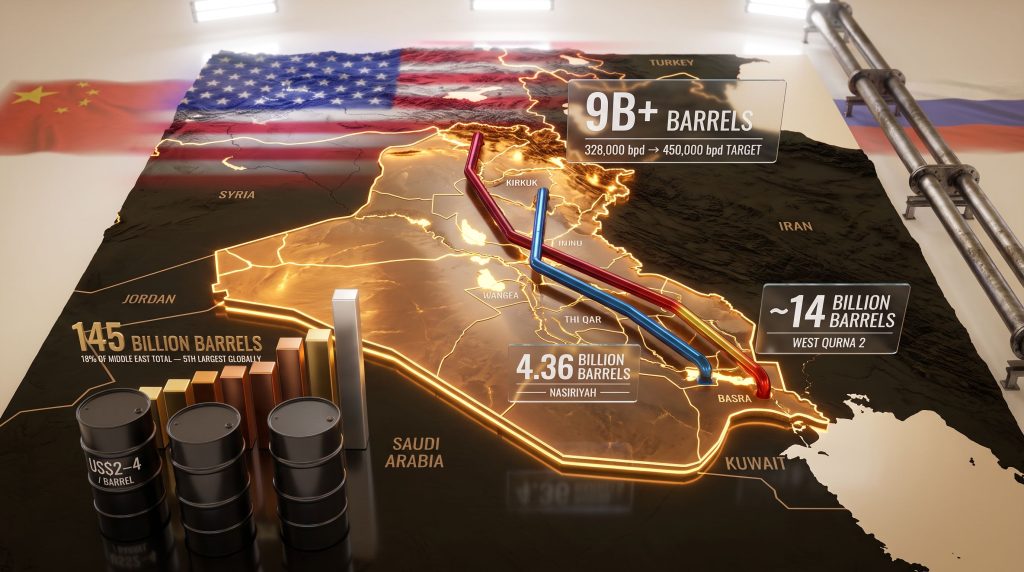
Few assets in the global energy system combine reserve scale, extraction economics, and geopolitical centrality quite like Iraq's oil sector. With an estimated 145 billion barrels of proved crude oil reserves according to the U.S. Energy Information Administration, Iraq accounts for nearly 18% of the entire Middle East's total proven reserves and holds the fifth-largest reserve base on earth. Yet what truly distinguishes Iraq from other major producers is not volume alone. Lifting costs of just US$2 to US$4 per barrel place Iraqi crude in the same ultra-low-cost tier as Saudi Arabia and Iran, meaning profit margins per barrel dwarf those achievable in virtually every other producing region on the planet.
Against this backdrop, Iraqi Prime Minister Ali al-Zaidi's announcement of a national production ambition of 8 to 10 million barrels per day (bpd) within six years has transformed what was already a fiercely contested energy landscape into a full-scale geopolitical arena. Current crude oil prices and output sit well below this ceiling, meaning the gap between present production and the stated target represents one of the largest undeveloped commercial hydrocarbon opportunities accessible to international operators anywhere in the world. It is no accident that Washington, Beijing, and Moscow have each treated Iraq as central to their long-term energy influence strategies.
Iraq's strategic weight extends beyond its reservoirs. Situated at the geographic heart of the Middle East, it borders Iran to the east, Saudi Arabia and Kuwait to the south, Jordan and Syria to the west, and Turkey to the north, the latter providing direct overland access into Europe. Whoever shapes Iraqi energy infrastructure therefore holds potential influence across multiple export corridors simultaneously. Iraq's role within the Shia Crescent, the geopolitical arc connecting Iran through Iraq and Syria to Lebanon, adds a further layer of proxy-power dynamics that amplifies the consequences of any shift in energy control within its borders.
When big ASX news breaks, our subscribers know first
How Russia and China Filled the Vacuum After 2018
The story of great-power competition inside Iraq's oil sector accelerated sharply after the U.S. unilaterally exited the Joint Comprehensive Plan of Action in 2018. Both Russia and China interpreted this withdrawal as evidence of a broader American strategic retreat from the Middle East, and both moved quickly to fill the resulting vacuum. Furthermore, the geopolitical trade tensions generated by this pivot created long-lasting structural consequences for energy markets well beyond the Middle East.
Russia concentrated its efforts on Iraq's semi-autonomous Kurdistan Region in the north, establishing effective dominance through energy contracts and deeply embedded political relationships with the Kurdistan Regional Government. Russian energy firms wove themselves into the upstream production infrastructure of the region in ways that created lasting dependency structures benefiting Moscow's leverage over both Erbil and Baghdad.
China's approach in the south was architecturally more sophisticated. Through two landmark cooperation agreements, the Oil for Reconstruction and Investment framework of 2019 and the Iraq-China Framework Agreement of 2020, Beijing secured access to Iraqi oil in exchange for infrastructure investment. The scale of what followed was significant. By the start of 2025, Chinese companies were managing approximately 34% of Iraq's proven reserves and exercising operational control over roughly two-thirds of Iraq's full-capacity production.
What made China's strategy particularly difficult to counter was its structural design. Rather than relying on a small number of high-profile contracts, Beijing directed dozens of relatively low-profile firms to quietly accumulate upstream positions across southern Iraq's Basra region. The individual pieces were then being progressively linked into an integrated exploration-production-refinery-export ecosystem, a structure explicitly designed to make Western re-entry commercially redundant even if it remained politically possible.
| Power | Primary Region | Core Strategy | Position by Early 2025 |
|---|---|---|---|
| Russia | Northern Iraq / Kurdistan | Contracts and KRG political relationships | Dominant upstream position |
| China | Southern Iraq / Basra | Dual framework deals and low-profile contract accumulation | ~34% of reserves; ~66% of full-capacity output |
| United States | Broadly diminished | Limited commercial presence | Significantly reduced post-2018 |
The Financial Architecture That Washington Never Surrendered
Beneath the commercial competition lies a structural lever that neither Russia nor China has ever been able to replicate. Since the post-2003 Development Fund for Iraq arrangements, Iraq's oil export revenues have been routed through the Federal Reserve Bank of New York. Because oil accounts for approximately 90% of Iraq's national government budget, this routing mechanism gives Washington a degree of macroeconomic influence over Baghdad that no other external power possesses, without constituting any direct ownership of Iraqi oil assets.
This financial architecture proved its strategic value in early 2025 when, under sustained U.S. pressure, Iraq dismantled its foreign-currency auction system. That system had been extensively exploited to route U.S. dollars toward sanctioned entities, most notably Iran, providing Tehran with one of its most reliable dollar-access conduits. Its closure demonstrated that Washington can apply decisive economic pressure on Baghdad through financial channels alone, without requiring military action or direct regulatory intervention inside Iraqi territory. The consequences of Russian oil sanctions have similarly reinforced how financial instruments can reshape energy sector dynamics at scale.
The U.S. power play in Iraq's oil sector operates simultaneously on two distinct levels: a financial layer anchored in Federal Reserve routing and banking system control, and a commercial layer driven by the re-entry of American energy majors into upstream production. Both are being activated in parallel.
ConocoPhillips and the Kirkuk Consolidation
The commercial dimension of the U.S. power play in Iraq's oil sector has become visible through a series of landmark deals involving American energy majors. ConocoPhillips has agreed to acquire a 42% interest in BP Energy Company of Kirkuk Limited, the vehicle through which BP is executing the redevelopment of five producing fields in northern Iraq's Kirkuk area. The five fields involved are:
- Baba Dome (part of the wider Kirkuk field)
- Avanah Dome (part of the wider Kirkuk field)
- Bai Hassan field
- Jambur field
- Khabbaz field
The underlying BP megadeal, formally activated on 2 October of the prior year, carries a value of US$25 billion and targets preliminary production of 328,000 bpd, with expectations of scaling to at least 450,000 bpd within two to three years, before further reassessment. The contract runs 25 years with renewal options, and lifting costs are expected to remain at or near Iraq's national average of US$2 to US$4 per barrel.
The five fields are conservatively estimated to hold up to 9 billion barrels of reserves. However, independent assessments of the broader surrounding area suggest the true hydrocarbon potential is considerably larger, with estimates placing additional resources in the surrounding zone at 11 to 12 billion barrels or more. At a lifting cost of US$3 per barrel and production of 450,000 bpd, the gross margin per barrel at US$70 oil exceeds US$67, implying potential gross revenues well above US$30 billion per year at plateau production.
The geopolitical dimension of this deal is not incidental. Russia and China have historically sought the complete political unification of Iraq under Baghdad's central authority, a configuration that would effectively marginalise Kurdish political autonomy and with it the Western commercial presence in the north. ConocoPhillips's deepening stake in Kirkuk directly challenges that long-term objective.
Chevron's Southern Iraq Expansion: West Qurna 2 and Nasiriyah
Chevron's advancing position in southern Iraq represents the other prong of the U.S. commercial re-entry strategy. Following Lukoil's forced exit from West Qurna 2 after the implementation of sanctions by both the U.S. and Great Britain, Chevron has moved into position to assume operational leadership of one of Iraq's most consequential assets. Indeed, the oil market trade risks associated with such operator transitions have added further complexity to an already volatile pricing environment.
West Qurna 2 is located 65 kilometres northwest of Basra and holds approximately 14 billion barrels of reserves in place. Under Lukoil's operation, the field was producing around 400,000 bpd, representing roughly 9% of Iraq's total output at that time. Lukoil held a 75% operating stake, with Iraq's North Oil Company holding the balance. The field's development roadmap outlined three progressive phases:
- Phase 1: Sustain and stabilise production at approximately 400,000 bpd
- Phase 2: Expand output to 480,000 bpd
- Phase 3: Add a further 650,000 bpd by developing the deeper Yamama formation
The ultimate production ambition stands at 1.13 million bpd, scaled back slightly from an original target of 1.2 million bpd. Both U.S. geological assessments conducted during the post-2003 period and independent international oil company evaluations have consistently validated these targets as technically achievable. The deeper Yamama carbonate formation represents a particularly significant geological prize, a reservoir system that remains substantially underdeveloped despite its enormous confirmed resource base.
Chevron's second southern Iraq target is the Nasiriyah oilfield, located in Thi Qar province. The field holds an estimated 4.36 billion barrels of recoverable reserves and was first discovered by the Iraq National Oil Company in 1975. Despite repeated development proposals across successive Iraqi governments, including both standalone field development and the larger Nasiriyah Integrated Project (NIP), which would incorporate construction of a 300,000-bpd refinery, sustained development has never materialised. Chevron's recent signing of an addendum to a heads of agreement letter signals that this long-stalled asset may be approaching genuine commercial momentum.
| Field | Location | Estimated Reserves | Prior Operator | U.S. Operator | Production Target |
|---|---|---|---|---|---|
| Kirkuk Complex (5 fields) | Northern Iraq | 9B+ barrels (conservative) | BP | ConocoPhillips (42% stake) | 450,000+ bpd |
| West Qurna 2 | 65km NW of Basra | ~14 billion barrels | Lukoil | Chevron (advancing) | 1.13 million bpd |
| Nasiriyah | Thi Qar Province | ~4.36 billion barrels | Undeveloped | Chevron (HOA addendum signed) | TBD |
The Common Seawater Supply Project: The Infrastructure Layer Nobody Talks About
An underappreciated enabler of the entire southern Iraq expansion is the Common Seawater Supply Project (CSSP). Southern Iraqi reservoirs require enhanced pressure maintenance to sustain production rates at scale. The CSSP addresses this by extracting seawater directly from the Persian Gulf and injecting it into oil-bearing formations across multiple fields simultaneously. This shared infrastructure model distributes the substantial capital costs of water injection across multiple operators and projects, materially improving the per-barrel economics of individual field developments.
The CSSP creates a structural synergy between all Western-operated fields in southern Iraq, meaning that as each additional field comes online under U.S. or allied operator management, the marginal cost advantages of the shared infrastructure increase. This architecture gives Western operators a collective efficiency advantage that individually contracted Chinese or Russian operators, working through separate project structures, struggle to replicate.
The next major ASX story will hit our subscribers first
The Broader Strategic Picture: Risks Washington Cannot Ignore
Despite the significant commercial momentum now behind the U.S. power play in Iraq's oil sector, several structural constraints deserve careful consideration.
Does OPEC Quota Policy Threaten Iraq's Expansion Plans?
OPEC quota dynamics present a near-term challenge. Iraq's stated ambition of 8 to 10 million bpd within six years would require Baghdad to substantially exceed its current OPEC production allocation, generating friction within the cartel and complicating relationships with fellow members. OPEC's global influence over production ceilings means resolving this tension is a prerequisite for the production expansion that underpins every major American commercial position in the country.
How Does Iraq's Dual Alignment Challenge Affect U.S. Interests?
Iraq's dual alignment challenge remains unresolved. Baghdad has historically balanced relationships with Washington and Tehran simultaneously, a balancing act that intensifies as U.S. financial and commercial pressure deepens. Iran-aligned political factions within Iraq's domestic political system retain significant influence over legislative and regulatory processes, and any government composition change in Baghdad could alter the commercial terms under which American firms operate.
Is the Sanctions Environment Truly Permanent?
The reversibility of sanctions is a less-discussed but real risk. The sanctions that forced Russian operators out of Kurdistan and created space for Western re-entry are instruments of policy, not permanent structural changes. A shift in U.S. foreign policy priorities could alter the sanctions environment and invite Russian or Chinese re-engagement, particularly given Beijing's demonstrated willingness to maintain economic relationships with sanctioned jurisdictions. For a broader analysis of how Iraq's energy superpower ambitions intersect with great-power competition, the geopolitical dimensions extend well beyond the oil fields themselves.
The current window for U.S. commercial re-entry into Iraq's oil sector is unusually wide, created by Russia's military preoccupation in Ukraine, Iran's focus on its own territorial defence, and China's deliberate restraint below the threshold of direct confrontation with Washington. None of these conditions are permanent, and the window will not remain open indefinitely.
The trajectory of the U.S. power play in Iraq's oil sector reflects a broader recognition within Washington that energy sector dominance in Iraq translates directly into geopolitical influence across the Middle East. Whether the commercial gains secured through 2025 and 2026 can be consolidated into durable structural positions before the geopolitical environment shifts again remains the defining question for every operator, investor, and policymaker watching this contest unfold.
This article is intended for informational purposes only and does not constitute financial or investment advice. References to production targets, reserve estimates, and commercial outcomes involve forward-looking assumptions subject to material uncertainty. Readers should conduct independent due diligence before making any investment decisions.
Want to Identify the Next Major Resource Discovery Before the Market Does?
Discovery Alert's proprietary Discovery IQ model delivers real-time alerts on significant ASX mineral discoveries, instantly translating complex resource data into actionable investment insights — explore historic discoveries and their exceptional returns to understand the scale of opportunity, then begin your 14-day free trial at Discovery Alert to position yourself ahead of the broader market.