August 26, 2026
The Chokepoint Problem That Decades of Energy Policy Failed to Solve
Every major industrial economy carries a version of the same hidden risk: a single geographic constraint capable of severing the supply chain for its most critical energy input. For island nations with no domestic crude production to speak of, that risk is not theoretical. It is structural, measurable, and in 2026, it became acutely real.
The Strait of Hormuz has long been described in energy security literature as the world's most critical oil transit chokepoint. According to the IEA's analysis of the Strait of Hormuz, an estimated 20 to 21 million barrels per day of crude oil and petroleum products pass through this narrow waterway, representing roughly 20% of global oil consumption. For Japan, historically sourcing approximately 85 to 90% of its crude oil from Middle Eastern producers, the strait has functioned less as a geographic feature and more as a single point of systemic failure built into the country's energy architecture.
The Iran conflict, which commenced in February 2026, converted that latent vulnerability into an operational emergency. Commercial shipping confidence through the strait deteriorated sharply. Japan was compelled to draw down its strategic petroleum reserves, accelerate emergency procurement from alternative suppliers including the United States, and begin reconfiguring its medium-term energy security posture in ways that would have seemed politically difficult just years earlier.
What has emerged from this crisis is not simply a reactive procurement scramble. It is a structurally ambitious, multi-layered strategy centred on Japan alternative West Asian oil pipelines, nuclear energy maximisation, and next-generation renewable technology, announced through a government policy meeting convened in late August 2026.
When big ASX news breaks, our subscribers know first
Understanding the Infrastructure That Already Exists
A critical and underappreciated fact in this discussion is that bypass infrastructure around the Strait of Hormuz is not a future aspiration. Two operational pipeline systems already exist, each capable of physically routing crude oil away from the chokepoint. The challenge is not their existence but their capacity relative to the volumes that normally transit Hormuz.
| Pipeline | Country | Outlet Port | Design Capacity | Bypass Destination |
|---|---|---|---|---|
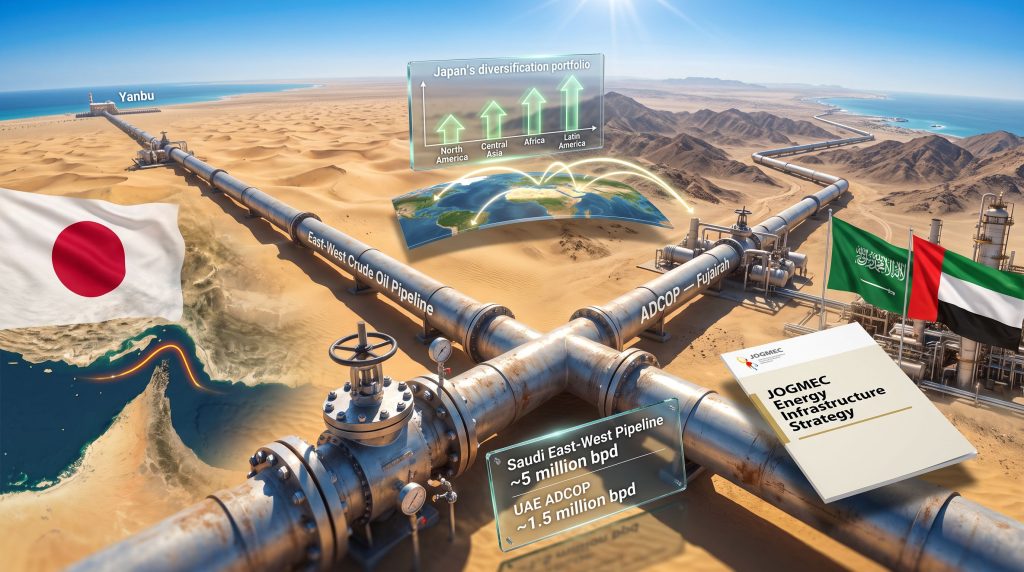
| East-West Crude Oil Pipeline | Saudi Arabia | Yanbu (Red Sea) | ~5 million bpd | Red Sea, Mediterranean access |
| Abu Dhabi Crude Oil Pipeline (ADCOP) | UAE | Fujairah (Gulf of Oman) | ~1.5 million bpd | Gulf of Oman, direct Asia routing |
Saudi Arabia's East-West Pipeline is the larger of the two, stretching approximately 1,200 kilometres across the Arabian Peninsula from the Eastern Province oil fields to the Red Sea port of Yanbu. It was originally constructed in the 1980s precisely because Saudi Arabia recognised the Hormuz vulnerability following the Iran-Iraq War, yet it has never been sustained at maximum throughput during a real crisis scenario. This aligns closely with the broader Saudi energy strategy of building resilient export infrastructure as a geopolitical tool.
The UAE's ADCOP pipeline, connecting Abu Dhabi production to the Fujairah terminal on the Gulf of Oman, offers a geographically distinct advantage: Fujairah sits south of the Strait of Hormuz, meaning tankers loading there avoid the chokepoint entirely without the additional distance required to route through the Red Sea. However, at approximately 1.5 million barrels per day of capacity, it represents a relatively modest contribution against the scale of normal Hormuz flows.
The arithmetic of bypass capacity matters here. Even combining both pipelines at theoretical maximum throughput, the available bypass volume falls significantly short of what normally transits the strait. This gap defines the urgency of Japan's push to expand and reinforce these corridors.
Japan's Strategic Instrument: How JOGMEC Operates in This Space
Japan's international energy infrastructure diplomacy is typically channelled through JOGMEC, the Japan Oil, Gas and Metals National Corporation. Understanding how this institution operates helps clarify what Japan's pipeline support commitment actually means in practice.
JOGMEC functions as a hybrid entity combining elements of a sovereign wealth vehicle, a technical cooperation agency, and a concessional financing body. Its core tools include:
- Debt guarantees and equity participation in upstream and midstream projects, reducing the commercial risk threshold for Japanese companies investing overseas
- Technical assistance programs that transfer Japanese engineering expertise to national oil companies and infrastructure operators in partner countries
- Subsidy mechanisms that can offset the additional transportation cost premium associated with longer bypass routing compared to direct Hormuz transit
- Feasibility financing for pipeline studies and expansion assessments before full capital commitments are made
This suite of instruments means Japan's support for Saudi Arabia's East-West Pipeline expansion and other Gulf bypass routes is not simply a diplomatic gesture. It represents tangible financial and technical resources being deployed to make these corridors more commercially viable and operationally reliable.
The Portfolio Architecture: Why No Single Solution Is Sufficient
A core strategic insight embedded in Japan's current approach is the explicit rejection of a single-solution framework. Policymakers have structured the response as a portfolio of interdependent measures, recognising that each individual element carries limitations. Furthermore, the energy security future of resource-dependent nations increasingly demands precisely this kind of diversified architectural thinking.
Layer One: Pipeline Expansion Support
Japan is committing to support Saudi Arabia and other Gulf producers in expanding bypass pipeline capacity. This includes both reinforcing existing infrastructure and potentially financing feasibility work on new corridors. The Nikkei reported that Japan would assist initiatives by Saudi Arabia and other countries to expand and build new routes for crude bypassing the Strait of Hormuz.
Layer Two: Supply Source Diversification
Parallel to infrastructure diplomacy, Japan is actively expanding its crude import base across:
- North America, particularly the United States, where emergency procurement has already been accelerated during the current crisis
- Latin American producers, which offer Atlantic Basin routing that avoids Middle Eastern chokepoints entirely
- Central Asian producers accessible through alternative logistics chains
- African suppliers, particularly from West Africa, which have historically served Asian refiners during prior Middle East supply disruptions
Layer Three: A Dedicated Naphtha Crude Reserve
One of the more technically specific and lesser-discussed elements of Japan's response is the proposed creation of a special crude oil reserve designated for naphtha production. This reflects an important industrial reality that goes beyond simple fuel supply security.
Naphtha is a light petroleum fraction derived from crude oil distillation, and it serves as the foundational feedstock for Japan's petrochemical sector. It is the precursor to ethylene and propylene production, which in turn underpin plastics, synthetic fibres, fertilisers, and a vast range of manufactured goods. An interruption to naphtha supply does not simply raise energy costs. It threatens the operating continuity of downstream industrial supply chains that have little short-term substitution flexibility.
Not all crude grades produce naphtha in equal proportions. Lighter, lower-sulphur crudes tend to yield higher naphtha cuts during refinery distillation, which is why the composition of Japan's strategic reserve matters as much as its volume. A reserve optimised for naphtha production requires careful crude grade selection, adding a layer of technical complexity to what might appear to be a straightforward stockpiling initiative.
Japan's industrial economy is unusually naphtha-intensive relative to other major importers. This reflects decades of petrochemical investment built around the assumption of reliable, low-cost Middle Eastern crude supply. Disrupting that assumption requires not just more crude, but the right crude.
Nuclear Power and Perovskite Solar: The Domestic Energy Dimension
Japan's pipeline diplomacy addresses the import supply chain. However, the government's August 2026 policy meeting also formalised commitments on the domestic energy production side that represent significant long-term structural shifts.
Nuclear Maximisation
The call to maximise the utilisation of nuclear power capacity is the culmination of a gradual trajectory that began approximately fifteen years after the Fukushima disaster. Japan progressively restarted reactor capacity from around 2023 onward, driven initially by decarbonisation pressures and rising electricity costs. The Iran conflict has now added energy security as an additional and politically powerful justification for accelerating this process.
An important and underappreciated driver of this acceleration is electricity demand growth from artificial intelligence infrastructure and data centre expansion. Japan has attracted significant data centre investment, and the power intensity of AI computing is creating demand growth rates that renewable energy deployment alone cannot immediately satisfy. Nuclear baseload capacity offers the combination of reliability and emissions profile that policymakers require to accommodate this demand.
Perovskite Solar Cells
Government support for perovskite solar cell development represents a longer-term technology bet with significant industrial policy implications. Perovskite photovoltaics have attracted substantial global research investment because they offer the potential for higher conversion efficiencies and lower manufacturing costs than conventional silicon-based panels, particularly in thin-film applications.
Japan's interest is strategic on two levels. First, it reduces long-term electricity import dependency. Second, it positions Japanese industrial firms in a solar technology segment where the competitive landscape is not yet dominated by Chinese manufacturing at scale, unlike conventional silicon panels. Consequently, these domestic energy initiatives sit alongside broader energy transition pressures reshaping industrial policy across major economies.
How Japan's Exposure Compares Across Asia
| Country | Crude Import Middle East Share | IEA Member | Strategic Reserve (Days) | Overland Pipeline Access | Island Geography Risk |
|---|---|---|---|---|---|
| Japan | ~85-90% (historical) | Yes | 90+ days | None | High |
| South Korea | ~70-75% | Yes | 90+ days | None | High |
| China | ~40-50% | No | Est. 90+ days | Russia, Central Asia | Moderate |
| India | ~60-65% | No (observer) | Growing | Limited | Low-Moderate |
Japan's island geography creates a structural vulnerability that continental importers do not share to the same degree. China, despite significant Middle Eastern exposure, maintains overland pipeline connectivity to Russian and Central Asian crude that provides a genuine Hormuz bypass at scale. Japan possesses no equivalent. Every barrel of crude imported by Japan arrives by sea, which is why maritime chokepoint risk carries a qualitatively different weight in Tokyo's strategic calculus.
The next major ASX story will hit our subscribers first
Structural Constraints That Optimism Cannot Overcome
Analysts and energy security researchers consistently highlight several structural limitations that Japan's pipeline strategy must contend with, regardless of the financing and political will applied. In addition, the broader oil price shock dynamics triggered by Hormuz disruptions have reinforced the urgency with which these limitations must be addressed.
- Volume ceiling: The combined theoretical maximum of the Saudi East-West Pipeline and ADCOP remains far below normal Hormuz transit volumes. Even fully utilised, these corridors cannot serve as a like-for-like replacement.
- Sustained throughput uncertainty: Operating either pipeline at maximum capacity for an extended crisis period involves operational variables that have not been tested under real-world emergency conditions at scale.
- Secondary logistics bottlenecks: Redirecting large crude volumes to Yanbu or Fujairah creates downstream congestion in tanker scheduling, port berth availability, and loading rate capacity. These ports were not designed to simultaneously handle emergency-level throughput from multiple major Asian buyers.
- Red Sea risk transference: Routing crude through the Saudi East-West Pipeline to Yanbu moves the supply chain from one regional risk zone to another. The Red Sea has itself been a focus of maritime security concerns in recent years.
A pipeline bypass strategy reduces Hormuz dependency. It does not eliminate geopolitical risk from the supply chain. The risk relocates rather than disappears.
Furthermore, rising critical minerals demand associated with Japan's renewable energy build-out adds yet another layer of supply chain complexity to an already strained strategic environment.
Frequently Asked Questions
What does Japan alternative West Asian oil pipelines mean in practice?
It refers to Japan's commitment, announced in August 2026, to financially and technically support the expansion of crude oil pipeline infrastructure in the Gulf region that routes oil around the Strait of Hormuz. As reported across regional media, the primary focus is on Saudi Arabia's East-West Pipeline and the UAE's ADCOP system.
Why can't existing bypass pipelines simply replace Hormuz volumes?
The combined capacity of operational bypass pipelines in the region is significantly lower than the roughly 20 to 21 million barrels per day that transits Hormuz under normal conditions. Expanding this capacity requires substantial capital investment, time, and operational scaling that cannot be achieved immediately.
What is naphtha and why is it strategically important to Japan?
Naphtha is a light refined petroleum fraction used as the primary feedstock for petrochemical production, including ethylene and propylene. Japan's industrial economy is deeply dependent on naphtha for plastics, synthetic materials, and chemical manufacturing. A supply disruption affects not just energy costs but industrial output continuity across multiple sectors.
How does Japan's energy security response compare to its post-Fukushima restructuring?
The current response may represent Japan's most comprehensive energy security restructuring since Fukushima in 2011. Where the post-Fukushima period forced a rapid shift away from nuclear toward LNG imports, the 2026 response is moving simultaneously across oil infrastructure, nuclear reactivation, and advanced renewables. According to the EIA's analysis of world oil transit chokepoints, the systemic pressure on Japan to restructure is consistent with patterns seen across major chokepoint disruption events historically.
Disclaimer: This article contains forward-looking assessments regarding energy infrastructure development, pipeline capacity, and policy implementation timelines. These involve inherent uncertainties and should not be interpreted as investment advice or definitive forecasts. Pipeline capacity figures and crude oil flow estimates are based on publicly available industry data and IEA reporting, which may be subject to revision.
Want to Identify the Next Major Resource Discovery Before the Market Does?
Discovery Alert's proprietary Discovery IQ model delivers real-time alerts on significant ASX mineral discoveries — cutting through complex data across 30+ commodities to surface actionable opportunities the moment they hit the exchange. Explore historic discoveries and their extraordinary returns, then start your 14-day free trial at Discovery Alert to position yourself ahead of the broader market.