June 4, 2026
Understanding the AI Data Crisis in Geospatial Industries
The geospatial industry stands at a critical inflection point where artificial intelligence promises transformational capabilities, yet geo-professionals struggling with AI data integration face unprecedented challenges that threaten to undermine these technological advances. While the potential for AI-driven insights remains substantial, fundamental infrastructure gaps are creating barriers that prevent organisations from realising the full value of their data assets.
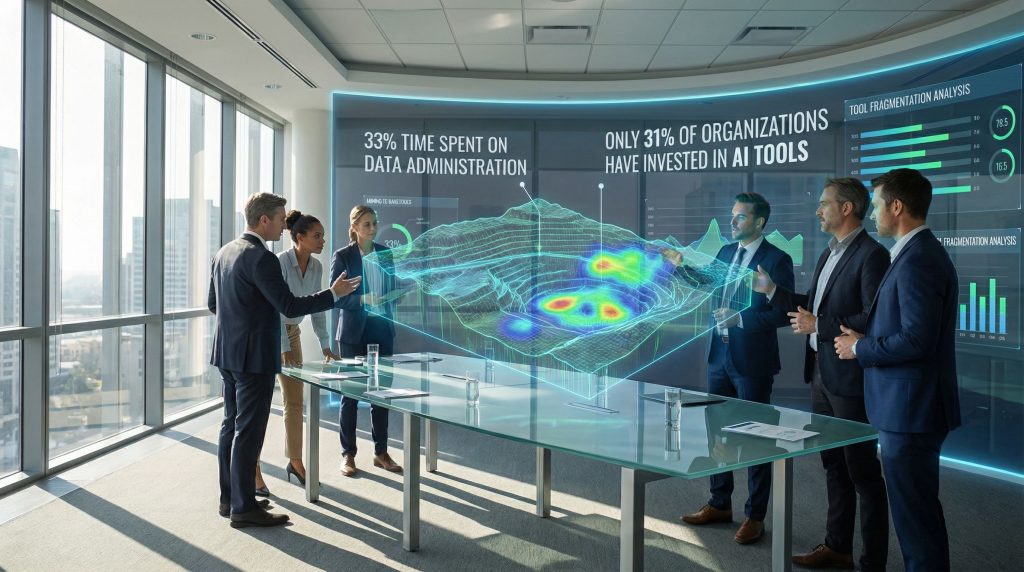
Mining and civil engineering professionals worldwide are grappling with complex, multisource datasets that span multiple software platforms, creating fragmentation that consumes valuable analytical time. According to Seequent's 7th Geoprofessionals Data Management Report, which surveyed more than 1,000 geo-professionals globally, 80% of mining professionals recognise data management as critically important, yet they spend approximately one-third of their professional time on data administration rather than interpretation and analysis.
What Defines the Current AI Data Management Challenge?
The industry faces a paradox where data abundance coincides with accessibility limitations. Despite recognising data as their most valuable organisational asset, geo-professionals encounter systematic obstacles that prevent effective AI implementation:
- Framework implementation lags significantly: Only 39% of mining companies have established defined data management frameworks
- Civil sector adoption remains limited: Just 41% of civil geo-professionals operate with established frameworks
- Chain of custody protocols are underdeveloped: Merely 30% of civil professionals maintain formal data custody procedures
- AI investment remains fragmented: 31% of organisations have invested in AI tools, while 18% have no investment plans
The absence of centralised "single source of truth" architectures compounds these challenges, creating environments where professionals must navigate disparate systems without unified data governance protocols. Furthermore, this situation highlights how mining evolution trends are increasingly dependent on data integration capabilities.
Why Traditional Data Frameworks Fail in AI-Driven Environments
Legacy geospatial systems were designed for human-driven workflows rather than machine learning requirements. These traditional approaches create several critical gaps:
Data Structure Incompatibilities: Historical datasets often lack the standardised formats and metadata structures required for effective AI training. Mining companies frequently maintain decades of exploration data across incompatible formats, creating preprocessing bottlenecks that delay AI implementation.
Quality Validation Protocols: Traditional quality assurance methods rely on statistical sampling and human verification, while AI systems require comprehensive validation across entire datasets to identify bias patterns and ensure model reliability.
Integration Architecture Limitations: Existing infrastructure typically connects systems through point-to-point integrations rather than unified data platforms capable of supporting real-time AI processing requirements.
When big ASX news breaks, our subscribers know first
The Multi-Platform Integration Dilemma
How Many Software Platforms Are Geo-Professionals Managing Simultaneously?
The complexity of modern geospatial workflows forces professionals to maintain expertise across multiple specialised software environments. This fragmentation creates significant operational overhead:
| Professional Type | Primary Challenge | Integration Complexity | Decision Impact |
|---|---|---|---|
| Mining Geologists | Historical data reconciliation | Very High | Exploration timing delays |
| Civil Engineers | Multi-vendor coordination | High | Project delivery extensions |
| Geotechnical Specialists | Quality validation protocols | Extreme | Risk assessment limitations |
ESRI, QGIS, and GeoPandas Integration Challenges: Each platform maintains distinct data models and processing workflows, requiring professionals to develop custom integration solutions or accept data transformation losses during platform transitions.
Cloud vs. Desktop Coordination: Many organisations operate hybrid environments where desktop-based legacy tools must interface with cloud-native AI services, creating latency and synchronisation challenges that affect real-time decision-making capabilities. In addition, this complexity directly impacts AI in mining operations efficiency.
What Are the Hidden Costs of Data Administration Overhead?
The time allocation analysis reveals substantial productivity impacts across the geospatial sector:
Resource Allocation Breakdown:
- Data management tasks consume 33% of professional time in mining operations
- Analytical work receives reduced attention, limiting value-generation activities
- Project timelines extend due to data preparation requirements
- Decision-making delays occur while teams reconcile conflicting datasets
"Data isn't just a byproduct of operations but the core asset that drives every decision, from exploration to reclamation. The industry is laser-focused on data management, but it also highlights the major challenge of unlocking the full value from current and historical data for a future where AI and automation will be increasingly important." – Dr. Janina Elliott, Segment Director Mining at Seequent
AI Validation and Quality Assurance Gaps
How Do Geo-Professionals Ensure AI Output Reliability?
The integration of AI systems into geospatial workflows introduces validation challenges that extend beyond traditional quality assurance protocols. Professionals must develop new competencies to verify AI-generated insights while maintaining confidence in automated processes.
Explainable AI Implementation: Organisations implementing AI solutions must balance processing efficiency with interpretability requirements. Mining operations, for example, need to understand why AI systems recommend specific drilling locations or grade predictions to maintain regulatory compliance and operational safety.
Bias Detection and Mitigation: Training datasets often reflect historical sampling patterns that may not represent current geological conditions or operational requirements. Professionals must develop systematic approaches to identify and correct these biases before deploying AI models in production environments. However, this process becomes more manageable when combined with AI-powered mining efficiency tools.
Human Oversight Integration: Successful AI implementations maintain human expertise in validation loops rather than pursuing full automation. This approach ensures that domain knowledge continues to guide AI decision-making while leveraging automated processing capabilities.
What Validation Standards Apply to AI-Generated Geospatial Data?
Industry standards organisations are developing frameworks specifically for AI-processed geospatial datasets, though adoption remains inconsistent:
Professional Standards Development:
- Accuracy assessment protocols for automated feature extraction
- Uncertainty quantification methods for AI predictions
- Reproducibility requirements for AI model outputs
- Documentation standards for AI processing workflows
- Quality control checkpoints throughout AI processing pipelines
These emerging standards address the unique challenges of validating AI outputs while maintaining compatibility with existing professional workflows and regulatory requirements. Furthermore, they complement advances in 3D geological modelling techniques.
Multisource Data Fusion Complexities
Why Is Multimodal Data Integration So Challenging?
Modern geospatial projects increasingly require fusion of diverse data sources, each with distinct characteristics, accuracy levels, and processing requirements. This complexity creates technical challenges that traditional integration approaches cannot adequately address.
| Data Source | Processing Intensity | Fusion Complexity | Real-Time Capability |
|---|---|---|---|
| Satellite Imagery | Moderate | High | Limited |
| LiDAR Point Clouds | Very High | Extreme | No |
| Ground-Penetrating Radar | High | Very High | Yes |
| Real-Time Sensors | Extreme | Extreme | Yes |
Scale Processing Limitations: Mining operations often require processing of massive LiDAR datasets covering hundreds of square kilometres while maintaining centimetre-level accuracy. Current processing workflows struggle to handle these scale requirements while preserving data fidelity across different sensor modalities.
Temporal Synchronisation: Infrastructure monitoring projects must coordinate data streams with different temporal resolutions and update frequencies. Satellite imagery may update monthly, while ground sensors provide continuous monitoring, requiring sophisticated temporal fusion algorithms. Consequently, effective drill results interpretation becomes even more complex.
How Do Teams Handle Real-Time Data Stream Integration?
Organisations pursuing real-time geospatial AI capabilities must develop cloud-native architectures capable of processing multiple simultaneous data streams:
Cloud Workflow Optimisation Strategies:
- Stream processing architectures for continuous data ingestion
- Edge computing deployment for local processing requirements
- Data lake implementations for scalable storage and retrieval
- API-first integration approaches for vendor-agnostic workflows
- Containerised processing for scalable computational resources
SpatioTemporal Asset Catalog (STAC) Implementation: Organisations adopting STAC standards can achieve improved interoperability between different data sources and processing systems, though implementation requires significant technical expertise and infrastructure investment.
Skills Gap and Workforce Transformation
What New Competencies Do Geo-Professionals Need for AI Integration?
The integration of AI technologies into geospatial workflows demands expanded skill sets that combine traditional geological expertise with data science capabilities. This transition presents both opportunities and challenges for workforce development.
| Traditional Competency | AI-Enhanced Requirement | Development Priority |
|---|---|---|
| Manual data interpretation | AI output validation | High |
| Statistical analysis | Machine learning concepts | Very High |
| Report generation | Automated insight verification | Medium |
| Quality control | Bias detection and mitigation | High |
Cultural Adaptation Requirements: Organisations must navigate resistance to AI adoption while maintaining confidence in traditional methodologies. This balance requires careful change management that demonstrates AI capabilities while preserving professional judgment and domain expertise.
Self-Service Tool Implementation: Leading organisations are developing self-service AI capabilities that enable geo-professionals to access AI insights without requiring extensive data science training. These approaches democratise AI access while maintaining professional oversight of results.
How Are Organisations Addressing the AI Skills Shortage?
Workforce development strategies vary significantly based on organisational maturity and resource availability. According to recent industry analysis, organisations are implementing various approaches:
Training Programme Approaches:
- Hands-on workshops focusing on AI tool integration with existing workflows
- Cross-functional collaboration between data scientists and geo-professionals
- Mentorship programmes pairing AI-experienced professionals with traditional experts
- Certification development for AI-enhanced geospatial competencies
- Vendor partnerships providing specialised training on AI-enabled tools
The most successful programmes emphasise AI as a capability enhancement rather than a replacement for traditional geological expertise, helping professionals understand how AI augments their existing knowledge rather than diminishing its value.
Strategic Implementation Pathways
What Separates AI Adoption Leaders from Laggards?
Analysis of organisational AI adoption patterns reveals distinct characteristics that differentiate successful implementations from struggling initiatives. The Seequent survey data identifies three primary organisational categories based on AI investment approaches.
| Adoption Category | Percentage | Primary Characteristics | Implementation Focus |
|---|---|---|---|
| AI Leaders | 31% | Framework-driven approach | Scalable infrastructure |
| Strategic Planners | 51% | Evaluation and pilot phases | Selective implementation |
| Non-Adopters | 18% | No current AI investment | Traditional workflows |
Competitive Advantage Factors: Leading organisations demonstrate several common characteristics that enable successful AI integration:
- Data foundation prioritisation before AI tool selection
- Cross-functional team development combining geological and technical expertise
- Incremental implementation strategies that build confidence through small wins
- Vendor relationship management that balances best-of-breed tools with integration complexity
- Performance measurement frameworks that quantify AI impact on business outcomes
How Can Organisations Build Scalable AI Data Foundations?
Successful AI implementation requires systematic approaches that address infrastructure, processes, and cultural factors simultaneously. Moreover, geo-professionals struggling with AI data challenges need comprehensive solutions:
Implementation Roadmap Components:
- Data inventory and quality assessment across all organisational systems
- Infrastructure architecture design for scalable data processing
- Pilot project selection focusing on high-impact, low-risk applications
- Skills development programmes tailored to organisational needs
- Governance framework establishment for AI decision-making
- Vendor evaluation and integration planning
- Performance monitoring and optimisation protocols
Interoperability Standards: Organisations pursuing multi-vendor environments must prioritise open standards and API-first architectures that prevent vendor lock-in while enabling best-of-breed tool selection.
"Data is the most valuable asset of any organisation, and it is clear from our report that both the civil sector and the mining sector are ready to unlock that value. The surge in AI shows a clear appetite for innovation. The opportunity now is to build the data foundations that will allow these technologies to thrive and deliver on their promise of a more efficient and sustainable future." – Angela Harvey, Chief Customer Officer at Seequent
The next major ASX story will hit our subscribers first
Future-Proofing Geospatial AI Operations
What Emerging Technologies Will Transform Data Management?
The geospatial industry is experiencing rapid technological evolution that will fundamentally alter how organisations approach data management and AI integration over the next decade.
Next-Generation Processing Architectures: Cloud-native geospatial processing platforms are emerging that provide elastic scalability for handling massive datasets while maintaining cost efficiency. These platforms integrate AI capabilities natively rather than requiring separate tool chains.
Autonomous Workflow Development: Advanced AI systems are beginning to demonstrate capabilities for autonomous data processing workflows that require minimal human intervention while maintaining quality standards. However, regulatory and safety requirements in mining and civil engineering will likely limit full automation adoption.
Edge Computing Integration: Real-time processing requirements are driving deployment of edge computing capabilities that enable AI processing at data collection points, reducing latency and bandwidth requirements while improving response times for time-critical applications.
How Should Professionals Prepare for Continued AI Evolution?
Preparation strategies must balance current operational needs with future capability requirements. For instance, geo-professionals struggling with AI data integration must develop adaptive approaches:
| Preparation Timeline | Technical Priority | Strategic Focus | Investment Approach |
|---|---|---|---|
| 6-12 months | Tool integration optimisation | Process standardisation | Moderate |
| 1-2 years | AI validation protocol development | Workforce capability building | High |
| 2-5 years | Autonomous workflow implementation | Market positioning | Very High |
Continuous Learning Frameworks: Professionals must develop systematic approaches to stay current with rapidly evolving AI technologies while maintaining expertise in core geological and engineering principles. This requires balancing traditional continuing education with emerging technology training.
Professional Network Development: Building relationships with AI technology vendors, research institutions, and peer organisations provides access to emerging best practices and implementation strategies that can accelerate adoption timelines.
Navigating the AI Data Transformation
Critical Success Factors for Industry Stakeholders
The successful integration of AI into geospatial workflows requires coordinated efforts across multiple organisational dimensions. Key success factors include:
Infrastructure Investment Priorities:
- Unified data platforms that eliminate silos between different data sources
- Scalable processing capabilities that can handle variable workload demands
- Security frameworks that protect sensitive geological and operational data
- Backup and recovery systems that ensure business continuity during AI system failures
Organisational Development Requirements:
- Change management programmes that address cultural resistance to AI adoption
- Skills development initiatives that enhance rather than replace traditional expertise
- Performance measurement systems that demonstrate AI value creation
- Risk management protocols that address AI-specific operational risks
Strategic Recommendations by Organisational Maturity:
For organisations beginning their AI journey, focus should remain on data foundation development and pilot project execution. More mature organisations can pursue advanced integration strategies and autonomous workflow development. However, all organisations must recognise that geo-professionals struggling with AI data challenges require systematic solutions rather than ad-hoc approaches.
The survey findings indicate that while the geospatial industry recognises the importance of data-driven decision making, significant gaps remain in implementation effectiveness. Organisations that address these foundational challenges systematically will be better positioned to capitalise on AI capabilities as they continue to evolve.
As Seequent notes in their report, the sector is moving in the right direction but not yet at the pace current demands require. Organisations that strengthen their data foundations now will be better positioned to adapt, innovate, and meet the evolving demands of the subsurface industries.
Disclaimer: This analysis is based on industry surveys and reported data. AI implementation outcomes may vary significantly based on organisational factors, technical infrastructure, and implementation approaches. Professional consultation is recommended for specific AI adoption strategies.
Looking to Stay Ahead of Mining Technology Trends?
Discovery Alert's proprietary Discovery IQ model provides real-time alerts on significant ASX mineral discoveries, helping investors capitalise on the technological advances and data-driven insights that are transforming the mining sector. Whether you're interested in companies pioneering AI integration or major discoveries that could benefit from improved data management practices, explore Discovery Alert's discoveries page to understand how historic mineral discoveries have generated substantial market returns, then begin your 14-day free trial today to position yourself ahead of the market.