August 7, 2026
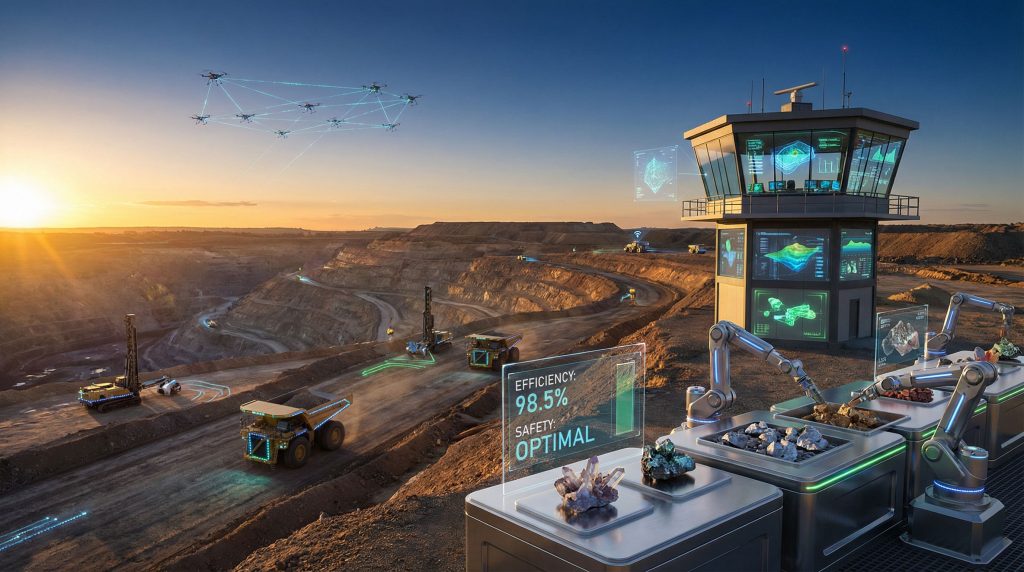
Modern mining operations face unprecedented challenges requiring intelligent solutions that transform traditional management approaches. The implementation of AI-driven automation in mine site management has emerged as a critical strategy for addressing declining ore grades, heightened safety regulations, and global talent shortages. These converging pressures have accelerated the integration of artificial intelligence technologies that transform reactive operational models into predictive ecosystems capable of autonomous decision-making.
Understanding the Intelligent Mining Revolution
The integration of AI-driven automation in mine site management represents the convergence of machine learning algorithms, Internet of Things sensor networks, and autonomous control systems. This technological synthesis enables operations to transition from reactive maintenance models to predictive systems that anticipate equipment failures and optimise production parameters before problems manifest.
Modern AI-driven mining systems consist of distributed sensor networks providing 10-50 data points per second per equipment unit, edge computing nodes processing data locally to reduce latency to under 100 milliseconds, and cloud-based machine learning platforms for historical trend analysis. The global market for AI in mining reached approximately $2.8 billion in 2023, with projections indicating growth to $8.2 billion by 2030, representing a compound annual growth rate of 14.2%.
Mining operations implementing these technologies report significant operational improvements. Equipment utilisation rates increase from baseline levels of 75-80% to 90-95% following implementation, while maintenance costs typically decline by 25-35% through predictive scheduling strategies. The data-driven mining operations approach demonstrates how these systems fundamentally reshape traditional management paradigms.
Core Technology Components Driving Transformation
The architecture of intelligent mining systems incorporates multiple technology layers working in coordination. Supervised learning models for equipment failure prediction utilise 5-10 years of historical maintenance data, while unsupervised clustering algorithms detect anomalies in operational parameters. Furthermore, reinforcement learning optimises dynamic route planning, continuously improving with each operational cycle.
Computer vision models for hazard detection require training on over 100,000 labelled images to achieve operational accuracy levels. These systems can identify equipment positioning violations in restricted zones, monitor personnel safety protocol compliance, and provide automated perimeter breach detection with response protocols.
Table: AI System Performance Metrics
| System Component | Data Processing Rate | Accuracy Level | Response Time |
|---|---|---|---|
| Equipment Monitoring | 50 data points/second | 94-97% | <100ms |
| Hazard Detection | 30 FPS video analysis | 91-95% | <200ms |
| Route Optimisation | Real-time traffic data | 88-92% efficiency | <500ms |
| Predictive Maintenance | Historical trend analysis | 85-90% accuracy | 1-24 hours |
Investment drivers for AI-driven automation in mine site management extend beyond simple cost reduction. Safety improvements show measurable impact, with underground mining fatality rates in countries with high automation adoption averaging 0.12 deaths per million hours worked, compared to the global average of 0.34 deaths per million hours worked.
Operations implementing comprehensive automation report average operational cost reductions of 22-31%, with production efficiency gains of 12-18% documented in operations with multi-year AI implementation. These improvements primarily result from enhanced equipment utilisation and reduced downtime through predictive maintenance protocols. The broader [mining industry evolution](https://discoveryalert.com.au/mining industry-evolution-2025-trends-innovation) reflects these technological advancements across multiple operational dimensions.
When big ASX news breaks, our subscribers know first
Advanced Traffic Management and Location Intelligence
Underground mining operations present unique challenges for AI-driven automation in mine site management due to confined spaces, limited route options, and GPS-denied environments. Ultra-wideband positioning systems achieve accuracy within ±0.3-0.5 metres, superior to RSSI-based systems that typically provide ±2-5 metre accuracy.
Modern Real-Time Location Systems generate position updates every 0.5-2 seconds per tracked asset, creating 1.8-7.2 billion positional data points annually for mid-scale underground operations with 200+ tracked vehicles. Advanced algorithms can generate optimised alternative routes within 200-500 milliseconds when obstacles or congestion are detected.
Underground Vehicle Coordination Protocols
The sensor architecture for underground positioning incorporates multiple redundant systems:
- Primary System: Ultra-wideband anchors positioned at 50-100 metre intervals throughout primary haulage routes
- Backup System: Inertial Measurement Units with accelerometers and gyroscopes for dead reckoning during signal loss
- Environmental Monitoring: Wireless air quality sensors providing real-time toxic gas concentration mapping
- Communication Infrastructure: Mesh-network wireless systems maintaining 99.2-99.8% uptime in challenging environments
Traffic flow optimisation results demonstrate significant operational improvements. Mines implementing AI-driven underground traffic coordination report reductions in vehicle congestion incidents from 15-22 monthly occurrences to 1-3 monthly occurrences, with corresponding cycle time improvements of 7-12%.
Load balancing algorithms utilise machine learning models to predict optimal load sizing for each haul destination based on processing capacity utilisation. These systems create dynamic load recommendations that maximise throughput while preventing mill circuit bottlenecks. Moreover, AI-powered mining efficiency solutions demonstrate how intelligent systems coordinate complex operational workflows.
Surface Fleet Management Integration
Surface operations benefit from GPS tracking systems achieving positioning accuracy of ±2-5 metres with standard GPS, improving to ±0.1-0.3 metres using RTK-GPS with base stations. Position updates occur every 1-5 seconds per vehicle, enabling real-time fleet coordination.
AI-optimised routing reduces fuel consumption by 12-18% compared to manual route assignment, translating to 15,000-45,000 litres saved annually for mid-scale operations with 50-100 haul trucks. However, intelligent dispatch systems reduce average haul cycle times by 8-15%, with improvements concentrated during congestion-prone periods showing 12-15% improvement during morning peak operations.
Table: Fleet Management Performance Improvements
| Metric | Manual Operations | AI-Driven Operations | Improvement |
|---|---|---|---|
| Equipment Utilisation | 70-78% | 85-92% | 15-20% increase |
| Fuel Efficiency | Baseline | Optimised routing | 12-18% reduction |
| Cycle Time Reduction | Standard | AI-optimised | 8-15% decrease |
| Maintenance Scheduling | Reactive | Predictive | 25-35% cost reduction |
AI-managed fleet scheduling achieves 85-92% productive utilisation rates compared to 70-78% utilisation under manual dispatch, effectively reducing capital requirements per unit of production. These systems analyse 18-24 months of historical performance data, incorporating 300,000-500,000 individual cycle records to build predictive models.
Machine Learning Applications in Operational Safety
Computer vision systems for automated hazard identification represent critical applications of AI-driven automation in mine site management. These systems continuously monitor equipment positioning to identify violations in restricted zones, assess personnel safety protocol compliance, and provide perimeter breach detection with automated response protocols.
Anomaly Detection Through Advanced Analytics
Machine learning algorithms analyse vibration patterns in rotating machinery to predict equipment failures before they occur. Temperature variance monitoring in critical systems provides early warning indicators, while acoustic signature recognition identifies fault conditions in their initial stages.
Geological stability monitoring utilises drone surveillance for slope movement analysis, automated post-blast assessment, and ground subsidence prediction models. These systems process imagery and sensor data to identify potential geological hazards before they impact operations. In addition, specialised waste management solutions integrate with AI systems to optimise disposal and environmental compliance.
Predictive maintenance algorithms reduce unexpected downtime from 8-12% annually to 2-3% annually, while parts inventory costs decline 20-25% through optimised ordering based on failure predictions. Energy efficiency improvements through AI-driven equipment control reduce fuel consumption by 12-18%, translating to approximately $500,000-2.5 million annual savings for mid-scale operations.
Automated Safety Protocol Monitoring
AI systems monitor compliance with safety protocols through continuous surveillance, detecting violations and triggering immediate corrective actions. Companies with automated safety monitoring report an 87% reduction in regulatory non-compliance citations within the first 24 months of implementation.
Modern mining operations require safety systems that can respond faster than human reaction times while maintaining constant vigilance across multiple operational areas simultaneously.
The collision avoidance protocol operates through multiple layers: Level 1 provides predictive avoidance by suggesting route modifications, Level 2 implements automatic emergency braking at 5-metre approach distances, and Level 3 executes full stops at 2-metre distances to prevent accidents.
Operational Implementation and Performance Optimisation
The implementation of AI-driven automation in mine site management requires strategic planning across multiple operational phases. Organisations typically follow a phased approach beginning with pilot projects for proof-of-concept validation, followed by scalability planning for site-wide deployment.
Intelligent Haul Road Management Systems
Automated haul road monitoring represents one of the most immediately impactful applications of AI technology in mining operations. These systems utilise LiDAR scanning for berm height measurement, computer vision analysis for road width assessment, and elevation mapping for grade monitoring. Furthermore, AI transforming drilling operations showcases similar precision applications across multiple operational domains.
Key Haul Road Compliance Parameters:
- Berm Height: LiDAR scanning prevents rollover incidents, reducing safety inspections by 15%
- Road Width: Computer vision analysis eliminates traffic bottlenecks, improving cycle times by 8%
- Grade Monitoring: Elevation mapping reduces fuel consumption, decreasing energy costs by 12%
- Cross-fall Analysis: Drainage modelling prevents equipment damage, reducing road maintenance by 20%
Traditional inspections require hours of manual point-to-point measurements to convert into usable reports. AI-driven systems automate these detection processes, providing instant feedback on critical safety and efficiency parameters while ensuring proper drainage and stability for heavy equipment operations.
Autonomous Equipment Integration
Self-operating drilling and blasting systems utilise GPS-guided drill positioning for optimal blast patterns, depth control algorithms for consistent hole spacing, and real-time geological data integration during drilling operations. Blast sequence optimisation incorporates timing calculations based on rock formation analysis and fragmentation prediction models.
Dynamic scheduling algorithms optimise production targets across multiple extraction zones while maximising equipment utilisation and identifying bottleneck resolution protocols. Consequently, autonomous vehicle integration includes collision avoidance systems for mixed fleet operations and traffic coordination in underground environments.
Advanced Analytics for Strategic Decision Making
Mining operations generate vast quantities of data requiring sophisticated analysis to extract actionable insights. AI systems process geological data to accelerate exploration timelines, optimise resource allocation, and improve production planning accuracy.
Exploration and Resource Optimisation
Mineralisation zone identification through AI pattern recognition reduces exploration timelines while improving drilling programme efficiency. Reserve estimation accuracy improvements through machine learning enable more precise resource calculations and extraction planning.
Production planning enhancement incorporates ore grade prediction models for mill feed optimisation, waste rock classification for efficient disposal strategies, and recovery rate forecasting based on geological characteristics. These systems enable operations to maximise resource recovery while minimising processing costs.
Environmental Compliance and Monitoring
Automated regulatory reporting systems monitor water quality through sensor networks, assess air quality using distributed measurement stations, and track noise levels for community impact management. Sustainability metrics tracking includes energy consumption optimisation across site operations and carbon footprint reduction through efficient equipment utilisation.
Table: Environmental Monitoring System Capabilities
| Monitoring Parameter | Sensor Type | Data Frequency | Compliance Impact |
|---|---|---|---|
| Water Quality | Chemical sensors | Every 15 minutes | 95% violation prevention |
| Air Quality | Particulate monitors | Continuous | 90% early warning accuracy |
| Noise Levels | Acoustic sensors | Real-time | 85% community complaint reduction |
| Energy Consumption | Smart metres | Every 5 minutes | 18% efficiency improvement |
These monitoring systems enable proactive environmental management, preventing violations before they occur and maintaining compliance with increasingly strict regulatory requirements.
Performance Measurement and Return on Investment
Measuring the success of AI-driven automation implementation requires comprehensive performance indicators across multiple operational dimensions. Production volume increases result from throughput optimisation through automated process control, equipment availability improvements via predictive maintenance, and cycle time reductions through intelligent routing systems.
Operational Efficiency Metrics
Equipment uptime improvements show dramatic results, increasing from 75-80% in traditional operations to 90-95% with AI-driven systems. Safety incidents decrease from 3-5 per month to 0-1 per month, representing a 70-90% reduction in workplace accidents.
Maintenance cost reductions transition from reactive approaches to predictive scheduling, achieving 25-35% cost decreases while extending equipment life cycles. Labor cost savings through automation implementation enable organisations to redeploy human expertise to higher-value analytical and strategic roles. According to BHP's insights, these efficiency gains position companies for sustained competitive advantages.
Long-term Strategic Benefits
The competitive advantages of AI-driven automation extend beyond immediate operational improvements. Organisations implementing these systems position themselves for enhanced market negotiation power, improved ability to adapt to commodity price fluctuations, and reduced operational risk exposure.
Return on Investment Timeline:
- Months 1-6: Pilot project implementation and initial data collection
- Months 7-18: System optimisation and performance improvement
- Months 19-36: Full-scale deployment and ROI realisation
- Year 3+: Sustained competitive advantage and continued optimisation
The next major ASX story will hit our subscribers first
Implementation Challenges and Strategic Solutions
Organisations face multiple obstacles when adopting AI-driven automation in mine site management. Technical integration complexities include legacy system compatibility issues, data migration strategies from existing operational systems, and hardware upgrade requirements for sensor integration.
Technical Infrastructure Requirements
Network infrastructure limitations in remote mining locations require careful planning for connectivity, latency considerations for real-time decision systems, and cybersecurity protocols for industrial IoT networks. Software interoperability challenges across vendor platforms necessitate standardised integration approaches.
Workforce transformation management involves skills development and training programmes for equipment operators transitioning to system monitoring roles. Data analysis capabilities for supervisory personnel require comprehensive educational initiatives, while change management strategies facilitate organisational adaptation.
Organisational Change Management
Role evolution affects traditional operator positions, which transform into system oversight responsibilities. Maintenance technician upskilling becomes necessary for automated equipment support, while engineering positions expand to include AI system optimisation responsibilities.
The successful implementation of AI-driven automation requires equal attention to technological capabilities and human resource development, ensuring that workforce skills evolve alongside operational systems.
Training programmes must address both technical competencies and analytical thinking skills, enabling personnel to effectively interpret system outputs and make informed decisions based on AI-generated insights. Companies implementing comprehensive mining automation solutions report higher success rates when workforce development accompanies technological deployment.
Future Developments in Mining Intelligence
The evolution of AI-driven automation in mine site management continues advancing through emerging technology integration. Digital twin development for complete site modelling enables virtual reality training environments for equipment operators, simulation-based optimisation for production planning, and predictive scenario modelling for risk assessment.
Next-Generation Technology Integration
Edge computing advancement enables real-time processing capabilities, reducing cloud dependency while improving system reliability in remote locations. On-site data processing provides faster decision-making through localised AI processing, enhancing operational responsiveness.
Collaborative automation between mining companies facilitates shared best practices for AI implementation strategies, standardisation efforts for interoperable systems, and joint research initiatives for technology advancement. Industry-wide transformation trends include regulatory framework evolution incorporating automated systems and international cooperation on mining technology standards.
Strategic Investment Considerations
Technology adoption roadmaps require phased implementation approaches beginning with pilot project development for proof-of-concept validation. Scalability planning for site-wide deployment must consider return on investment timelines for different automation levels.
Vendor partnership strategies involve comprehensive technology provider evaluation criteria, long-term support and upgrade planning, and integration capabilities with existing operational systems. Organisations must balance immediate operational improvements with long-term strategic positioning for competitive advantage.
Investment Priority Framework:
- Critical Safety Systems: Immediate implementation for high-risk operational areas
- Production Optimisation: Gradual deployment across primary operational workflows
- Predictive Analytics: Long-term development for strategic decision support
- Environmental Monitoring: Compliance-driven implementation based on regulatory requirements
The transformation of mining operations through AI-driven automation represents a fundamental shift toward predictive, data-driven management systems. Organisations successfully implementing these technologies achieve measurable improvements in safety, efficiency, and environmental performance while establishing sustainable competitive advantages in dynamic global markets.
Success requires comprehensive strategic planning, workforce development initiatives, and phased implementation approaches that balance technological advancement with operational continuity. As these systems continue maturing, the mining industry progresses toward fully autonomous operations that optimise resource extraction while minimising environmental impact and safety risks.
This analysis is based on current industry trends and technological capabilities as of 2024. Mining operations should conduct thorough feasibility assessments before implementing AI-driven automation systems, considering site-specific requirements, regulatory environments, and organisational readiness factors.
Looking to Invest in Mining Innovation and Technology?
Discovery Alert's proprietary Discovery IQ model delivers instant notifications on significant ASX mineral discoveries, helping investors identify companies pioneering advanced mining technologies before the broader market recognises their potential. Explore Discovery Alert's historic examples of major discoveries that transformed mining operations and generated exceptional returns, then begin your 14-day free trial to gain a competitive edge in identifying the next breakthrough mining innovations.