May 22, 2026
Africa's Refining Paradox: How Incentive Failures Built a Fuel Import Crisis
Few economic contradictions are as striking as that of a country sitting atop vast hydrocarbon reserves while simultaneously spending billions of dollars each year importing the refined fuels its population depends on. This tension, long familiar to energy economists, has defined Nigeria's downstream sector for decades. The country holds proven crude oil reserves estimated at approximately 37 billion barrels according to OPEC's Annual Statistical Bulletin, placing it consistently among the top tier of global oil holders. Yet Nigerian motorists, businesses, and industries have remained structurally dependent on imported petrol, diesel, and kerosene for much of the past three decades.
Understanding why this paradox persists requires examining not just infrastructure, but incentive architecture — the underlying system that determines whether investors, operators, and partners have genuine reasons to make assets perform. That same lens is now being applied to one of the most significant shifts in Nigerian energy policy in recent memory: the potential entry of Chinese investors in Nigeria refineries as majority equity holders, under a framework modelled on one of the country's most successful energy joint ventures.
When big ASX news breaks, our subscribers know first
The Structural Roots of Nigeria's Refinery Underperformance
Nigeria's four state-owned refining facilities — two at Port Harcourt, one at Warri, and one at Kaduna — carry a combined nameplate processing capacity of approximately 445,000 barrels per day. On paper, this is sufficient to cover a meaningful share of domestic refined product demand. In practice, however, utilisation rates have repeatedly collapsed to well below 30%, and in some years have approached single digits, leaving the facilities either idle or operating sporadically.
The consequences have been severe and compounding. Furthermore, the resource export challenges facing Nigeria's downstream sector have compounded broader economic pressures across the country's energy industry:
- Subsidy expenditure on imported fuel has consumed billions of dollars from the national budget annually during periods of elevated oil prices, squeezing capital available for infrastructure and public services
- Foreign exchange pressure from fuel import bills has contributed to structural strain on the naira
- Energy insecurity has constrained industrial activity and elevated operating costs for Nigerian businesses
- Public frustration has intensified with each new rehabilitation announcement that fails to deliver sustained results
What makes Nigeria's situation particularly instructive for the rest of Africa is that the failure is not primarily geological or technical in origin. The crude oil is there. The refinery shells exist. The failure has been largely institutional and structural, rooted in how contracts were designed and how risk was allocated.
The Contractor Model and Its Built-In Limitations
For years, Nigeria pursued refinery revival through traditional engineering, procurement, and construction contracts. Under this model, a third-party firm is engaged to complete a defined scope of rehabilitation work in exchange for a fee. The Port Harcourt refinery's most recent rehabilitation cycle, for example, was previously assigned to Italian engineering firm Maire Tecnimont. Progress under this arrangement fell short of expectations, reinforcing a pattern observed across multiple previous rehabilitation programmes.
The structural problem with the EPC approach is straightforward: the contractor's financial interest ends at project handover. There is no mechanism linking contractor compensation to whether the facility achieves efficient, profitable, long-term operation. This misalignment between incentives and outcomes has been identified by energy sector analysts as a central variable in explaining why Nigeria's refineries have repeatedly absorbed capital without recovering sustained throughput. Consequently, the supply chain implications of prolonged underperformance extend far beyond Nigeria's borders.
The fundamental challenge in Nigeria's refinery sector has never been the absence of investment announcements. It has been the absence of investors with a lasting financial reason to care whether the refineries actually work.
The NLNG Blueprint: Engineering Incentive Alignment Through Equity
The proposed solution draws directly from a model that has already demonstrated its effectiveness within Nigeria's own energy landscape. Nigeria LNG Limited (NLNG), the joint venture that operates the Bonny Island liquefied natural gas complex, is widely regarded as one of the most operationally successful large-scale energy ventures in sub-Saharan Africa. The Nigeria LNG model distributes equity among multiple partners, each of whom holds a direct financial stake in the facility's performance and participates actively in management and decision-making.
The NLNG model works because equity holders cannot generate returns unless the asset operates well. This single principle transforms the relationship between investor and infrastructure from transactional to deeply committed.
NNPC's proposal to apply this same framework to the Port Harcourt and Warri refineries represents a genuine strategic reorientation, not simply a change of contractor. The distinction matters enormously:
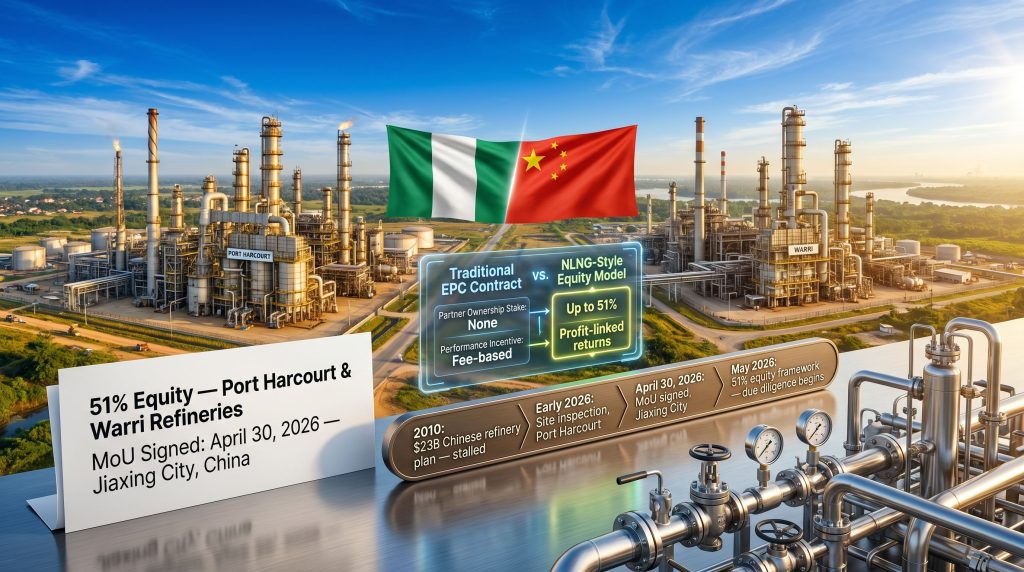
| Feature | Traditional EPC Contract | Proposed NLNG-Style Equity Model |
|---|---|---|
| Partner Ownership Stake | None | Up to 51% |
| Risk Exposure | Construction risk only | Shared operational and financial risk |
| Governance Role | None | Active co-governance |
| Performance Incentive | Fee-based completion | Profit-linked returns |
| Long-Term Commitment | Project duration only | Multi-decade operational horizon |
| Scope | Rehabilitation only | Rehabilitation + expansion + petrochemicals |
The April 2026 MoU: What Was Agreed and What Remains Open
On April 30, 2026, NNPC Group CEO Bayo Ojulari travelled to Jiaxing City, China, where he signed a Memorandum of Understanding with representatives of two Chinese firms: Sanjiang Chemical Company Limited, represented by Chairman Guan Jianzhong, and Xinganchen (Fuzhou) Industrial Park Operation and Management Co., Ltd., represented by Chairman Bill Bi. CNBC Africa reported on NNPC's CEO confirming the active nature of these discussions.
The agreement was formally characterised as a potential technical equity partnership, and the language is deliberately precise. According to reporting by Business Insider Africa, the discussions encompass far more than standard rehabilitation work. The proposed scope includes:
- Refinery operations and maintenance services focused on efficiency, reliability, and safety standards
- Capacity expansion to bring both facilities closer to nameplate throughput
- Yield optimisation to improve the value extracted from each barrel of crude processed
- Petrochemical integration, potentially transforming the refinery sites into broader industrial complexes
- Gas-based industrial project development around the refinery complexes
- Compliance upgrades to meet cleaner fuel standards
Under the framework under discussion, the Chinese partners could acquire up to 51% equity in both the Port Harcourt and Warri refineries, creating a majority ownership position that would give them co-governance rights and direct financial exposure to performance outcomes.
It is critical to note that the MoU is explicitly non-binding. No equity transfer, capital commitment, or binding commercial agreement has been executed. The agreement establishes a structured framework for negotiation, subject to comprehensive technical, financial, operational, legal, and regulatory due diligence. Readers should treat current reporting as reflecting early-stage intent, not a completed transaction.
Important Disclaimer: Investment decisions should not be made based on MoU announcements or pre-due-diligence reporting. The commercial, regulatory, and technical pathway from a signed MoU to an operational equity partnership in Nigeria's downstream sector is lengthy, complex, and carries meaningful execution risk.
China's Refinery Ambitions in Nigeria: A Longer History Than Most Realise
The current negotiations do not represent China's first attempt to establish a major refinery presence in Nigeria. In 2010, a consortium backed by Chinese financial institutions, including support from SINOSURE (China Export and Credit Insurance Corporation), announced plans to finance the construction of three new oil refineries and one petrochemical complex across Nigeria. The combined estimated value of that initiative was approximately $23 billion, making it one of the largest announced energy infrastructure commitments in sub-Saharan African history at that time.
The project never advanced to implementation. It stalled, was placed on hold, and was ultimately never executed, leaving behind a cautionary tale about the gap between announcement and delivery. OilPrice.com has documented how Nigeria has repeatedly squandered billions on refinery overhauls, further colouring how observers assess any new Chinese energy commitment in the country.
Timeline: Key Moments in Chinese Refinery Engagement with Nigeria
| Year | Development |
|---|---|
| 2010 | Chinese bank consortium and SINOSURE back plans for three refineries and one petrochemical complex (~$23B) — project stalls and is never built |
| Early 2026 | Chinese investor delegations visit Port Harcourt refinery for site inspections; NNPC enters active discussions |
| April 30, 2026 | NNPC signs MoU with Sanjiang Chemical and Xinganchen in Jiaxing City, China |
| May 2026 | Reports emerge of proposed 51% equity stake structure modelled on NLNG framework; due diligence phase begins |
The shift from 2010's greenfield ambitions to 2026's brownfield equity approach is analytically significant. Greenfield refinery construction in Nigeria requires site acquisition, environmental approvals, community engagement, utility infrastructure, and a multi-year construction timeline before a single barrel is processed. A brownfield equity play in an existing, if underperforming, facility offers a faster route to operational revenue, clearer asset valuation, and established regulatory standing.
This transition from large-scale construction promises to rehabilitation and co-ownership positions Chinese investors in Nigeria refineries as pragmatic industrial partners rather than infrastructure financiers — a subtle but strategically important rebranding of the relationship.
Why a 51% Stake Changes Everything: Geopolitical and Economic Dimensions
Majority foreign equity ownership in state-owned refinery assets crosses a threshold that purely contractual arrangements do not. Furthermore, the broader geopolitical investment landscape for African energy infrastructure means that for Nigeria, this raises questions that go well beyond operational efficiency:
-
Sovereignty considerations: Strategic national infrastructure, particularly in the energy sector, has historically been viewed as a domain where state control is politically and economically vital in resource-rich nations. Ceding majority control to foreign investors, even under a profit-sharing framework, is a politically sensitive move that will require careful legislative and public handling.
-
Supply chain integration: A Chinese majority stake in Port Harcourt and Warri could gradually embed these facilities within Chinese industrial procurement networks, influencing decisions on catalyst sourcing, spare parts supply, technology upgrades, and technical staffing.
-
Petrochemical development potential: The inclusion of petrochemical integration in the proposed scope is arguably the most economically transformative element of the entire discussion. A refinery complex anchoring downstream petrochemical production could create industrial employment, reduce gas flaring, and generate manufactured export value — a qualitative shift in Nigeria's economic relationship with its own hydrocarbon resources.
-
Precedent effect: A successfully executed majority Chinese equity stake in two of Nigeria's flagship refineries would set a template that other African oil producers are likely to examine closely, particularly those facing similar refinery underperformance challenges.
The Fuel Import Dependency: Nigeria's Macroeconomic Pressure Point
The strategic logic behind pursuing this deal is, at its core, a currency and fiscal stability argument. Nigeria currently imports the overwhelming majority of its refined petroleum products despite being Africa's leading crude oil producer. This creates a perpetual foreign exchange drain, as dollar-denominated fuel import payments flow out of the Nigerian economy while domestically earned naira provides inadequate offset.
Restoring the Port Harcourt and Warri refineries to meaningful operational capacity, particularly toward their combined nameplate contribution to the 445,000 barrels per day system total, would materially reduce import volumes. For a country that has faced significant naira depreciation and currency volatility in recent years, this is not merely an energy policy objective. It is a macroeconomic stabilisation priority. In addition, a coherent energy trade strategy at the national level could help Nigeria align its downstream ambitions with longer-term export diversification goals.
The next major ASX story will hit our subscribers first
Industry Perspectives on the Equity Model
Clement Isong, Executive Secretary of the Major Energies Marketers Association of Nigeria, has articulated the core logic of the equity model in terms that resonate across the industry. According to reporting by Business Insider Africa, Isong argues that the critical distinction in the proposed arrangement is the transformation of the Chinese partner from a fee-earning service provider into a co-owner with direct financial exposure to whether the refinery generates returns.
Under that structure, every inefficiency, every unplanned shutdown, and every barrel of lost throughput costs the equity partner money, creating a fundamentally different operational calculus than any contractor arrangement can replicate.
This analysis aligns with broader thinking in development economics about the role of incentive alignment in infrastructure privatisation and public-private partnerships. The literature consistently identifies equity participation as a stronger predictor of long-term operational commitment than contractual performance clauses.
Questions That Remain Unanswered
Despite the compelling structural logic, several unresolved issues deserve analytical attention:
-
Firm capability verification: Sanjiang Chemical and Xinganchen are not globally recognised names in large-scale refinery operations. Due diligence will need to establish whether these firms possess the technical depth, operational track record, and financial capacity to manage facilities of the complexity and scale of Port Harcourt and Warri.
-
Regulatory pathway: Nigeria's Petroleum Industry Act (PIA), enacted in 2021, substantially restructured the regulatory framework for the downstream sector. Any equity transfer in a state-owned refinery will require engagement with the Nigerian Midstream and Downstream Petroleum Regulatory Authority (NMDPRA), alongside legislative scrutiny.
-
Community and stakeholder dimensions: The Niger Delta communities surrounding these refinery sites have complex, often fraught relationships with energy infrastructure operators. Community acceptance is a practical prerequisite for uninterrupted operations, not merely a procedural step.
-
Credibility deficit: Nigeria's history of high-profile refinery announcements that have not translated into operational improvements creates a reasonable basis for scepticism. The 2010 Chinese $23 billion commitment stands as the most prominent example, but the list of incomplete or underdelivered rehabilitation programmes is long.
The Path from MoU to Operating Partnership
For the proposed deal to advance from signed statement of intent to functioning equity partnership, a structured sequence of steps must be completed successfully:
- Technical site assessments at both Port Harcourt and Warri to establish current physical condition, remaining useful life of equipment, and the engineering scope required for full rehabilitation
- Asset valuation and equity pricing to establish a commercially agreed basis for the 51% stake transfer
- Capital expenditure modelling covering rehabilitation costs, capacity expansion investment, and petrochemical integration requirements under multiple operational scenarios
- Regulatory submissions and approvals under the PIA framework, including NMDPRA licensing and any required National Assembly engagement on foreign ownership thresholds
- Binding legal documentation converting the MoU into a Shareholders' Agreement or Joint Venture Agreement with enforceable governance, profit-sharing, and performance benchmark provisions
- Community and environmental consultation processes required under Nigerian law and international best practice
- First capital deployment and commencement of rehabilitation works under the new ownership structure
Each of these steps carries its own timeline, cost, and risk of delay or failure. The conversion rate from signed MoU to executed joint venture in African downstream energy is historically low, which makes Scenario C — the scenario where negotiations ultimately collapse — a non-trivial probability.
Three Scenarios for Nigeria's Refining Future
Scenario A: Full Implementation
Chinese investors in Nigeria refineries acquire the 51% equity stake, rehabilitation is completed at both facilities, and Port Harcourt and Warri reach sustained operational throughput approaching nameplate capacity. Nigeria's fuel import dependency declines, foreign exchange pressure eases, and the petrochemical integration component creates new industrial activity and employment.
Scenario B: Partial or Restructured Outcome
Due diligence reveals complications — whether technical, financial, or regulatory — that require scaling back the initial terms. A reduced equity position is negotiated, or only one refinery proceeds under the new framework. Progress is made, but falls short of the transformative scenario envisioned.
Scenario C: Negotiation Failure
Technical assessments, valuation disagreements, regulatory hurdles, or political opposition to majority foreign ownership of strategic national assets prove insurmountable. The MoU expires without conversion to a binding agreement, and Nigeria returns to the search for alternative partners, extending the pattern of announced-but-unimplemented refinery deals.
The structural logic of the equity model is sound. Whether the specific firms, regulatory environment, and political conditions in Nigeria in 2026 are sufficient to translate that logic into operational reality is the open question on which everything else depends.
China's Broader African Energy Footprint: How Nigeria Fits the Pattern
Chinese engagement with African energy infrastructure has evolved considerably since the early 2000s, moving through several distinct phases and investment models. Understanding where the Nigeria refinery proposal sits within this broader trajectory adds important context.
| Investment Model | African Examples | Chinese Control Level | Risk Profile |
|---|---|---|---|
| Greenfield refinery construction | Angola, Sudan | Moderate (EPC contractor) | High (development risk) |
| Infrastructure-for-resources financing | DRC, Zambia | Low (creditor) | Medium (credit risk) |
| Equity joint venture in existing asset | Nigeria (proposed) | High (51% majority) | Lower (brownfield) |
| State-to-state crude offtake agreements | Angola, Chad | None (buyer only) | Low |
The Nigeria proposal is relatively unusual in the African context because it combines majority operational control with direct equity exposure in an existing state-owned asset rather than a newly constructed one. This brownfield equity model carries lower development risk than greenfield construction, offers clearer near-term revenue pathways, and allows Chinese firms to leverage their operational expertise in an asset that already has regulatory status, site infrastructure, and an established crude supply relationship.
If the deal progresses, it would represent one of the deepest insertions of Chinese industrial influence into Africa's largest oil economy, with implications extending well beyond refinery throughput statistics into the broader geopolitical competition for influence over Africa's strategic energy infrastructure.
FAQs: Chinese Investors and Nigeria's Refineries
Which refineries are at the centre of the proposed partnership?
The discussions focus on the Port Harcourt and Warri refineries, two of Nigeria's most strategically significant downstream facilities, both of which have undergone multiple rehabilitation programmes without achieving sustained operational recovery.
Which Chinese firms signed the MoU with NNPC?
Sanjiang Chemical Company Limited and Xinganchen (Fuzhou) Industrial Park Operation and Management Co., Ltd. formalised the agreement with NNPC in Jiaxing City, China, on April 30, 2026.
Is the deal confirmed?
No. The MoU is explicitly non-binding and subject to comprehensive due diligence across technical, financial, legal, and regulatory dimensions. No equity transfer or binding commercial agreement has been executed as of the time of reporting.
What equity stake is being proposed for the Chinese partners?
The framework under discussion envisions Chinese investors in Nigeria refineries acquiring up to 51% of the equity in the Port Harcourt and Warri refineries, conferring majority ownership and co-governance rights.
Why is equity ownership considered a better model than a rehabilitation contract?
An equity partner's financial returns are directly tied to whether the refinery operates efficiently and profitably. This creates continuous, unavoidable incentive alignment that fee-based contractor arrangements cannot replicate, since contractors are paid for completing construction tasks rather than for ensuring long-term operational performance.
Has China previously attempted refinery investments in Nigeria?
Yes. A Chinese-backed consortium announced plans in 2010 to finance three new refineries and a petrochemical complex valued at approximately $23 billion. That project stalled and was never implemented, making it one of the largest unrealised energy infrastructure commitments in sub-Saharan African history.
Want To Invest in the Next Major Resource Discovery Before the Market Does?
Discovery Alert's proprietary Discovery IQ model delivers real-time alerts on significant ASX mineral discoveries, turning complex resource data into actionable investment insights for both short-term traders and long-term investors — explore historic discovery returns to understand just how transformative early positioning can be, then start your 14-day free trial at Discovery Alert to gain an immediate market edge.