May 22, 2026
The Economics of Ore Transformation: Why Refining Beats Exporting
Few dynamics in the global mining sector are as economically stark as the value gap between raw ore and processed output. For decades, resource-rich nations across West Africa shipped raw bauxite to foreign refineries, capturing only a fraction of the metal's eventual worth. Today, that model is fracturing. As Chinese aluminium producers race to lock in upstream security and host nations demand industrial participation, a new refinery-driven paradigm is taking hold, and nowhere is this more visible than in Guinea.
The Chalco Guinea alumina project represents one of the most structurally significant downstream investments currently taking shape in West African resources. Understanding its mechanics, ownership architecture, and long-term implications requires stepping beyond the headline announcement and into the industrial logic that makes this deal strategically compelling for all parties involved.
When big ASX news breaks, our subscribers know first
Guinea's Bauxite Endowment: The Geological Foundation
Guinea's geological fortune is almost without parallel in the bauxite world. The country holds an estimated one-third of all known global bauxite reserves, a concentration that makes it the single most important node in the entire aluminium supply chain's raw material base. The provinces of Boffa and Boké are at the heart of this endowment, hosting thick lateritic bauxite deposits with favourable alumina-to-silica ratios that make them particularly suited to the Bayer refining process. Furthermore, among the bauxite production leaders, Guinea consistently stands out as a tier-one jurisdiction with unmatched reserve depth.
The Bayer Process and Why Ore Quality Matters
The Bayer Process, which is the dominant industrial method for refining bauxite into alumina, works by dissolving aluminium oxide from crushed bauxite using hot caustic soda under pressure. The efficiency of this process is heavily influenced by the reactive silica content of the ore. Deposits with low reactive silica, such as those found in Guinea's lateritic geology, require less caustic soda per tonne of alumina produced, materially reducing operating costs.
This is not a minor detail. Caustic soda can represent 15 to 25 percent of total refinery operating costs, and Guinea's ore quality directly improves that equation versus higher-silica deposits found elsewhere. For investors and producers evaluating long-run refinery economics, Guinea's geology is a structural cost advantage, not just a reserve volume story.
Infrastructure Access in the Boffa and Boké Provinces
Export infrastructure connecting Guinea's interior reserves to global shipping lanes has improved meaningfully. Guinea Alumina Corporation shipped its first bauxite cargo from the Boké region in 2019, establishing a logistics baseline that the Chalco Guinea alumina project can build upon. The Port of Kamsar and newer purpose-built jetty infrastructure have expanded throughput capacity, though alumina export requires different handling equipment than raw bauxite, meaning port upgrades remain a necessary capital expenditure before first alumina output can reach international buyers. Indeed, the largest bauxite mines operating in this region have already demonstrated that the logistical foundations for scaled exports are firmly in place.
How the Chalco Guinea Alumina Project Is Structured
The path to this deal traces through several years of diplomatic and commercial negotiations. A memorandum of understanding between Chalco and Guinea Alumina Corporation was established in March 2023, creating the formal intent to explore alumina refinery cooperation. That intent crystallised into a Framework Agreement formalised in June 2024, progressing feasibility and joint investment planning during a UAE state visit to China. The UAE connection matters because Emirates Global Aluminium, through its subsidiary Guinea Alumina Corporation, holds operational standing in the Boké bauxite system and became a key counterpart in structuring the broader cooperation.
The most recent milestone, the amendment and restart of the Mining Convention with the Guinean government, paves the way for establishing a dedicated Project Company to oversee refinery development and operations.
| Milestone | Date | Significance |
|---|---|---|
| Initial MOU signed between Chalco and GAC | March 2023 | Established intent to explore alumina refinery cooperation |
| Framework Agreement formalised | June 2024 | Progressed feasibility and joint investment planning during UAE state visit to China |
| Mining Convention Amendment and Restart | 2025-2026 | Paved the way for dedicated Project Company formation |
| Shareholder disclosure deadline | August 10, 2026 | Formal investor consent process for alumina investment plan |
The Corporate Vehicle: Chalco Energy Holdings
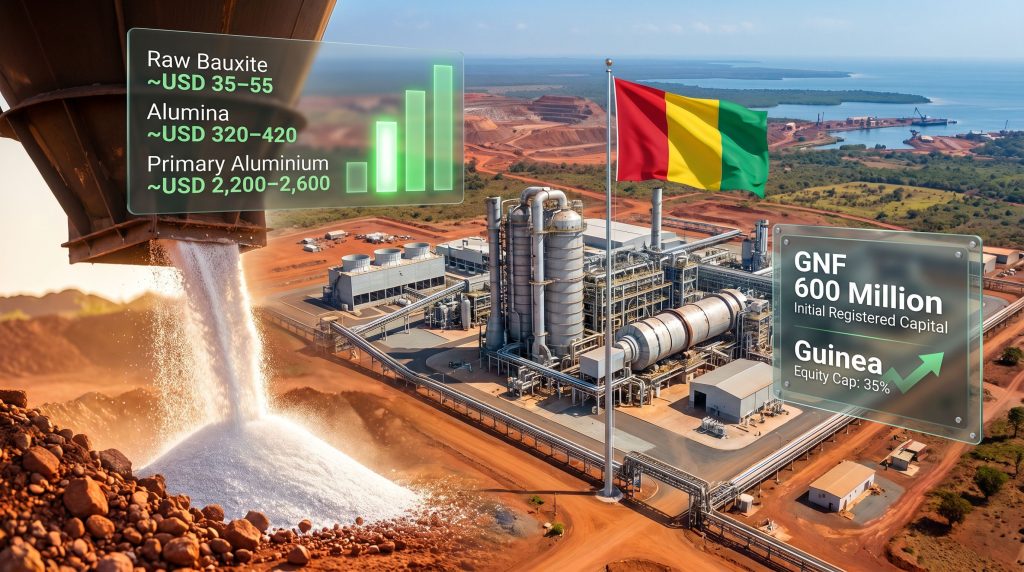
Chalco's Hong Kong-listed unit will establish the Project Company in Guinea through its subsidiary, Chalco Energy Holdings. The proposed initial registered capital for the entity is set at GNF 600 million, which converts to approximately USD 68,200 or RMB 470,900 at the time of the agreement. While that figure appears modest in the context of major infrastructure projects, it represents the formation capital for the project vehicle itself, not the total investment envelope. Chalco has separately outlined a USD 500 million bauxite investment blueprint covering its long-term Guinea ambitions.
Guinea's Equity Stake: Free-Carried Shares and Purchase Rights
The ownership framework contains an important distinction that shapes the long-term risk and return profile for Chalco shareholders. Guinea's government receives two categories of equity participation:
- Free-carried shares, allocated without requiring capital contribution from the state
- Additional equity that the Guinean government may acquire at fair market value, up to a defined ceiling
The combined total of both categories is capped at 35% of the Project Company's total issued shares. If the Guinean government chooses to increase its stake toward or up to that threshold, the transaction qualifies as a major transaction under Hong Kong Stock Exchange listing rules, triggering a requirement for formal shareholder approval at a general meeting. This mechanism protects minority investors and ensures transparency over the extent of state participation in the asset.
The Value-Add Imperative: Why Alumina Refining Changes Guinea's Economy
The economic logic underpinning this project becomes vivid when processing stages are compared directly on a per-tonne value basis:
| Processing Stage | Approximate Value Per Tonne | Value Multiplier vs. Raw Bauxite |
|---|---|---|
| Raw Bauxite | ~USD 35-55 | 1x (baseline) |
| Alumina (Refined) | ~USD 320-420 | ~7-9x |
| Primary Aluminium | ~USD 2,200-2,600 | ~50-60x |
For Guinea, even the step from raw bauxite to refined alumina represents a seven to nine times increase in the value extracted per tonne of ore processed. At scale, this is transformational for government revenue, local employment, and industrial capability. It also explains the consistent pressure Guinea has applied to mining investors to advance downstream processing on Guinean soil rather than simply shipping ore to refineries in China, Australia, or the Middle East.
Regulatory Alignment Through Equity Participation
A less obvious but strategically important dimension of giving Guinea an equity stake in the Project Company is what it does to the operational risk profile of the asset. Large-scale mining infrastructure projects in West Africa have historically faced permit suspensions, contract renegotiations, and nationalisation pressures when host governments feel they are not receiving adequate economic participation.
By embedding Guinea's government as a co-investor, Chalco creates alignment of interest that reduces the probability of disruptive regulatory intervention. This is sometimes referred to in project finance circles as a host government alignment premium, and its value can be substantial over the life of a 25 to 30-year refinery asset.
Granting a host government equity in a resource project is increasingly viewed not as a concession but as a risk management tool. When a government owns a share of the upside, it becomes a partner in ensuring the project succeeds rather than a counterparty seeking to extract maximum short-term royalties.
What a Greenfield Alumina Refinery Actually Requires
The engineering and capital requirements for a new alumina refinery are substantial and often underappreciated by observers focused purely on the reserves story. Key infrastructure requirements for the Chalco Guinea alumina project include:
- Site preparation and water access – Bayer Process refineries are water-intensive, requiring reliable high-volume freshwater supply for digestion and washing circuits
- Energy supply infrastructure – Alumina refining is one of the most thermally intensive industrial processes, with steam generation representing a major portion of operating costs
- Caustic soda logistics – Large volumes of sodium hydroxide must be imported, stored, and handled, requiring dedicated chemical storage and port infrastructure
- Residue management systems – The Bayer Process produces bauxite residue (commonly called red mud) at roughly 1 to 1.5 tonnes per tonne of alumina produced; disposal under Guinean environmental regulations requires engineered storage areas
- Port capacity upgrades – Alumina is typically exported as a dry bulk powder requiring covered storage and different handling equipment than the coarser bauxite ore currently shipped from Boké
Each of these elements represents a capital allocation decision with long lead times, reinforcing why the shareholder approval process running through August 2026 is not merely procedural but materially consequential for the investment case. Consequently, several alumina refinery projects in Guinea are navigating similarly complex infrastructure and regulatory prerequisites before reaching financial close.
China's Alumina Supply Chain Logic: Why Guinea Matters Strategically
China's aluminium smelting industry consumes roughly 60% of global alumina output, making upstream security a structural priority for Chinese producers. The seaborne alumina market, long dominated by Australian exports, underwent a significant disruption in early 2024 when environmental compliance issues at a major Australian refinery constrained supply. Spot alumina prices surged sharply, exposing just how thinly buffered Chinese smelters were against supply disruptions.
Guinea-based alumina refining capacity, developed and owned by Chinese entities, directly reduces this vulnerability. Unlike bauxite ore, which still requires refining before it is smelter-ready, in-country alumina produced at a Guinean facility can be shipped directly to Chinese pot lines, compressing the supply chain and locking in preferential access. In addition, China commodity demand patterns continue to reinforce the strategic rationale for Chinese producers securing refining assets outside their domestic borders.
Benchmarking Chalco Against Peer Investments in West Africa
Chalco is not the first Chinese enterprise to pursue vertical integration in Guinea's aluminium chain. Winning International Group and the Singapore-listed Societe Miniere de Boke have both developed bauxite operations in the region. However, the Chalco Guinea alumina project distinguishes itself by targeting the refining stage rather than stopping at ore extraction, representing a qualitatively different level of value chain integration.
What makes the Chalco structure unique among state-linked mining deals is the combination of a Hong Kong-listed corporate vehicle, a host government equity framework with a defined ceiling, and Hong Kong listing rule compliance mechanisms that impose external discipline on the deal's governance. This is notably more transparent than many bilateral Sino-African resource arrangements, which have historically operated with limited public disclosure. Furthermore, when benchmarked against the top aluminium miners operating globally, Chalco's Guinea strategy reflects a broader industry pivot towards securing refinery-stage assets in high-endowment jurisdictions.
The next major ASX story will hit our subscribers first
Key Risks and What Investors Should Monitor
This section contains forward-looking analysis and should not be construed as financial advice. Investors should conduct independent due diligence.
Several risk vectors deserve attention:
- Ownership dilution: If Guinea exercises its full 35% equity option, Chalco's proportional return on invested capital compresses accordingly. The trade-off is improved operational stability, but the dilution effect is real and should be modelled into valuation frameworks.
- Energy availability: Guinea's power infrastructure remains underdeveloped relative to the thermal demands of a large alumina refinery. Captive power generation would likely be required, adding significantly to capital expenditure.
- Caustic soda price exposure: With no domestic caustic soda production in Guinea, the refinery would be entirely import-dependent for this critical reagent, creating ongoing cost volatility linked to global chemical markets.
- Construction timeline risk: Greenfield alumina refineries in developing markets have a consistent history of cost overruns and schedule delays, typically ranging from 20 to 40 percent above initial estimates.
- Shareholder approval uncertainty: The general meeting process running to the August 10, 2026 disclosure deadline could surface investor concerns about capital allocation, dilution mechanics, or Guinea-specific political risk.
However, it is worth noting that the mining decarbonisation benefits associated with in-country processing, such as reduced long-haul ore transport emissions, may provide Chalco with additional ESG positioning that helps address some shareholder concerns during the approval process.
Frequently Asked Questions: Chalco Guinea Alumina Project
What is the Chalco Guinea alumina project?
The Chalco Guinea alumina project is a planned alumina refinery development in Guinea, West Africa, led by Aluminium Corporation of China through its Hong Kong-listed subsidiary and associated entities, specifically Chalco Energy Holdings. The project is linked to the Boffa bauxite reserves and is being structured through a dedicated Project Company to be established in Guinea.
What equity stake will Guinea hold in the Project Company?
The Guinean government's combined shareholding, through both free-carried shares and any additional equity acquired at fair market value, is capped at a maximum of 35% of the Project Company's total issued shares.
What is the initial registered capital of the Project Company?
The proposed initial registered capital is GNF 600 million, equivalent to approximately USD 68,200 or RMB 470,900 at the time of the agreement.
When will shareholders vote on the alumina investment plan?
Chalco's board intends to seek shareholder approval through a general meeting, with detailed project disclosures expected to be circulated to investors by August 10, 2026.
Why does Guinea's bauxite quality matter for refinery economics?
Guinea's lateritic bauxite deposits carry low reactive silica content, which reduces caustic soda consumption during the Bayer Process. Since caustic soda accounts for 15 to 25 percent of refinery operating costs, ore quality has a direct and material impact on the long-run cost competitiveness of any Guinea-based alumina refinery.
The Structural Shift This Project Signals
The Chalco Guinea alumina project is more than a single corporate investment. It reflects a convergence of three major structural forces reshaping the global aluminium industry:
- A Chinese producer securing upstream refining capacity outside its borders to buffer against supply disruptions and price volatility in the seaborne alumina market
- A West African nation capturing more value from its geological endowment by shifting from raw ore exports to processed output
- A governance framework that embeds host government equity participation to improve project longevity, using capital markets compliance mechanisms to maintain investor transparency
For those tracking critical minerals trade flows, the trajectory is clear. Guinea's role in the global aluminium supply chain is evolving from that of an ore exporter to an alumina producer, and the Chalco Guinea alumina project is among the most concrete expressions of that transition currently underway.
Want to Track the Next Major Mineral Discovery Before the Market Does?
Discovery Alert's proprietary Discovery IQ model delivers real-time alerts on significant ASX mineral discoveries, transforming complex mineral data into clear, actionable insights for both short-term traders and long-term investors — explore the historic returns major discoveries have generated and begin your 14-day free trial today to position yourself ahead of the market.