May 22, 2026
The Minerals That Nations Fight Over: Understanding the Strategic Logic Behind a $2.9 Billion Federal Loan
For most of recorded industrial history, the race to secure critical raw materials has shaped foreign policy, military strategy, and economic architecture far more than is commonly acknowledged. The scramble for rubber in the early twentieth century, petroleum in the mid-century, and rare earth elements in the twenty-first all share a common thread: nations that depend on adversaries for indispensable materials carry a structural vulnerability that no amount of diplomatic goodwill can fully offset. Today, antimony sits at the centre of that same dynamic, and the consequences of that reality are now being measured in billions of dollars of federal capital directed toward a single mountainside in rural Idaho — specifically through the Perpetua Stibnite project loan from US Export-Import Bank.
When big ASX news breaks, our subscribers know first
Antimony's Quietly Critical Role in Defence and Industry
Antimony is not a mineral that attracts casual investor attention. It lacks the cultural cachet of gold, the clean-energy narrative of lithium, and the technological mystique of rare earth elements. Yet antimony's vital uses in modern industrial and defence systems make it indispensable in ways that are poorly understood outside specialist circles.
The metal's core industrial value lies in a set of physical properties that are genuinely difficult to replicate:
- Lead hardening: When alloyed with lead in ratios as low as 1–15%, antimony dramatically increases hardness and reduces creep, making it essential in ammunition manufacturing, particularly for bullet projectiles and armour-piercing rounds.
- Flame retardancy: Antimony trioxide, the most commercially significant antimony compound, acts as a synergist with halogenated flame retardants. It does not function as a standalone fire suppressant but dramatically amplifies the effectiveness of bromine- and chlorine-based systems. This chemistry is embedded in military vehicle upholstery, aircraft components, and electronic circuit boards.
- Semiconductor and infrared applications: Indium antimonide is a narrow-bandgap semiconductor widely used in infrared detectors and night-vision systems, placing antimony at the intersection of two of the most sensitive military technology domains.
- Battery and energy storage research: Emerging research into sodium-ion and lithium-antimony battery configurations suggests a potential future demand vector, though this application remains pre-commercial.
The defence sector's dependence on antimony is therefore multi-layered. It is not simply a single application that could theoretically be substituted but rather a compound dependency embedded across ammunition supply chains, electronic warfare systems, and fire-protection standards for military platforms.
The Import Dependency Problem and China's 2024 Export Controls
Prior to 2024, the United States sourced the overwhelming majority of its antimony from China, which has historically controlled approximately half of global antimony mine production and an even larger share of refined output. Russia has been a secondary source, accounting for a material portion of remaining US imports.
This concentration created a strategic exposure that analysts had flagged for years but that policy responses had been slow to address. Furthermore, the situation changed materially when China introduced formal export restrictions on antimony in the second half of 2024, a move that triggered immediate antimony shortage risks across defence procurement channels.
The restriction followed a pattern that strategic planners had observed before. In 2010, China temporarily curtailed rare earth exports in the context of a territorial dispute with Japan, demonstrating that mineral export controls could be deployed as a geopolitical instrument with limited notice. The antimony restrictions in 2024 reinforced the lesson: commodity dependency on a strategic competitor is not simply a cost consideration but a national security exposure.
Consequently, the antimony price surge that followed China's export controls further underscored the fragility of existing supply arrangements and heightened urgency around domestic alternatives.
"The time between a geopolitical supply shock and its impact on downstream defence manufacturing can be measured in weeks. The time required to develop a new domestic mining operation is measured in years. Bridging that gap requires proactive investment before a crisis, not reactive scrambling after one."
What Is the Stibnite Gold Project and Why Does Its Location Matter?
The Stibnite Mining District in Valley County, Idaho, is not a new discovery. The site has a documented mining history stretching back to the early twentieth century, with significant antimony and tungsten production recorded during both World Wars when domestic military demand was acute. After decades of inactivity, the site was left with legacy contamination issues characteristic of mid-century mining operations, including degraded water quality and disturbed hydrology in the East Fork of the South Fork of the Salmon River.
This history creates both the opportunity and the obligation at the heart of the Perpetua Stibnite project loan from US Export-Import Bank arrangement. Perpetua's development plan is explicitly structured around a dual mandate: responsible extraction of the mineral resource while fulfilling a comprehensive site remediation obligation for the legacy-contaminated district.
Project Snapshot
| Feature | Detail |
|---|---|
| Location | Stibnite Mining District, Valley County, Idaho |
| Primary Commodities | Gold and Antimony |
| Strategic Significance | Only identified domestic antimony reserve in the US |
| Project Developer | Perpetua Resources Corporation (Nasdaq-listed) |
| Total Project Cost | $2.5 billion |
| EXIM Loan Value | $2.9 billion (senior secured, 13-year facility) |
| Upfront Loan Tranche | $2.4 billion |
| Remaining Loan Allocation | Capitalised construction interest and EXIM exposure fee |
The gold component of the project is economically material, functioning as the primary revenue engine that makes the overall project financially viable. Antimony provides a critical minerals premium and the national security justification for federal financing, while gold provides the cash flow profile that debt underwriters require. This dual-commodity structure is strategically clever: it aligns commercial returns with supply-chain security objectives in a way that neither commodity could achieve independently.
The environmental remediation dimension also carries political weight. Redeveloping a legacy industrial site with a built-in restoration commitment is substantially easier to advance through federal and state permitting than opening a greenfield mine in a previously undisturbed landscape. Perpetua's approach frames mining not as environmental damage but as the mechanism through which a damaged environment is repaired, a narrative that has resonated with key stakeholders across Idaho's political spectrum.
The EXIM Financing Structure: From Letter of Interest to $2.9 Billion Commitment
Understanding how the Perpetua Stibnite project loan from US Export-Import Bank actually came together requires familiarity with EXIM's multi-stage underwriting process, which is often mischaracterised in financial media as a single approval event. According to CNBC, the final approval represents the culmination of a multi-year federal assessment and governance process.
Financing Milestone Progression
| Stage | Approximate Year | Value | Binding Status |
|---|---|---|---|
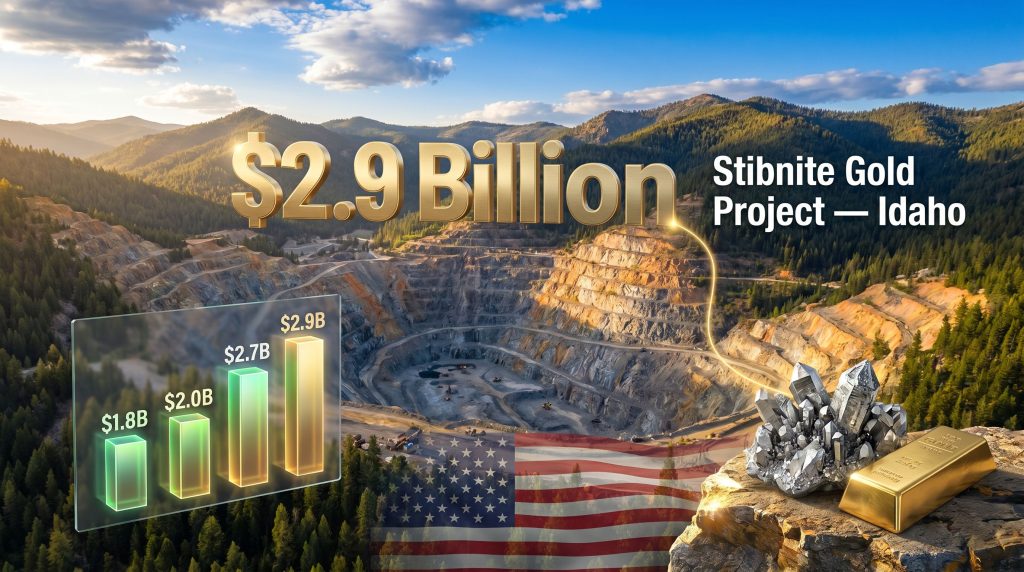
| Non-binding Letter of Interest | 2024 | Up to $1.8 billion | Non-binding |
| Preliminary Project Letter and Indicative Term Sheet | 2025 | Up to $2.0 billion | Non-binding |
| Congressional Notification of Proposed Loan | 2025–2026 | $2.7 billion | Pre-approval governance |
| Final Senior Secured Loan Approval | 2026 | $2.9 billion | Binding commitment |
Each stage in this progression represents a substantively different level of federal commitment:
- Letter of Interest (LOI): An expression of intent to consider financing, contingent on due diligence. Non-binding and issued relatively early in the project assessment cycle. Investors should not interpret an LOI as a financing guarantee.
- Indicative Term Sheet: A more detailed expression of likely financing terms, still non-binding but indicating that EXIM's internal credit analysis has reached a sufficient level of confidence to outline structural parameters.
- Congressional Notification: A legally required governance step for large EXIM transactions. Congress must be notified before final approval is granted, providing a democratic oversight mechanism for significant federal financial commitments.
- Final Loan Approval: The binding commitment. At this stage, EXIM has completed full credit underwriting, environmental and social assessment, and legal documentation review. The loan becomes real.
The progression from $1.8 billion at LOI stage to $2.9 billion at final approval reflects the incorporation of capitalised construction interest and EXIM's exposure fee into the facility total. These are not additional project costs but rather financing costs that accumulate during the multi-year construction period before the project generates revenue.
Why Does the Loan Exceed the Project Cost?
A common point of confusion is why the $2.9 billion EXIM facility exceeds the $2.5 billion stated project cost. The explanation lies in the mechanics of project finance for long-duration construction assets:
- During the construction phase, the project generates no revenue
- Interest accrues on drawn loan balances throughout this period
- Rather than requiring cash interest payments that would drain equity reserves, the interest is capitalised (added to the loan balance)
- EXIM also charges an exposure fee, which is a risk premium for providing the guarantee facility
- These items together account for the approximately $400 million gap between project cost and loan facility size
Loan proceeds will become available upon completion of definitive documentation and satisfaction of conditions precedent, expected in the second half of 2026. Conditions precedent in project finance typically include confirmation of environmental compliance, equity injection verification, execution of key construction and offtake contracts, and insurance arrangements.
The Make More in America Initiative: A Conceptual Shift in EXIM's Mandate
The Export-Import Bank of the United States was originally conceived as an export promotion agency, providing credit support to facilitate the purchase of American goods and services by foreign buyers. The Stibnite financing, however, represents something categorically different: a domestic supply chain security instrument directed at upstream resource extraction.
The Make More in America initiative formalises this expanded mandate, authorising EXIM to deploy capital toward projects where the primary objective is strengthening domestic industrial capacity rather than promoting exports. The programme targets sectors where US industrial competitiveness has been eroded by foreign state-backed competition, with critical minerals production occupying a priority position.
This conceptual shift matters for several reasons:
- It signals that EXIM is being repositioned as a tool of industrial policy rather than purely trade promotion
- It creates a financing instrument for upstream mining projects that historically lacked access to long-duration government-backed debt
- It establishes a precedent for federal credit support of projects that serve defence supply chain objectives regardless of whether they involve export activity
The Stibnite loan does not exist in isolation. It connects to a broader architecture of federal industrial policy instruments that includes Title XVII loan guarantees from the Department of Energy, Defence Production Act funding from the Department of Defence, and production and investment tax credits under the Inflation Reduction Act.
US Federal Financing Instruments for Critical Minerals
| Instrument | Agency | Primary Focus | Mechanism |
|---|---|---|---|
| Make More in America | Export-Import Bank | Domestic supply chains | Senior secured loans |
| Title XVII Loan Guarantees | Department of Energy | Clean energy minerals | Loan guarantees |
| Defence Production Act Funds | Department of Defence | Military-critical minerals | Grants and offtake support |
| IRA Tax Credits | Treasury/IRS | Clean energy manufacturing | Production and investment credits |
The next major ASX story will hit our subscribers first
Execution Risk: The Gap Between Financing Close and First Production
Securing a $2.9 billion loan commitment is a significant milestone. However, investors and observers who conflate financing close with operational commencement misunderstand the risk profile of large-scale mining development.
The path from definitive documentation to first production involves substantial execution risk across several dimensions:
- Construction cost inflation: Large-scale mining construction in remote locations is exposed to labour, materials, and logistics cost volatility that even robust feasibility studies cannot fully anticipate
- Contractor availability: Valley County, Idaho, is a rural region with limited existing industrial infrastructure, requiring mobilisation of significant external workforce and equipment
- Environmental monitoring obligations: The site's legacy contamination history and Perpetua's remediation commitments create ongoing regulatory compliance obligations throughout construction
- Equipment procurement lead times: Long-lead items for processing infrastructure carry multi-year procurement timelines that must be managed carefully against overall project scheduling
The construction period is a multi-year undertaking, with capitalised interest arrangements built into the loan structure specifically to manage cash flow during this phase. First production targets will be confirmed upon financial close.
Idaho Senator Mike Crapo has noted that EXIM's investment in Perpetua advances a reliable domestic supply of critical minerals essential to manufacturing and defence, while helping to reduce dependence on foreign adversaries and supporting American workers. Bipartisan congressional support from Idaho's delegation signals a degree of political durability that insulates the project from single-administration policy risk, an important consideration for a development timeline that will span multiple electoral cycles.
Global Precedents and the Emerging Architecture of Mineral Sovereignty
The United States is not acting alone in deploying state-backed financing for upstream critical mineral projects. Across G7 nations, the recognition that private capital markets systematically under-invest in long-duration, capital-intensive mining projects has driven the development of sovereign financing instruments. For instance, a strategic antimony loan of this scale reflects an accelerating global trend toward resource sovereignty financing.
- Canada's Critical Minerals Strategy allocates federal financing through the Canada Infrastructure Bank and Export Development Canada for domestic and allied-nation resource projects
- Australia's Critical Minerals Facility through Export Finance Australia provides concessional loans to projects producing minerals on the national critical minerals list
- Japan's JOGMEC model has for decades used state-backed equity, debt, and risk guarantees to secure overseas resource supply chains aligned with Japanese industrial needs
The Stibnite EXIM loan may represent something beyond a one-off intervention. Mining Technology reports that if the facility performs as structured and the project reaches production, it establishes an institutional template and a precedent for congressional appetite that could be replicated across other critical mineral projects where private capital has proven insufficient. The broader implication is a structural shift in how the United States finances resource security: not through stockpiles and import diversification alone, but through the patient, long-duration capital commitments that domestic mine development actually requires.
Frequently Asked Questions: Perpetua Stibnite Project EXIM Loan
What is the total value of the EXIM loan for the Stibnite project?
The US Export-Import Bank approved a $2.9 billion senior secured long-term loan for the Perpetua Stibnite project loan from US Export-Import Bank facility covering Perpetua Resources' Stibnite Gold Project in Idaho. The facility consists of a $2.4 billion upfront tranche, with the remainder allocated to cover capitalised interest during construction and EXIM's exposure fee.
Does the EXIM loan fully fund the Stibnite project?
Yes. The $2.9 billion EXIM facility, combined with Perpetua Resources' existing cash holdings, is structured to fully cover the project's $2.5 billion total development cost.
When will the EXIM loan funds become available to Perpetua Resources?
Loan proceeds will be released upon completion of definitive documentation and satisfaction of conditions precedent, anticipated to occur in the second half of 2026.
Why is the federal government financing a private mining project?
The Stibnite project hosts the only identified domestic reserve of antimony in the United States, a mineral classified as critical to national security due to its role in defence manufacturing, ammunition production, and flame-retardant materials. EXIM's Make More in America initiative authorises the bank to support domestic supply chain projects with strategic national security relevance.
What is the loan term for the EXIM Stibnite facility?
The facility is structured as a 13-year senior secured credit agreement.
Is antimony the only reason the project received federal financing at this scale?
Antimony's status as the sole domestic US reserve and its classification as a critical defence mineral was the central strategic justification for federal financing. However, the project's gold production component provides the commercial revenue profile that supports the debt service structure, making both commodities integral to the overall financing logic.
Disclaimer: This article is for informational purposes only and does not constitute financial advice or an investment recommendation. Forward-looking statements regarding project timelines, production targets, and financing outcomes involve material uncertainty. Readers should conduct their own due diligence and consult a qualified financial adviser before making any investment decisions.
Want to Know Which ASX Mineral Discoveries Could Deliver the Next Major Return?
Discovery Alert's proprietary Discovery IQ model scans ASX announcements in real time, instantly identifying significant mineral discoveries — including critical minerals like antimony — and delivering actionable alerts to subscribers ahead of the broader market. Explore historic examples of exceptional discovery returns and begin your 14-day free trial at Discovery Alert to position yourself at the forefront of the next major find.