
May 22, 2026
The Geology Beneath the Ambition: Why Nigeria's Mineral Endowment Has Been Hiding in Plain Sight
Across the African continent, a quiet reordering of economic priorities is underway. Nations that built their fiscal architectures around a single commodity are confronting the structural fragility that monoculture dependence creates, particularly as global energy markets shift and the demand profile for industrial minerals accelerates. Nigeria's experience sits at the sharpest edge of this reckoning. For decades, petroleum revenues shaped everything from public sector wage bills to infrastructure investment patterns, crowding out the geological and regulatory foundations that a competitive mining sector requires. Understanding why Nigeria mining investments shift from oil dependence has gathered momentum requires looking not at recent policy announcements in isolation, but at the deep structural forces that made the status quo untenable.
Nigeria's geological profile is, by any credible assessment, exceptional. The country hosts significant deposits of lithium, gold, iron ore, tin, columbite, baryte, lead, zinc, and coal across its northern and central states. What makes this more remarkable is that Nigeria was once a meaningful mineral exporter before petroleum changed the national economic calculus entirely. Colonial-era railway infrastructure was built specifically to move mineral output from the interior toward coastal ports, a physical legacy that speaks to how commercially viable that extraction once was. The abandonment of this productive base after the oil boom was not inevitable. It was a policy outcome, driven by the gravitational pull of easier petroleum revenues.
When big ASX news breaks, our subscribers know first
The Fiscal Architecture That Mining Reform Must Overcome
The consequences of sustained oil dependence are measurable across every dimension of Nigeria's public finances. Government expenditure became structurally locked into recurrent cost obligations, with fuel subsidy commitments consuming fiscal space that could otherwise have supported infrastructure development, geological survey capacity, or sector diversification incentives. Furthermore, by the period immediately preceding 2023, Nigeria's fiscal position had deteriorated to the point where external borrowing was required to meet public sector wage obligations, leaving negligible room for the capital investment that productive sector development demands.
This matters for understanding the current reform cycle because the mining sector did not simply suffer from neglect. It suffered from the active reallocation of institutional attention, financial resources, and infrastructure investment toward petroleum at every decision point across multiple decades. Rebuilding the foundations of a competitive mining jurisdiction from that base requires more than policy announcements. It requires recapitalising geological knowledge, rebuilding regulatory capacity, and creating the physical infrastructure through which investors can actually operate. Consequently, mining industry consolidation pressures are being felt acutely in this transition period.
Decades of petroleum-centric fiscal policy created a compounding deficit in the institutional and physical prerequisites for competitive mining investment. The absence of credible geoscience data, functioning rail freight, and reliable power supply are not peripheral inconveniences for investors. They are primary determinants of whether a project's economics are viable at all.
What $2.6 Billion in Mining Investment Actually Tells Us
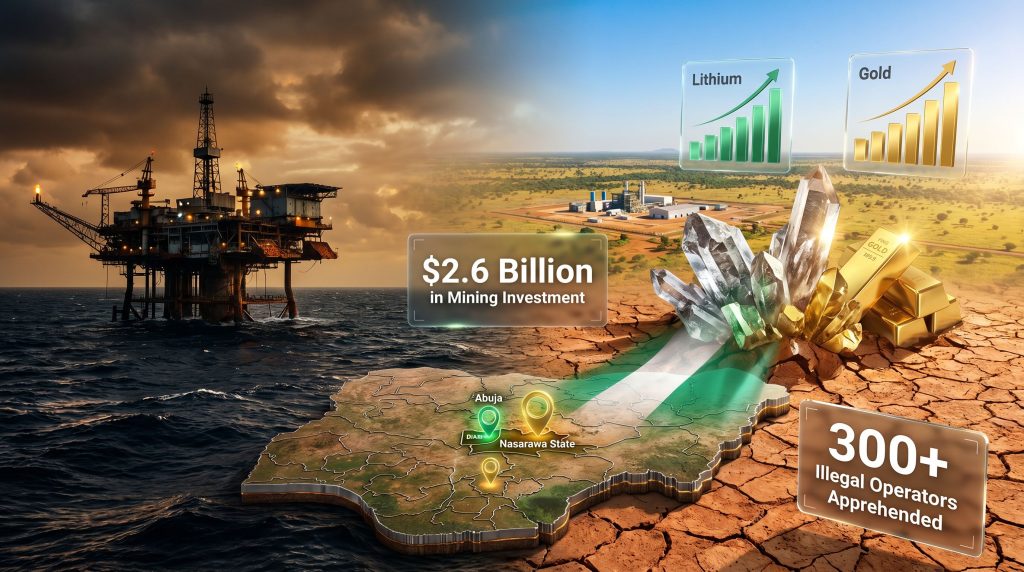
The figure that has drawn significant attention is the more than $2.6 billion in mining-related investment that Nigeria's solid minerals sector attracted over a two-year period. For a sector that had contributed a marginal share of GDP for most of the post-independence era, this represents a meaningful inflection. However, the composition of that investment matters as much as the headline number. According to recent reporting on Nigeria's economic shift, the country is signalling a genuine strategic pivot away from petroleum reliance.
| Investment Commitment | Reported Value | Location | Primary Focus |
|---|---|---|---|
| Lithium processing facility (awaiting commissioning) | $600 million | Nasarawa State | Lithium beneficiation |
| Secondary lithium processing plant | $200 million | Near Abuja | Lithium processing |
| Gold processing infrastructure | Undisclosed | Multiple states | Gold refining |
| Mineral beneficiation facilities | Multiple | Nationwide | Various solid minerals |
Several features of this investment profile are analytically significant:
- The dominant commitments are in processing and beneficiation, not exploration. This is a more advanced signal of investor confidence than greenfield exploration spending, which typically precedes commercial-scale operations by years.
- The concentration of lithium investment in Nasarawa State and the Abuja corridor reflects known deposit geology in north-central Nigeria, where pegmatite formations host the spodumene-bearing mineralisation that is attracting international battery supply chain interest. Indeed, spodumene extraction methods are becoming increasingly central to how Nigeria positions its lithium assets globally.
- The absence of disclosed values for gold processing investment suggests either early-stage commercial sensitivity or that gold sector commitments are fragmented across multiple smaller operators rather than anchored by a single large-scale participant.
- Processing investment creates industrial linkage effects that raw mineral extraction does not. Beneficiation facilities generate engineering employment, logistics demand, and technology transfer opportunities that compound the economic impact beyond the royalty line.
A critical but underappreciated dimension of this investment wave is what it reveals about the global battery supply chain's geographic diversification imperative. Western battery manufacturers and electric vehicle producers are under increasing pressure to reduce concentration risk in their lithium supply chains. The global lithium market remains heavily weighted toward Australian spodumene and Chilean and Argentinian brine operations, with downstream processing concentrated in China. Nigeria's emergence as a lithium processing destination, rather than simply a raw ore exporter, positions it within a supply chain restructuring dynamic that extends far beyond domestic policy reform.
The 2025 Tax Reform Act: Fiscal Integration or Compliance Burden?
The thematic centrepiece of Nigeria's current sector governance effort is the alignment of solid minerals operations with the 2025 Tax Reform Act, framed under the working title of a resource-to-revenue framework. A joint sensitisation meeting convened by the Nigeria Revenue Service and the Ministry of Solid Minerals Development in Abuja, covering the North-Central zone, brought together operators, regulators, and industry participants to build compliance understanding across royalty obligations, environmental standards, and licensing requirements.
The structure of this engagement model is worth examining carefully. Rather than relying solely on enforcement mechanisms, the government has opted for a staged stakeholder consultation approach, conducting regional sensitisation meetings before full compliance requirements take effect. This mirrors successful regulatory integration strategies in more mature mining jurisdictions, where operator buy-in during the transition to new fiscal frameworks has historically produced better revenue outcomes than adversarial enforcement alone.
For foreign investors, the 2025 Tax Reform Act introduces several material considerations:
- Royalty administration alignment: Operators must now integrate royalty payment schedules with the broader Nigerian Revenue Service framework, increasing transparency but also adding compliance cost for smaller operators.
- Environmental standard codification: The Act embeds environmental compliance obligations into the fiscal framework, meaning that failure to meet environmental standards has financial consequences beyond regulatory penalties.
- Licensing and fiscal linkage: The renewal and transfer of mining licences is more explicitly connected to fiscal compliance history under the new framework, reducing the ability of non-compliant operators to maintain active tenements.
- Artisanal and small-scale mining (ASM) formalisation: The Act creates a defined fiscal pathway for ASM operators to enter the formal royalty system, which represents both a revenue opportunity and a governance challenge given the scale of informal sector activity.
Regulatory Watch: The formalisation of artisanal mining sits at the intersection of governance reform and social policy. Nigeria's ASM sector employs hundreds of thousands of people, and any compliance framework that imposes costs without delivering tangible benefits risks driving operators further into informality rather than drawing them into the formal fiscal system. Getting this balance right is arguably more consequential for long-term royalty revenue than any single large-scale investment commitment.
Illegal Mining Enforcement: Reading the Data Correctly
Nigeria's enforcement posture toward illegal mining operations has produced a set of metrics that international investors tend to read as governance signals. More than 300 illegal mining operators, including foreign nationals, have been apprehended under current enforcement activity. Over 150 prosecutions are progressing through the legal system, and more than 100 illegally occupied mining sites have been recovered and returned to licensed operators.
These numbers matter beyond their face value for two reasons. First, they indicate that the legal and regulatory machinery is being actively engaged, which reduces the perception risk that Nigeria's mining governance framework exists only on paper. Second, the presence of foreign nationals among those apprehended points to a structural feature of Nigeria's informal mining ecosystem that receives limited public attention: the role of internationally connected informal networks in artisanal gold and mineral extraction across West Africa.
Similar enforcement challenges have been documented extensively in Ghana, where the galamsey crackdown became a sustained national policy priority, and in the DRC, where informal Chinese-linked operators have been a recurring point of regulatory tension. Nigeria's enforcement data positions the country within a broader African pattern of jurisdictions attempting to assert formal governance authority over sectors where informal extraction has become deeply embedded. For legitimate investors, the enforcement metrics reduce two specific categories of risk: mineral title uncertainty and environmental liability, both of which can directly affect the viability of licensed operations.
Nigeria's Mineral Portfolio in a Continental Competition Context
Nigeria is not pursuing mining diversification in isolation. Across Africa, a competition for international mining capital is intensifying as governments recognise the critical minerals demand driven by the global energy transition.
| Dimension | Nigeria | Ghana | South Africa | Zimbabwe | Egypt |
|---|---|---|---|---|---|
| Primary mineral focus | Lithium, gold, tin, baryte | Gold, bauxite | Platinum, gold, coal | Diamonds, lithium, gold | Gold, phosphates, iron ore |
| Recent investment signal | $2.6bn over two years | Under pressure from lease uncertainty | Mature, constrained growth | Targeting production growth | Advancing sector reform |
| ASM formalisation status | Active reform underway | Ongoing enforcement crackdowns | Limited formal programme | Partial framework | Early development stage |
| Geological data quality | Improving | Moderate | Strong legacy data | Moderate | Improving |
| Key reform instrument | 2025 Tax Reform Act | Minerals Commission framework | MPRDA | Mines and Minerals Act | MRMIA sector development |
Nigeria's competitive differentiators within this landscape include its domestic market scale, its proximity to West African trade corridors, and critically, the strategic value of its lithium geology at a moment when battery supply chain geography is being actively contested between Western industrial policy and Chinese processing dominance. Understanding how lithium mining works at a technical level helps contextualise why Nigeria's pegmatite deposits are drawing such sustained investor interest in the current cycle.
The next major ASX story will hit our subscribers first
Four Structural Barriers That Policy Cannot Resolve Alone
Acknowledging the investment momentum does not require overlooking the constraints that remain material for international operators conducting project-level due diligence. Four barriers stand out as genuinely structural rather than addressable through regulatory reform alone:
- Power supply unreliability: Nigeria's electricity infrastructure imposes significant operational cost penalties on mineral processing facilities, which are energy-intensive by design. A $600 million lithium processing plant operating at reduced capacity utilisation due to power interruptions will not generate the returns that justify the capital commitment.
- Security conditions in mineral-bearing zones: Several of Nigeria's most mineral-rich states in the north and north-central regions intersect with areas of elevated security risk, creating operational continuity risk that international operators must model explicitly in their investment cases.
- Geoscience data depth: Despite stated reform commitments, the publicly accessible geological survey data available to international majors conducting pre-feasibility assessments remains below the standard they routinely work with in more data-rich African jurisdictions like South Africa.
- Federal-state regulatory friction: Mining governance authority in Nigeria is divided between federal and state levels in ways that can create licensing uncertainty, particularly for projects crossing state boundaries or requiring coordinated environmental approvals from multiple jurisdictions.
Scenario Pathways: Where Nigeria's Mining Sector Could Be in a Decade
The trajectory of Nigeria mining investments shift from oil dependence is genuinely uncertain, and investors should resist the temptation to anchor expectations to either the most optimistic or most pessimistic outcomes. Three credible scenarios exist:
Base case: Reform momentum holds. Licensing reform and geoscience investment deliver incremental improvements to the investment environment. Lithium and gold processing facilities reach nameplate capacity, generating export revenue and royalty income. Mining's share of GDP rises meaningfully but modestly, providing a genuine diversification buffer without displacing oil as the dominant revenue source within the decade.
Risk case: Execution gap widens. Policy reform stalls at the announcement stage. Infrastructure constraints prevent processing facilities from operating efficiently. Security conditions in key mineral states deter sustained foreign direct investment flows. Mining remains a secondary fiscal priority as oil revenue volatility continues to dominate budget outcomes.
Upside case: Global commodity cycle accelerates the transition. Rising lithium and gold prices validate processing investment at scale. Nigeria captures a share of battery supply chain investment from manufacturers seeking to reduce DRC and Chinese processing concentration. The 2025 Tax Reform Act generates royalty revenue sufficient to fund reinvestment in geological survey capacity and transport infrastructure. According to analysis of Nigeria's industrial potential, the country's mineral portfolio could genuinely reposition it as a dominant raw materials supplier if execution capacity matches policy ambition.
Investment Lens: The distance between the base case and the risk case will be determined primarily by Nigeria's institutional execution capacity across federal and state jurisdictions, not by the quality of its policy design, which is substantively more coherent in the current cycle than in prior reform attempts. For investors, this means that project-level risk assessment must weight regulatory consistency and infrastructure access at least as heavily as deposit geology and commodity price assumptions.
Frequently Asked Questions: Nigeria Mining Investments and Economic Diversification
What minerals are attracting the most investment in Nigeria?
Lithium and gold are currently the primary drivers of new capital commitments, with lithium processing facilities in Nasarawa State and near Abuja representing the largest individual investments. Tin, baryte, lead, and zinc also form part of Nigeria's broader solid minerals portfolio with established geological precedent.
How significant is $2.6 billion relative to Nigeria's broader economy?
The figure represents a notable acceleration for a sector that contributed a marginal share of GDP for most of the post-independence era. It does not yet rival petroleum's dominance in government revenue or foreign exchange earnings, but the processing-focused nature of recent commitments suggests the investment base is becoming more durable.
What is the 2025 Tax Reform Act's practical effect on mining operators?
The Act integrates royalty and tax administration for solid minerals into Nigeria's formal fiscal framework, requiring operators to align licensing, royalty payments, and environmental compliance with updated obligations. It is designed to increase government revenue from mining while improving transparency and reducing the informality that has historically characterised significant portions of the sector.
Why does Nigeria oppose raw mineral exports?
The government's policy position holds that exporting unprocessed ore generates substantially lower economic returns than domestic beneficiation. Processing creates industrial employment, builds downstream manufacturing capacity, and captures greater value per tonne extracted. The policy also reflects a broader African trend toward resource nationalism and value chain integration.
What are the primary risks for international investors in Nigerian mining?
Power supply unreliability, security conditions in certain mineral-bearing zones, limited depth of publicly accessible geoscience data, and inconsistent regulatory enforcement across federal and state jurisdictions are the most material risk factors for international operators evaluating Nigeria mining investments shift from oil dependence as a long-term strategic opportunity.
Want to Track the Next Major Mineral Discovery Before the Market Does?
Discovery Alert's proprietary Discovery IQ model delivers real-time alerts on significant ASX mineral discoveries — turning complex mineral data into actionable insights for investors at every level. Explore historic examples of major discovery returns and begin your 14-day free trial today to position yourself ahead of the market.