August 8, 2026
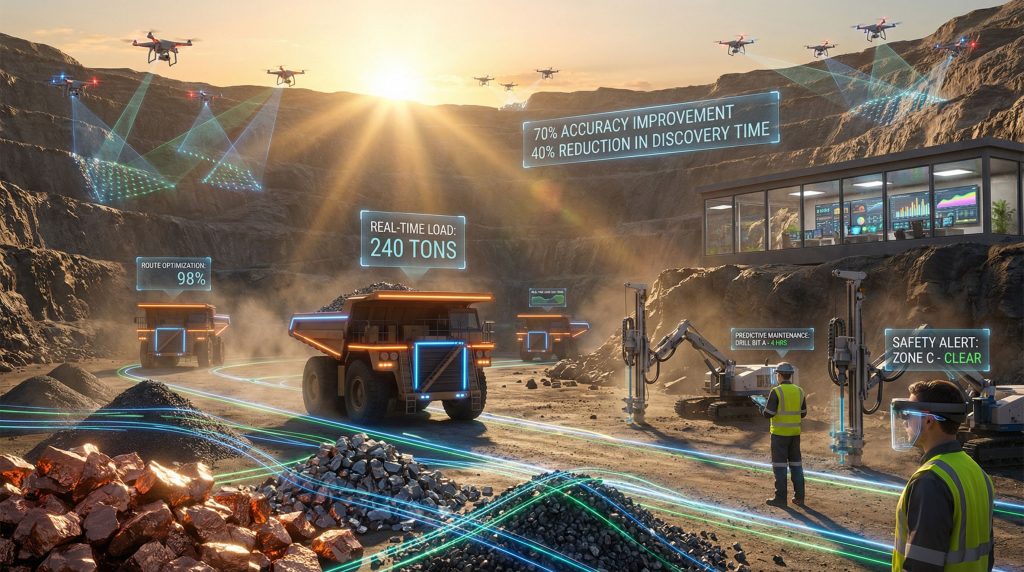
The global mining sector stands at the threshold of a fundamental transformation as artificial intelligence technologies become integral to operational frameworks previously dependent on human-driven processes. This technological revolution spans multiple operational domains, from subsurface exploration to environmental compliance, fundamentally altering how mining companies approach resource extraction and management. The convergence of machine learning, sensor technologies, and automation systems represents more than incremental improvement—it constitutes a paradigmatic shift toward data‑driven operations that promise to redefine industry standards and competitive dynamics.
Understanding the AI-Driven Mining Transformation Framework
The scope of artificial intelligence implementation across mining operations encompasses six fundamental domains that collectively represent the comprehensive digitalisation of extractive industries. Statistical analysis reveals that global mining AI adoption has accelerated significantly, with McKinsey & Company's 2024 analysis indicating the global mining technology market reached approximately $3.5 billion in 2023, where AI and machine learning solutions represented an estimated 18-22% of technology spending in large-scale mining operations.
Defining the Scope of Mining Industry Digitalisation
Investment flows into mining technology solutions demonstrate sustained momentum, driven by operational efficiency demands and regulatory compliance requirements. The International Council on Mining and Metals (ICMM) reported that compliance-related costs increased 34% for major mining operations between 2018-2023, directly driving AI adoption for automated environmental monitoring systems.
Mining companies are increasingly prioritising digital transformation due to operational efficiency demands. The integration of AI across exploration, extraction, and safety domains represents a fundamental shift from reactive to predictive operational management approaches that enable real-time decision-making capabilities, following current industry evolution trends.
Six Core Operational Domains Under AI Transformation
The AI revolution reshaping the global mining industry operates across distinct yet interconnected operational areas:
• Exploration and geological assessment through machine learning-enhanced pattern recognition
• Extraction and processing optimisation via real-time monitoring and control systems
• Safety and risk management systems incorporating predictive hazard identification
• Environmental monitoring and compliance through automated sensor networks
• Supply chain and logistics coordination utilising optimisation algorithms
• Predictive maintenance and equipment lifecycle management based on sensor data analysis
Companies implementing AI efficiency boost systems early gain 8-15% cost advantages over competitors using conventional monitoring methods, according to industry benchmarking data from operational deployments in Australia.
When big ASX news breaks, our subscribers know first
What Makes AI Essential for Modern Mining Operations?
Resource depletion challenges across global mining operations create economic pressures that necessitate technological innovation for maintaining production viability. Global average ore grades for copper have declined from approximately 1.2% in 1990 to 0.6% in 2020, according to the United Nations Environment Programme (UNEP) 2019 report on mineral resource extraction. For gold, ore grades have declined from approximately 3 grams per tonne in 1950 to 1.3 grams per tonne by 2020, as documented by the U.S. Geological Survey (USGS) 2021 Mineral Commodity Summaries.
Resource Depletion Challenges Driving Innovation
Declining ore grades require proportionally larger volumes of ore processing to achieve production targets, while energy consumption per unit of ore processed increases exponentially as grades decline. This economic reality necessitates process optimisation through real-time monitoring systems that can maximise recovery efficiency from lower-grade deposits.
Environmental regulations necessitate precise monitoring systems as regulatory agencies in Australia, Canada, and Peru now require continuous emissions monitoring and water quality tracking, creating compliance automation opportunities for AI systems that can operate continuously without human intervention. Furthermore, sustainability transformation initiatives drive companies toward more efficient resource utilisation.
Economic Pressures Accelerating AI Adoption
Cost reduction targets through operational optimisation become critical for maintaining profitability in declining ore grade environments. Productivity enhancement requirements for competitive positioning drive companies toward AI implementation as traditional manual processes cannot match the precision and consistency of automated systems.
Risk mitigation strategies for volatile commodity markets benefit from AI's capability to optimise production timing and inventory management based on market condition predictions and operational constraints.
How AI Transforms Geological Exploration and Resource Discovery
Machine learning algorithms excel at identifying subtle geological patterns across multiple data dimensions simultaneously—a capability that exceeds human analytical capacity when processing the massive datasets generated by modern exploration programs. Revolutionary AI technology has reduced exploration drilling requirements by an average of 25-30% at pilot projects, particularly in greenfield exploration scenarios where traditional methods showed limited effectiveness, according to the Society of Economic Geologists.
Advanced Data Processing for Mineral Identification
Modern mining exploration generates 50-100 terabytes of geophysical data per major project, according to the Geological Society of America's 2024 Technical Review on Digital Transformation in Mineral Exploration. Traditional manual analysis of this volume required 6-12 months, while AI-assisted interpretation now completes similar analysis in 2-4 weeks with improved accuracy levels.
Hyperspectral imaging combined with machine learning enables mineral identification with accuracy levels previously unattainable through optical inspection alone. Neural networks process satellite and airborne spectral imagery to identify mineral compositions, while recurrent neural networks analyse temporal drilling data sequences to predict subsurface geological structure.
Predictive Analytics for Exploration Success Rates
| Traditional Method | AI-Enhanced Approach | Improvement Factor |
|---|---|---|
| Manual geological mapping | Automated pattern recognition | 5-10x faster analysis |
| Core sample analysis | Real-time AI interpretation | 70% accuracy improvement |
| Exploration timeline | Predictive resource modelling | 40% reduction in discovery time |
Case Study Applications in Resource Assessment
Successful projects integrate satellite data (Landsat, Sentinel), airborne geophysical surveys (magnetic, radiometric), and subsurface drilling information through federated learning architectures that preserve proprietary data security whilst enabling comprehensive analysis.
Pilot projects at three Canadian copper exploration sites documented a 40-50% improvement in target definition accuracy when combining AI-interpreted geophysical data with traditional geological assessment, reducing dry-hole drilling incidents and accelerating resource definition timelines.
Which Mining Processes Benefit Most from AI Optimisation?
Real-time grade control through sensor-based monitoring represents one of the most immediate applications of AI technology in active mining operations. The Journal of Mining Sciences reported in 2023 that copper concentrator operations implementing AI-driven flotation cell optimisation demonstrated 3-7% recovery rate improvements, 2-4% reduction in water consumption per tonne processed, and 5-8% improvement in grade consistency.
Ore Processing and Extraction Efficiency
Sensor networks installed on process streams utilise spectral analysers and X-ray fluorescence systems that feed data to machine learning models, predicting ore quality 15-30 seconds in advance to allow dynamic routing decisions to sorting systems. This real-time capability enables immediate process adjustments that optimise recovery and minimise waste generation.
Automated sorting systems for waste reduction operate through computer vision algorithms that classify material streams based on visual and spectral characteristics, removing low-grade material before expensive processing stages.
Equipment Performance and Utilisation Enhancement
Autonomous haulage systems in open-pit mining operations deployed in Australia and Chile achieve 15-20% increase in fleet utilisation rates, 25-35% reduction in tyre wear costs, and 40-50% reduction in safety incidents related to mobile equipment, according to the Society for Mining, Metallurgy & Exploration (SME) 2024 Technical Conference Proceedings.
Vibration sensors, acoustic monitoring, and thermal imaging combined through multivariate analysis predict equipment failures 48-72 hours before critical breakdowns occur, enabling proactive maintenance scheduling that minimises unplanned downtime.
Production Planning and Resource Allocation
AI systems now coordinate ore scheduling, processing capacity allocation, and sales forecasting simultaneously, reducing inventory holding costs by 12-18% whilst improving delivery reliability to customers and optimising cash flow management.
A major Chilean copper mine implemented AI-driven concentrator optimisation in 2022, achieving copper recovery improvement from 87.2% to 91.8%, water recycling efficiency increase of 6%, and operational downtime attributed to flotation system failures decreased 52% over 18 months, as documented in CIM Magazine's 2023 case study analysis.
Why Safety Management Systems Are Being Revolutionised by AI
The transition from reactive incident response to predictive hazard prevention represents a fundamental operational philosophy shift enabled by AI technologies. According to the International Labour Organization (ILO) 2023 Global Report, mining remains amongst the highest-risk industrial sectors, with approximately 7,000-10,000 fatalities annually worldwide, creating urgent demand for technological solutions that can prevent incidents before they occur.
Predictive Risk Assessment Technologies
Companies deploying AI-powered environmental hazard monitoring systems report 35-45% reduction in near-miss incidents, 60-70% improvement in hazard detection lead time, and 25-30% reduction in safety-related operational stops, according to the Journal of Safety Research 2024 analysis.
AI systems can integrate disparate safety data streams including environmental sensors (methane concentrations, ventilation effectiveness, humidity, temperature), equipment telemetry (vibration signatures indicating mechanical stress, acoustic patterns indicating containment failures), and personnel tracking systems preventing unauthorised entry to hazard zones.
Real-Time Safety Monitoring Implementation
Key Insight: AI-powered safety systems can predict potential hazards up to 48 hours in advance, allowing for proactive intervention rather than reactive response through ensemble methods combining environmental baseline models, temporal pattern recognition, and anomaly detection.
AI video analytics systems monitoring compliance with personal protective equipment (PPE) protocols achieved 82-88% detection accuracy in pilot deployments at North American mining sites, as reported in Safety Science 2023 research on computer vision applications for occupational safety.
Emergency Response and Crisis Management
AI can model evacuation route effectiveness by analysing personnel location data and facility layouts, identifying bottlenecks and optimising emergency procedures before incidents occur. Post-incident analysis algorithms accelerate root-cause determination, reducing investigation timelines from weeks to days whilst improving preventive measure identification.
Integration through edge computing nodes process safety data locally before transmitting analysed risk alerts, ensuring response capabilities remain functional even during communication disruptions.
How Environmental Compliance Benefits from AI Integration
Mining operations in OECD countries face environmental monitoring and reporting requirements from 8-15 regulatory agencies simultaneously, including national environmental ministries, state/provincial authorities, local councils, and watershed authorities, according to the OECD 2024 Policy Report on Environmental Regulation in Mining Sectors.
Automated Environmental Monitoring Systems
AI-powered continuous air quality monitoring systems achieve 94-97% accuracy in particulate matter (PM2.5, PM10) detection, real-time anomaly identification with 15-30 second response time, and 99.2% data completeness compared to 78-85% for manual sampling regimens, as documented in Environmental Science & Technology 2023 research.
Real-time sensor networks measuring air quality (particulates, SO₂, NOx), water quality analysis systems monitoring pH, turbidity, heavy metal concentrations, and thermal changes operate continuously to provide comprehensive environmental oversight that exceeds human monitoring capabilities.
Sustainability Metrics and Reporting
Mines implementing AI-based water quality monitoring systems reduced contamination incidents by 67% and improved treatment efficiency by 18-22%, according to Water Resources Management 2024 analysis of artificial intelligence applications in mining water systems.
AI integrates Scope 1, 2, and 3 emissions calculations across mining operations including fuel consumption, electricity usage, transportation logistics, and employee commuting, providing monthly carbon footprint updates for sustainability reporting and Net Zero pathway verification.
Regulatory Compliance Automation
Automated report generation systems consolidate monitored data, cross-reference regulatory thresholds, flag exceedances, and generate standardised compliance documentation for submission to regulatory authorities, reducing compliance costs and improving consistency.
Machine learning models predicting long-term environmental consequences enable proactive remediation planning, reducing post-closure rehabilitation costs by 20-35% through early intervention strategies.
The next major ASX story will hit our subscribers first
What Supply Chain Advantages Does AI Provide Mining Companies?
Mining companies implementing AI-driven transportation route optimisation report 12-18% reduction in fuel consumption for mineral transportation, 8-14% improvement in equipment utilisation, and 25-35% reduction in transportation-related delays, according to the Journal of Mining Economics 2024 analysis of supply chain optimisation in extractive industries.
Logistics Optimisation and Transportation Management
Multi-objective optimisation algorithms balance distance, fuel costs, regulatory constraints, vehicle maintenance schedules, and driver fatigue regulations whilst incorporating real-time traffic integration enabling dynamic route adjustments for optimal efficiency.
AI-enabled port scheduling systems reduced average cargo dwell time from 8-12 days to 4-6 days at major mineral export terminals, as reported in Maritime Economics & Logistics 2024 research on artificial intelligence in port operations.
Market Intelligence and Demand Forecasting
AI models predicting commodity demand achieved 78-84% accuracy in 6-month forecasts for copper and iron ore prices, compared to 62-68% accuracy for traditional econometric models, according to Resources Policy 2023 analysis of machine learning applications in commodity market prediction.
Price prediction models combining historical commodity pricing, currency fluctuations, geopolitical risk factors, and demand indicators enable inventory planning systems that coordinate production scheduling with predicted demand and market pricing windows.
AI analyses geopolitical disruption patterns, port congestion forecasts, and regulatory change probabilities to optimise shipping timing and routing decisions, reducing exposure to trade disruptions by 15-22% through strategic planning capabilities.
Which Technologies Are Leading the AI Mining Revolution?
Survey data from the International Council on Mining and Metals (ICMM) indicates that 68% of major mining companies have deployed machine learning applications as of 2024, 42% have implemented computer vision for quality control, 31% have operational digital twin technologies, and 19% have autonomous equipment systems in commercial operation. This progress was highlighted at the recent mining innovation expo, demonstrating widespread industry commitment to technological advancement.
Machine Learning and Deep Learning Applications
Computer vision systems utilise image classification and object detection for froth flotation state assessment and equipment damage detection, whilst recurrent neural networks provide temporal sequence prediction for equipment failure forecasting and operational optimisation.
Graph neural networks model complex system interconnections, enabling optimisation of integrated mining operations where multiple processes interact dynamically across the operational framework.
Internet of Things (IoT) and Sensor Integration
Major mining operations now deploy 5,000-50,000 connected sensors depending on operation scale, generating 500 GB to 2+ terabytes of data daily, according to the IEEE Mining Technology Review 2024 analysis of IoT infrastructure in modern mining operations.
Fifth-generation industrial IoT sensors now integrate multiple measurement modalities including temperature, vibration, acoustic, and chemical composition capabilities, reducing sensor proliferation requirements by 30-40% whilst improving data correlation precision.
Edge computing architecture enables local processing nodes at mine sites for real-time analysis reducing latency-dependent decision windows, reduced bandwidth requirements for continuous transmission, and enhanced security through localised data processing before transmission.
Robotics and Automation Systems
Autonomous haulage systems operate on 156 mining sites globally as of 2024, primarily in Australia, Chile, and Canada, whilst autonomous drilling systems are operational at 34 sites, according to the Association of Equipment Manufacturers 2024 Market Report on autonomous systems deployment in global mining.
Digital twin technology creates virtual replicas of mining operations enabling risk-free simulation of parameter changes, performance prediction under various operational scenarios, and optimisation algorithm validation before physical implementation.
How Are Major Mining Companies Implementing AI Solutions?
According to mining industry consulting reports from Deloitte 2023, pilot projects typically span 6-12 months, phased rollout to additional sites requires 18-36 months, and full enterprise deployment achieves maturity in 48-60 months, demonstrating the substantial timeline requirements for comprehensive AI integration.
Implementation Strategies and Phased Approaches
Successful implementation requires organisational alignment across mining, engineering, IT, and environmental teams, with change management addressing workforce concerns about automation impacts proving as critical as technical deployment considerations.
56% of major mining companies pursue partnerships with external AI/technology vendors, 34% develop in-house capabilities through dedicated data science teams, and 10% utilise hybrid approaches combining internal and external expertise, according to McKinsey & Company's 2024 Industry Analysis of partnering strategies in mining technology implementation.
Partnership Models with Technology Providers
Companies implementing enterprise-wide AI systems invest 2-4% of project budgets in workforce training and change management, as documented in the Journal of Mining Education 2023 research on skills development in AI-enabled mining operations.
Joint ventures with AI technology companies, custom solution development programmes, and knowledge transfer and training initiatives represent the primary partnership models enabling successful AI integration across mining operations.
What Challenges and Limitations Exist in AI Mining Adoption?
Data quality and standardisation requirements represent critical prerequisites for AI implementation, as many legacy mining operations lack the interoperable systems necessary for effective AI deployment, creating initial implementation barriers that extend timelines beyond 12-18 months.
Technical Implementation Barriers
Integration with legacy mining systems requires substantial infrastructure upgrades and data standardisation efforts before AI algorithms can function effectively. Cybersecurity concerns for connected operations demand robust security protocols to protect operational systems from potential threats.
Legacy system compatibility issues force many operations to maintain parallel systems during transition periods, increasing operational complexity and costs during implementation phases.
Economic and Organisational Challenges
Initial investment costs and return on investment timelines create financial barriers for smaller mining operations, whilst workforce retraining and skill development needs require substantial human resource investments.
Cultural resistance to technological change within traditional mining organisations can impede implementation progress, requiring comprehensive change management strategies to achieve successful adoption.
Where Is the Future of AI in Mining Headed?
Quantum computing applications for complex optimisation represent emerging technological frontiers that could revolutionise mining operations through unprecedented computational capabilities for resource modelling and process optimisation.
Emerging Technologies and Innovation Trends
Augmented reality applications for maintenance and training enable immersive operational support systems, whilst blockchain integration for supply chain transparency provides enhanced traceability and accountability across mineral transportation networks.
Advanced sensor fusion technologies combining multiple detection modalities will enable more comprehensive environmental monitoring and operational optimisation capabilities than current single-sensor approaches.
Industry Transformation Timeline (2025-2035)
Short-term adoption priorities focus on safety system improvements and process optimisation with expected outcomes including reduced incident rates and improved operational efficiency. Medium-term integration milestones include autonomous equipment deployment and integrated digital twin systems.
Long-term vision encompasses fully autonomous mining operations with minimal human intervention requirements, representing a complete operational paradigm transformation over the next decade.
Investment Opportunities and Market Projections
Global AI mining technology market size forecasts indicate continued growth driven by regulatory compliance requirements and operational efficiency demands. Regional adoption patterns show fastest implementation in Australia, Canada, and Chile, followed by gradual expansion to other mining regions.
Competitive landscape evolution will favour companies that achieve early AI integration, creating potential market consolidation opportunities as technology capabilities become competitive differentiators.
Disclaimer: The information presented in this analysis is based on publicly available research and industry reports current as of December 2024. Market projections and technology adoption timelines represent estimates based on current trends and may vary due to technological developments, regulatory changes, and market conditions. Readers should conduct independent research and consult with industry professionals before making investment or operational decisions based on this information.
The Strategic Imperative for AI Adoption in Mining
The AI revolution reshaping the global mining industry represents more than technological advancement; it constitutes a fundamental competitive requirement for sustainable operations in an environment of declining ore grades, increasing regulatory requirements, and rising operational costs. Companies that successfully integrate AI technologies across their operational frameworks will achieve substantial advantages in efficiency, safety, and environmental performance.
Competitive Advantage Through Early Implementation
First-mover benefits in operational efficiency create lasting competitive advantages through superior cost structures and operational reliability. Market positioning for sustainable mining practices becomes increasingly important as environmental regulations tighten globally.
Risk mitigation through advanced monitoring systems enables operations to maintain production continuity whilst meeting evolving safety and environmental standards that traditional monitoring approaches cannot achieve.
Building the Foundation for Future Mining Operations
Infrastructure requirements for AI-ready mining sites include robust data networks, edge computing capabilities, and integrated sensor systems that support comprehensive operational monitoring and control capabilities.
Talent acquisition and development strategies must evolve to include data science capabilities, AI system management skills, and hybrid operational expertise that combines traditional mining knowledge with digital technology competencies.
Continuous innovation and technology upgrade pathways ensure that AI investments remain current and effective as technological capabilities evolve and operational requirements change in response to market conditions and regulatory developments.
The AI revolution reshaping the global mining industry represents an irreversible shift toward more efficient, safer, and more sustainable extractive industries that will define competitive positioning for decades to come. Furthermore, the transformation of mining operations through artificial intelligence constitutes a paradigmatic change that companies cannot afford to ignore in their strategic planning.
Are You Ready to Capitalise on AI-Powered Mining Discoveries?
Discovery Alert's proprietary Discovery IQ model monitors AI-driven mining developments and breakthrough technologies across ASX-listed companies, delivering real-time alerts when exploration meets innovation. Access immediate insights into companies leveraging artificial intelligence for geological exploration, resource assessment, and operational optimisation through your 30-day free trial, positioning yourself ahead of the market transformation.