August 5, 2026
The explosive growth in artificial intelligence computing demands has fundamentally altered the trajectory of global energy markets, creating a complex web of infrastructure challenges that stretch far beyond traditional technology sector boundaries. The exponential computational requirements driving modern AI development represent more than incremental growth patterns, instead constituting a paradigm shift that challenges existing power generation, transmission, and grid management frameworks across multiple continents. Furthermore, AI and energy demand continues to evolve as technological capabilities expand and deployment scales reach unprecedented levels.
The Data Center Revolution: Understanding AI's Unprecedented Power Appetite
Quantifying the Energy Explosion Behind Machine Learning
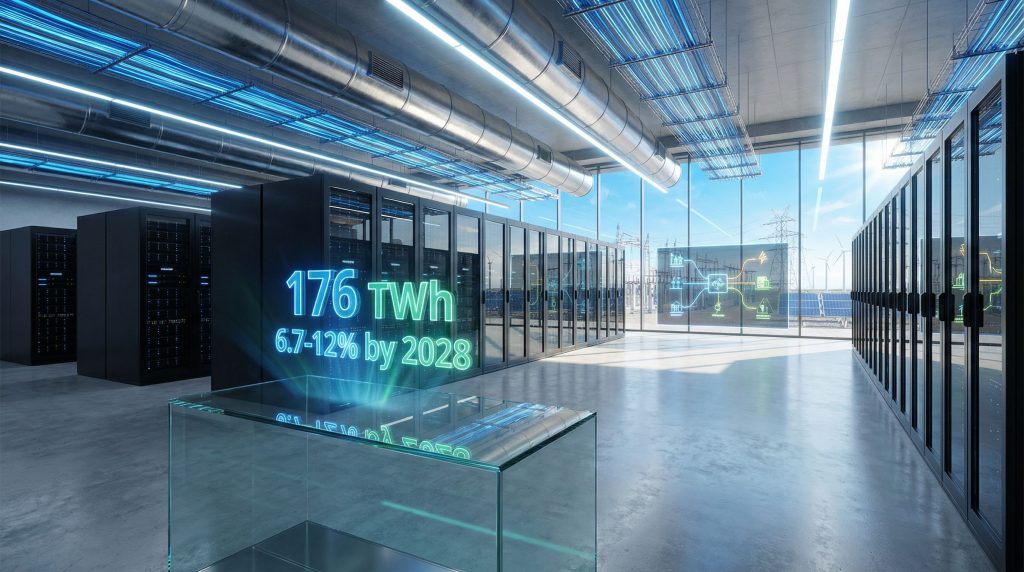
Current baseline measurements indicate that data centers consumed approximately 4% of total U.S. electricity in 2023, according to the U.S. Energy Information Administration. This figure serves as the foundation for projections that anticipate dramatic expansion over the coming decade. Global data center electricity consumption is projected to reach approximately 4-5% of worldwide electricity demand by 2030, based on International Energy Agency analyses and comprehensive industry assessments.
The scale of AI-specific power requirements dwarfs traditional computing applications by several orders of magnitude. Large language model training operations require significantly higher power densities than conventional data center workloads, with research from the University of Massachusetts Amherst demonstrating that training a single large language model can consume 284 megawatt-hours of electricity with corresponding carbon emissions.
| AI Model Category | Power Requirement | Training Duration | Total Energy Consumption |
|---|---|---|---|
| Small Models (<1B parameters) | 5-10 MW | 2-4 weeks | 168-672 MWh |
| Medium Models (1-10B parameters) | 15-35 MW | 4-8 weeks | 1,008-4,704 MWh |
| Large Models (10-100B parameters) | 50-100 MW | 8-16 weeks | 6,720-25,600 MWh |
| Massive Models (>100B parameters) | 100+ MW | 16+ weeks | 25,600+ MWh |
The Economics of Computational Scale
Modern GPU clusters utilising systems such as NVIDIA H100 configurations consume approximately 700W per GPU under full load. Hyperscale training clusters containing thousands of these processors can reach multi-megawatt power consumption profiles that rival small cities in their electrical demands.
The relationship between model training and inference creates persistent energy overhead that extends far beyond initial development phases. According to machine learning research analyses, inference operations can consume 10-50% of training energy depending on model size and query frequency, but occur continuously throughout the model's operational lifetime. This creates sustained baseload demand that fundamentally differs from traditional batch-processing computational workloads.
Training cost analysis reveals staggering energy intensities for cutting-edge AI systems. OpenAI's GPT-3 model training required approximately 1,287 MWh of electricity with corresponding carbon emissions quantified at approximately 552 metric tons of CO2-equivalent, according to public disclosures and academic sustainability research.
When big ASX news breaks, our subscribers know first
What Makes AI Energy Demand Different From Traditional Tech Growth?
Scaling Laws and the Exponential Energy Trap
Neural scaling laws demonstrate that performance improvements in large language models follow power-law relationships where model performance improves proportionally to the logarithm of compute measured in floating-point operations. This mathematical relationship means each doubling of model performance requires substantially more than a doubling of computational resources.
Research on transformer scaling indicates that computational requirements grow approximately as O(n log n) where n represents model parameters, creating super-linear scaling that compounds energy consumption challenges. Analysis from energy consumption studies indicates that AI model training energy requirements have doubled approximately every 3.5-4 months over the past five years, significantly exceeding Moore's Law progression.
Modern AI inference services must maintain constant operational readiness, creating consistent baseload demand that processing one million tokens generates carbon emissions equivalent to driving a gas car between 5-20 miles depending on regional grid carbon intensity.
24/7 Operational Requirements vs. Traditional Computing
Unlike traditional batch-processing data centers that can power down or reduce load during off-peak hours, AI inference services such as ChatGPT, Copilot, and Claude must maintain continuous operational availability. This requirement creates persistent, non-variable demand curves that present unique grid management challenges compared to conventional IT workloads exhibiting significant daily and seasonal variation.
Geographic clustering effects amplify these challenges when multiple large AI data centers concentrate in the same region, creating localised grid stress exceeding 1-2 GW of simultaneous peak demand, equivalent to a small power plant. Data center cooling infrastructure typically requires 0.4-0.6 kWh of energy for every 1.0 kWh of compute power in modern facilities, with high-density GPU deployments pushing this ratio higher to 0.5-0.7:1 due to concentrated heat generation.
Research on language model carbon footprint indicates that processing one million tokens (approximately 200,000 words) generates carbon emissions equivalent to approximately 8-15 kg of CO2-equivalent under typical regional grid mix scenarios. A typical ChatGPT response of approximately 500 tokens under average U.S. grid conditions generates approximately 4-7.5 grams of CO2-equivalent emissions.
Where Is This Energy Coming From? Grid Impact Analysis
Natural Gas Dependency and Regional Strain
According to U.S. Energy Information Administration data and utility regulatory filings, natural gas accounts for approximately 40-45% of U.S. data center electricity generation. Coal comprises approximately 20-25%, nuclear approximately 20%, renewables approximately 10-12%, with other sources comprising the remainder. Regional variation creates significant disparities in energy sourcing patterns across major data center markets.
Data centers in Texas rely more heavily on natural gas at 55-60% due to abundant supply and interconnection availability, whilst facilities in the Pacific Northwest utilise hydroelectric power at 60-70% rates. Current geopolitical tensions have created additional supply chain pressures, with recent analysis indicating Middle East conflicts have reduced global oil supply by 7.4-8.2 million barrels per day.
The cessation of tanker traffic through critical maritime chokepoints has disrupted approximately 20% of global LNG supply, with Qatar's LNG export infrastructure particularly vulnerable because substantially all Qatari LNG originates from the Ras Laffan complex and must transit these waterways to reach international markets. In addition, US natural gas forecast projections indicate significant pricing volatility ahead as global demand patterns continue evolving.
| Region | Natural Gas % | Nuclear % | Renewables % | Coal % |
|---|---|---|---|---|
| Texas | 55-60% | 10-15% | 15-20% | 10-15% |
| Pacific Northwest | 15-20% | 8-12% | 60-70% | 2-5% |
| Northeast | 40-45% | 30-35% | 8-12% | 15-20% |
| Southeast | 35-40% | 25-30% | 5-10% | 25-35% |
The Renewable Energy Transition Challenge
Power Purchase Agreement structures between technology companies and renewable energy developers typically span 15-25 years at fixed price points, providing project financing certainty whilst locking companies into specific price and location parameters. PPA pricing for wind and solar in 2025-2026 ranges from approximately $25-45/MWh depending on resource quality and geographic location.
Technology companies are increasingly implementing co-location strategies, building or securing dedicated interconnection points to solar and wind farms to create on-campus renewable generation. This approach reduces transmission losses, which typically account for approximately 6-8% of long-distance electricity transport, whilst providing localised grid stability benefits.
Regional transmission operators including PJM, ERCOT, and ISO-NE report that requested transmission interconnection queues for large data center projects have grown from approximately 5-10 GW in 2022 to 40-50 GW by 2026, with queue wait times extending from 2-3 years to 4-6 years due to infrastructure constraints. Consequently, critical minerals for energy transition become increasingly vital for supporting this massive infrastructure build-out.
How Are Energy Markets Responding to AI-Driven Demand?
Electricity Price Volatility and Consumer Impact
Industrial electricity rates in data center-heavy regions including Northern Virginia, Iowa, and Texas have increased 8-15% year-over-year according to utility commission filings, specifically attributed to data center demand clustering. Wholesale electricity prices in markets with high data center concentration have experienced volatility increases of 20-35% compared to 2019-2021 baseline periods.
Peak demand pricing in wholesale markets has increased 15-25% year-over-year in regions with significant data center demand growth, creating ripple effects throughout regional energy markets. Loudoun County, Virginia, the epicentre of U.S. data center concentration, experiences data centers consuming approximately 25-30% of available regional generation capacity, creating grid stress during peak demand periods.
Large, concentrated data center loads create voltage stability and frequency regulation challenges for grid operators. Real-time power adjustments of ±50-100 MW can occur within seconds as data center workload fluctuates, requiring enhanced ancillary services and grid stability investment.
Infrastructure Investment Surge
U.S. Department of Energy analyses project that approximately 14 GW of new electricity generation capacity and corresponding transmission infrastructure will be required by 2030 to support AI data center expansion, representing approximately 4-5% of total new U.S. capacity additions during this period.
Industry estimates project $100-150 billion in required grid modernisation investments over 2024-2030, including:
- Generation capacity expansion
- Transmission infrastructure upgrades
- Distribution system modernisation
- Grid stability and frequency regulation systems
- Energy storage integration capabilities
- Advanced metering and control systems
Technology companies are increasingly negotiating directly with utilities and transmission operators for dedicated generation-to-data-center transmission corridors, bypassing traditional interconnection queues. These arrangements require custom engineering and regulatory approval but provide superior reliability whilst reducing aggregate transmission losses.
Major technology companies have collectively announced or invested in approximately $50+ billion in dedicated power infrastructure projects, including nuclear partnerships, renewable energy PPAs, and grid modernisation initiatives according to corporate announcements and regulatory filings. For instance, the role of artificial intelligence in transforming energy consumption demonstrates how rapid technological advancement challenges traditional infrastructure planning.
Which Energy Technologies Are Winning the AI Power Race?
Nuclear Power's AI Renaissance
Approximately 20+ small modular reactor projects are in development or planning stages globally as of 2026, with approximately 5-8 specifically targeted for data center applications according to International Atomic Energy Agency and U.S. Nuclear Regulatory Commission filings.
Current nuclear capacity factors average approximately 92-93% in the U.S., compared to approximately 35-40% for solar and 30-40% for wind, according to EIA data. This consistent baseload generation capability aligns precisely with AI data centers' 24/7 power requirements.
Microsoft's partnership with Constellation Energy exemplifies this trend, with the September 2024 announcement to restart Three Mile Island Unit 1 specifically for data center power demands. This represents a $1.6 billion investment according to announced terms, with the facility projected to provide approximately 835 MW of continuous baseload power.
Natural Gas: The Bridge Fuel Reality
Natural gas-fired generation added approximately 15-20 GW of new capacity annually in the U.S. during 2023-2025, with data center demand cited as a primary driver in specific regions. Rapid deployment capability represents a critical advantage, with natural gas combined-cycle plants designed and constructed in 3-4 years compared to 7-10 years for nuclear facilities.
Recent partnerships demonstrate this trend, with Chevron and Microsoft announcing collaboration on a giant Texas gas power plant specifically designed to support data center operations. This project illustrates how technology companies are securing dedicated fossil fuel generation to meet immediate AI infrastructure demands whilst longer-term renewable and nuclear projects develop.
Carbon intensity trade-offs create complex environmental calculations, as natural gas generation provides reliable baseload power without renewable intermittency challenges, but increases overall carbon emissions compared to nuclear or renewable alternatives. Meanwhile, canada energy transition efforts provide valuable insights into balancing economic growth with environmental objectives during this critical period.
Renewable Energy Integration Challenges
Battery storage capacity in the U.S. reached approximately 15-20 GWh by end of 2025, with projections reaching 60-80 GWh by 2030 according to utility operator data and renewable energy industry reports. Energy storage costs have declined dramatically from approximately $1,200/kWh in 2010 to $100-150/kWh for lithium-ion systems by 2026.
| Energy Storage Technology | Cost per kWh (2026) | Discharge Duration | AI Suitability Rating |
|---|---|---|---|
| Lithium-ion Battery | $100-150 | 2-4 hours | High |
| Flow Battery | $200-300 | 4-8 hours | Very High |
| Compressed Air | $150-250 | 6-12 hours | Moderate |
| Pumped Hydro | $50-100 | 8+ hours | High |
Hyperscale technology companies including Microsoft, Google, Amazon, and Meta are signing massive long-term power purchase agreements with renewable energy developers, providing guaranteed revenue streams for up to 25 years. According to Google's annual environmental reports, the company has signed PPAs for approximately 70+ GW of renewable energy capacity globally, with substantial portions dedicated to data center operations.
The intermittency challenge remains significant for AI workloads requiring consistent power availability. Wind and solar resources experience capacity factors of 30-40%, necessitating backup generation or substantial energy storage investments to maintain continuous operations. Furthermore, battery-grade lithium refinery developments in emerging markets demonstrate the global nature of energy storage supply chains.
What Are the Global Implications for Energy Security?
Geopolitical Dimensions of AI Energy Demand
National competitiveness in artificial intelligence development increasingly correlates with energy infrastructure capacity and reliability. Countries with abundant, reliable electricity generation possess structural advantages in hosting large-scale AI training operations, creating new forms of technological and economic leverage in international relations.
Critical mineral dependencies for renewable energy scaling create additional geopolitical complexities, particularly for lithium, cobalt, and rare earth elements essential for battery storage and advanced electrical infrastructure. Supply chain disruptions in these materials can significantly impact AI infrastructure development timelines and costs.
Energy independence considerations for AI sovereignty drive domestic policy discussions around strategic energy reserves, domestic generation capacity, and supply chain security. Nations recognise that AI capability depends fundamentally on secure, abundant electricity access, influencing long-term energy policy decisions. Additionally, us uranium market trends highlight the critical role of nuclear fuel security in supporting advanced technology infrastructure.
Developing Market Opportunities and Challenges
Infrastructure gaps in emerging AI markets create both barriers and opportunities for international technology deployment. Countries with limited electrical grid capacity face constraints on AI development, whilst those investing in modern generation and transmission infrastructure position themselves as competitive AI hosting locations.
Technology transfer and capacity building requirements create complex development patterns, where advanced AI capabilities concentrate in regions with sophisticated energy infrastructure, potentially exacerbating global technological disparities unless addressed through coordinated development programmes.
Energy access implications for global AI development suggest that democratising artificial intelligence requires simultaneous expansion of electrical generation and distribution capacity, particularly in developing regions seeking to participate in AI-driven economic growth.
The next major ASX story will hit our subscribers first
How Can Energy Efficiency Mitigate AI's Growing Appetite?
Next-Generation Hardware Solutions
Neuromorphic computing architectures promise dramatic efficiency improvements by mimicking brain-like processing patterns that consume substantially less energy than traditional digital processors. These specialised chips could reduce AI workload energy consumption by 10-100x for specific applications, though deployment remains in early research phases.
Optical processors represent another frontier technology, utilising light-based calculations that could dramatically reduce electrical power requirements for certain AI computations. Early research indicates potential energy savings of 1,000x for specific neural network operations, though commercial viability remains uncertain.
Quantum computing applications for artificial intelligence could theoretically solve certain optimisation problems with exponentially lower energy requirements than classical computers, though practical quantum AI applications remain limited by current hardware constraints and error rates.
Software and Algorithmic Optimisation
MIT's Clover system demonstrates practical efficiency improvements, achieving 80-90% carbon intensity reduction through intelligent scheduling that optimises AI workloads based on real-time grid carbon intensity and renewable energy availability.
Model compression techniques including:
- Pruning unnecessary neural network connections
- Quantisation reducing numerical precision requirements
- Distillation transferring knowledge to smaller models
- Sparse training avoiding dense computational matrices
Edge computing distribution strategies reduce centralised power demands by processing AI inference locally rather than in massive data centers. This approach can reduce overall energy consumption by 20-50% for certain applications whilst improving response times and reducing network traffic.
What Does the Future Hold for AI and Energy Demand?
Scenario Modelling: 2030 Energy Landscape
| Scenario | Global AI Energy Consumption | Primary Generation Sources | Infrastructure Investment Required |
|---|---|---|---|
| Conservative | 800-1,200 TWh/year | 40% gas, 30% renewables, 20% nuclear | $200-300 billion |
| Moderate | 1,500-2,200 TWh/year | 35% gas, 35% renewables, 25% nuclear | $400-600 billion |
| Exponential | 2,500-3,500 TWh/year | 30% gas, 40% renewables, 25% nuclear | $700-1,000 billion |
Breakthrough technologies that could fundamentally alter these trajectories include room-temperature superconductors enabling lossless power transmission, fusion power providing abundant clean energy, and revolutionary computing architectures that dramatically reduce computational energy requirements per operation.
Policy interventions show potential effectiveness through carbon pricing mechanisms that incentivise efficient AI development, renewable energy mandates for data center operations, and research funding for energy-efficient computing technologies.
Investment Implications and Market Opportunities
Energy infrastructure stocks positioned for AI growth include utility companies in data center-heavy regions, renewable energy developers with hyperscale technology partnerships, and grid modernisation technology providers. These sectors benefit directly from the sustained infrastructure investment required to support AI expansion.
Renewable energy companies with existing data center partnerships demonstrate strong positioning for continued growth, as technology companies increasingly commit to carbon-neutral operations whilst scaling AI capabilities. Long-term power purchase agreements provide stable revenue streams supporting project financing and expansion.
Grid modernisation and energy storage technology investments address critical infrastructure bottlenecks, with companies developing advanced battery systems, grid management software, and transmission technologies positioned to benefit from AI-driven infrastructure expansion.
Frequently Asked Questions About AI Energy Consumption
How much electricity does ChatGPT use per query?
A typical ChatGPT response consumes approximately 4-7.5 grams of CO2-equivalent emissions under average U.S. grid conditions, translating to roughly 0.01-0.02 kWh per query depending on response length and computational complexity. This energy consumption varies significantly based on query complexity, model size, and regional electricity generation sources.
Will AI energy demand crash the electrical grid?
Current projections suggest AI and energy demand will strain but not crash electrical grids, assuming coordinated infrastructure investment and policy responses. The challenge lies in timing, as AI deployment often outpaces grid modernisation timelines, creating localised stress in data center-concentrated regions rather than system-wide failures.
Which countries are best positioned for AI energy needs?
Countries with abundant renewable energy resources, modern electrical infrastructure, and stable regulatory frameworks demonstrate the strongest positioning. Iceland, Norway, and certain regions of Canada and the United States benefit from hydroelectric power, whilst nations investing heavily in nuclear and renewable generation capacity position themselves advantageously for AI infrastructure hosting.
Can renewable energy alone power the AI revolution?
Renewable energy alone faces significant challenges powering AI operations due to intermittency and storage limitations. AI and energy demand requirements for 24/7 power availability align poorly with variable solar and wind generation patterns, necessitating either massive energy storage investments or complementary baseload generation from nuclear or natural gas sources during transition periods.
Conclusion: Navigating the Energy-AI Nexus
The intersection of artificial intelligence development and global energy systems represents one of the most significant infrastructure challenges of the coming decade. Current trajectories indicate that AI and energy demand will fundamentally reshape electricity markets, infrastructure investment priorities, and geopolitical considerations around energy security.
Key market dynamics include the sustained nature of AI power requirements, which differ qualitatively from previous technology booms through their continuous, baseload characteristics. Investment themes centre on grid modernisation, renewable energy scaling, and advanced nuclear technologies capable of providing reliable, carbon-neutral power for AI operations.
Critical decision points for policymakers involve balancing AI competitiveness with environmental objectives, coordinating infrastructure investment across public and private sectors, and addressing potential inequities in global AI access driven by energy infrastructure disparities.
Long-term outlook for sustainable AI energy solutions depends on breakthrough technologies in computing efficiency, energy storage, and clean generation, combined with policy frameworks that incentivise responsible AI development and deployment practices.
Investment Disclaimer: This analysis is for informational purposes only and does not constitute investment advice. Energy market investments carry significant risks, including commodity price volatility, regulatory changes, and technological disruption. Potential investors should conduct independent research and consider their risk tolerance before making investment decisions.
The energy requirements driving artificial intelligence represent a fundamental shift requiring coordinated responses across technology, energy, and policy sectors. Success in navigating this transition will determine both the pace of AI advancement and the sustainability of global energy systems in the decades ahead.
Looking to Capitalise on AI's Energy Infrastructure Revolution?
Discovery Alert's proprietary Discovery IQ model delivers real-time alerts on significant mineral discoveries across critical energy transition commodities, instantly empowering subscribers to identify actionable opportunities in lithium, uranium, copper, and rare earth projects ahead of the broader market. Begin your 14-day free trial today at Discovery Alert and position yourself strategically within the energy infrastructure supply chain supporting AI's explosive growth.