August 11, 2026
The electronics manufacturing sector confronts an escalating paradox: while global demand for tantalum-based capacitors surges across consumer devices, automotive systems, and industrial applications, the traditional supply chain remains heavily dependent on primary mining operations concentrated in geopolitically sensitive regions. This dependency creates both supply security vulnerabilities and sustainability challenges that conventional recycling approaches have struggled to address effectively.
Electronic waste streams contain substantial tantalum reserves locked within discarded printed circuit boards, yet recovery rates through existing methods remain disappointingly low. Furthermore, the technical barriers preventing efficient tantalum extraction from e-waste have historically centered on identification challenges, processing limitations, and economic constraints that make urban mining commercially unviable at industrial scale.
Recent developments in AI enhanced tantalum recycling technologies promise to fundamentally transform this landscape through precision sorting systems and optimised chemical processing protocols. These innovations target the core inefficiencies that have prevented e-waste from becoming a reliable secondary source for this critical material, potentially reshaping supply chain dynamics across multiple industries.
Precision Identification Challenges in Electronic Component Recycling
Modern electronics manufacturing has increasingly adopted cost-optimisation strategies that substitute tantalum capacitors with visually identical niobium alternatives, creating fundamental identification problems for recycling operations. This substitution trend has evolved as manufacturers seek to reduce material costs while maintaining functional performance standards in their products.
Traditional manual sorting approaches achieve accuracy rates below 85% when processing mixed capacitor types, primarily due to the visual similarity between tantalum and niobium components. Workers attempting to distinguish between these materials rely primarily on size, colour, and marking variations that have become increasingly standardised across manufacturers.
The concentration challenge compounds identification difficulties, as tantalum content within mixed printed circuit board waste streams typically represents less than 0.1% by weight. Consequently, this dispersed distribution throughout heterogeneous waste matrices makes selective recovery economically challenging without precision pre-sorting capabilities.
Key barriers limiting conventional recovery include:
• Visual indistinguishability between tantalum and niobium capacitors in modern designs
• Labour-intensive manual sorting requirements restricting throughput capacity
• Quality control limitations preventing consistent material stream purity
• Economic thresholds requiring minimum processing volumes for viability
Contamination risks during conventional processing further complicate recovery economics. When tantalum and niobium components become mixed during smelting operations, the resulting material requires additional purification steps that significantly increase processing costs and energy consumption.
The electronics sector's shift toward miniaturisation has exacerbated these challenges by reducing component size while maintaining material complexity. In addition, smaller capacitors contain proportionally less tantalum content while requiring equivalent sorting precision, effectively reducing the economic return per unit processed.
Industrial Scale Processing Limitations
Current recycling infrastructure operates primarily through high-temperature smelting processes that recover mixed metal alloys rather than pure elemental streams. This approach results in tantalum losses exceeding 20-30% during conventional processing, as the material becomes dispersed throughout slag and other byproduct streams.
Manual sorting operations typically process 200-400 components per hour per operator, creating labour cost structures that become prohibitive when applied to the volumes required for industrial-scale tantalum recovery. These throughput limitations prevent recycling operations from achieving the economies of scale necessary for market competitiveness.
Quality assurance protocols in manual operations rely on visual inspection and basic testing methods that cannot reliably distinguish between chemically similar materials. However, this limitation results in product contamination that reduces market value and limits applications for recycled tantalum in high-performance electronics manufacturing.
When big ASX news breaks, our subscribers know first
Revolutionary AI-Driven Material Recognition Systems
Advanced computer vision technologies have emerged as the cornerstone solution for precise tantalum identification within complex e-waste streams. AI enhanced tantalum recycling systems employ convolutional neural networks specifically trained to recognise capacitor variations across multiple manufacturers, component generations, and degradation states.
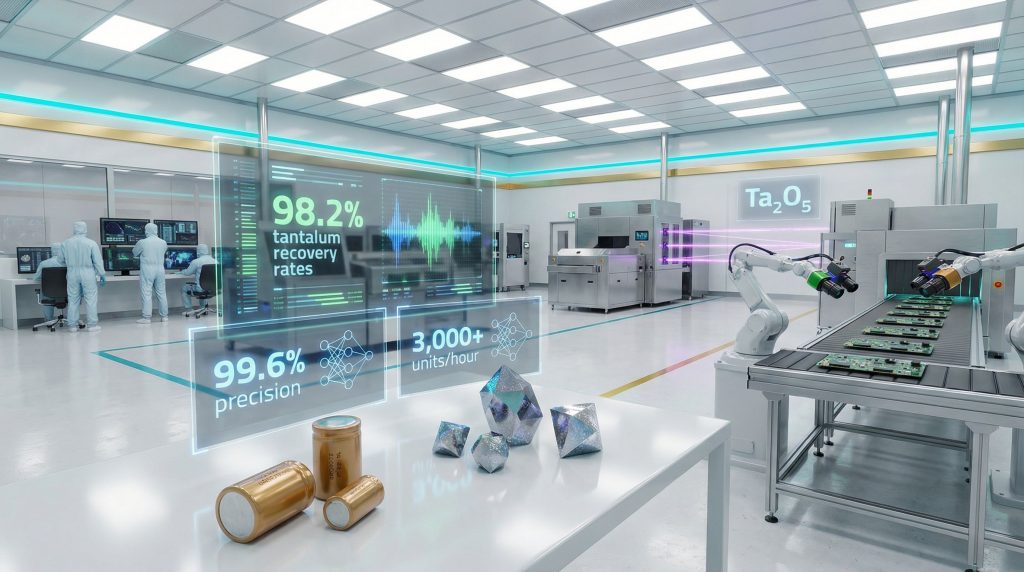
The CNN architecture achieves 99.6% precision in tantalum capacitor identification through explainable activation mapping techniques that provide transparent decision-making processes. For instance, this transparency enables quality control validation and troubleshooting capabilities essential for industrial applications requiring consistent accuracy standards.
Processing capabilities reach approximately 3,000 components per hour in current configurations, representing a ten-fold improvement over manual sorting throughput. This performance level begins approaching the volumes necessary for commercial-scale operations while maintaining precision requirements.
The neural network training process incorporates:
• Diverse capacitor databases spanning multiple manufacturers and product generations
• Component variation datasets including size, colour, and surface condition ranges
• Degradation state recognition for processing aged electronic components
• Multi-angle imaging integration for comprehensive component analysis
Multi-energy X-ray transmission systems provide complementary elemental analysis capabilities that definitively distinguish tantalum from niobium regardless of visual similarity. K-edge detection algorithms exploit the fundamental differences in absorption spectra between these elements, with tantalum exhibiting K-edge absorption at 67.42 keV compared to niobium's 18.99 keV.
The enhanced data-driven mining operations approach significantly improves material identification accuracy whilst reducing human error factors.
Spectral Analysis and Automated Calibration
Pixel-wise spectral processing enables precise material identification within individual components, even when multiple materials exist within single capacitor assemblies. Furthermore, automated calibration protocols maintain measurement accuracy across extended operating periods while compensating for equipment drift and environmental variations.
| Technology Component | Accuracy Rate | Processing Speed | Primary Application |
|---|---|---|---|
| CNN Visual Recognition | 99.6% precision | 3,000+ units/hour | Component identification |
| MEXRT Elemental Analysis | 97.5% recall | Variable throughput | Ta vs Nb distinction |
| Combined Dual-Stage System | 98%+ overall | Scalable configuration | Complete sorting solution |
The two-stage approach addresses individual technology limitations while maximising overall system reliability. Visual recognition provides rapid initial classification, while X-ray analysis delivers definitive elemental verification for components requiring additional confirmation.
Real-time processing capabilities enable continuous operation integration with conveyor systems and automated rejection mechanisms. In addition, this integration allows seamless incorporation into existing e-waste processing facilities without requiring complete infrastructure redesigns.
Advanced Chemical Recovery and Purification Methods
Innovation in chemical processing has eliminated traditional fluoride-based refining protocols that posed significant environmental and safety concerns. AI enhanced tantalum recycling systems employ oxalic and sulfuric acid combinations in reverse leaching processes that selectively remove impurities while preserving target tantalum materials.
The reverse leaching approach represents a fundamental departure from conventional forward leaching methods that dissolve target metals from feedstock materials. Instead, the process strips away contaminants, particularly manganese compounds commonly found in electronic components, while maintaining tantalum in solid form throughout initial processing stages.
Recovery performance reaches 98.2% for tantalum extraction from sorted capacitor feedstock, with final product purity exceeding 99.8% for tantalum pentoxide output. These performance levels meet or exceed industry standards for primary tantalum production while operating under significantly milder temperature and pressure conditions.
The innovative battery recycling process techniques share similar environmental considerations with tantalum recovery operations.
Process optimisation incorporates several key innovations:
• Water-based density separation for preliminary material concentration
• Magnetic removal of ferrous materials before chemical processing
• Controlled shredding protocols maximising surface area exposure
• Standardised calcination producing consistent Ta₂O₅ output format
The fluoride-free chemistry addresses both environmental sustainability concerns and worker safety requirements that have historically limited tantalum recycling adoption. Elimination of hydrofluoric acid handling reduces facility infrastructure requirements while improving operational safety profiles.
Energy Efficiency and Environmental Impact
Mild processing conditions significantly reduce energy consumption compared to high-temperature smelting operations traditionally employed in tantalum recovery. Moreover, lower operating temperatures decrease both direct energy costs and greenhouse gas emissions associated with heating requirements.
Water usage optimisation through recycling and treatment systems minimises environmental impact while reducing operating costs. Chemical recovery protocols enable reuse of processing solutions across multiple processing cycles, further improving resource efficiency.
The reverse leaching methodology demonstrates how targeted chemical engineering can achieve superior recovery performance while simultaneously reducing environmental impact and operational complexity.
Quality control integration throughout the processing sequence ensures consistent product specifications. Advanced microscopy and ion-beam analysis verify final product purity levels, providing certification capabilities required for electronics manufacturing applications.
Commercial Scalability and Infrastructure Requirements
Pilot system demonstrations validate the technological foundation for industrial-scale deployment while identifying specific infrastructure requirements for commercial operations. Furthermore, modular system architectures enable capacity expansion through parallel processing channels rather than complete facility redesigns.
Current performance benchmarks include:
• Demonstrated tantalum recovery rates: 98.2%
• Product purity achievement: >99.8% Ta₂O₅
• Component processing throughput: ~3,000 units/hour
• System availability and reliability metrics supporting continuous operation
Multi-channel hardware configurations address current bottlenecks in MEXRT acquisition time that limit single-channel throughput. Parallel processing architectures can achieve industrial throughput targets while maintaining precision requirements across all processing channels.
Economic modelling suggests favourable cost structures compared to manual sorting and robotic pick-and-place alternatives, particularly when processing volumes reach industrial scales. Operating cost advantages stem primarily from reduced labour requirements and higher material recovery rates.
The broader context of mining industry innovation supports these technological advancements in recycling operations.
Capital Investment and Return Analysis
Initial capital requirements encompass specialised equipment acquisition, facility preparation, and working capital for feedstock procurement. Equipment costs concentrate in advanced sensing systems and automated handling infrastructure necessary for continuous operation.
| Processing Method | Recovery Efficiency | Labour Requirements | Environmental Impact |
|---|---|---|---|
| Traditional Manual Sorting | 70-80% recovery | High labour intensity | Moderate environmental burden |
| Robotic Pick-and-Place | 85-90% recovery | Medium automation level | Reduced labour exposure |
| AI-Enhanced Dual-Stage | 98%+ recovery | Minimal direct labour | Significantly reduced impact |
Break-even analysis depends heavily on feedstock acquisition costs and market pricing for recovered tantalum pentoxide. However, current tantalum market prices support economic viability when processing volumes exceed minimum thresholds required for equipment utilisation efficiency.
Partnership opportunities with electronics manufacturers and e-waste collection networks can provide feedstock security while creating closed-loop supply chain arrangements. These partnerships reduce feedstock acquisition costs while providing guaranteed material outlets.
Supply Chain Integration and Market Positioning
Electronic waste generation reached 62 million metric tons globally in 2022, with only 22.3% undergoing formal collection and recycling processes. This represents a substantial untapped resource base for tantalum recovery, particularly concentrated in regions with high electronics consumption rates.
AI enhanced tantalum recycling systems can integrate with existing e-waste infrastructure through targeted component recovery rather than complete material processing. This selective approach maximises resource utilisation while minimising infrastructure investment requirements.
Critical mineral designation by multiple governments, including the United States, European Union, and Japan, creates policy support for domestic tantalum recycling initiatives. Consequently, strategic material security concerns provide additional economic incentives for supply chain diversification away from primary mining dependence.
The development of critical raw materials facility infrastructure supports these recycling initiatives across Europe.
Urban mining infrastructure development opportunities include:
• Regional processing facility networks optimising transportation costs
• E-waste collection system integration for targeted component recovery
• Electronics manufacturer partnerships for closed-loop material flows
• Quality certification protocols enabling direct supply chain integration
The electronics sector consumes approximately 60% of global tantalum production, primarily for capacitor manufacturing applications. This consumption pattern creates natural market opportunities for recycled tantalum that meets electronics industry quality specifications.
Conflict Mineral Risk Mitigation
Tantalum's designation as a conflict mineral creates compliance obligations for electronics manufacturers under regulations including Dodd-Frank Section 1502 and EU Conflict Minerals Regulation. Recycled tantalum provides supply chain risk mitigation while supporting regulatory compliance objectives.
However, recycling alone does not eliminate conflict mineral concerns, as adoption scale determines actual impact on supply chain risks. Substantial recycling capacity development would be required to significantly alter global supply chain dependencies.
Traceability systems integration enables blockchain-based material provenance tracking from e-waste source through final product delivery. In addition, this capability supports supply chain transparency requirements while providing audit trails for regulatory compliance.
Technical Limitations and Development Pathways
MEXRT acquisition time remains the primary bottleneck limiting system throughput in current configurations. Multi-channel X-ray systems under development promise to address this constraint through parallel processing capabilities, though equipment complexity and costs increase accordingly.
Feedstock quality variability presents ongoing challenges for consistent processing efficiency. Electronic component variations across manufacturers, product generations, and degradation states require adaptive processing protocols that maintain performance across diverse input materials.
Current system constraints requiring further development:
• Enhanced AI training datasets incorporating broader component variations
• Maintenance protocols for complex sensor arrays in industrial environments
• Standardisation frameworks for industry-wide technology adoption
• Integration capabilities with existing waste management infrastructure
Equipment maintenance requirements for advanced sensing systems demand specialised technical support that may not be readily available in all geographic markets. Training programmes and service infrastructure development represent additional considerations for commercial deployment.
Future Technology Integration Opportunities
Artificial intelligence capabilities continue advancing through machine learning improvements and expanded training datasets. Enhanced pattern recognition algorithms can potentially achieve even higher accuracy rates while processing increasingly complex component variations.
Integration with blockchain technology enables comprehensive material tracking from e-waste collection through final product delivery. This capability supports circular economy objectives while providing transparency for regulatory compliance and quality assurance.
Advanced analytics integration can optimise processing parameters in real-time based on feedstock characteristics and quality requirements. Furthermore, predictive maintenance capabilities can minimise equipment downtime while optimising operational efficiency.
The next major ASX story will hit our subscribers first
Environmental Impact and Sustainability Assessment
AI enhanced tantalum recycling technologies demonstrate substantial environmental advantages compared to primary mining operations and conventional recycling approaches. Energy consumption reduction stems primarily from elimination of high-temperature processing requirements and optimised chemical usage.
Greenhouse gas emission reductions result from lower energy intensity processing and elimination of fluoride-based chemistry. Transportation impacts may increase through centralised processing requirements, though material concentration improvements offset much of this burden.
Sustainability improvements include:
• Significant reduction in chemical processing waste streams
• Elimination of hydrofluoric acid environmental and safety concerns
• Higher material recovery rates reducing overall resource requirements
• Water usage optimisation through recycling and treatment systems
Life cycle assessment considerations encompass equipment manufacturing impacts, facility construction requirements, and long-term infrastructure sustainability. Initial studies suggest favourable environmental profiles, though comprehensive LCA analysis remains ongoing.
Circular economy contributions extend beyond material recovery to include reduced primary mining pressure and supply chain resilience improvements. These broader benefits support sustainability objectives across multiple stakeholder categories.
The broader critical minerals energy transition context emphasises the importance of sustainable recycling technologies.
Investment Opportunities and Market Analysis
Commercial deployment timelines suggest pilot system validation will conclude within 12-18 months, followed by scale-up engineering and industrial facility development. Early-stage technology investment opportunities exist across equipment development, facility deployment, and operational partnerships.
Market positioning advantages stem from superior recovery performance, environmental benefits, and supply chain security contributions. Competitive differentiation versus conventional recycling methods creates market entry opportunities in regions prioritising critical mineral security.
Investment considerations encompass:
• Technology licensing opportunities for equipment manufacturers
• Facility development partnerships with e-waste processors
• Strategic alliances with electronics manufacturers for feedstock security
• Regional processing network development for market coverage
Intellectual property positions in AI-based sorting systems and chemical processing innovations may provide competitive advantages and licensing revenue opportunities. Patent portfolios covering key technological breakthroughs represent valuable assets for technology developers.
Partnership strategies with established e-waste management companies can accelerate market penetration while leveraging existing collection and processing infrastructure. These collaborations reduce capital requirements while providing operational expertise.
Research from Foreign Policy Analytics indicates that AI is driving fresh demand for tantalum capacitors in computing applications, further supporting the economic case for advanced recycling technologies.
Additionally, studies published in Science Direct demonstrate the growing importance of techno-economic assessments for critical mineral recycling initiatives.
Disclaimer: This analysis contains forward-looking statements regarding technology development, market opportunities, and investment prospects. Actual results may differ materially from projections due to technical, market, regulatory, and competitive factors. Investment decisions should incorporate comprehensive due diligence and risk assessment appropriate to individual circumstances.
The convergence of artificial intelligence, advanced materials science, and circular economy principles creates unprecedented opportunities for transforming critical mineral supply chains. AI enhanced tantalum recycling represents a compelling example of how technological innovation can address resource security challenges while delivering environmental and economic benefits across multiple stakeholder categories.
Want to Identify the Next Critical Minerals Investment Opportunity?
Discovery Alert's proprietary Discovery IQ model delivers real-time alerts on significant ASX mineral discoveries, instantly empowering subscribers to identify actionable opportunities ahead of the broader market. Begin your 30-day free trial today and secure your market-leading advantage in the evolving critical minerals landscape.