June 28, 2026
The convergence of artificial intelligence and energy infrastructure represents one of the most significant structural shifts in global power markets since the industrial electrification of the early 20th century. While renewable energy sources dominate headlines about future power generation, the immediate reality of scaling AI operations has created an unexpected renaissance for natural gas as the bridge fuel for computational infrastructure. Understanding how this technological revolution will reshape A.I. and gas in energy demand through 2030 requires examining not just the scale of AI's energy appetite, but the unique characteristics that make natural gas indispensable for maintaining the 24/7 reliability that modern AI systems demand.
The Computational Power Revolution Behind Energy Demand
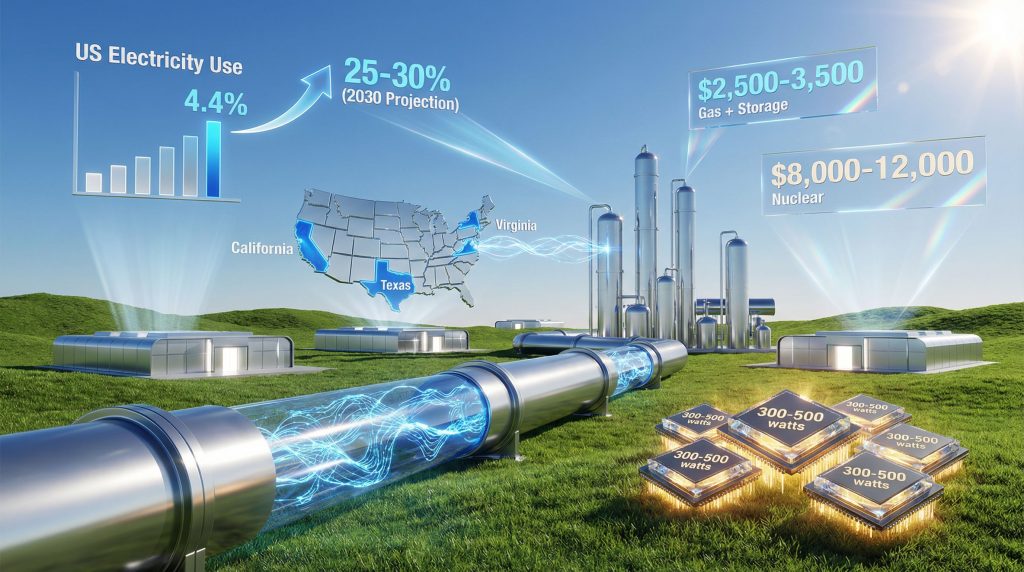
The energy intensity of artificial intelligence represents a fundamental departure from traditional computing workloads. Modern high-end AI processors, including NVIDIA's H100 and H200 graphics processing units, consume between 350 and 700 watts under full operational load, representing a dramatic increase from earlier generation processors that operated in the 250-watt range. This escalation in chip-level power consumption reflects the computational complexity required for training and operating large language models and other AI applications.
Beyond individual processor requirements, the infrastructure supporting these systems has undergone equally dramatic transformation. Data centre power density has evolved from 5-15 kilowatts per server rack for traditional IT workloads to 20-50 kilowatts per rack for AI-specific installations. This concentration of power demand within relatively small physical footprints creates cooling challenges that can account for 30-40% of total facility energy consumption, further amplifying the overall electrical requirements for AI operations.
The distinction between training and inference workloads adds another layer of complexity to energy demand projections. Training large AI models represents a one-time computational investment that can require 1,000+ hours of GPU computation, while inference operations represent the continuous energy cost of running deployed AI systems at scale. As AI applications proliferate across industries, inference workloads are becoming the dominant driver of sustained electricity demand, according to leading energy research organisations.
Natural Gas as the Bridge Fuel for AI Infrastructure
Natural gas power generation offers critical advantages that align with the operational requirements of AI infrastructure. Combined cycle gas plants can achieve operational response times of 20-30 minutes from startup to full capacity, while simple cycle combustion turbines can reach full output within 10-15 minutes. This rapid dispatch capability contrasts sharply with coal-fired generation, which typically requires 30-60 minutes for comparable response times.
The reliability characteristics of natural gas generation prove particularly valuable for AI data centre operations that require 99.5% or higher uptime standards. Gas-fired power plants operate with capacity factors of 40-60% nationally, meaning they generate electricity at 40-60% of their theoretical maximum output over annual periods. This operational flexibility allows utilities to balance intermittent renewable generation while maintaining the consistent baseload power that AI operations demand.
Furthermore, grid stability requirements for continuous AI operations have elevated the importance of dispatchable generation resources. While renewable sources achieve capacity factors of 25-35% for wind and 15-25% for solar, the variability inherent in these sources creates challenges for maintaining the consistent power quality required for sensitive computational equipment. Natural gas plants provide the grid balancing services necessary to integrate renewable energy while ensuring reliable power delivery to critical AI infrastructure.
When big ASX news breaks, our subscribers know first
Breaking Down AI Energy Demand Projections Through 2030
Current estimates place data centre electricity consumption at approximately 4-5% of total U.S. electricity demand as of 2024, with AI-specific workloads representing a rapidly growing subset of this total. However, industry experts emphasise that historical energy efficiency improvements have masked the true extent of underlying demand growth, creating challenges for accurate long-term forecasting.
The trajectory of A.I. and gas in energy demand becomes clearer when examining regional concentration patterns. Virginia's Northern region, home to significant data centre development, faces projected electricity demand increases of up to 70% by 2030. This growth reflects both the geographic concentration of AI infrastructure development and the multiplicative effects of supporting facilities and cooling systems.
| Demand Scenario | 2024 Baseline | 2030 Projection | Growth Driver |
|---|---|---|---|
| Conservative | 4.4% US electricity | 12-15% | Efficiency gains offset growth |
| Moderate | 4.4% US electricity | 18-21% | Continued AI expansion |
| Aggressive | 4.4% US electricity | 25-30% | Breakthrough AI applications |
In addition, Texas represents another critical region for understanding future demand patterns. The Electric Reliability Council of Texas (ERCOT) has identified requirements for approximately 14 gigawatts of new generation capacity specifically designed to serve AI data centre loads. This represents new infrastructure rather than replacement of existing generation, highlighting the additive nature of AI energy demand rather than substitution for other electrical loads.
The Hidden Demand Masked by Efficiency Gains
Energy efficiency improvements across residential and commercial sectors have historically offset underlying electricity demand growth, creating what industry analysts describe as a "masked demand" phenomenon. Over the past decade, advances in building efficiency, appliance standards, and industrial processes absorbed much of the natural growth in electricity consumption, allowing utilities to maintain relatively flat capacity requirements despite economic and population expansion.
The emergence of AI workloads represents a structural break from this historical pattern. Industry observations indicate that efficiency improvements can no longer offset the scale of new demand from AI operations, forcing utilities to confront the reality of substantial capacity additions for the first time in decades. This shift from discussions of hundreds of megawatts to requirements measured in gigawatts reflects the magnitude of infrastructure transformation required to support expanding AI deployment.
However, California's experience illustrates the challenges of integrating high renewable penetration with baseload AI demand requirements. Despite achieving renewable energy targets approaching 60% of total generation, the state's grid operators face difficulties providing the consistent 24/7 power quality that AI data centres require. Battery storage systems, while improving in cost and performance, remain economically challenging for providing the 24-hour cycles necessary to smooth renewable intermittency at data centre scales.
Supply Chain Implications for Natural Gas Infrastructure
The United States maintains substantial natural gas reserves, with proven recoverable resources estimated at over 2,000 trillion cubic feet according to Energy Information Administration assessments. At current national consumption rates of approximately 30 trillion cubic feet annually, this represents multi-decade supply availability. Nevertheless, the distribution of these reserves across different producing basins creates infrastructure challenges for delivering gas to regions experiencing rapid AI-driven electricity demand growth.
Pipeline Infrastructure Bottlenecks and Regional Supply Dynamics
Interstate pipeline infrastructure represents a critical constraint in matching natural gas supply with emerging demand patterns. Major pipeline projects typically require 3-7 years for development, including environmental review, regulatory approval through the Federal Energy Regulatory Commission, and construction phases. Recent projects like the Mountain Valley Pipeline have experienced even longer timelines, highlighting the challenges of expanding midstream infrastructure to serve new demand centres.
The Haynesville Shale basin, spanning East Texas and Northwest Louisiana, exemplifies the importance of geographic diversification in natural gas supply. Industry experts emphasise that relying solely on Permian Basin associated gas production proves insufficient for meeting national demand growth. Consequently, the Haynesville basin's focus on dry natural gas production, rather than oil-associated gas, provides more predictable supply curves for power generation planning.
Regional pipeline capacity constraints create particular challenges for serving Virginia's growing data centre load. The existing pipeline network connecting producing regions like the Marcellus Shale in Pennsylvania with Virginia consumption centres operates near capacity during peak demand periods, requiring careful coordination between gas producers, pipeline operators, and electric utilities.
Production Basin Optimisation and Economic Challenges
Mature shale gas production faces economic headwinds as operators exhaust the most productive drilling locations within established basins. While geological reserves remain abundant, the economics of extraction deteriorate as companies move from tier-one drilling locations to progressively less productive intervals. This phenomenon, described as "degradation in returns" rather than resource depletion, affects long-term supply economics and pricing dynamics.
For instance, the Woodford and Barnett formations represent examples of how operators adapt to changing economic conditions by targeting different geological intervals. These formations contain gassier reservoir characteristics compared to their oil-focused counterparts, making them more attractive as natural gas demand strengthens relative to oil markets. This strategic shift toward gas-rich targets reflects market adaptation to changing demand patterns driven by power generation requirements.
Moreover, basin-level production decline rates averaging 8-12% annually require continuous drilling programmes to maintain output levels. This operational reality means that sustained natural gas supply depends on continued capital investment in new well development, creating sensitivity to commodity price cycles and regulatory approval processes that affect drilling permit timelines.
Long-Term Contract Market Evolution
Technology companies developing AI infrastructure increasingly seek supply security through long-term natural gas contracts extending 10-20 years, representing a fundamental shift from traditional spot market procurement strategies. This evolution reflects the substantial capital investments in AI data centre infrastructure and the operational requirement for predictable energy costs over extended periods.
The desire for long-term supply agreements creates opportunities for natural gas producers willing to commit reserves over extended periods, but also introduces counterparty risk considerations given the rapid pace of technological change in the AI sector. Producers must evaluate the long-term viability of technology companies while assessing the potential for efficiency improvements that might reduce future gas demand per unit of computational output.
Furthermore, regulatory uncertainty adds complexity to long-term contract negotiations, as both buyers and sellers must consider potential policy changes affecting carbon emissions, environmental regulations, and energy infrastructure development over contract periods extending well into the 2040s.
Competing Technologies and Market Dynamics
Nuclear Renaissance Feasibility and Timeline Constraints
Nuclear power generation offers the theoretical capability to provide baseload electricity for AI operations without carbon emissions, but faces substantial practical constraints in meeting near-term demand growth. Small Modular Reactor (SMR) technology, designed to reduce construction timelines and capital requirements compared to traditional nuclear plants, still faces deployment timelines extending to 2032-2035 for initial commercial operations.
Capital cost comparisons highlight the economic advantages of natural gas infrastructure over nuclear alternatives. New nuclear construction costs range from $6,000-12,000 per kilowatt of capacity, compared to $1,200-2,000 per kilowatt for natural gas combined cycle plants. These cost differentials, combined with construction timeline advantages for gas facilities, make natural gas the preferred option for meeting immediate AI infrastructure requirements.
Additionally, nuclear power faces supply chain constraints, including specialised workforce shortages estimated at over 200,000 workers needed to support a nuclear renaissance. The complexity of nuclear construction and operation requires highly trained personnel in areas ranging from reactor physics to specialised welding techniques, creating bottlenecks that extend project timelines beyond the immediate requirements of AI infrastructure development.
Renewable Integration Challenges for Continuous AI Operations
Solar and wind generation provide cost-competitive electricity during peak output periods but face fundamental challenges in meeting the 24/7 operational requirements of AI data centres. Solar capacity factors average 15-25% nationally, while wind achieves 25-35% capacity factors, compared to the 85-90% capacity factors achievable with natural gas combined cycle plants when operated as baseload facilities.
Battery storage technology continues improving in cost and performance, with projections suggesting $100-200 per kilowatt-hour costs by 2030. However, providing 24-hour energy storage for large-scale AI facilities requires massive battery installations that add substantial capital costs and operational complexity compared to dispatchable natural gas generation. According to industry analysis on gas-powered AI infrastructure, this technology gap makes natural gas essential for near-term AI deployment.
Grid stability considerations become critical when renewable penetration exceeds 60% of total generation. California's experience with renewable curtailment during peak solar production periods illustrates the challenges of integrating variable generation with consistent AI demand patterns. Natural gas plants provide the flexibility to ramp output up and down to balance renewable variability while maintaining grid frequency and voltage within acceptable ranges.
Hybrid System Economics and Optimisation Strategies
| Technology Mix | Capital Cost ($/kW) | Capacity Factor | Reliability Score |
|---|---|---|---|
| Gas + Storage | $2,500-3,500 | 85-90% | 99.5% |
| Nuclear Baseload | $8,000-12,000 | 90-95% | 99.8% |
| Renewables + Storage | $3,000-5,000 | 35-45% | 95-98% |
The economic optimisation of power systems for AI applications increasingly involves hybrid approaches combining multiple generation sources. Natural gas provides the reliability and dispatch flexibility necessary for grid balancing, while renewable sources contribute cost-effective energy during favourable weather conditions. Storage systems bridge the gap between renewable availability and consistent AI demand patterns.
Demand response potential represents an emerging opportunity for AI facilities to participate in grid optimisation. Unlike traditional industrial loads, some AI workloads can be shifted temporally to take advantage of low-cost renewable generation periods, potentially reducing overall system costs while maintaining computational output. This flexibility could reduce peak demand on natural gas generation while maximising utilisation of renewable resources.
Grid Infrastructure Adaptation Strategies
Islanded Systems versus Grid-Connected Solutions
The development of private electrical grids specifically designed for AI operations represents one approach to addressing infrastructure constraints. Project Matador, proposed as one of the largest private electrical grids in the United States, aims to provide dedicated power supply for data centre operations through a combination of generation resources optimised for AI requirements.
However, islanded systems require over-building generation capacity to ensure reliability during equipment maintenance periods and peak demand events. This redundancy translates to substantial investments in backup natural gas generation that operates only during emergency conditions, creating economic inefficiencies compared to shared grid resources that benefit from diversity across multiple load centres.
For instance, the economics of islanded versus grid-connected systems depend heavily on transmission investment requirements and utility rate structures. When existing transmission capacity proves insufficient for AI loads, the cost of new transmission infrastructure may exceed the premium for developing dedicated private generation resources.
Smart Grid Integration and Load Balancing
Advanced grid management systems offer opportunities to optimise A.I. and gas in energy demand patterns through real-time coordination between AI workloads and natural gas generation dispatch. Smart grid technologies can achieve 20-30% efficiency improvements by coordinating electricity supply with flexible demand patterns, reducing overall system costs while maintaining service reliability.
Real-time pricing mechanisms allow AI operators to shift computational workloads to periods when renewable generation exceeds demand, reducing reliance on natural gas peaker plants and lowering overall electricity costs. This temporal flexibility represents a unique advantage of AI workloads compared to traditional industrial processes that operate on fixed schedules.
Furthermore, demand response programmes can potentially reduce peak electricity requirements by 10-15% through coordinated load reduction during system stress periods. AI facilities participating in these programmes provide valuable grid services while reducing their exposure to peak electricity pricing during high-demand periods.
Environmental and Regulatory Framework Evolution
Carbon Emissions Trajectory and Climate Considerations
Natural gas lifecycle emissions range from 490-570 kilograms of CO2 equivalent per megawatt-hour of electricity generation, representing approximately half the emissions intensity of coal-fired generation but substantially higher than nuclear or renewable sources. The scale of AI energy demand growth means that natural gas consumption for electricity generation could significantly impact national carbon emissions trajectories.
AI training emissions comparisons provide context for understanding the carbon intensity of computational workloads. Training large language models can generate emissions equivalent to 5-20 miles of automobile travel per million tokens processed, with inference operations representing ongoing emissions from deployed AI systems. These comparisons help frame the environmental trade-offs inherent in AI infrastructure development.
Consequently, technology companies face increasing pressure to demonstrate net-zero carbon commitments while scaling AI infrastructure, creating tension between growth objectives and sustainability goals. This dynamic drives interest in renewable energy procurement and carbon offset programmes, but immediate operational requirements often necessitate natural gas backup generation for reliability assurance.
Regulatory Framework Adaptation and Policy Implications
Federal permitting reform proposals aim to reduce infrastructure development timelines by 2-3 years through streamlined environmental review processes and coordinated agency approvals. These reforms could accelerate both natural gas infrastructure development and competing renewable energy projects, affecting the relative economics of different generation technologies.
State-level renewable portfolio standards face pressure to adapt to AI infrastructure requirements that demand consistent baseload power quality. Some jurisdictions are considering modifications to renewable energy mandates that recognise the grid reliability services provided by natural gas generation in supporting renewable integration.
Moreover, carbon pricing mechanisms, ranging from $25-85 per tonne of CO2 by 2030 according to various policy proposals, would affect the relative economics of natural gas versus renewable generation for AI applications. Higher carbon prices favour renewable and nuclear generation, while lower prices maintain natural gas cost advantages for reliable baseload power.
The next major ASX story will hit our subscribers first
Investment Opportunities in the AI-Gas Convergence
Midstream Infrastructure Development
Pipeline capacity expansion represents a $50-80 billion investment opportunity as natural gas demand grows to serve AI infrastructure development. Interstate pipeline projects connecting producing regions with AI data centre clusters offer potential returns but require substantial capital commitments and regulatory approval processes extending 5-10 years.
Gas processing and fractionation facilities require upgrades to handle increased throughput from expanded drilling programmes targeting AI-driven demand. These midstream investments typically offer more predictable returns than upstream exploration while providing essential infrastructure services for the natural gas supply chain. For those examining investment strategies, this sector presents compelling opportunities.
LNG export terminal development creates opportunities to serve international AI markets, particularly in regions with limited domestic natural gas resources. European and Asian AI infrastructure development could drive demand for U.S. LNG exports, creating additional market outlets for domestic production growth.
Technology Innovation and Efficiency Improvements
AI chip efficiency represents a critical factor affecting long-term energy demand projections. Improvements in processing efficiency measured in floating-point operations per watt could reduce energy intensity by 80-90% for comparable computational workloads, fundamentally altering demand growth trajectories.
Carbon capture and storage integration with natural gas power plants offers opportunities to reduce emissions intensity while maintaining the reliability advantages of gas generation for AI applications. These technologies could bridge the gap between immediate AI infrastructure requirements and long-term decarbonisation objectives.
Additionally, advanced energy storage systems specifically designed for AI applications represent emerging investment opportunities. These systems must provide both power quality conditioning and energy time-shifting capabilities to optimise the integration of renewable generation with consistent AI power requirements.
Market Timing and Risk Considerations
Natural gas price volatility, historically ranging from $2.50-6.50 per million British thermal units (MMBtu), creates both opportunities and risks for investments tied to AI energy demand. Long-term contracts can provide price stability but may limit participation in potential commodity price appreciation. Those interested in us natural gas forecast trends should consider these dynamics.
AI infrastructure deployment curves typically require 18-24 months from initial planning to operational status, creating timing coordination challenges between gas supply development and demand realisation. Investment strategies must account for potential delays in AI project development that could affect natural gas demand timing.
Furthermore, regulatory approval cycles for energy infrastructure projects introduce additional timing uncertainty that affects investment returns. Projects requiring federal permitting face 3-7 year development timelines that must align with AI infrastructure deployment schedules to optimise market opportunities.
Energy Security and Geopolitical Implications
Domestic Production Advantages and Strategic Considerations
United States shale gas reserves provide over 50 years of supply at current consumption rates, offering energy security advantages for AI infrastructure development compared to regions dependent on energy imports. This domestic resource base supports strategic competitiveness in global AI development while reducing exposure to international energy market volatility.
Energy independence implications extend beyond AI applications to broader economic competitiveness considerations. Countries with reliable, cost-effective energy supplies maintain advantages in attracting AI infrastructure investment and supporting domestic technology sector development, similar to energy transition challenges faced by other nations.
Strategic petroleum reserve parallels suggest potential policy interest in establishing strategic reserves for critical minerals required in AI chip manufacturing and energy storage systems. These considerations could affect investment flows between traditional energy infrastructure and emerging technology supply chains.
International Competition Dynamics
China's reliance on coal-fired electricity generation creates competitive disadvantages for AI infrastructure development as environmental, social, and governance (ESG) considerations increasingly influence technology investment decisions. Natural gas provides cleaner generation profiles that support international competitiveness in attracting AI investment capital.
European Union dependence on natural gas imports creates vulnerability for AI infrastructure development, particularly given geopolitical tensions affecting Russian pipeline supplies. This situation could drive European interest in renewable energy acceleration or nuclear power revival to support AI competitiveness, reflecting broader energy transition insights.
Middle Eastern countries with substantial natural gas reserves are developing renewable energy AI hub strategies to leverage both energy resources and favourable climatic conditions for data centre cooling. These developments could create competition for U.S. AI infrastructure investment while generating demand for American technology exports.
Strategic Implications for Market Participants
Utility Sector Transformation Requirements
Electric utilities face fundamental changes in planning horizons as AI infrastructure requires 20-30 year commitment periods compared to traditional 10-15 year planning cycles. This extension demands different approaches to resource adequacy planning and capital allocation strategies that account for technological uncertainty over extended periods.
Customer concentration risks emerge as individual AI data centres can represent substantial portions of utility service territory load. Single facility outages or contract terminations could significantly impact utility financial performance, requiring different risk management approaches compared to diversified residential and commercial customer bases.
Furthermore, long-term planning processes must adapt to rapid changes in AI technology that could dramatically alter future energy demand patterns. Utilities must balance the certainty required for infrastructure investment with flexibility to adapt to changing technology requirements and efficiency improvements.
Technology Company Energy Strategy Evolution
Power purchase agreement structures are evolving to address the unique requirements of AI infrastructure, including provisions for capacity reserves, power quality standards, and long-term price predictability. These agreements must balance technology companies' need for cost certainty with utilities' requirement for reasonable returns on infrastructure investment.
On-site generation investment decisions involve trade-offs between energy cost control and capital allocation efficiency. Technology companies must evaluate whether direct investment in natural gas generation facilities offers superior economics compared to long-term utility contracts for comparable electricity supply.
Geographic data centre distribution strategies increasingly consider regional energy resource availability, regulatory environments, and grid infrastructure capacity. These considerations could drive AI infrastructure development toward regions with abundant natural gas supplies and supportive regulatory frameworks. However, global trade tensions, such as us-china trade impacts, add complexity to international expansion plans.
The convergence of A.I. and gas in energy demand represents a transformative force reshaping both the technology sector and energy infrastructure planning. Natural gas emerges as the critical bridge fuel enabling AI expansion while renewable and nuclear technologies develop the scale and reliability necessary for long-term sustainability. Understanding these dynamics provides essential context for investment decisions and policy development in both sectors through 2030 and beyond.
Investment Consideration: The timing and scale of AI infrastructure development will fundamentally determine natural gas demand patterns over the next decade, creating both significant opportunities and substantial risks for market participants across the energy value chain.
Ready to capitalise on the AI energy revolution?
Discovery Alert's proprietary Discovery IQ model delivers real-time notifications on significant mineral discoveries across the energy transition sectors, including critical materials powering AI infrastructure development. Understand why major mineral discoveries have historically generated exceptional returns and begin your 14-day free trial today to position yourself ahead of this transformative market convergence.