August 11, 2026
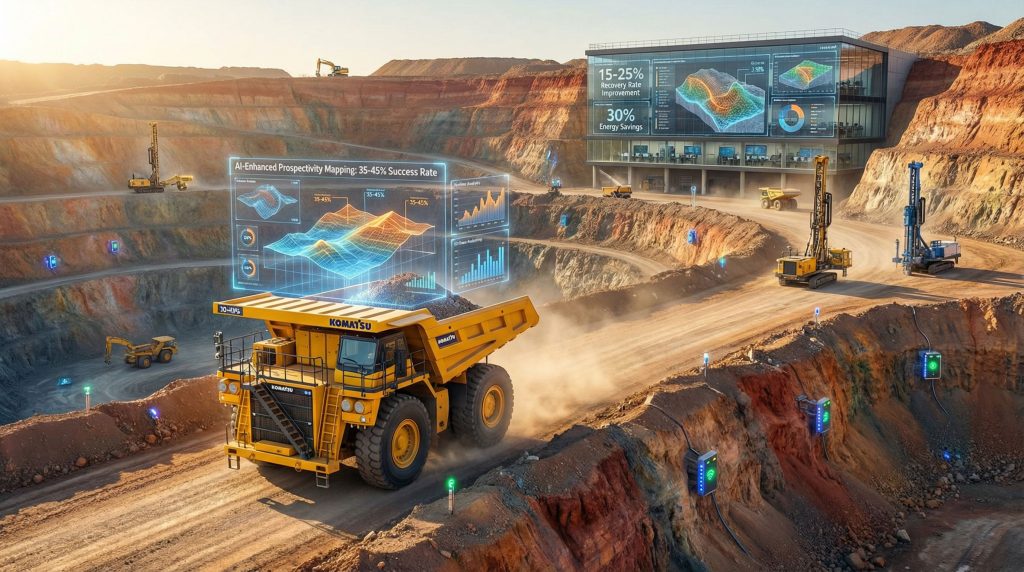
The mining industry stands at the forefront of technological transformation, where AI in mining applications are revolutionising operational efficiency, safety protocols, and environmental stewardship. Machine learning algorithms and predictive analytics systems represent the technological backbone of modern mining infrastructure transformation, enabling companies to harness data-driven operations for unprecedented performance gains.
The fundamental distinction between artificial intelligence implementations and conventional digital solutions lies in their adaptive learning capabilities. Traditional mining automation follows programmed decision trees, while AI systems continuously refine their operational parameters based on evolving site conditions, equipment performance patterns, and geological variations.
Integration Architecture Across Mining Value Chains
Current AI in mining deployments integrate across five primary operational domains:
• Exploration and resource modelling – Geological data interpretation and prospect evaluation
• Extraction operations – Real-time optimisation of drilling, blasting, and material handling
• Processing and beneficiation – Automated ore sorting and recovery optimisation
• Equipment management – Predictive maintenance and fleet coordination
• Environmental monitoring – Automated compliance tracking and impact assessment
This interconnected approach enables mining operations to achieve system-wide optimisation rather than isolated equipment improvements. Furthermore, the integration of these systems creates synergistic effects that amplify individual performance gains.
Current Market Implementation Patterns
Equipment manufacturers have developed specialised AI packages targeting specific mining applications. Weir Group, for instance, offers integrated solutions covering pumps, cyclones, high-pressure grinding rolls, screens, and material handling systems. Their approach centres on three operational objectives: system insight through real-time performance visibility, uptime extension via predictive condition monitoring, and production maximisation through AI mill optimization algorithms.
The organisational structure supporting these technologies reflects the specialised nature of mining AI applications. Companies like Weir maintain dedicated positions including Directors of Minerals Digital and Intelligent Operations, alongside equipment-specific product managers, indicating enterprise-wide commitment to artificial intelligence integration.
Industry Insight: Successful AI deployment in mining requires combining sophisticated algorithms with deep domain knowledge and extensive field support capabilities.
When big ASX news breaks, our subscribers know first
Advanced Geological Data Integration and Mineral Discovery
Geological exploration represents one of the most data-intensive applications of AI in mining, where machine learning algorithms process satellite imagery, geophysical surveys, historical drilling records, and regional geological databases simultaneously. This multi-source data fusion approach enables exploration teams to identify subtle geological patterns that traditional analysis methods might overlook.
Predictive Modelling for Resource Identification
Contemporary exploration programmes utilise machine learning models trained on successful discovery datasets to evaluate untested geological terrains. These systems analyse structural geology, geochemical anomalies, and mineralisation indicators to generate prospectivity maps highlighting areas with elevated discovery potential.
The computational advantage of AI systems becomes apparent in their ability to process vast geological datasets continuously. Traditional exploration teams might require months to analyse regional geological surveys, while AI algorithms can evaluate equivalent data volumes within hours, enabling rapid target prioritisation and resource allocation decisions.
Additionally, the integration of drilling results interpretation through AI systems provides unprecedented accuracy in understanding subsurface geology. These advanced analytical capabilities transform raw geological data into actionable intelligence for exploration teams.
Drilling Optimisation and Target Refinement
Real-time drilling optimisation systems represent a significant advancement in exploration efficiency. These AI frameworks analyse drilling parameters, rock characteristics, and geological formations continuously, making automated adjustments to drilling speed, pressure, and trajectory to maximise core recovery and minimise equipment wear.
The precision targeting capabilities of AI-guided drilling systems enable exploration programmes to test geological hypotheses more effectively. Machine learning algorithms can identify optimal drilling angles and depths based on three-dimensional geological models, reducing the number of exploration holes required whilst increasing the probability of intersecting mineralised zones.
| Exploration Approach | Target Accuracy | Cost Efficiency | Time Reduction |
|---|---|---|---|
| Traditional geological surveys | 15-20% success | Baseline costs | Baseline timeline |
| AI-enhanced prospectivity mapping | 35-45% success | 25-40% reduction | 30-50% improvement |
| Integrated machine learning analysis | 40-55% success | 35-50% reduction | 45-65% improvement |
Note: Performance metrics vary by geological setting, commodity type, and exploration stage. Results should be validated against specific project conditions.
Operational Excellence Through Artificial Intelligence Integration
Mining operations generate enormous quantities of operational data from equipment sensors, production monitoring systems, and process control networks. AI in mining applications transform this data into actionable intelligence for continuous optimisation across multiple operational parameters. Consequently, operations can achieve previously unattainable levels of efficiency and coordination.
Autonomous Equipment Coordination and Fleet Optimisation
Modern mining sites deploy AI systems to coordinate autonomous haulage trucks, excavation equipment, and material handling systems. These coordination algorithms optimise traffic patterns, minimise equipment conflicts, and balance production rates across multiple extraction areas simultaneously.
Route planning algorithms consider real-time variables including equipment availability, road conditions, maintenance schedules, and production priorities. The result is dynamic fleet management that adapts continuously to changing operational conditions, maximising equipment utilisation whilst minimising operational delays.
For instance, Weir Group's artificial intelligence solutions demonstrate how integrated AI systems can coordinate multiple pieces of equipment across entire mining operations, delivering measurable improvements in throughput and efficiency.
Production Process Optimisation Technologies
AI-powered blast design systems analyse geological conditions, desired fragmentation outcomes, and downstream processing requirements to calculate optimal explosive placement and timing sequences. These systems consider multiple variables including rock hardness, joint patterns, desired particle size distribution, and environmental constraints.
Excavation equipment optimisation focuses on matching shovel performance with material characteristics and haulage system capacity. Machine learning algorithms analyse digging resistance, bucket fill factors, and cycle times to optimise excavation parameters for maximum throughput.
Material Processing and Quality Enhancement
Computer vision systems integrated with AI algorithms enable real-time ore classification and automated sorting decisions. These systems analyse mineral composition, particle size distribution, and quality characteristics to optimise processing parameters continuously.
AI-powered mineral processing applications deliver measurable improvements in recovery rates. Equipment manufacturers report that AI-driven ore sorting systems can improve mineral recovery rates by 15-25% whilst reducing processing costs by up to 20% compared to conventional methods. These improvements result from more precise material classification and optimised processing parameter selection.
Technical Achievement: Advanced ore sorting systems combine high-resolution imaging, spectroscopic analysis, and machine learning algorithms to achieve millisecond-level sorting decisions on individual ore particles.
Safety Enhancement and Risk Mitigation Systems
Worker safety represents a critical application area for artificial intelligence, where predictive analytics and real-time monitoring systems help prevent accidents and optimise emergency response procedures. However, the implementation of these systems requires careful balance between technological capability and human oversight.
Behavioural Pattern Recognition and Accident Prevention
Wearable sensor networks integrated with AI algorithms monitor worker movements, fatigue levels, and behavioural patterns to identify potentially hazardous situations before accidents occur. These systems track physiological indicators, location data, and work patterns to detect anomalies that might indicate increased accident risk.
Environmental hazard detection systems utilise distributed sensor networks to monitor air quality, ground stability, and structural integrity continuously. Machine learning algorithms analyse sensor data patterns to identify developing hazards such as ground instability, gas accumulations, or equipment malfunctions.
Predictive Equipment Maintenance Strategies
Vibration analysis and thermal monitoring systems collect continuous equipment health data that AI algorithms process to predict maintenance requirements before failures occur. These predictive maintenance systems analyse bearing temperatures, vibration signatures, lubricant conditions, and operational parameters to forecast optimal maintenance timing.
Equipment failure prediction systems help mining operations avoid costly unplanned downtime whilst optimising maintenance resource allocation. By predicting failures before they occur, operations can schedule maintenance activities during planned production breaks, minimising operational disruptions.
Emergency Response and Crisis Management
Automated evacuation route optimisation systems utilise real-time mine conditions, personnel locations, and hazard information to calculate optimal evacuation paths during emergency situations. These systems consider multiple factors including air quality, structural stability, and personnel capacity to ensure safe and efficient evacuations.
Real-time communication integration ensures that emergency response teams receive current information about personnel locations, hazard conditions, and evacuation progress throughout crisis situations. Furthermore, these systems can automatically initiate emergency protocols based on sensor data and threat assessment algorithms.
Environmental Impact Reduction and Sustainability Enhancement
AI applications deliver significant environmental benefits through optimised resource utilisation, reduced energy consumption, and enhanced environmental monitoring capabilities. Moreover, these systems enable mining operations to demonstrate measurable progress towards sustainability objectives, including the significant decarbonisation benefits that advanced technology implementation can provide.
Energy Consumption Optimisation Systems
Ventilation system optimisation represents one of the most impactful applications of AI technology in mining operations. Intelligent ventilation control systems monitor air quality, temperature, and humidity throughout underground workings, adjusting fan speeds and airflow patterns to maintain safe working conditions whilst minimising energy consumption.
These optimisation systems can achieve energy savings of up to 30% in ventilation operations by dynamically adjusting airflow based on real-time occupancy patterns, equipment operation schedules, and environmental conditions. The systems balance worker safety requirements with energy efficiency objectives through continuous optimisation algorithms.
Power distribution optimisation utilises AI algorithms to manage electrical load balancing, peak demand reduction, and equipment scheduling to minimise overall energy costs. These systems predict equipment power requirements and optimise operating schedules to reduce peak demand charges whilst maintaining production targets.
Water Management and Waste Reduction
AI-powered water management systems optimise water recycling, treatment processes, and consumption patterns across mining operations. These systems monitor water quality parameters, flow rates, and treatment effectiveness to maximise water reuse whilst maintaining process performance standards.
Tailings dam monitoring technologies utilise sensor networks and machine learning algorithms to detect potential stability issues, seepage patterns, and structural changes that might indicate developing problems. Continuous monitoring enables proactive maintenance and risk mitigation strategies.
Automated Environmental Compliance
Environmental monitoring systems automatically track emissions, water quality, noise levels, and dust generation to ensure regulatory compliance. AI algorithms analyse monitoring data to predict potential compliance issues and recommend corrective actions before violations occur.
Automated reporting systems generate regulatory compliance documentation, environmental impact assessments, and sustainability metrics with minimal manual intervention, reducing administrative burden whilst improving accuracy and consistency.
Industry Leaders and Technology Implementation Strategies
Major mining equipment manufacturers have developed comprehensive AI strategies combining hardware, software, and service delivery models to support customer technology adoption. These industry innovation trends reflect the sector's commitment to technological transformation and competitive advantage.
Equipment Manufacturer AI Integration Approaches
Weir Group exemplifies the integrated approach to mining AI, combining market-leading equipment expertise with advanced data modelling and AI capabilities. The company's digital solutions leverage proprietary operational data accumulated through years of equipment deployment in challenging mining environments.
The three-pillar strategy focuses on insight (actionable system health visibility), uptime (predictive condition monitoring), and production (AI-powered optimisation). This framework addresses the primary value drivers that mining operations seek from technology investments: improved visibility, reduced downtime, and increased production efficiency.
Organisational structures reflect the commitment to AI integration, with dedicated roles including Directors of Minerals Digital and Intelligent Operations working alongside equipment-specific product managers. This structure enables both horizontal technology integration and vertical equipment specialisation.
Technology Partnership and Service Models
Successful AI implementation requires ongoing technical support and system optimisation services. Equipment manufacturers leverage extensive service centre networks to provide local expertise for AI system deployment, optimisation, and troubleshooting.
The service-integrated delivery model recognises that effective AI deployment extends beyond initial installation to include continuous optimisation, performance monitoring, and system enhancement activities. This approach ensures that AI systems deliver sustained value improvements throughout their operational lifecycle.
Market Positioning and Competitive Advantages
Technology providers differentiate their offerings through proprietary data access, domain expertise, and integrated service capabilities. Companies with extensive operational experience possess valuable datasets that enhance AI algorithm training and improve system performance.
The competitive advantage in AI stems from combining technological capability with deep understanding of mining operational challenges and proven track records in harsh operating environments. In addition, successful implementation requires comprehensive understanding of mining AI transformation across different operational contexts.
The next major ASX story will hit our subscribers first
Implementation Challenges and Technical Limitations
Despite significant potential benefits, AI implementation faces several technical, economic, and organisational challenges that require careful consideration during deployment planning. These challenges must be addressed systematically to ensure successful technology adoption.
Technical Integration Complexities
Legacy system compatibility represents a significant challenge for AI implementation in existing mining operations. Many mines operate with equipment and control systems installed over multiple decades, creating integration challenges for modern AI platforms.
Data standardisation requirements add complexity to AI system deployment. Mining operations utilise equipment from multiple manufacturers, each with different data formats, communication protocols, and system architectures. Creating unified data platforms requires significant technical integration work.
Cybersecurity considerations become critical as mining operations increase connectivity and data sharing. AI systems require robust security architectures to protect operational data, prevent unauthorised access, and ensure system reliability in connected mining environments.
Workforce Development and Change Management
Successful AI implementation requires comprehensive workforce development programmes to ensure personnel can effectively utilise new technologies. Training programmes must address both technical system operation and the analytical skills needed to interpret AI-generated insights.
Job role evolution patterns show that AI implementation typically enhances rather than replaces human workers, but requires different skill sets focused on data analysis, system monitoring, and strategic decision-making rather than routine operational tasks.
Change management strategies must address worker concerns about technology adoption whilst building organisational capability to leverage AI insights effectively. This includes developing new performance metrics, decision-making processes, and operational procedures.
Economic and Return on Investment Considerations
AI system implementation requires significant upfront capital investment for software licensing, hardware infrastructure, system integration, and workforce training. Cost-benefit analyses must consider both direct cost savings and indirect benefits such as improved safety, reduced environmental impact, and enhanced regulatory compliance.
Payback period calculations vary significantly based on operation size, commodity prices, and implementation scope. Larger operations typically achieve faster payback due to economies of scale, whilst smaller operations may require phased implementation approaches.
Risk assessment frameworks must evaluate technology risks alongside operational and market risks. These include system reliability concerns, cybersecurity vulnerabilities, and dependency on technology vendors for ongoing support.
Future Technology Convergence and Industry Evolution
The future of artificial intelligence involves convergence with other emerging technologies to create more comprehensive and capable operational systems. However, successful implementation will require careful planning and strategic investment in supporting infrastructure.
Internet of Things Integration and Connectivity Enhancement
Internet of Things integration expands the data collection capabilities of mining operations, enabling AI systems to analyse broader sets of operational parameters. Sensor networks throughout mining sites collect environmental data, equipment performance metrics, and process variables that enhance AI algorithm effectiveness.
5G connectivity enables real-time data transmission from remote mining locations, supporting AI applications that require low-latency communication between distributed systems. High-speed connectivity allows for more sophisticated AI algorithms that can process complex data sets in real-time.
Edge computing applications enable AI processing capabilities at mining sites, reducing dependency on external connectivity whilst improving response times for critical operational decisions. Local processing capabilities ensure that AI systems continue operating effectively even when communication links to central data centres are disrupted.
Regulatory Framework Evolution
Safety regulations continue evolving to address AI-enabled mining systems, with regulatory bodies developing standards for autonomous equipment operation, AI decision-making processes, and human-AI interaction protocols.
Industry certification requirements for AI systems ensure that technology implementations meet safety, reliability, and performance standards. These certifications provide assurance to mining companies and regulatory authorities regarding AI system capabilities and limitations.
International standardisation initiatives work to develop common frameworks for AI system evaluation, data sharing protocols, and cross-border technology deployment. Standardisation efforts facilitate technology adoption whilst ensuring consistent safety and performance standards.
Long-Term Strategic Implications
Competitive advantages from AI implementation may prove temporary as technology becomes more widely adopted across the industry. Mining companies must continuously innovate and optimise their AI applications to maintain operational advantages.
Market consolidation potential exists as AI implementation costs and technical complexity favour larger mining operations with greater resources for technology investment. Smaller operations may need to collaborate or consolidate to achieve competitive AI capabilities.
Global supply chain transformation effects include more precise demand forecasting, optimised inventory management, and enhanced quality control throughout mineral commodity supply chains.
Strategic Implementation Guidelines and Best Practices
Successful AI implementation requires systematic planning, careful vendor selection, and comprehensive performance measurement frameworks. Consequently, organisations must develop structured approaches to technology adoption that align with operational objectives.
Assessment and Planning Frameworks
Current state analysis methodologies evaluate existing operational capabilities, technology infrastructure, data availability, and organisational readiness for AI implementation. This assessment identifies opportunities for AI value creation and potential implementation barriers.
Technology readiness evaluation considers technical infrastructure requirements, data quality and availability, system integration complexity, and organisational capability to support AI systems effectively.
Implementation roadmap development prioritises AI applications based on value potential, implementation complexity, and resource requirements. Phased approaches enable mining operations to build AI capability incrementally whilst demonstrating value and building organisational support.
Vendor Selection and Partnership Strategies
Technology provider evaluation requires assessment of AI algorithm capabilities, domain expertise in mining applications, integration support services, and long-term technology roadmaps. Providers with extensive mining experience offer advantages in understanding operational requirements and challenges.
Integration capability assessment evaluates vendors' ability to work with existing systems, provide ongoing technical support, and adapt solutions to specific operational requirements. Service-based delivery models provide ongoing optimisation and system enhancement capabilities.
Support and maintenance considerations include vendor service network coverage, response time commitments, system update and enhancement processes, and long-term technology support commitments.
Performance Measurement and Continuous Improvement
Key performance indicator development must align AI system metrics with broader operational objectives including safety, productivity, cost reduction, and environmental performance. Metrics should capture both direct AI system performance and broader operational improvements.
Continuous improvement methodologies enable mining operations to optimise AI system performance over time through data quality enhancement, algorithm refinement, and expanded application scope.
Success metric tracking systems provide ongoing visibility into AI system performance, value creation, and opportunities for further optimisation. These systems support data-driven decision-making regarding AI technology investments and operational changes.
Disclaimer: AI technology implementation results vary significantly based on operational conditions, geological settings, equipment configurations, and organisational factors. Mining companies should conduct thorough assessments and pilot programmes before committing to large-scale AI implementations. Financial projections and performance improvements should be validated against specific operational conditions and market factors.
Looking to Invest in AI-Powered Mining Companies?
Discovery Alert's proprietary Discovery IQ model delivers instant notifications on significant ASX mineral discoveries, empowering investors to identify actionable opportunities in innovative mining companies before the broader market catches up. Begin your 30-day free trial today and position yourself ahead of the technological transformation reshaping the mining sector.