May 20, 2026
The mineral exploration industry stands at a technological inflection point where computational power intersects with geological understanding in unprecedented ways. Traditional exploration methodologies, while proven over decades, face mounting pressure to deliver faster, more accurate results as easily accessible deposits diminish and exploration moves into increasingly challenging terrains. This convergence of necessity and technological capability has created fertile ground for AI in mineral exploration applications that promise to fundamentally reshape how the industry identifies, evaluates, and develops mineral resources.
Advanced computational frameworks are now capable of processing vast geological datasets that would take human analysts months or years to interpret manually. The implications extend beyond simple efficiency gains, touching on fundamental questions about resource discovery accuracy, capital allocation optimisation, and the industry's ability to meet growing global demand for critical minerals essential to modern technological infrastructure.
What Are the Core AI Technologies Transforming Geological Discovery?
Machine learning algorithms have emerged as powerful tools for processing complex geological datasets that traditional statistical methods struggle to interpret effectively. Supervised learning models excel at lithological classification tasks by training on extensive databases of rock samples, geochemical analyses, and corresponding geological interpretations. These systems can identify subtle patterns in mineral composition, structural characteristics, and alteration signatures that human geologists might overlook or take significantly longer to recognise.
Unsupervised clustering algorithms provide particular value in anomaly detection within geochemical datasets, where unusual elemental associations or concentration patterns may indicate mineralisation processes. These algorithms can process thousands of geochemical samples simultaneously, identifying statistical outliers and clustering similar samples based on multi-element signatures without requiring pre-existing classification frameworks.
Deep learning architectures have shown remarkable capabilities in pattern recognition applications for seismic data interpretation. Convolutional neural networks can process three-dimensional seismic volumes to identify structural features, fault systems, and geological boundaries with greater consistency than traditional interpretation methods. Furthermore, the technology proves particularly valuable in complex geological terrains where structural relationships are difficult to decipher using conventional approaches.
Hyperspectral image analysis represents another frontier where neural network applications are gaining traction. These systems can process spectral data across hundreds of wavelength bands to identify mineral signatures that are invisible to standard RGB imaging or human visual interpretation. The technology enables identification of alteration minerals associated with ore deposits, even when these signatures are subtle or partially obscured by surface materials.
According to research findings, companies implementing AI in mineral exploration workflows report that machine learning algorithms can reduce target identification time by up to 70% while improving accuracy rates significantly compared to traditional geological interpretation methods.
Predictive analytics frameworks combine multiple algorithmic approaches to create comprehensive prospectivity models. Bayesian inference systems provide probabilistic mapping of deposit occurrence likelihood by integrating diverse geological, geochemical, and geophysical datasets. These systems quantify uncertainty in geological interpretations, providing exploration teams with risk-assessed target prioritisation rather than simple binary classifications.
Random Forest algorithms excel in multi-parameter geological assessment scenarios where numerous variables influence mineralisation potential. These ensemble methods can handle mixed data types including continuous geochemical measurements, categorical geological classifications, and binary structural indicators, making them particularly suited to integrated exploration datasets.
When big ASX news breaks, our subscribers know first
How Do AI-Powered Remote Sensing Technologies Enhance Discovery Rates?
Satellite-based hyperspectral imaging systems have revolutionised regional-scale mineral mapping by enabling identification of alteration minerals across vast areas without requiring ground access. These systems collect spectral data across hundreds of narrow wavelength bands, creating detailed fingerprints of surface mineralogy that can indicate subsurface ore deposits.
Advanced processing algorithms can now differentiate between spectrally similar minerals that were previously indistinguishable in satellite imagery. Clay minerals associated with hydrothermal alteration, for example, exhibit subtle spectral differences that machine learning models can detect and classify automatically across entire survey areas.
LiDAR integration with machine learning creates unprecedented opportunities for topographic analysis in mineral exploration contexts. Digital elevation models derived from LiDAR data can reveal subtle geomorphological features that indicate structural controls on mineralisation, fault systems that channel mineralising fluids, or erosional patterns that expose mineralised zones.
However, successful implementation of data‐driven mining operations requires careful consideration of data quality and integration protocols to ensure maximum effectiveness of AI-powered remote sensing technologies.
Drone-based multispectral and hyperspectral systems provide high-resolution data collection capabilities for detailed prospect evaluation. These platforms can collect spectral data at spatial resolutions measured in centimetres rather than metres, enabling identification of small-scale alteration features that might be missed in satellite-based surveys.
Computer vision applications in automated geological mapping represent a significant advancement in field data collection efficiency. Algorithms can now process high-resolution aerial imagery to automatically identify and classify rock exposures, map structural features like faults and fractures, and detect alteration zones based on colour and textural characteristics.
Real-time processing capabilities enable adaptive survey design where initial results inform subsequent data collection priorities. Machine learning models can process incoming spectral or imaging data during survey operations, allowing exploration teams to modify survey parameters or extend coverage areas based on preliminary results.
What Performance Improvements Are AI Systems Delivering?
The integration of artificial intelligence in mineral exploration workflows is generating measurable improvements across multiple performance metrics, though specific quantitative comparisons require careful evaluation of individual case studies and implementation contexts. Industry practitioners report enhanced target identification accuracy, reduced exploration timelines, and improved cost-effectiveness ratios compared to traditional exploration approaches.
Drill target accuracy improvements represent one of the most significant impacts of AI in mineral exploration implementation. Machine learning models trained on integrated geological, geochemical, and geophysical datasets can identify targets with higher probability of success than conventional targeting methodologies. These improvements stem from the algorithms' ability to process complex, multi-dimensional datasets and identify subtle patterns that human analysts might overlook.
Time reduction in initial prospect assessment phases results from automated data processing and interpretation capabilities. Tasks that previously required weeks or months of manual analysis can now be completed in days or hours, enabling exploration teams to evaluate more prospects within the same timeframe and budget constraints.
False positive reduction in exploration targeting provides substantial economic benefits by minimising expenditure on drill programmes that fail to intersect significant mineralisation. AI in mineral exploration systems trained on successful and unsuccessful exploration outcomes can identify characteristics that distinguish productive targets from geological features that appear similar but lack economic mineral concentrations.
In addition to improved targeting accuracy, the integration of drilling results interpretation systems has enhanced the ability to extract maximum value from exploration programmes by automating data analysis and pattern recognition processes.
Cost per discovery improvements emerge from the combination of enhanced targeting accuracy, reduced exploration timelines, and decreased false positive rates. While specific financial metrics vary considerably based on commodity type, geological setting, and implementation approach, industry reports suggest substantial reductions in the capital required to advance prospects from initial identification to resource definition.
Enhanced grade estimation accuracy represents another significant benefit of AI integration. Machine learning models can identify subtle relationships between geological characteristics and ore grade distribution that improve resource estimation accuracy compared to traditional geostatistical approaches.
How Are Advanced Analytics Transforming Subsurface Modeling?
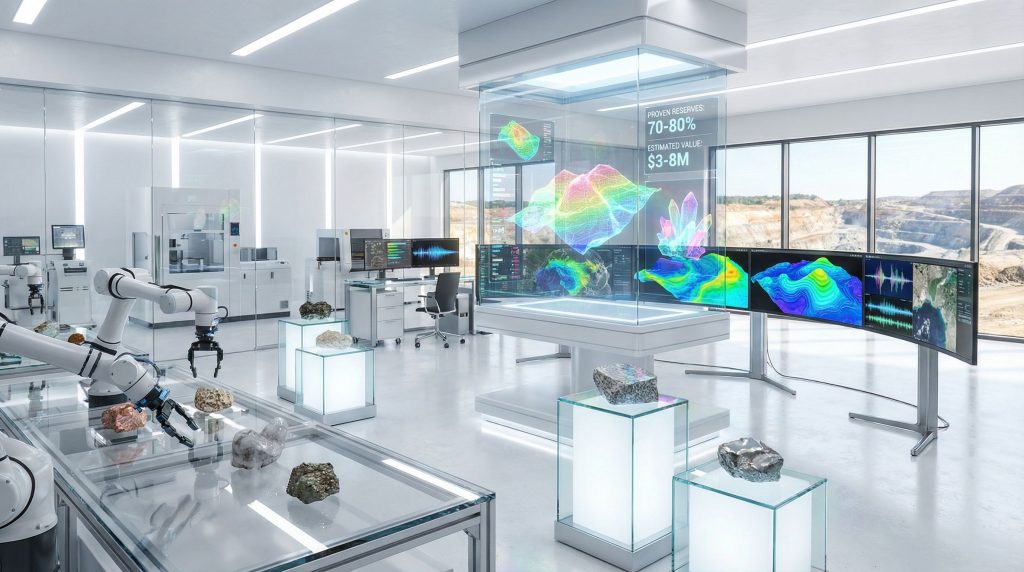
Three-dimensional geological reconstruction technologies enhanced by machine learning algorithms are revolutionising how exploration teams visualise and interpret subsurface geology. Voxel-based modelling systems can now incorporate AI optimisation routines that automatically adjust geological interpretations based on new data inputs, creating dynamic models that evolve as exploration programmes progress.
Geostatistical algorithms enhanced by AI pattern recognition provide more sophisticated approaches to spatial data analysis than traditional interpolation methods. These systems can identify complex spatial relationships in geological and geochemical data, enabling more accurate prediction of ore body continuity and grade distribution between drill holes.
Real-time model updating capabilities represent a fundamental shift from static geological interpretations to dynamic modelling systems that incorporate new information continuously. As drilling programmes generate additional data points, machine learning algorithms can automatically update geological models, structural interpretations, and grade distribution estimates without requiring complete reprocessing of existing datasets.
The advancement of 3D geological modelling technologies has become instrumental in creating more accurate subsurface representations that stakeholders can utilise for informed decision-making throughout the exploration process.
Uncertainty quantification in geological interpretations has become more sophisticated through probabilistic modelling approaches enhanced by AI systems. Rather than providing single-value estimates for geological parameters, these systems generate probability distributions that quantify confidence levels and identify areas where additional data collection would most effectively reduce uncertainty.
Multi-physics data integration platforms utilise AI algorithms to combine diverse geophysical datasets including gravity, magnetic, electromagnetic, and seismic surveys into coherent geological interpretations. These integrated approaches can identify mineralisation signatures that might be ambiguous in individual datasets but become clear when multiple data types are analysed simultaneously.
Geophysical data interpretation through neural networks enables automated identification of geological structures, lithological boundaries, and alteration zones from complex geophysical signatures. Deep learning models trained on extensive geophysical datasets can recognise patterns that correspond to specific geological features, reducing interpretation time and improving consistency across large survey areas.
What Implementation Challenges Must Companies Navigate?
Data quality and standardisation requirements represent fundamental challenges for organisations implementing AI systems in mineral exploration workflows. Geological databases often contain information collected over decades using varying analytical methods, sampling protocols, and quality control procedures. Machine learning algorithms require consistent, high-quality training data to function effectively, necessitating significant data cleansing and standardisation efforts.
Legacy data integration challenges arise when companies attempt to incorporate historical exploration information into AI-enhanced systems. Older datasets may lack the metadata, quality control documentation, or digital formats required for effective machine learning applications. Converting and validating these datasets requires substantial technical and financial resources.
Technical infrastructure considerations extend beyond simple computing power requirements to encompass data storage, networking, security, and processing capabilities. Large-scale geological datasets require significant storage capacity and high-speed processing capabilities that may exceed many organisations' existing IT infrastructure.
Furthermore, the broader context of mining industry innovation requires companies to balance technological advancement with practical implementation constraints while maintaining operational effectiveness.
Skilled personnel requirements represent a significant challenge as AI implementation requires expertise that spans geological knowledge, data science capabilities, and software engineering skills. This combination of expertise is relatively rare in the mineral exploration industry, creating competitive pressures for qualified personnel and potentially constraining implementation timelines.
Quality control frameworks for AI-generated results require development of new validation procedures and acceptance criteria. Traditional geological interpretation relies on professional judgement and peer review processes that may not be directly applicable to AI-generated analyses. Organisations must develop systematic approaches to validate algorithmic results and establish appropriate confidence thresholds.
Data security protocols become increasingly important as AI systems require access to proprietary geological information that represents significant competitive advantages. Protecting this information while enabling the data sharing necessary for effective AI training requires sophisticated cybersecurity measures and carefully structured access controls.
How Do Implementation Strategies Vary Across Exploration Phases?
Early-stage reconnaissance applications focus on regional-scale analysis where AI systems process large geographical areas to identify prospective regions for detailed investigation. Satellite-based spectral analysis, automated literature mining, and historical data pattern recognition provide cost-effective screening tools for identifying areas with mineral potential.
Regional prospectivity mapping utilises AI algorithms to integrate diverse regional datasets including geological maps, geochemical surveys, geophysical data, and remote sensing imagery. These systems can process information covering thousands of square kilometres to identify zones with elevated mineral potential based on learned associations between geological characteristics and known mineral occurrences.
Historical data pattern analysis enables identification of geological settings similar to known mineral deposits. Machine learning models trained on successful exploration case studies can identify analogous geological conditions in unexplored regions, providing systematic approaches to greenfield targeting that extend beyond traditional geological reasoning.
Consequently, organisations implementing AI‐driven mining efficiency programmes across different exploration phases report improved resource allocation and enhanced targeting capabilities.
Advanced exploration phase implementations require higher-resolution analysis and more sophisticated modelling approaches as exploration programmes focus on specific prospects rather than regional screening. High-resolution target definition, drilling optimisation, and resource estimation represent primary applications during this phase.
Drilling optimisation algorithms can analyse geological, geochemical, and geophysical data to recommend optimal drill hole locations, orientations, and depths for maximising information gain while minimising drilling costs. These systems consider factors including target geometry, geological complexity, and logistical constraints to develop efficient drilling programmes.
Real-time data processing enables adaptive exploration strategies where initial results inform subsequent data collection priorities. Machine learning models can process incoming analytical results during exploration programmes, enabling teams to modify sampling strategies, extend survey coverage, or adjust drilling programmes based on preliminary findings.
The next major ASX story will hit our subscribers first
What Economic Implications Are Emerging From AI Adoption?
Capital expenditure optimisation represents a primary economic driver for AI adoption in mineral exploration. Organisations implementing these technologies report improved efficiency in resource allocation, enhanced targeting accuracy, and reduced expenditure on unsuccessful exploration initiatives. The economic benefits extend beyond simple cost reduction to encompass improved probability of discovery success.
Return on investment calculations for AI technology implementation must consider both direct cost savings and indirect benefits including accelerated project timelines, improved resource estimation accuracy, and enhanced competitive positioning. While specific financial metrics vary based on implementation scope and geological setting, industry practitioners generally report positive economic outcomes within 2-3 year implementation periods.
Risk-adjusted net present value analysis incorporating AI success rates provides more sophisticated approaches to exploration project evaluation. These analyses can quantify the economic benefits of improved targeting accuracy, reduced exploration timelines, and enhanced resource definition capabilities that AI systems provide.
Industry-wide economic impact projections suggest that widespread AI adoption could substantially improve global exploration efficiency, potentially accelerating mineral discovery rates and reducing supply constraints for critical materials. These improvements become increasingly important as global demand for battery metals, rare earth elements, and other technology-critical materials continues growing.
Investment flow patterns are shifting toward exploration companies demonstrating effective AI implementation capabilities. Institutional investors and funding organisations increasingly recognise AI-enhanced exploration as a competitive advantage that justifies premium valuations and preferential investment allocation.
Operational cost reduction emerges from automated data processing, enhanced targeting accuracy, and improved project management capabilities. Organisations report substantial reductions in personnel time required for data interpretation, geological modelling, and exploration planning tasks.
How Are Regulatory Frameworks Adapting to AI-Enhanced Methods?
Resource classification protocols are evolving to accommodate AI-derived estimates and interpretations. Traditional mineral resource reporting standards developed before widespread AI adoption require adaptation to address questions about algorithmic transparency, validation procedures, and confidence level assessment for AI-generated analyses.
Transparency requirements for algorithmic decision-making represent emerging regulatory considerations as AI systems become integral to exploration targeting and resource estimation processes. Regulatory bodies are developing guidelines for documenting AI methodologies, validation procedures, and quality control measures in technical reports and resource disclosures.
International reporting standard adaptations address the need for consistent approaches to AI-enhanced exploration across different jurisdictions. Organisations including the Joint Ore Reserves Committee (JORC) and similar international bodies are developing guidelines for incorporating AI-generated analyses into mineral resource and reserve reporting.
For instance, according to Global Mining Review, regulatory frameworks worldwide are beginning to establish guidelines for AI transparency and validation procedures in mineral resource reporting, ensuring that algorithmic decision-making processes meet professional standards while enabling technological innovation.
Data governance considerations encompass both intellectual property protection and cross-border data sharing requirements. Organisations must navigate complex regulatory environments where geological data may have strategic national importance while still enabling the data sharing necessary for effective AI model training and validation.
Environmental impact assessment modifications may be required as AI-enhanced exploration enables identification of previously unknown deposits or alteration of traditional exploration approaches. Regulatory frameworks must adapt to address potential environmental implications of AI-driven exploration discoveries.
Intellectual property frameworks require clarification regarding ownership and protection of AI-generated geological interpretations, targeting recommendations, and resource estimates. These considerations become particularly important when multiple organisations collaborate on AI development or implementation initiatives.
What Future Developments Will Shape AI Applications?
Quantum computing applications represent a potentially transformative development for mineral exploration as these systems could process geological datasets and optimisation problems that exceed current computational capabilities. Complex geological modelling, large-scale data integration, and multi-parameter optimisation problems may become tractable with quantum computational resources.
Internet of Things sensor networks enable continuous environmental and geological monitoring that could provide unprecedented datasets for AI training and validation. Permanent sensor installations in exploration areas could collect real-time data on geochemical conditions, structural deformation, and environmental parameters that enhance AI model accuracy.
Blockchain technology applications may address data verification and intellectual property protection challenges in collaborative AI development initiatives. Distributed ledger systems could provide transparent, tamper-resistant documentation of data sources, algorithm development, and result validation procedures.
Augmented reality interfaces for field geology applications could transform how exploration geologists interact with AI-generated interpretations and recommendations. These systems could overlay AI-derived geological models, target recommendations, and analytical results onto real-world geological exposures, enhancing field decision-making capabilities.
Industry collaboration trends suggest movement toward open-source AI model development and shared training datasets that could accelerate technological advancement while reducing individual organisation implementation costs. Collaborative frameworks enable smaller organisations to access sophisticated AI capabilities that might otherwise require prohibitive development investments.
Academic-industry partnership frameworks are becoming increasingly important for advancing AI applications in mineral exploration. Universities provide research capabilities and theoretical foundations while industry organisations contribute practical experience, datasets, and implementation resources.
How Can Companies Develop Effective Implementation Strategies?
Organisational readiness assessment represents a critical first step in AI implementation planning. Companies must evaluate existing technical capabilities, data quality and availability, infrastructure requirements, and personnel skill levels to identify implementation prerequisites and potential obstacles.
Technical capability evaluation should encompass both geological expertise and data science capabilities within the organisation. Successful AI implementation requires teams that understand both the geological processes being modelled and the technical requirements of machine learning systems.
Staff training and development requirements often represent significant organisational investments as AI implementation requires personnel who can bridge geological knowledge and data science capabilities. Organisations may need to invest in extensive training programmes or recruit personnel with hybrid skill sets.
Technology selection criteria should consider factors including algorithm performance, implementation complexity, integration requirements with existing systems, and vendor support capabilities. Organisations must balance technical sophistication with practical implementation constraints and organisational capabilities.
Pilot project design provides opportunities to validate AI approaches on limited datasets or geographical areas before committing to enterprise-wide implementation. Successful pilot projects demonstrate technical feasibility, quantify economic benefits, and identify implementation challenges in controlled environments.
Performance measurement systems for AI initiatives require development of metrics that capture both technical performance and business value creation. Traditional exploration success metrics may require modification to account for AI system capabilities and limitations.
Change management protocols become particularly important as AI implementation often requires significant modifications to existing workflows, decision-making processes, and organisational structures. Successful implementation requires systematic approaches to managing these organisational transitions while maintaining operational effectiveness.
Disclaimer: This article contains analysis and projections about artificial intelligence applications in mineral exploration. The information presented is based on available industry reports, technical publications, and announced partnerships. Readers should conduct their own research and consult with qualified professionals before making investment or business decisions. Performance projections and economic benefits may vary significantly based on implementation approach, geological setting, and organisational capabilities. The mineral exploration industry involves substantial technical and financial risks that AI technology cannot eliminate entirely.
Want to Stay Ahead of the Next Major Mineral Discovery?
Discovery Alert's proprietary Discovery IQ model delivers real-time notifications on significant ASX mineral discoveries, enabling investors to capitalise on actionable opportunities before the broader market responds. Explore how historic discoveries have generated substantial returns and begin your 14-day free trial today to secure your competitive advantage in the evolving landscape of AI-enhanced exploration.