June 29, 2026
The Exploration Efficiency Crisis No One Is Talking About
The economics of mineral discovery have been quietly deteriorating for decades. Average discovery costs per unit of metal found have risen dramatically since the 1990s, while the grade of newly found deposits continues to trend downward. Understanding the importance of mineral exploration has never been more critical, as the industry spends more to find less, in harder places, under more complex political conditions. This structural squeeze is not a temporary cyclical problem. It reflects a fundamental depletion of the low-hanging geological fruit that sustained the 20th century mining boom.
The global demand projections for copper, lithium, cobalt, and rare earth elements, however, show no sign of moderating. The International Energy Agency has estimated that reaching net-zero emissions by 2050 would require a more than fourfold increase in mineral supply for clean energy technologies. The physics of the energy transition are non-negotiable. The copper in every wind turbine, the lithium in every battery cell, the rare earths in every electric motor all have to come from somewhere.
This is the paradox that defines modern mineral exploration: the world urgently needs new discoveries, yet the capital required to fund early-stage exploration remains stubbornly difficult to mobilise. Markets remain structurally risk-averse toward junior explorers, who have historically been responsible for the vast majority of significant new mineral discoveries. Into this gap, a new generation of analytical tools built on AI in mineral exploration and legacy data integration is beginning to offer a genuine structural solution.
When big ASX news breaks, our subscribers know first
Why Traditional Exploration Has Hit a Ceiling
The Political and Geological Double Bind
For much of the 20th century, mineral exploration operated in a relatively forgiving environment. Shallow, high-grade deposits in geologically predictable terrains and politically stable jurisdictions were available to explorers willing to apply basic geological methods. That era is effectively over.
As Botswana Minerals Managing Director James Campbell observed at a Seequent industry event in June 2026, future mineral discoveries will increasingly come from countries carrying elevated political risk. This creates a compounding problem. The geology that remains unexplored tends to be geologically complex, and the jurisdictions where it sits tend to be operationally difficult. The cost-per-metre of exploration drilling in frontier environments is substantially higher than in established mining districts, and the risk of capital loss is commensurately greater.
The industry's response to this challenge cannot simply be to drill deeper and wider. The economics do not support it. Instead, explorers must become radically more precise in deciding where to drill, using every available data signal to derisk targeting decisions before a single hole is committed to. This is where AI in mineral exploration and legacy data integration becomes not just useful but operationally essential.
The Capital Allocation Problem
Junior exploration companies, which have historically been described as the engine room of new mineral discovery, face a structural funding challenge that shows no sign of resolving. Institutional investors have largely retreated from early-stage exploration risk, preferring the relative certainty of producing assets or advanced development projects. The risk-return profile of greenfield exploration simply does not fit most portfolio mandates.
This capital scarcity imposes a brutal efficiency requirement. Every exploration dollar must work harder. Every drill hole must be better justified. Every geological interpretation must be more rigorous. Furthermore, the margin for methodological inefficiency that once existed has been almost entirely compressed away, making the mineral discovery curve increasingly difficult to navigate without smarter analytical tools.
"The challenge facing mineral exploration today is as much financial and informational as it is geological. Extracting maximum value from every dollar deployed means making better decisions before a single drill bit turns."
What Is Legacy Data and Why Is It a Strategic Asset?
Defining the Archive
In geoscience contexts, legacy data encompasses the full spectrum of historical exploration records accumulated over decades and sometimes centuries of past activity. This includes:
- Handwritten drill core logs from mid-20th century exploration programs
- Analogue geological maps produced by state-run geological surveys
- Geophysical survey reports stored in proprietary or obsolete formats
- Archived assay results from historical sampling campaigns
- Colonial-era reconnaissance surveys covering large areas of Africa, Latin America, and Central Asia
The critical characteristic of legacy data is that much of it exists in formats that are entirely incompatible with modern geoscience workflows. Physical documents, scanned PDFs without spatial referencing, early-generation databases that cannot be queried by contemporary software — these records represent enormous sunk capital: money that was spent gathering geological information that has never been fully monetised.
Africa's Underexplored Potential
The African continent presents perhaps the most compelling case for legacy data rescue and AI-assisted reanalysis. Despite possessing some of the world's most significant undeveloped critical mineral endowments, including world-class copper and cobalt systems in the Central African Copperbelt, extensive manganese deposits, and rare earth mineralisation across multiple geological provinces, Africa remains materially underexplored relative to its geological potential.
Extensive archives of historical exploration data from colonial-era surveys and mid-20th century state-run programs exist across the continent. However, the vast majority of this material has never been systematically digitised, georeferenced, or integrated into modern targeting workflows. Campbell described Africa's geological endowment as exceptional, noting that enormous opportunity exists to unlock value from very old data archives that have never been fully interrogated.
The implication is significant. A well-executed legacy data rescue program across priority African terrains could identify high-quality exploration targets at a fraction of the cost of equivalent greenfield fieldwork, effectively multiplying the value of past expenditure without additional boots-on-ground investment.
Comparing Data Types by AI Readiness
| Data Type | Format | Accessibility | AI Readiness |
|---|---|---|---|
| Historical drill logs | Paper / scanned PDF | Low | Requires preprocessing |
| Analogue geological maps | Physical / raster image | Low | Requires georeferencing |
| Early geophysical surveys | Proprietary formats | Medium | Partial conversion needed |
| Modern sensor data | Digital / structured | High | Immediately usable |
| Satellite remote sensing | Digital / georeferenced | High | Immediately usable |
How AI in Mineral Exploration Actually Works
Pattern Recognition at Scale
The core value proposition of AI in exploration success is its capacity to simultaneously ingest and cross-reference datasets of a scale and heterogeneity that no team of geologists could realistically process. Modern machine learning systems can integrate geophysical grids, geochemical sampling results, satellite-derived spectral data, structural geology interpretations, and historical drill intercepts, identifying non-linear spatial relationships and subtle geological correlations across all of them at once.
Campbell described this capability plainly: "AI can interrogate large heterogeneous databases and identify patterns that would take an army of geologists working over a considerable period to detect manually." The output is a statistically grounded, reproducible analytical result rather than a single interpreter's subjective reading of a geological map.
This matters for investor confidence as much as for geological accuracy. An auditable, reproducible AI-generated analysis of geological evidence is fundamentally more defensible in a board or capital markets context than an individual geologist's interpretive judgment. According to research on AI transforming mineral exploration, the shift from data overload to targeted discovery represents one of the most significant methodological advances the industry has seen in decades.
Predictive Prospectivity Modelling: How Targets Are Generated
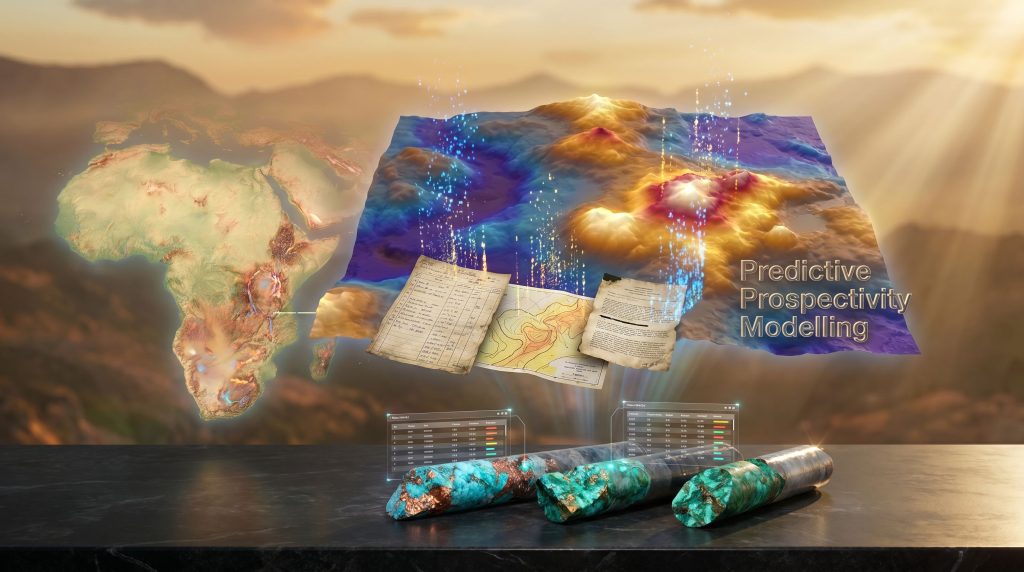
One of the most commercially significant AI applications in exploration is predictive prospectivity modelling. The process works as follows:
- Data ingestion: All available geological, geophysical, geochemical, and remote sensing datasets are compiled and standardised into a common spatial framework.
- Feature extraction: AI algorithms identify the spatial and attribute characteristics of known mineralisation occurrences within the dataset.
- Pattern generalisation: The system learns which combinations of geological features are statistically associated with economic mineralisation.
- Heatmap generation: A probabilistic prospectivity model is produced, ranking exploration ground by its likelihood of hosting deposits similar to the training examples.
- Target prioritisation: Discrete drillable target zones are identified from the highest-ranked prospectivity areas, dramatically narrowing the search space.
- Iterative refinement: As drilling results are acquired, the model is updated and refined, creating a dynamic targeting system rather than a static map.
This workflow compresses what would previously have been a multi-year targeting exercise into a process measurable in weeks or months, with continuous improvement built into the methodology.
Legacy Data Rescue: The Technical Mechanics
Converting dormant archival records into active exploration assets requires a specific set of AI capabilities that have matured substantially in recent years:
- Automated georeferencing: AI systems can identify spatial control points in historical maps and register them to modern coordinate systems without manual intervention at scale.
- Raster to vector conversion: Scanned map images are processed to extract geological boundaries, structural lineaments, and mineralisation polygons as spatially queryable vector layers.
- Natural language processing (NLP): Unstructured text from old drill logs and exploration reports is parsed by NLP algorithms to extract lithological descriptions, mineralisation intervals, downhole depths, and sample results.
- Data normalisation: Inconsistent historical data conventions are harmonised so that records from different time periods and survey programs can be meaningfully compared.
The net result of this process is that archival files are transformed from passive storage into active, queryable exploration datasets that can be integrated with modern geoscience platforms.
Emerging Frontiers: Agentic AI and Real-Time Integration
Beyond current capabilities, Campbell highlighted two near-term developments that will further accelerate the AI transition in exploration. Real-time integration of downhole geophysics with live geological models during active drilling programs will compress the feedback loop between data acquisition and geological interpretation from weeks to hours. Agentic AI workflows, where systems autonomously execute complex multi-step analytical sequences without continuous human direction, are beginning to appear in advanced exploration programs and are expected to become more widespread.
These capabilities represent a qualitative shift in how exploration programs are managed. Rather than generating a static interpretation at the end of a field season, geological understanding will evolve continuously and in real time as new data is acquired.
The Human-Machine Partnership: What AI Cannot Replace
Augmentation, Not Substitution
A persistent misconception in discussions of AI in mineral exploration and legacy data is that machine learning systems will eventually replace geologists. Campbell was direct in challenging this framing. "AI is not here to replace the geologist. Its value lies in enabling geological work to proceed more quickly and more efficiently, with a clearer view of the risks and uncertainties involved." Human judgment retains capabilities that no current AI system can replicate.
The areas where human expertise remains genuinely non-negotiable include:
- Genetic interpretation: AI identifies statistical patterns in data but cannot independently assign geological meaning to mineralisation systems. Understanding why a deposit formed in a particular location requires conceptual geological knowledge that AI cannot generate from data alone.
- Scepticism and quality control: Experienced geologists are essential for interrogating AI outputs, identifying model artefacts, and preventing over-reliance on algorithmic results that may reflect data biases rather than genuine geological signals.
- Accountability: Investment decisions, resource estimates, regulatory submissions, and professional liability all require human sign-off. AI outputs are analytical inputs to human decisions, not substitutes for them.
- Ground-truthing: Physical sampling, core logging, and drilling verification are irreplaceable. No computational model can confirm the presence of an economic mineral deposit.
Responsible AI Deployment: Four Governing Principles
Campbell emphasised that AI needs to be used responsibly. A practical framework for responsible AI deployment in exploration rests on four foundations:
- Data discipline: AI performance is strictly bounded by input data quality. Incomplete, inconsistent, or geographically biased datasets will produce unreliable outputs regardless of algorithmic sophistication. The geological principle of garbage-in, garbage-out applies with full force.
- Transparent uncertainty communication: AI outputs should explicitly convey confidence levels and data gaps, not just ranked target lists. Investors and boards need to understand the uncertainty envelope around any AI-generated geological interpretation.
- Iterative validation: Predictive models must be continuously tested against physical drilling results and updated accordingly. A model that is never challenged by new data will become progressively less reliable.
- Ethical data governance: Particularly relevant when working with legacy data from regions with complex colonial histories or unclear state-ownership regimes. The provenance and legal status of historical datasets must be carefully assessed before they are incorporated into exploration targeting workflows.
Who Will Win the Next Era of Mineral Discovery?
The Three-Pillar Competitive Framework
Campbell's assessment of where competitive advantage will concentrate in next-generation mineral exploration identifies three converging capabilities that successful explorers will need to combine: superior data discipline, rigorous geological judgment, and the execution capacity to fund sustained programs.
This framework has important implications for how junior exploration companies are evaluated. The winners will not necessarily be the companies with the largest tenement portfolios. They will be the companies that have built the most robust, curated, and proprietary geological databases, combined with the analytical capability to extract maximum targeting value from those assets and the financial structure to sustain exploration through to discovery.
"The future of mineral exploration belongs to those who can unite geological discipline with computational capability and commercial constraint. Data quality, analytical rigour, and funding durability are the three pillars that will define the next generation of mineral discovery."
Africa as the Highest-Return AI Exploration Frontier
The intersection of extensive legacy data archives, significant geological potential, and material underexploration makes Africa particularly compelling for AI-assisted exploration programs. The combination of historical data richness accumulated over colonial and post-colonial exploration programs and the availability of modern AI tools capable of rescuing and analysing that data creates an asymmetric opportunity. Explorers willing to invest in data infrastructure in priority African terrains may be able to identify high-quality targets at a cost structure that is simply not achievable through conventional greenfield methods.
Platform Integration: Lowering the Adoption Barrier
Specialist subsurface software platforms are increasingly embedding AI and machine learning capabilities directly into established geoscience workflows. This integration is commercially significant because it lowers the adoption barrier for smaller operators. Junior exploration companies that lack dedicated data science teams can access AI-powered prospectivity modelling through the same platforms they already use for geological modelling and data management, without needing to build specialised technical capability from scratch.
Seequent, a subsidiary of Bentley Systems and one of the leading providers of subsurface solutions software globally, serves the full spectrum of the mining industry from major diversified miners through to junior exploration companies and independent geoscience consultancies. Events like its annual Seequent Day, which brought together industry speakers and customer case studies in June 2026 focused on improving subsurface understanding, reflect a broader industry movement toward embedding AI capability within accessible professional workflows. Furthermore, insights into unlocking legacy data for mineral discovery suggest that this integration trend will only accelerate as platforms mature and adoption broadens across the sector.
The next major ASX story will hit our subscribers first
Frequently Asked Questions: AI in Mineral Exploration and Legacy Data
What is AI used for in mineral exploration?
AI is used to analyse large, heterogeneous geological datasets including historical legacy records, geophysical surveys, geochemical sampling results, and satellite imagery. It identifies statistical patterns associated with mineral deposits, generates ranked exploration targets through prospectivity modelling, and quantifies geological uncertainty. The primary commercial benefit is accelerating and improving the precision of the pre-drilling targeting phase, allowing limited exploration budgets to be allocated more effectively.
Can AI find mineral deposits on its own?
No. AI generates probabilistic target predictions based on data patterns but cannot physically confirm the presence of an economic deposit. Physical drilling, sampling, and laboratory analysis remain the definitive verification methods. AI functions as an analytical accelerant that supports geological expertise and investment decision-making, not as a replacement for either.
What is legacy data in mining exploration?
Legacy data refers to historical geological records accumulated over decades or centuries of past exploration activity. This includes handwritten drill logs, analogue geological maps, early geophysical survey reports, and archived assay results, much of which exists in unstructured, non-digital formats that have never been integrated into modern exploration workflows.
Why is Africa a priority for AI-assisted exploration?
Africa holds significant underdeveloped critical mineral resources but remains underexplored relative to its geological potential. Extensive legacy data archives from historical exploration programs exist across the continent. AI-assisted digitisation and reanalysis of these records offers a high-return pathway to identifying new targets at a lower cost than equivalent greenfield fieldwork. Consequently, interpreting drill results from AI-prioritised targets in these regions is becoming an increasingly important skill for investors and explorers alike.
What are the biggest risks of using AI in mineral exploration?
The primary risks include over-reliance on AI outputs without adequate geological interpretation, poor input data quality producing unreliable predictions, and the mistaken assumption that AI eliminates exploration risk. Responsible deployment requires rigorous data governance, transparent uncertainty communication, continuous validation against physical drilling results, and maintained human accountability for all significant decisions.
Disclaimer: This article is intended for informational purposes only and does not constitute financial or investment advice. Statements regarding AI capabilities, exploration outcomes, and market dynamics involve forward-looking assessments that are subject to uncertainty. Readers should conduct independent due diligence before making any investment decisions.
Want to Know When AI Uncovers the Next Major ASX Mineral Discovery?
Discovery Alert's proprietary Discovery IQ model does the hard work for you — scanning ASX announcements in real time and delivering instant alerts on significant mineral discoveries across 30-plus commodities, so you can act before the broader market catches on. Explore historic discoveries and their extraordinary returns, then start your 14-day free trial at Discovery Alert to position yourself at the forefront of the next major find.