August 21, 2026
Machine learning algorithms have fundamentally transformed how geological data reveals subsurface mineral deposits, creating unprecedented opportunities for exploration efficiency across diverse terranes. Neural networks now process decades of exploration records simultaneously, identifying subtle patterns that traditional interpretation methods struggle to detect. This technological evolution represents more than incremental improvement – it constitutes a systematic reimagining of how AI in mineral exploration operates at every operational scale.
What Role Does AI Play in Revolutionizing Resource Discovery Methods?
Machine Learning Applications in Geological Data Processing
Supervised learning algorithms transform labeled geological datasets into predictive models by analyzing relationships between known mineral occurrences and their associated geological signatures. These systems excel when trained on comprehensive databases containing 50+ years of global geological exploration records, enabling pattern recognition across multiple deposit types and geological environments. Random Forest algorithms demonstrate particular effectiveness in handling complex, non-linear relationships within geological datasets where traditional mathematical formulas cannot adequately express the connections between input variables and mineral deposit locations.
Unsupervised learning approaches operate without pre-existing labels, discovering previously unrecognized patterns within geological data that might indicate new mineral systems. K-means clustering algorithms group geological features based on similarity metrics, achieving variable accuracy rates but delivering very high processing speeds that enable real-time analysis during field operations. These methods prove especially valuable in frontier exploration areas where limited historical data exists for supervised training.
Deep learning frameworks process what geologists term "multi-dimensional" exploration data, integrating satellite imagery, hyperspectral measurements, geochemical analyses, geophysical surveys, and historical drilling records simultaneously. Convolutional neural networks designed for image classification consistently achieve 90-97% accuracy rates in mineral identification tasks, representing substantial improvement over traditional visual estimation methods that typically achieve 75-85% accuracy depending on interpreter expertise.
Integration of Remote Sensing and AI Technologies
Computer vision algorithms analyze satellite imagery to identify surface geological features, mineral staining patterns, and structural characteristics across vast geographic areas with minimal fieldwork requirements. Modern satellite systems provide imagery resolution ranging from approximately 30 meters per pixel for freely available data to less than one meter for commercial systems, enabling geological feature detection from regional scales down to localized deposit-scale phenomena.
Hyperspectral data interpretation through automated classification systems detects color variations in satellite imagery that correspond to specific mineral assemblages. These systems prove particularly effective in arid regions where surface geological features remain relatively unobstructed by vegetation cover. Furthermore, AI-powered exploration tools have successfully identified previously undiscovered deposits through pattern recognition applied to surface color variations and structural features visible in satellite imagery.
Drone-based surveying platforms equipped with multispectral or hyperspectral sensors collect high-resolution imagery over specific target areas while flying patterns optimized by AI systems for complete coverage with minimal redundancy. Real-time processing capabilities during flight operations allow field teams to adapt survey strategies immediately when anomalous features are detected, significantly improving survey efficiency compared to predetermined flight patterns.
When big ASX news breaks, our subscribers know first
Which AI Technologies Are Delivering the Greatest Impact on Drilling Efficiency?
Predictive Modeling for Target Identification
Support Vector Machine algorithms identify optimal decision boundaries within geological data and often provide superior performance when relationships within datasets can be expressed through relatively clear mathematical distinctions between mineralized and non-mineralized zones. These systems achieve 80-88% accuracy ranges while maintaining high processing speeds suitable for operational decision-making timelines.
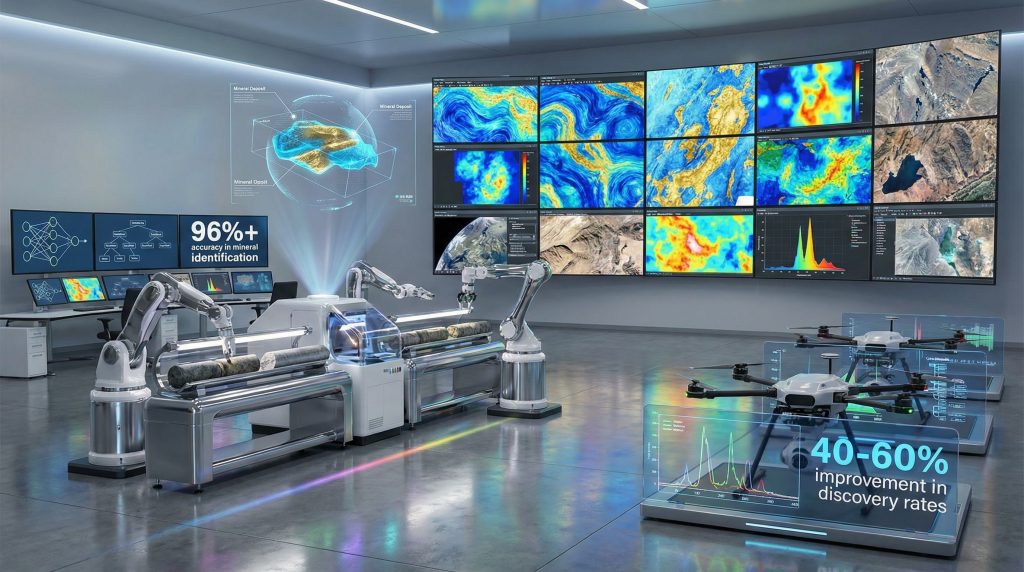
Ensemble methods combine predictions from multiple algorithms to generate consensus predictions, reducing likelihood that results will be biased by specific characteristics of individual algorithms. The theoretical foundation rests on the principle that when diverse prediction methods align, resulting predictions carry higher confidence than any single method could provide. Research indicates that major mining corporations report 40-60% improvement in discovery rates through implementation of these integrated ai mining efficiency strategies.
Probabilistic models explicitly quantify uncertainty in predictions rather than providing single-point estimates, enabling exploration teams to assess not only where mineral deposits are likely to occur but also confidence levels of such predictions. A prediction indicating 85% probability of mineralization carries different risk implications than a prediction indicating 50% probability, even when both indicate the same target location.
Advanced Image Recognition in Core Sample Analysis
Automated core logging systems examine digital images of drill core samples and identify individual mineral phases, their proportions, and spatial relationships with 96%+ accuracy rates in mineral identification tasks. This performance specification reflects testing on core samples from known mineral deposits where correct mineral identification is established through independent analytical methods such as X-ray diffraction.
Real-time analysis capabilities during drilling operations compress traditional analytical timelines from days or weeks to immediate results, enabling drilling operations to continue uninterrupted while analytical results inform adaptive drilling strategies during hole progression. Traditional exploration workflows involve drilling, core sample removal, laboratory transportation, analytical work over extended periods, and only then deciding whether to continue drilling or relocate – a process that real-time AI in mineral exploration analysis fundamentally streamlines.
The implementation of automated core analysis systems demonstrates particular utility in drilling programs targeting narrow mineral zones within thick sequences of barren host rock. In addition, sophisticated drill result interpretation enables drilling teams to decide immediately whether to continue drilling deeper, move laterally, or terminate holes, directly translating to reduced total drilling meters required to define deposit geometries and ore grade distributions.
How Are Leading Mining Companies Implementing AI-Driven Exploration Strategies?
Corporate Case Studies and Success Metrics
Integration timelines for AI technology adoption across exploration operations vary from 6-18 months for companies with robust data infrastructure to 2-4 years for organizations with legacy systems requiring substantial data migration and staff retraining. These timelines reflect both technical requirements including building data warehouses and integrating disparate systems, as well as human factors encompassing staff training and organizational change management.
Cost reduction strategies through targeted drilling programs represent one of the most quantifiable benefits of AI exploration implementation. Traditional exploration programs typically conduct exploratory drilling with 10-40% success rates in intersecting ore-grade mineralization, meaning 60-90% of holes fail to encounter economic mineralization. When AI-enhanced prospectivity mapping increases success rates to 20-60%, the reduction in drilling meters required becomes substantial – if targets previously required 10 holes to discover specific ore tonnages, improved success rates enable achieving identical objectives with only 5 holes.
Major mining companies establishing AI-enhanced exploration divisions report that organizational change management represents a more significant barrier than technical implementation challenges. This reflects the reality that AI systems require exploration geologists to collaborate with data scientists and software engineers, shifting away from traditional workflows where individual geologists made targeting decisions based purely on technical judgment.
Startup Innovation in AI-Powered Mineral Discovery
Emerging AI-focused exploration companies leverage comprehensive geological databases spanning multiple decades to train models across diverse deposit types and geological environments. These organizations often achieve precision targeting methodologies reducing exploration areas to 2km² zones, dramatically focusing field efforts compared to traditional regional-scale exploration approaches.
Startup companies frequently demonstrate success rate improvements in brownfield exploration scenarios where historical mining or exploration has established baseline geological understanding. In such contexts, AI models trained on regional historical exploration data identify patterns in successful past discoveries, focusing subsequent exploration efforts on areas with geological characteristics most similar to known deposits.
The diversity of geological settings necessitates deployment of multiple AI models rather than single universal approaches. However, the broader mining industry evolution encompasses both copper porphyry systems and sediment-hosted stratabound deposits that require distinct models because geological indicators distinguishing mineralized from barren rocks differ fundamentally between deposit types.
What Data Sources Power Modern AI Exploration Systems?
Multi-Modal Dataset Integration Techniques
Corporate-scale AI implementation typically involves construction of centralized geological databases where all exploration data including core sample descriptions, drill hole locations, geochemical analyses, geophysical measurements, and historical assay results is consolidated into standardized formats. This data centralization enables AI model training across all historical exploration conducted by companies and allows newly acquired data to be immediately incorporated into models.
Geophysical survey data processing utilizes correlation algorithms to identify relationships between subsurface physical properties and mineral occurrences. Magnetic, gravitational, electromagnetic, and seismic data undergo automated interpretation through machine learning systems trained to recognize geophysical signatures associated with different mineral deposit types.
Geochemical analysis automation employs pattern detection algorithms to identify anomalous element concentrations and element association patterns indicative of mineral systems. These systems process soil samples, rock chip analyses, and stream sediment data to generate integrated geochemical anomaly maps that guide subsequent exploration targeting. Furthermore, data-driven mining operations are increasingly relying on these automated processes to enhance exploration efficiency.
Quality Control and Data Validation Frameworks
Data governance protocols define who can access different categories of data, how data quality is monitored and maintained, and what permissions are required to modify or reinterpret historical information. These protocols protect data integrity and prevent scenarios where inaccurate historical interpretations propagate into AI models, ensuring model training utilises only verified, high-quality datasets.
Cross-validation methodologies deliberately withhold data from model training to test prediction accuracy on unknown areas. This approach enables objective assessment of model performance by comparing predictions against actual exploration results in areas where the model had no prior knowledge of mineral occurrences or geological conditions.
Historical drilling records require careful handling of incomplete or inconsistent data, as exploration databases often span decades with varying data collection standards and analytical methodologies. AI systems must account for these inconsistencies through data preprocessing and normalisation techniques that standardise different measurement types and scales into unified datasets suitable for machine learning applications.
Which Specific AI Algorithms Are Most Effective for Different Mineral Types?
Commodity-Specific Algorithm Selection
Copper and base metals exploration utilises clustering algorithms and anomaly detection systems optimised for identifying the large-scale alteration patterns and geochemical signatures characteristic of porphyry and volcanic-hosted massive sulfide deposits. These algorithms excel at processing multi-element geochemical data where copper mineralisation associates with specific suites of pathfinder elements including molybdenum, gold, and various alteration indicators.
Precious metals exploration employs classification models for grade estimation, addressing the challenge that gold and silver deposits often occur in narrow, high-grade zones that require precise spatial targeting. Neural network architectures prove particularly effective for these applications due to their ability to identify complex spatial relationships between geological features and precious metal concentrations.
Critical minerals exploration utilises specialised neural networks designed for rare earth element identification, reflecting the unique geological environments and mineral assemblages associated with these strategically important commodities. These systems must distinguish between different rare earth element profiles and their associated mineral phases, requiring training on specialised datasets from known critical mineral deposits.
Algorithm Performance Comparison Analysis
| Algorithm Type | Best Applications | Accuracy Range | Processing Speed | Data Requirements |
|---|---|---|---|---|
| Random Forest | Prospectivity mapping | 85-92% | High | Moderate |
| Neural Networks | Image classification | 90-97% | Medium | High |
| Support Vector Machines | Grade prediction | 80-88% | High | Moderate |
| K-means Clustering | Geological grouping | Variable | Very High | Low |
Random Forest algorithms demonstrate particular effectiveness in prospectivity mapping applications where 85-92% accuracy ranges combine with high processing speeds to enable real-time exploration targeting decisions. These systems handle complex, non-linear relationships within geological datasets while maintaining computational efficiency suitable for field deployment.
Neural network architectures achieve 90-97% accuracy in image classification tasks but require medium processing speeds due to computational complexity. These systems excel in automated core sample analysis and satellite imagery interpretation where high accuracy justifies longer processing times.
How Does AI Address Environmental and Sustainability Concerns in Exploration?
Environmental Impact Reduction Strategies
Precision targeting through AI in mineral exploration analysis minimises surface disturbance by focusing exploration activities on areas with highest probability of containing economic mineralisation. Traditional exploration often involves systematic grid drilling across large areas, while AI-enhanced targeting can reduce exploration footprints by factors of five or more through improved target selection accuracy.
Water usage optimisation in drilling operations utilises AI-powered planning systems that minimise total drilling requirements while maximising geological information acquisition. These systems calculate optimal drill hole spacing and depths based on geological complexity, reducing water consumption and associated environmental impacts of exploration programmes.
Wildlife habitat protection benefits from intelligent survey routing algorithms that plan exploration access routes and drilling locations to minimise disruption to sensitive ecological areas. Consequently, decarbonisation in mining efforts increasingly incorporate AI systems that can integrate environmental constraint mapping with geological targeting to identify optimal exploration strategies that balance discovery objectives with environmental stewardship.
Regulatory Compliance and Monitoring Systems
Automated environmental impact assessments utilise AI systems to predict potential environmental consequences of proposed exploration activities before implementation. These systems integrate geological, hydrological, and ecological data to model how exploration activities might affect local ecosystems and groundwater systems.
Real-time monitoring of exploration activities employs sensor networks and AI analysis to track environmental parameters during drilling operations. These systems can detect deviations from environmental baselines and alert operators to potential issues before they become significant environmental impacts.
Predictive models for environmental risk evaluation help exploration companies assess potential long-term consequences of different exploration strategies. These models consider factors including groundwater contamination potential, surface water impacts, and soil disturbance to guide environmentally responsible exploration planning.
The next major ASX story will hit our subscribers first
What Are the Current Limitations and Challenges of AI in Mineral Exploration?
Technical Constraints and Data Requirements
Quality and quantity thresholds for effective AI model training require substantial datasets that many exploration companies struggle to assemble. Models trained on insufficient data may produce unreliable predictions or fail to generalise effectively to geological conditions different from training datasets. Minimum dataset requirements often exceed what individual exploration projects can generate, necessitating regional or industry-wide data sharing arrangements.
Geological complexity factors challenge current algorithms when dealing with structurally complex terranes, metamorphic overprinting of original deposit characteristics, or deposit types with limited historical analogs in training datasets. AI systems trained primarily on well-documented deposit types may perform poorly when applied to novel geological environments or deposit styles not adequately represented in training data.
Integration difficulties with legacy exploration systems create technical barriers for companies with substantial investments in existing geological databases and interpretation workflows. Many exploration companies operate multiple software platforms that do not communicate effectively, requiring expensive and time-consuming data migration projects to enable AI implementation.
Economic and Operational Barriers
Initial investment costs for AI implementation include not only software and computing infrastructure but also data preparation, staff training, and organisational change management expenses. These upfront costs can range from hundreds of thousands to millions of dollars depending on implementation scope and existing technological infrastructure.
Skills gaps within geological teams create ongoing challenges as successful AI implementation requires collaboration between geologists, data scientists, and software engineers. Many exploration companies lack internal expertise in machine learning and data science, necessitating either external consulting or substantial staff development investments.
Return on investment timelines for AI exploration systems often extend over multiple exploration cycles, making financial justification challenging in industry contexts where quarterly performance metrics dominate decision-making. The lag between AI implementation and measurable improvements in discovery rates can test organisational commitment to these technological investments.
How Will AI Technology Continue to Evolve in Mineral Exploration?
Emerging Technologies and Future Applications
Quantum computing applications for complex geological modelling represent a frontier technology that could address current computational limitations in processing massive geological datasets. Quantum algorithms may eventually enable real-time analysis of geological complexity that currently requires substantial computing resources and extended processing times.
Edge computing solutions enable real-time field analysis by deploying AI processing capabilities directly to drilling rigs and field survey equipment. These systems reduce dependence on internet connectivity and cloud computing resources while enabling immediate analytical results during field operations.
Augmented reality integration with AI-powered geological interpretation creates immersive visualisation environments where geologists can interact with three-dimensional geological models enhanced by AI predictions. For instance, advanced digital exploration techniques combine human geological expertise with AI analytical capabilities to improve interpretation accuracy and decision-making speed.
Industry Transformation Timeline and Predictions
Short-term developments between 2025-2027 focus on enhanced automation and accuracy improvements in existing AI applications. Current research emphasises improving model accuracy, reducing computational requirements, and expanding successful AI in mineral exploration applications to additional deposit types and geological environments.
Medium-term evolution from 2028-2030 anticipates development of fully integrated AI exploration workflows where multiple AI systems operate collaboratively across all phases of exploration from initial targeting through resource definition drilling. These integrated systems would optimise exploration strategies continuously based on incoming data and evolving geological understanding.
Long-term vision beyond 2030 envisions autonomous exploration systems capable of independent decision-making throughout exploration processes. These systems would integrate AI analysis with robotic drilling and sampling systems to conduct exploration programmes with minimal human intervention while maintaining safety and environmental compliance standards.
What Steps Should Mining Companies Take to Implement AI Exploration Programs?
Strategic Planning and Technology Assessment
Evaluation frameworks for AI readiness should assess existing data infrastructure, staff technical capabilities, and organisational readiness for technological change. Companies must evaluate whether their current geological databases contain sufficient quality and quantity of data to support AI model training, and identify data gaps that require addressing before successful implementation.
Partner selection criteria for AI technology providers should emphasise proven experience in geological applications rather than general AI capabilities. Successful partnerships require technology providers who understand geological principles and exploration workflows, not merely companies with strong general AI expertise.
Risk assessment and mitigation strategies must address both technical risks including model accuracy and reliability, and organisational risks including staff resistance and integration challenges. Successful AI adoption requires realistic assessment of implementation timelines and potential obstacles that could affect project success.
Implementation Roadmap and Best Practices
Pilot programme development should focus on specific exploration challenges where AI can demonstrate clear value rather than attempting comprehensive system-wide implementation immediately. Successful pilot programmes establish proof of concept while building internal expertise and organisational confidence in AI applications.
Staff training and change management considerations require ongoing commitment to developing internal capabilities rather than relying entirely on external consultants. Companies that invest in training existing geological staff rather than replacing personnel typically achieve more successful organisational transitions and better integration of AI capabilities with existing geological expertise.
Scalability planning for enterprise-wide deployment should consider how successful pilot programmes can expand across different geographical regions, deposit types, and operational scales. Effective scalability requires standardised data formats, consistent analytical protocols, and organisational processes that can accommodate expanded AI implementation.
Important Disclaimer: The information presented in this article is for educational and informational purposes only. AI in mineral exploration remains an evolving field with varying degrees of proven effectiveness across different geological environments and deposit types. Performance claims and accuracy statistics should be independently verified before making investment or operational decisions. Readers are advised to consult with qualified geological and technical professionals before implementing AI technologies in exploration programmes.
The integration of artificial intelligence into mineral exploration represents a fundamental transformation of how the mining industry approaches resource discovery. While technological capabilities continue advancing rapidly, successful implementation requires careful consideration of geological complexity, organisational readiness, and economic factors. Companies that approach AI adoption strategically, with realistic expectations and appropriate technical support, position themselves to benefit from these powerful technological capabilities while avoiding common implementation pitfalls that have challenged early adopters across various industries.
Looking to Capitalise on AI-Driven Mining Discoveries?
Whilst AI revolutionises mineral exploration, Discovery Alert's proprietary Discovery IQ model ensures you never miss the market-moving announcements that follow these technological breakthroughs. Stay ahead of major ASX mineral discoveries with real-time alerts that turn complex geological data into actionable investment insights, giving you immediate access to the next generation of AI-enhanced exploration successes.