
August 4, 2026
The Productivity Paradox at the Heart of Mining's AI Era
Every major productivity leap in mining history has arrived with a paradox attached. Mechanisation promised to remove the physical limits of human labour, yet the mines that extracted the most value were those that paired machinery with experienced operators who understood its limitations. Automation followed the same pattern. The technology created capability; human judgment determined whether that capability translated into operational gain.
Artificial intelligence is following this same structural arc, but with an additional layer of complexity. Unlike mechanisation or automation, AI produces probabilistic outputs rather than deterministic ones. A conveyor either runs or it does not. An AI recommendation carries a confidence interval, a set of assumptions, and a dependence on data quality that demands contextual interpretation before it becomes actionable. In an industry where the consequences of misreading a process signal can cascade across interconnected systems in minutes, that distinction is not a technical footnote. It is the central operational challenge of AI in mining human expertise integration.
The companies generating genuine value from AI deployments are not those with the most sophisticated models. They are those that have recognised AI as an instrument requiring skilled interpretation, and have built their adoption frameworks around that reality.
When big ASX news breaks, our subscribers know first
What Mining's Institutional Memory Actually Contains
There is a category of knowledge inside mining operations that has never appeared in a training manual, a standard operating procedure, or a process flowsheet. It lives in the accumulated sensory awareness of people who have spent decades on site. An experienced process operator does not simply read instruments; they integrate subtle cues that arrive simultaneously from multiple sources: the pitch of a pump, the colour of froth in a flotation cell, the way vibration patterns shift during certain ore transitions.
This capability, known in organisational psychology as tacit knowledge, is both extraordinarily valuable and structurally difficult to transfer. Unlike explicit knowledge, which can be documented and taught, tacit knowledge is developed through years of direct experience and is often held unconsciously by the person who possesses it. A long-serving operator on a processing plant may not be able to articulate exactly why they adjusted a reagent dosing rate at a specific moment, but their intervention prevented a recovery loss that no automated system had flagged.
The retirement wave moving through Australia's mining workforce is placing this knowledge base under acute pressure. The sector is facing a structural transition in which large cohorts of experienced operators, maintenance specialists, and engineers are approaching the end of their working lives at a time when replacement pipelines are under-resourced and formal training programs cannot replicate site-specific expertise.
The operational risk is not simply a skills gap. It is the permanent erasure of decision-making intelligence that took decades to accumulate and exists nowhere in any documented form.
This is precisely where AI in mining human expertise integration offers its most compelling long-term value proposition. When AI systems are built in genuine partnership with experienced operators, involving structured knowledge elicitation before any model development begins, the technology functions as a preservation mechanism. The pattern recognition, anomaly thresholds, and decision logic that experienced personnel carry internally can be systematically encoded into AI training datasets, creating a form of institutional memory that survives workforce transitions.
The critical distinction is methodology. An AI model built entirely on operational data captures what happened. A model built on operational data combined with expert knowledge captures what it meant and what the appropriate response should have been. These produce very different operational outcomes.
Mapping the Full Landscape: Over 150 Distinct AI Applications
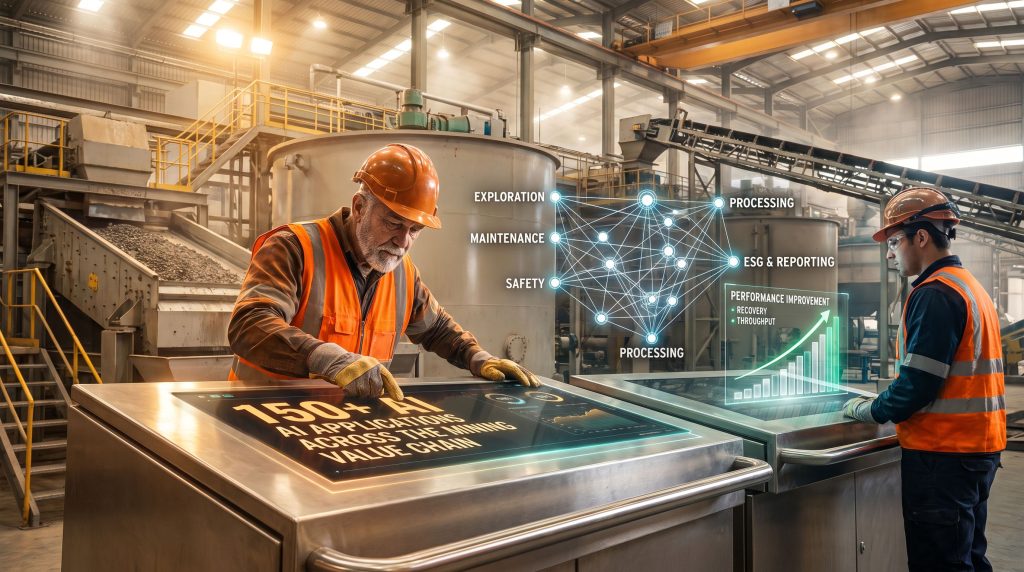
One of the least appreciated dimensions of AI in mining is the sheer breadth of its applicability across the value chain. Industry analysis identifies more than 150 distinct AI application categories spanning every stage from exploration targeting to ESG compliance reporting. The challenge confronting most mining operations is not a shortage of AI opportunity; it is the strategic question of where to begin.
Furthermore, AI in mineral exploration is increasingly demonstrating its capacity to process geological survey data at a scale that fundamentally changes how target generation is approached.
| Value Chain Stage | AI Application Category | Operational Examples |
|---|---|---|
| Exploration | Target generation and anomaly detection | Geological survey analysis, satellite imagery interpretation, drill data pattern recognition |
| Mine Planning | Optimisation modelling | Pit design, ore body scheduling, grade control algorithms |
| Processing | Plant performance optimisation | Recovery improvement, throughput modelling, reagent dosing optimisation |
| Maintenance | Predictive and prescriptive maintenance | Equipment health monitoring, failure precursor detection, parts demand forecasting |
| Safety | Risk identification and environmental monitoring | Fatigue detection systems, proximity alerts, hazardous atmosphere mapping |
| Workforce | Knowledge management and capability development | Operator decision support tools, simulation-based training platforms |
| ESG and Reporting | Emissions tracking and compliance monitoring | Energy consumption analytics, water management systems, regulatory reporting automation |
Mineral processing plants consistently emerge as the optimal starting point for AI adoption programs, and the operational logic is straightforward. Processing facilities generate dense, continuous streams of historical operational data. They typically carry existing sensor infrastructure. And critically, their performance outcomes — including recovery rates, throughput volumes, and reagent consumption — are directly measurable against clear benchmarks. This combination allows AI-generated recommendations to be tested, validated, and refined in near real-time without requiring major capital expenditure to establish the data foundation.
This is not a universally understood starting point. Many organisations drawn to data-driven mining operations begin by reaching for the most visible or technologically impressive applications, which are often the least operationally grounded. The processing plant entry point is less glamorous but substantially more likely to generate demonstrated value within a timeframe that builds internal confidence for broader adoption.
The Self-Funding Deployment Model: Building Momentum From Early Returns
One deployment architecture gaining traction across the sector involves structuring initial AI programs to generate returns sufficient to fund subsequent phases without requiring ongoing capital allocation. This model reframes AI adoption from a technology investment into a cash-generating operational program, which fundamentally changes the internal conversation around adoption.
The benchmark target for a well-designed, single-challenge AI program deployed in a mineral processing environment is a return of up to 10 times the initial investment within six months. This figure is not a theoretical ceiling; it reflects the magnitude of value available when AI is applied to a clearly defined, high-impact operational constraint in an environment with sufficient data maturity.
The step-by-step structure of a focused deployment looks like this:
- Define a single measurable operational challenge where success criteria can be specified before any technology work begins
- Conduct structured knowledge elicitation with experienced operators and engineers as a mandatory prerequisite to model development
- Integrate historical operational data with domain expert input to build a contextually grounded training dataset
- Deploy in a controlled processing environment with human validation checkpoints embedded at each output stage
- Measure outcomes against pre-defined performance indicators such as recovery rate improvement, throughput gains, or unplanned downtime reduction
- Reinvest early returns to fund the next deployment phase, expanding AI capability across additional operational areas without additional capital approval cycles
- Track cross-functional collaboration improvements as a secondary value metric alongside technical performance
The discipline of starting with one challenge, demonstrating measurable value quickly, and using that value to fund the next phase is what separates AI programs that build lasting organisational momentum from those that stall at the proof-of-concept stage.
The Unexpected Dividend: How AI Is Restructuring Team Collaboration
Quantitative performance improvements — such as recovery rate gains and throughput increases — tend to dominate the narrative around AI in mining human expertise deployments. However, operational experience from processing plant implementations is surfacing a secondary benefit that is proving equally significant in practice.
When AI systems generate recommendations that multiple disciplines must collectively interpret and validate, they create a shared analytical reference point that did not previously exist. Operators, metallurgists, and process engineers who previously worked within defined functional boundaries find themselves engaged in collaborative problem-solving conversations structured around a common data-driven output.
The result is a knowledge transfer dynamic that operates in both directions. Experienced operators provide structured feedback on AI recommendations, which engineering teams use to refine model parameters. Metallurgists contribute process context that improves output quality. The AI system becomes progressively more accurate and operationally relevant, but only because human expertise remains embedded in the feedback loop at every iteration.
This pattern has been observed directly in processing plant deployments, where clients have noted that the improvement in cross-functional working relationships ranked alongside technical recovery gains as a primary benefit of AI integration. The technology does not simply optimise existing processes; it reorganises the human systems around those processes in ways that generate compounding value over time.
Risk Framework: What Goes Wrong Without Human Oversight
The same AI capabilities that generate operational value carry corresponding risks when deployed without appropriate governance frameworks. The following table maps the primary risk categories against their operational descriptions and recommended mitigation approaches.
| Risk Category | Operational Description | Mitigation Approach |
|---|---|---|
| Data Quality Dependency | Model reliability is directly constrained by the quality of training data; poor data hygiene produces unreliable recommendations | Establish data governance frameworks before model development commences |
| Output Overreliance | Operators deferring to AI recommendations without applying independent domain judgment | Mandate human validation checkpoints within all AI-assisted decision workflows |
| Legacy Integration Costs | Connecting AI systems to older infrastructure can be technically complex and capital intensive | Prioritise deployment in environments with existing sensor networks and data maturity |
| Tacit Knowledge Exclusion | Models developed without operator input miss contextual knowledge that determines output appropriateness | Treat knowledge elicitation as a prerequisite, not an optional enhancement |
| Data Security Exposure | Operational data shared with third-party AI platforms creates sovereignty and confidentiality risks | Establish contractual data governance protections before platform engagement |
| Workforce Displacement Anxiety | Workforce concerns about AI-driven job reduction can undermine adoption and feedback quality | Frame AI as an augmentation tool; invest in transparent communication and upskilling programs |
One of the more operationally dangerous failure modes in AI deployment is overconfidence in model outputs. When users assign higher certainty to AI recommendations than the model's actual accuracy warrants, the resulting decisions carry the authority of algorithmic validation without its substance. In mining environments where equipment failures and process deviations carry material safety and financial consequences, this dynamic must be explicitly managed through governance structures that define clear thresholds for autonomous action versus mandatory human review.
The next major ASX story will hit our subscribers first
AI Across the Mining Disciplines: Augmentation in Practice
Exploration: Prioritising Targets Without Replacing Geological Judgment
AI systems applied to exploration can process geological surveys, historical drill records, geochemical datasets, and satellite imagery at a scale that far exceeds traditional analytical capacity. The output is a probability-ranked target list that focuses exploration resources on the highest-potential areas. However, structural geology interpretation, fluid pathway analysis, and assessment of socio-environmental constraints remain domains where experienced geologists provide contextual judgment that models cannot replicate from data alone. As BHP's insights on artificial intelligence illustrate, the value is in pairing AI scale with human judgement, not replacing one with the other.
Predictive Maintenance: Shifting From Reactive to Anticipatory Operations
Unplanned equipment downtime in large-scale mining operations can cost millions of dollars per day, making predictive maintenance in mining one of the highest-value AI applications available. By analysing vibration signatures, thermal patterns, lubrication data, and operational history, AI systems identify failure precursors before they manifest as breakdowns. The critical governance requirement is that maintenance engineers validate AI-generated alerts against their knowledge of specific equipment histories and site conditions before determining the appropriate response.
Safety Monitoring: Processing Multi-Source Data at Scale
Safety monitoring applications process simultaneous data streams from cameras, wearables, proximity sensors, and environmental monitors at a scale no human team can replicate. Applications include fatigue detection, exclusion zone monitoring, near-miss pattern analysis, and hazardous atmosphere identification. A non-negotiable governance requirement is that AI safety alerts must feed into human-managed response protocols rather than autonomous action systems, to preserve accountability and maintain regulatory compliance.
Emerging Workforce Roles Created by AI Integration
Mining automation transformation is generating demand for new hybrid roles that did not exist in previous technology cycles:
- AI Literacy Specialists who bridge the communication gap between data science teams and operational personnel
- Knowledge Engineers responsible for eliciting, structuring, and encoding domain expertise into AI training datasets
- Human-AI Interface Designers focused on ensuring AI outputs are presented in formats that support rather than overwhelm operator decision-making
- AI Governance Officers responsible for data ethics, model transparency, and compliance with emerging regulatory frameworks
Drilling and Blasting: Precision Through Data
In addition to the disciplines above, AI in drilling and blasting is enabling more precise fragmentation outcomes and reducing energy consumption by aligning blast parameters with real-time geological data — a development that exemplifies the broader augmentation model at work across mining disciplines.
What Separates AI Leaders From the Rest of the Industry
The mining operations generating sustained value from AI share five structural characteristics that distinguish them from organisations still cycling through isolated proof-of-concept deployments.
- Business-problem-first orientation: Technology selection follows a rigorous operational diagnosis, not a vendor demonstration or a competitor benchmark
- Systematic knowledge capture: Domain expertise is treated as a strategic asset and deliberately encoded into AI systems before deployment begins
- Value-linked governance: AI programs are evaluated against measurable business outcomes, not technology adoption metrics or deployment velocity
- Cross-functional integration: AI outputs are shared across operational disciplines, creating the collaborative decision-making environments described above
- Continuous feedback architecture: Human validation loops are built into AI workflows as permanent features, enabling models to improve with operational experience over time
The competitive distinction is not the sophistication of the models these organisations deploy. It is the depth of integration between AI capability and the domain expertise, operational workflows, and governance structures that determine whether model outputs become operational value.
Over the next five years, AI is expected to transition from a discrete analytical tool to an embedded component of how mining operations function at every level. The analogy to computing's evolution from fixed desktop infrastructure to mobile, always-accessible capability is instructive: the technology becomes progressively more accessible, more integrated, and more foundational to daily operational decision-making. The organisations that will lead this transition are those investing now in human capability, governance architecture, and the organisational discipline to deploy AI in mining human expertise frameworks built around genuine operational problems rather than technology ambition. Research from the University of Queensland's AI and mining group further reinforces this view, highlighting that sustained value creation depends on the quality of integration between technical systems and human decision-making.
Frequently Asked Questions: AI in Mining and Human Expertise
What is the role of human expertise in AI-driven mining operations?
Human expertise provides the contextual judgment, domain knowledge, and decision-making accountability that AI systems cannot replicate independently. In mining, experienced operators and engineers validate AI outputs, identify anomalies that models miss, and ensure recommendations are appropriate for specific site conditions and real-time operational states. The most effective deployments treat domain expertise as a core input to model development, not merely a post-deployment check on model outputs.
Can AI replace experienced mining operators?
Operational evidence from AI deployments points firmly in the opposite direction. AI generates the greatest value when it augments the capabilities of experienced operators, enabling them to process larger volumes of information, identify patterns earlier, and make better-informed decisions under time pressure. The tacit knowledge held by long-serving site personnel is increasingly being recognised as a critical and irreplaceable input to AI model development.
Where should mining companies start with AI adoption?
Mineral processing plants represent the most operationally grounded starting point. They combine historical data depth, existing sensor infrastructure, and directly measurable performance outcomes in a way that enables early value demonstration. A focused, single-challenge deployment targeting a specific processing constraint and structured to generate measurable returns within six months provides the proof of value needed to build broader organisational confidence.
How many AI applications exist across the mining value chain?
Industry analysis identifies more than 150 distinct AI applications spanning exploration, mine planning, processing, maintenance, safety, workforce development, and ESG reporting. The strategic challenge is not identifying applications; it is determining which applications will generate the fastest measurable return and build the organisational confidence needed to sustain broader adoption programs.
What are the biggest risks of AI deployment in mining?
The primary risks include data quality dependency, output overreliance without human validation, high legacy integration costs, exclusion of tacit knowledge from model development, data security exposure, and workforce displacement anxiety. Each risk is manageable through appropriate governance frameworks and a human-centred deployment philosophy that keeps domain expertise embedded in every stage of the AI in mining human expertise lifecycle.
This article contains forward-looking analysis and industry observations that reflect current operational trends and deployment patterns. Outcomes from AI programs will vary depending on operational context, data maturity, and organisational readiness. Readers considering AI investment decisions should conduct independent due diligence appropriate to their specific circumstances.
Readers seeking further perspectives on technology and digital transformation in the mining sector can find ongoing coverage at Australian Mining, which publishes regular features on operational innovation across the Australian and global resources industry.
Want to Know Which ASX Mining Companies Are Making Significant Mineral Discoveries Right Now?
Discovery Alert's proprietary Discovery IQ model delivers real-time alerts on significant ASX mineral discoveries, instantly translating complex mineral data into actionable investment insights — giving both short-term traders and long-term investors a market-leading edge the moment a discovery is announced. Explore Discovery Alert's dedicated discoveries page to understand how historic mineral discoveries have generated substantial returns, and begin your 14-day free trial today to position yourself ahead of the broader market.