August 4, 2026
The Engineering Case for Domestic Electrolyzer Manufacturing
The global clean energy transition has exposed a structural paradox at the heart of industrial policy: nations richest in the raw materials powering tomorrow's technologies are often the last to manufacture those technologies themselves. Nowhere is this contradiction more visible than in the hydrogen economy, where platinum-group metals (PGMs) serve as irreplaceable catalysts in proton exchange membrane (PEM) electrolyzers, and yet the countries mining those metals have historically shipped them offshore as unprocessed ore.
Understanding why Sasol South Africa's first homegrown hydrogen electrolyzer represents a genuine industrial inflection point requires stepping back from the commissioning event itself and examining the engineering logic, material economics, and value-chain architecture that make this milestone structurally significant, not merely symbolically interesting.
When big ASX news breaks, our subscribers know first
What Electrolyzers Actually Do, and Why Catalysts Are Everything
The Electrochemical Mechanism Behind Hydrogen Production
At its core, a PEM electrolyzer is a device that uses electrical current to split water molecules into their constituent hydrogen and oxygen atoms. The process sounds straightforward, but the engineering challenge lies in doing it efficiently at scale. Inside a PEM cell, a solid polymer membrane conducts protons while blocking electrons, creating the chemical separation necessary to isolate pure hydrogen gas on one side of the system.
The efficiency of this process depends almost entirely on the catalysts applied to both sides of the membrane. Without highly active catalysts, the voltage required to drive the reaction increases substantially, wasting energy and undermining the economic case for green hydrogen production.
Why Platinum and Iridium Cannot Be Substituted
This is where South Africa's geological endowment becomes economically decisive. PEM electrolyzers require platinum at the cathode to catalyse the hydrogen evolution reaction, and iridium at the anode to catalyse the oxygen evolution reaction. Despite decades of research into alternative materials, no commercially viable substitute for either metal has emerged in PEM systems.
Furthermore, the PEM technology benefits extend well beyond simple water-splitting efficiency, with system-level advantages that are reshaping how industrial planners approach large-scale green hydrogen infrastructure.
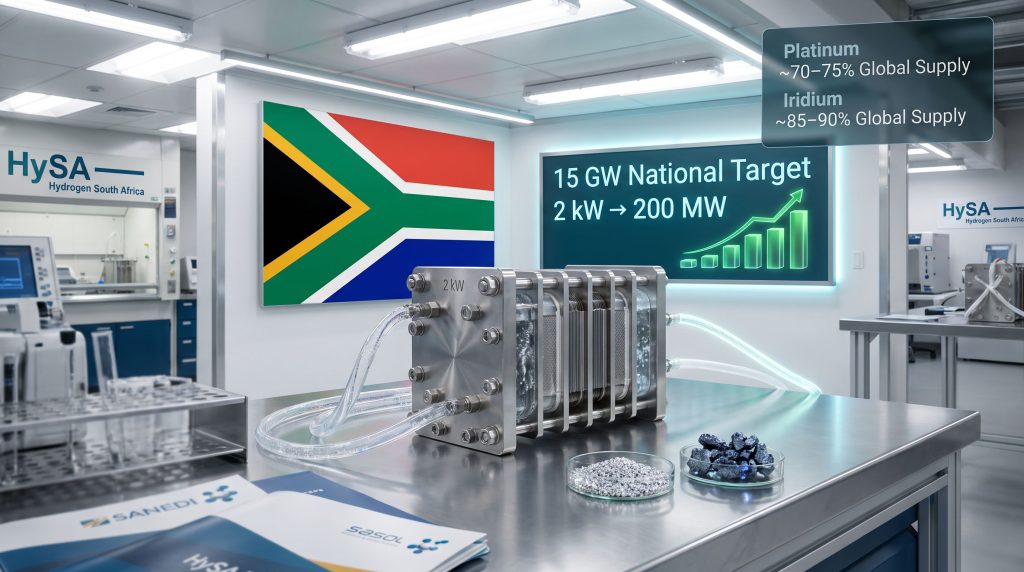
Critical Technical Note: Iridium is arguably the more constrained input. It is one of the rarest elements in Earth's crust, produced almost exclusively as a byproduct of platinum mining, and South Africa controls an estimated 85 to 90 percent of global iridium supply. Any large-scale global buildout of PEM electrolyzers runs directly through South African geology.
The alkaline electrolyzer, a competing technology, does not require iridium and uses nickel-based catalysts instead. However, PEM systems offer superior efficiency at partial loads, faster response times to variable power inputs, and higher current density, making them better suited to integration with intermittent renewable energy sources like solar and wind. This advantage is precisely why PEM technology is preferred for green hydrogen projects paired with renewable generation.
South Africa's PGM Dominance: Mapping the Supply Chain Advantage
South Africa's position in the platinum-group metals market is without parallel in the global mining landscape. The Bushveld Igneous Complex, stretching across the northern reaches of the country, contains the largest known PGM reserves on Earth. The scale of this endowment shapes every calculation in the hydrogen economy.
| Metal | South Africa's Share of Global Supply | Primary Role in Hydrogen Systems |
|---|---|---|
| Platinum | ~70-75% | PEM electrolyzer cathode catalyst |
| Iridium | ~85-90% | PEM electrolyzer anode catalyst |
| Palladium | ~35-40% | Hydrogen fuel cell components |
Combined, platinum and iridium exports contribute an estimated 6% of South Africa's annual GDP, according to reporting by Afripoli. That figure reflects the raw material value of these metals, but it dramatically understates the economic potential embedded in the downstream value chain. A kilogram of iridium sold as refined metal captures a fraction of the value it would generate as a catalyst layer in a commercially deployed electrolyzer system.
The Value-Chain Gap That Defined a Lost Decade
For years, South Africa's PGM wealth translated into mining revenue without meaningful downstream industrialisation in hydrogen technology. The reasons were structural: electrolyzer manufacturing requires specialised membrane materials, precision engineering capabilities, institutional research partnerships, and access to capital for long-cycle technology development. None of these conditions emerge automatically from mineral wealth.
The result was a paradox visible to energy economists but rarely articulated in mainstream coverage: the nation holding the geological keys to global green hydrogen production was not manufacturing a single electrolyzer component. Indeed, PGM supply constraints have long been recognised as a structural challenge that ripples across the entire hydrogen value chain. Every unit deployed in European and Asian green hydrogen projects was produced without South African industrial participation beyond the raw catalyst material.
Sasol's 2 kW PEM Electrolyzer: Decoding the Technical Milestone
What "Homegrown" Means in Practice
The language around the Sasol South Africa first homegrown hydrogen electrolyzer requires careful unpacking. The term does not simply mean assembled in South Africa. It refers to a unit locally designed and engineered through a domestic institutional research framework, producing original intellectual property rather than replicating imported schematics.
This distinction matters enormously for long-term industrial strategy. Assembling imported components creates manufacturing jobs. Developing the underlying engineering capability creates a technology platform that can be iterated, scaled, licensed, and exported.
Key Technical Specifications
| Parameter | Detail |
|---|---|
| Output Capacity | 2 kilowatts (kW), laboratory scale |
| Technology Type | Proton Exchange Membrane (PEM) |
| Installation Site | Sasol Research and Technology Campus, Sasolburg |
| Commissioning Date | 31 July 2026 |
| Development Program | Hydrogen South Africa (HySA) |
| Testing Conditions | Variable renewable energy inputs |
How This Differs From Sasol's Existing Industrial Electrolyzer
A point frequently missed in coverage of this milestone is that Sasol already operates electrolysis technology at scale. The company's Sasolburg facility has been running a 60 megawatt electrolyzer, but that unit was a repurposed existing industrial asset, not a locally developed system. The engineering lineage of that plant traces back to imported technology.
The 2 kW unit commissioned on 31 July 2026 represents something categorically different: original domestic engineering output under a national research programme. The scale difference is not the meaningful distinction. The intellectual property origin is.
Testing Under Variable Renewable Energy: Why This Matters Operationally
One of the least-discussed technical challenges in green hydrogen production is electrolyzer behaviour under intermittent power inputs. Solar and wind generation fluctuate constantly, and electrolyzers designed for steady-state industrial operation can suffer efficiency losses, membrane degradation, and accelerated component wear when exposed to variable loads.
Testing the Sasolburg unit specifically under variable renewable energy conditions means the research outputs will directly inform the engineering specifications for future large-scale installations. Consequently, renewable energy integration with PEM systems becomes considerably more reliable when operational data is gathered under real-world intermittent conditions. This is applied research with a clear commercial pathway, not laboratory work disconnected from deployment realities.
The Institutional Architecture: How the HySA Program Was Built
Tripartite Structure as a Deep-Tech Development Model
The Hydrogen South Africa programme operates through a three-pillar institutional structure that connects public research funding, academic engineering expertise, and industrial deployment capacity:
- Department of Science, Technology and Innovation (DSTI): Programme lead and policy framework
- South African National Energy Development Institute (SANEDI): Operational coordination and energy systems integration
- North-West University: Academic research, intellectual property development, and technical workforce training
- Sasol: Industrial anchor partner providing deployment infrastructure, engineering resources, and commercial off-take context
This architecture is notable because it mirrors the institutional models used successfully in hydrogen technology development in Germany, Japan, and South Korea, where sustained government-academia-industry collaboration over decade-long timeframes produced globally competitive electrolyzer manufacturing industries. South Africa's version is earlier-stage but structurally comparable.
Sasol's Executive Vice President Sarushen Pillay noted at the inauguration that the programme provides a unique industrial platform for advancing locally developed electrolyzer technology. He characterised the collaboration between government, academic institutions, and industrial partners as central to what the initiative had already demonstrated as achievable, according to Engineering News.
Clarifying the "First" Claim
It is worth noting that Hydrox Holdings had previously produced an advanced alkaline electrolyzer within South Africa, establishing an earlier claim to domestic electrolyzer manufacturing. The Sasol and HySA unit is more precisely South Africa's first locally developed PEM electrolyzer and the first produced under the national HySA programme framework. The technology distinction matters: alkaline and PEM systems serve different operational profiles, and PEM capability is specifically what unlocks the renewable-energy-integrated green hydrogen applications that dominate the industrial pipeline.
From Laboratory Scale to 200 Megawatts: The Industrial Roadmap
Hydrogen technology commercialisation follows a well-established development pathway, and South Africa's programme fits recognisably within it:
- Laboratory scale (1-10 kW): Proof of concept, catalyst testing, materials validation, operational learning under controlled conditions
- Pilot scale (100 kW to 1 MW): Grid integration testing, efficiency benchmarking under real-world renewable inputs
- Demonstration scale (1-50 MW): Commercial viability assessment, cost-reduction iteration, off-take agreement development
- Industrial scale (50 MW and above): Full production deployment, supply chain integration, export capability
The Sasolburg 2 kW unit sits firmly at stage one. The critical question is how quickly South Africa can traverse the subsequent stages, and what the HySHiFT consortium's Secunda project reveals about that timeline.
The HySHiFT Consortium: Secunda as a Commercial Anchor
| Project Parameter | Detail |
|---|---|
| Target Capacity | 200 megawatts (MW) |
| Location | Secunda, South Africa |
| Primary Output | Sustainable Aviation Fuel (SAF) |
| Consortium Members | Sasol, Linde, ENERTRAG, HydRegen Energy |
| Production Pathway | Green hydrogen via Fischer-Tropsch synthesis |
Secunda is not an arbitrary site choice. It hosts one of the world's largest existing coal-to-liquids operations, giving the location an established industrial workforce with deep chemical process engineering expertise, existing infrastructure for large-scale chemical synthesis, and a physical plant that can be partially repurposed rather than built from greenfield. The Fischer-Tropsch synthesis process used for Sasol's synthetic fuels work translates directly to SAF production from green hydrogen feedstock.
The 15 GW National Target: Ambition in Context
South Africa's Labour Market Intelligence Report 2024 identifies a national target of at least 15 gigawatts of installed electrolyzer capacity. To contextualise that figure: the European Union's entire target for domestic electrolyzer manufacturing capacity by 2030 was set at 40 GW across 27 member states. South Africa's 15 GW target, if achieved, would place it among the world's leading electrolyzer deployment nations by installed base.
Achieving that target requires not just capital investment but a parallel workforce development programme. Operating and maintaining large-scale PEM electrolyzer infrastructure requires specialised skills that do not yet exist at scale within South Africa's technical education pipeline. The Sasolburg facility's role as a skills development platform is therefore as strategically significant as its research output.
The next major ASX story will hit our subscribers first
Hydrogen's Dual Value Chain: Where South Africa's Advantage Compounds
PGMs at Both Ends of the Hydrogen System
A dimension of South Africa's strategic position that rarely receives adequate analytical attention is its exposure to both the production and utilisation sides of the hydrogen economy simultaneously.
| Application | PGM Used | Function |
|---|---|---|
| PEM Electrolyzer (production side) | Platinum + Iridium | Catalyse water splitting to produce H₂ |
| Hydrogen Fuel Cell (utilisation side) | Platinum | Catalyse H₂ oxidation to generate electricity |
Most nations participating in the green hydrogen economy sit on one side of this ledger or the other. South Africa's PGM endowment gives it structural exposure across both, and now, with domestic electrolyzer manufacturing capability established, a third layer of value capture through capital equipment production.
Sustainable Aviation Fuel as the Priority Off-Take Market
The HySHiFT project's focus on sustainable aviation fuel is strategically astute. International aviation decarbonisation commitments are creating mandated SAF blending requirements across multiple major markets, generating contracted demand rather than speculative market exposure. In addition, the broader critical minerals demand surge underpinning the energy transition is placing South Africa's PGM assets at the centre of global industrial planning. Green hydrogen produced via PEM electrolysis and converted to SAF through Fischer-Tropsch synthesis represents one of the few technically viable pathways to deeply decarbonised aviation fuel at commercial scale.
Barriers That Remain: The Honest Industrial Assessment
Critical Gap: While South Africa mines the raw PGM inputs that make PEM electrolyzers possible, the broader manufacturing ecosystem required for electrolyzer production remains largely undeveloped domestically. Membrane fabrication, bipolar plate manufacturing, balance-of-plant component supply, and precision assembly capability represent an industrial layer that must be built alongside technology development.
The remaining challenges are substantial and should not be minimised:
- Green hydrogen cost competitiveness: Grey hydrogen produced from natural gas or coal gasification remains significantly cheaper in South Africa's current industrial context. Closing that cost gap requires both cheaper renewable electricity and electrolyzer cost reductions through scale
- Iridium supply concentration risk: Paradoxically, South Africa's iridium dominance creates a global bottleneck that could constrain PEM electrolyzer deployment worldwide if mining output cannot scale proportionally with demand
- Grid stability: South Africa's electricity grid has faced well-documented reliability challenges, complicating the consistent renewable energy supply that large-scale electrolysis requires
- Component supply chain development: The membrane, bipolar plate, and balance-of-plant component industries that support electrolyzer assembly are nascent or absent domestically
However, the mining decarbonisation benefits that flow from domestically produced hydrogen technology extend well beyond the energy sector, potentially reshaping industrial cost structures across South Africa's resource extraction base.
Frequently Asked Questions
What makes PEM electrolyzers different from alkaline electrolyzers?
PEM electrolyzers use a solid polymer membrane that allows faster response times, higher current density, and better compatibility with variable renewable energy inputs. Alkaline systems are generally cheaper and use nickel-based catalysts, but they respond more slowly to power fluctuations, making them less ideal for solar or wind-paired applications.
Is the 2 kW unit South Africa's absolute first domestically produced electrolyzer?
Not precisely. Hydrox Holdings produced an advanced alkaline electrolyzer in South Africa before this commissioning. The Sasol South Africa first homegrown hydrogen electrolyzer is more accurately described as the country's first locally developed PEM electrolyzer and the first produced under the national HySA research programme.
Why does the HySHiFT project focus on sustainable aviation fuel specifically?
Aviation is one of the most difficult sectors to decarbonise using direct electrification. SAF produced from green hydrogen is technically compatible with existing aircraft engines and fuel infrastructure, making it one of the only scalable near-term pathways to aviation emissions reduction. Mandated blending requirements in major aviation markets are creating durable demand for SAF, reducing off-take risk for projects like HySHiFT.
What does the 15 GW national target require to achieve?
Beyond capital investment, achieving 15 GW of electrolyzer capacity requires a significant expansion of renewable energy generation to power the electrolysis process, development of domestic component manufacturing supply chains, technical workforce training programmes, and international off-take agreements for green hydrogen and its derivatives including SAF and green ammonia.
Key Takeaways for Industry Observers
- Domestic engineering capability, not just assembly, has been established through the HySA programme, creating an intellectual property foundation for future technology iteration
- The 2 kW to 200 MW progression provides a credible and well-precedented development pathway toward commercial green hydrogen production at Secunda
- South Africa's dual PGM exposure across both electrolyzer production and fuel cell utilisation creates compounding economic opportunity that raw material exports alone cannot replicate
- Skills development is a co-equal output of the Sasolburg facility alongside technical research, addressing a workforce gap that would otherwise constrain the 15 GW national ambition
- The manufacturing ecosystem gap represents the next industrial challenge: building the component supply chains that sit below the electrolyzer system level
This article is intended for informational purposes only and does not constitute financial advice. Statements regarding national targets, project timelines, and market projections involve forward-looking assumptions that are subject to material uncertainty. Readers are encouraged to conduct independent research before drawing investment conclusions.
Want to Track the Next Major Mineral Discovery Before the Market Does?
Discovery Alert's proprietary Discovery IQ model delivers real-time ASX alerts on significant mineral discoveries — including the platinum-group metals central to the green hydrogen economy — instantly translating complex data into actionable investment insights for both short-term traders and long-term investors. Explore how historic discoveries have generated substantial returns on Discovery Alert's dedicated discoveries page, and begin your 14-day free trial today to position yourself ahead of the broader market.