August 4, 2026
The Science Behind the Sasol South Africa Hydrogen Electrolyzer Breakthrough
Across the global energy landscape, a quiet but consequential shift is underway. The race to decarbonise heavy industry has converged on a single molecule: hydrogen. But producing clean hydrogen at scale requires a technology that, until very recently, South Africa had never manufactured domestically despite holding the raw materials that make it possible. The Sasol South Africa hydrogen electrolyzer represents a pivotal step in changing that reality, and understanding why this matters requires starting not with a news event, but with the electrochemical machinery at the centre of the hydrogen economy itself.
When big ASX news breaks, our subscribers know first
What Is a PEM Electrolyzer and Why Does It Matter?
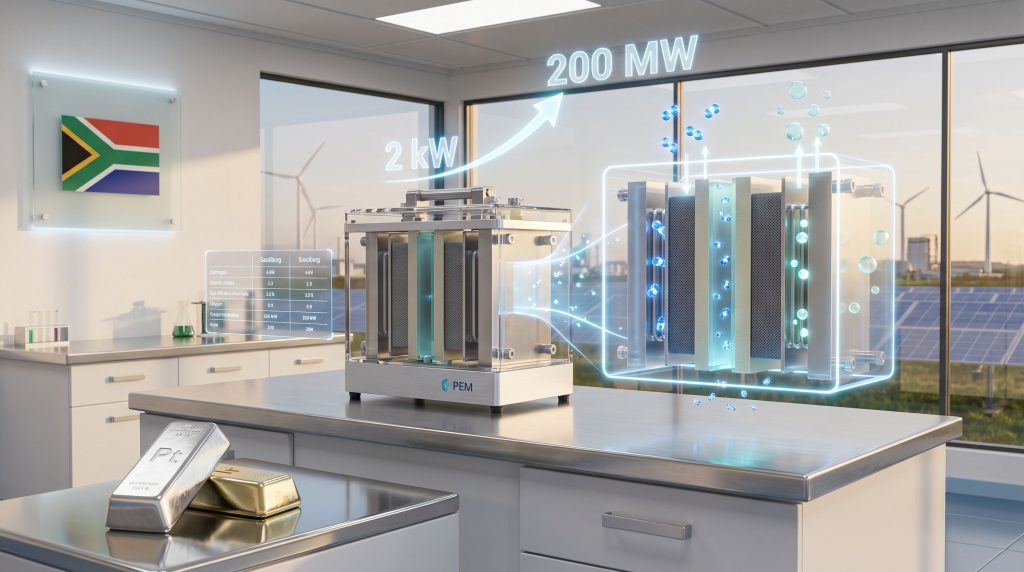
A proton exchange membrane (PEM) electrolyzer is a device that splits water into hydrogen and oxygen using electrical energy. The core of the system is the membrane electrode assembly (MEA), a layered structure in which an ion-conducting polymer membrane separates two catalyst-coated electrodes. The PEM technology benefits associated with this design are increasingly central to the global green hydrogen conversation.
Here is how the process works, step by step:
- Water is fed to the anode side of the cell.
- An electrical current drives the oxidation of water at the anode, releasing oxygen gas, protons, and electrons.
- Protons migrate through the proton exchange membrane to the cathode side.
- Electrons travel through the external circuit, doing electrical work in the process.
- At the cathode, protons and electrons recombine to form hydrogen gas.
The critical advantage of PEM systems over older alkaline electrolyzer designs is their ability to respond rapidly to fluctuating electrical inputs. This dynamic load-following capability makes PEM electrolyzers uniquely compatible with variable renewable energy sources such as solar and wind, which produce intermittent power by nature. Alkaline systems, by contrast, struggle with rapid power ramping and are better suited to stable baseload operation.
Key Technical Specifications and Scale Comparison
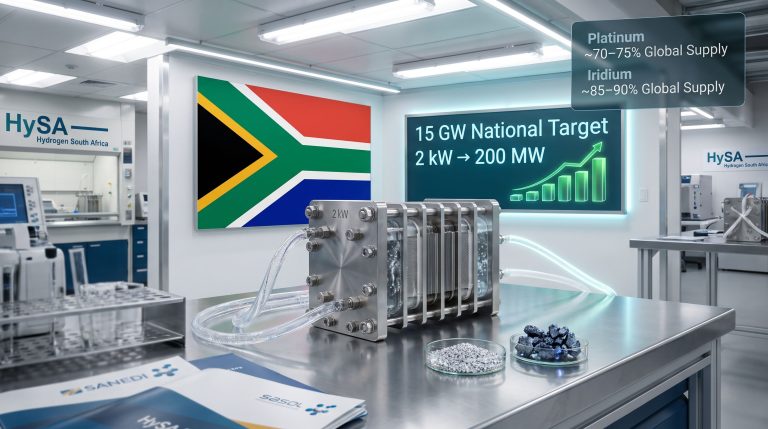
The Sasol South Africa hydrogen electrolyzer commissioned on 31 July 2026 is a 2-kilowatt lab-scale unit. While modest in output capacity, its significance is institutional rather than industrial. It establishes domestically owned intellectual property, a trained engineering workforce, and a real-world testing platform under variable renewable energy conditions.
The scale gap between this unit and South Africa's broader ambitions is substantial, but it follows a well-understood commercialisation ladder:
| Electrolyzer Scale | Capacity | Primary Purpose | Project Stage |
|---|---|---|---|
| Sasol Sasolburg Lab Unit | 2 kW | R&D, skills development, variable RE testing | Commissioned July 2026 |
| Sasol Sasolburg Green H₂ Project | ~60 MW | Green hydrogen production | Previously advanced |
| HySHiFT Secunda Consortium | 200 MW | Sustainable aviation fuel production | Planned |
| South Africa National Target | 15 GW+ | National hydrogen economy | Long-term policy goal |
South Africa's Structural Position in the Global Hydrogen Value Chain
There is a remarkable paradox embedded in South Africa's industrial history. The country holds the world's largest known reserves of platinum group metals (PGMs), producing the majority of global platinum and iridium output annually. These two metals are not interchangeable luxuries in a PEM electrolyzer; they are irreplaceable functional components operating at the atomic level of the reaction.
- Iridium serves as the anode catalyst, enabling the oxygen evolution reaction (OER). It is among the rarest stable elements on Earth, and no commercially viable substitute has yet been demonstrated at scale.
- Platinum functions as the cathode catalyst, facilitating the hydrogen evolution reaction (HER) with minimal energy loss.
PGM mining contributes up to 6% of South Africa's gross domestic product annually, making it one of the economy's most structurally significant sectors. Yet until July 2026, every electrolyzer assembled anywhere in the world that used South African platinum and iridium was manufactured somewhere else, capturing the technology premium that South Africa's raw material exports made possible.
"South Africa's transition from raw PGM exporter to electrolyzer technology developer represents a fundamental shift in industrial value capture, moving from commodity pricing exposure to technology-embedded product economics."
This distinction carries profound investment implications. Commodity pricing for platinum and iridium is driven by global supply-demand dynamics largely outside South Africa's control. Electrolyzer manufacturing, by contrast, carries margins tied to intellectual property, engineering capability, and manufacturing scale. Furthermore, the growing critical minerals demand driven by the energy transition makes this domestic capability even more strategically valuable.
The Institutional Architecture Behind the Project
The HySA Program: Publicly Funded IP Development
The electrolyzer commissioned at Sasolburg was not the product of a private research budget alone. It emerged from the Hydrogen South Africa (HySA) program, a nationally funded research framework led by the Department of Science, Technology and Innovation (DSTI), implemented in partnership with the South African National Energy Development Institute (SANEDI) and North-West University, which contributed key intellectual property to the design.
This publicly funded IP structure has a specific economic consequence that is often overlooked in mainstream coverage. Because the core technology was developed domestically rather than licensed from international electrolyzer manufacturers, future South African producers using HySA-derived designs will not carry the royalty and licensing cost burdens that typically erode margins for technology adopters in emerging markets. This is a structural cost advantage that compounds as scale increases.
Sasol's Role as Industrial Host
Sasolburg was selected as the commissioning site due to Sasol's existing Research and Technology campus infrastructure and its historical expertise in synthetic fuels chemistry. The site provides the physical and engineering environment needed to test renewable energy integration with real operating parameters, rather than controlled laboratory conditions.
Sasol's commissioning of this PEM electrolyser marks a significant industrial milestone. Sasol Executive Vice President Sarushen Pillay stated that this commissioning demonstrates what becomes achievable when government institutions, academic researchers, and industrial partners align their capabilities around a shared technology objective. He further noted that hydrogen's role as a feedstock for sustainable fuels and chemicals makes this kind of locally developed electrolyzer platform a genuinely strategic industrial asset for South Africa.
Comparing National Hydrogen R&D Models
South Africa's tripartite government-academia-industry model is not unique globally, but its application in an emerging market context is instructive:
| Country | National Program | Key Mechanism |
|---|---|---|
| South Africa | HySA (Hydrogen South Africa) | State-funded IP, industrial hosting |
| Germany | H2Global | Import/export market-making mechanism |
| Australia | ARENA Hydrogen Programs | Grant funding for demonstration projects |
| South Africa (advantage) | PGM feedstock proximity | Domestic catalyst supply chain integration |
The South African model's distinguishing feature is its integration with the country's upstream mining sector, creating a potential end-to-end value chain that no other national hydrogen program currently replicates.
From Lab Scale to Industrial Reality: Understanding the Commercialisation Pathway
The Four-Stage Electrolyzer Development Ladder
Technology commercialisation in electrolyzer manufacturing follows a staged progression that cannot be meaningfully compressed:
- Lab-scale proof of concept (current: 2 kW) — Validates fundamental technology performance, generates performance data under real conditions, trains core engineering teams.
- Pilot-scale demonstration (10–100 kW range) — Tests manufacturing processes, refines MEA production, identifies supply chain requirements.
- Project-scale deployment (MW-class systems) — Commercial production economics emerge, grid integration challenges become operational realities.
- Industrial-scale infrastructure (GW-class national targets) — Requires renewable energy capacity, transmission infrastructure, and financing at sovereign scale.
The 2 kW Sasolburg unit occupies Stage 1. Its primary outputs are not measured in kilograms of hydrogen produced, but in performance datasets, engineering competency, and technology validation that feed directly into the design specifications for the 200 MW HySHiFT project at Secunda.
What Is the HySHiFT Consortium?
The HySHiFT consortium is a South African green hydrogen initiative anchored by Sasol alongside Linde, ENERTRAG, and HydRegen Energy. The consortium is developing a 200-megawatt electrolyzer facility at Sasol's Secunda site, with hydrogen output directed toward sustainable aviation fuel (SAF) synthesis. This represents one of the largest planned green hydrogen-to-SAF conversion projects on the African continent.
Secunda is particularly significant as a project location. It houses Sasol's existing Fischer-Tropsch process infrastructure, the same synthetic fuels technology that converts syngas into liquid fuels. Adapting this infrastructure to process green hydrogen into SAF reduces capital requirements compared to building equivalent capacity at a greenfield site.
Sasol's Green Hydrogen Milestones: A Timeline
| Year | Milestone |
|---|---|
| 2023 | First green hydrogen produced at Sasolburg during renewable-powered electrolyzer commissioning |
| 2024 | Labour Market Intelligence Report identifies 15 GW national electrolyzer capacity target |
| 31 July 2026 | South Africa's first domestically manufactured PEM electrolyzer commissioned at Sasolburg |
| Planned | 200 MW HySHiFT electrolyzer at Secunda for sustainable aviation fuel production |
The next major ASX story will hit our subscribers first
The Economics of Domestic Electrolyzer Manufacturing
The Value Chain Upgrade Opportunity
Moving up the PGM value chain is not a new concept for South Africa; however, electrolyzer manufacturing represents its most technologically complex iteration to date. The upgrade pathway from raw ore to finished electrolyzer components involves multiple value-adding stages:
- Raw platinum and iridium mining and refining (current primary export activity)
- Catalyst powder fabrication (specialist chemical processing)
- Membrane electrode assembly (MEA) production (precision manufacturing)
- Full electrolyzer stack assembly and testing (advanced engineering)
Each stage captures margins that currently accrue to manufacturers in Europe, North America, and East Asia. In addition, the broader critical minerals trade dynamics reshaping global markets make South Africa's integrated position increasingly attractive to international partners and investors.
Green Hydrogen Export Positioning
South Africa's geographic position relative to European import demand, combined with its PGM resource base, creates a differentiated competitive profile among emerging green hydrogen export nations. Competing export-oriented hydrogen economies include Australia, Chile, Namibia, and Morocco, each with their own renewable resource and infrastructure advantages.
What separates South Africa's long-term proposition is the possibility of manufacturing the production equipment domestically using domestically sourced catalysts, then using that equipment to produce exportable green hydrogen or green ammonia as a hydrogen carrier. No other competing nation currently holds an equivalent integrated position across the full value chain.
Fuel Cells and the Dual-End Value Chain
An aspect of South Africa's hydrogen positioning that receives insufficient analytical attention is its symmetrical relevance to both ends of the hydrogen energy cycle. Platinum and iridium are not only essential in electrolyzers that produce hydrogen; they are equally critical in proton exchange membrane fuel cells (PEMFCs) that consume hydrogen to generate electricity.
This creates a genuinely unusual strategic situation:
- South Africa's PGM output is required to manufacture the devices that produce green hydrogen.
- South Africa's PGM output is simultaneously required to manufacture the devices that consume green hydrogen in vehicles, heavy transport, and stationary power applications.
As the global hydrogen economy expands across both production and consumption applications, demand for South African platinum and iridium grows from both directions simultaneously. This dual-end demand dynamic is rarely captured in conventional commodity demand forecasts. The mining decarbonisation benefits that flow from this positioning compound further as industrial hydrogen adoption accelerates.
South Africa's 15 GW National Target: Context and Challenges
The Labour Market Intelligence Report 2024 identifies a national electrolyzer capacity target of at least 15 gigawatts for South Africa. Reaching that figure from a base of one 2-kilowatt lab unit requires navigating several simultaneous challenges:
- Renewable energy prerequisites: 15 GW of electrolysis requires substantial dedicated renewable generation capacity. South Africa's current electricity system, still heavily coal-dependent, must expand its renewable base significantly before green hydrogen economics become compelling at national scale.
- Financing requirements: PEM electrolyzer capital costs at GW-scale represent financing requirements measured in billions of dollars, requiring institutional investment frameworks, development finance institutions, and private capital alignment.
- Workforce development: The HySA program's skills development mandate directly addresses the human capital pipeline. The Sasolburg commissioning is as much a training exercise as a technology demonstration, building the engineering workforce that larger projects will require.
- Supply chain development: Domestic MEA production, stack assembly, and balance-of-plant manufacturing capabilities must be built in parallel with project development.
Disclaimer: Projections regarding South Africa's 15 GW electrolyzer target, green hydrogen export volumes, and project timelines represent policy aspirations and planning scenarios. Actual outcomes will depend on renewable energy development rates, financing availability, technology cost trajectories, and international market conditions. This article does not constitute investment advice.
Frequently Asked Questions
What type of electrolyzer did Sasol commission in South Africa?
Sasol commissioned a 2-kilowatt proton exchange membrane (PEM) electrolyzer at its Research and Technology campus in Sasolburg. The unit was developed using intellectual property generated through the publicly funded HySA program, making the Sasol South Africa hydrogen electrolyzer the country's first domestically manufactured unit of its type.
Why is South Africa significant in global hydrogen production?
South Africa controls the world's largest reserves of platinum and iridium, both essential and currently irreplaceable catalysts in PEM electrolyzers and fuel cells. PGM mining contributes up to 6% of South Africa's annual GDP, positioning the country as a critical upstream supplier to the global hydrogen economy across both the production and consumption ends of the value chain.
What is the HySA program?
The Hydrogen South Africa (HySA) program is a nationally funded research initiative led by the Department of Science, Technology and Innovation, operating through SANEDI and North-West University. Its mandate covers domestically owned hydrogen technology IP development and the building of South Africa's hydrogen engineering workforce.
How does the 2 kW unit relate to the 200 MW HySHiFT project?
The 2 kW unit is a lab-scale research and training platform generating performance data under variable renewable energy conditions. The 200 MW HySHiFT project at Secunda is a planned full-scale industrial facility targeting sustainable aviation fuel production. Consequently, the lab unit's data directly informs the engineering specifications for the larger project.
What is sustainable aviation fuel and why is green hydrogen needed to produce it?
Sustainable aviation fuel (SAF) is a low-carbon alternative to conventional jet fuel, synthesised through processes such as Fischer-Tropsch conversion. Green hydrogen serves as a feedstock in this synthesis pathway, replacing fossil-fuel-derived hydrogen with electrolytically produced hydrogen powered by renewable energy. Sasol's existing Secunda infrastructure makes it a natural host for this conversion process.
Want to Track the ASX Stocks Positioned for the Green Hydrogen and Critical Minerals Boom?
As South Africa's PGM-driven hydrogen value chain develops and demand for platinum and iridium accelerates from both electrolyser production and fuel cell consumption, the ASX companies supplying the critical minerals underpinning this transition deserve close attention — and Discovery Alert's proprietary Discovery IQ model delivers real-time alerts the moment significant mineral discoveries hit the ASX, giving subscribers an immediate edge. Explore historic discovery returns on Discovery Alert's discoveries page and begin your 14-day free trial to position yourself ahead of the market.