June 4, 2026
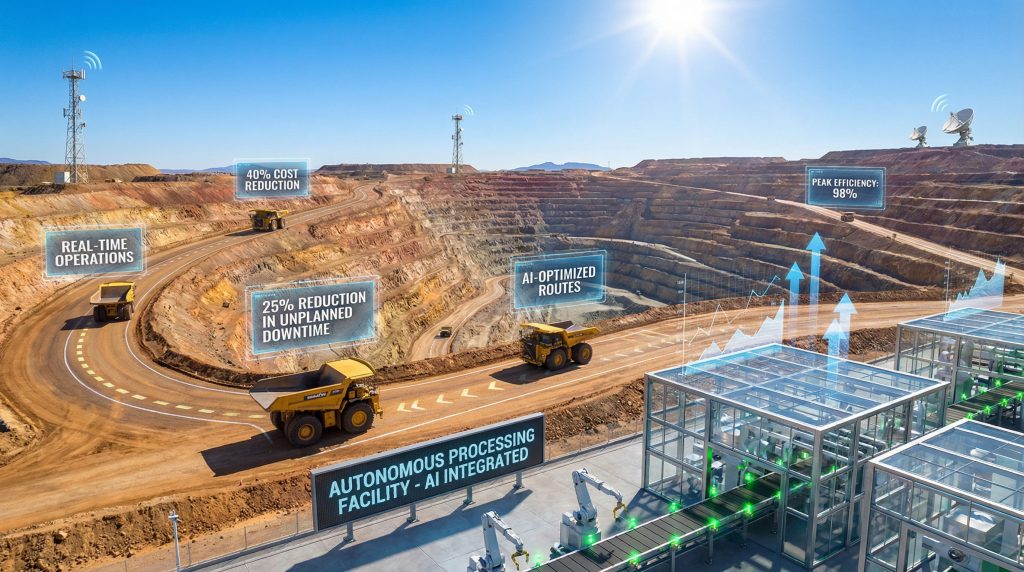
Mining operations worldwide are experiencing a technological revolution that fundamentally transforms how companies extract, process, and manage mineral resources. The integration of AI in mining operations has evolved from experimental pilot programs to essential infrastructure that drives competitive advantage across the global mining industry. Furthermore, these intelligent systems enable mining companies to process vast datasets, optimise complex workflows, and implement predictive strategies that were previously impossible with traditional methodologies.
Machine learning algorithms now process terabytes of geological, operational, and environmental data in real-time, creating opportunities for precision-driven decision-making across mining value chains. The integration of AI technologies represents more than operational enhancement; it constitutes a strategic repositioning of mining companies to compete effectively in an increasingly data-driven global economy where marginal efficiency gains translate directly into competitive advantages and improved profitability metrics.
What Makes Artificial Intelligence Essential for Modern Mining Operations?
The Digital Transformation Imperative in Resource Extraction
Mining operations face escalating complexity that traditional management approaches cannot adequately address. Modern mines operate sophisticated equipment networks spanning hundreds of square kilometers, generating continuous streams of sensor data from drilling systems, processing equipment, environmental monitors, and autonomous vehicles. This operational complexity requires intelligent coordination systems capable of processing multivariable inputs and optimising outputs across interconnected workflows.
Economic pressures further intensify the need for AI in mining operations. Commodity price volatility, increasing regulatory compliance costs, and rising energy expenses create margin pressures that demand operational optimisation at unprecedented levels. Mining companies must simultaneously reduce operational costs, improve safety performance, and minimise environmental impact while maintaining production targets.
Legacy mining infrastructure presents unique integration challenges that AI technologies must overcome. Most mining operations utilise equipment and control systems installed over decades, creating heterogeneous technological environments that require sophisticated integration protocols. However, AI mining efficiency solutions must interface with existing supervisory control and data acquisition (SCADA) systems, enterprise resource planning (ERP) platforms, and specialised mining software while maintaining operational continuity during implementation phases.
Core AI Technologies Reshaping Mining Workflows
Machine learning algorithms have become fundamental to modern mining operations, enabling pattern recognition in complex geological datasets that human analysts cannot efficiently process. These algorithms analyse historical drilling data, geophysical survey results, and geological mapping information to identify mineral occurrence patterns and optimise exploration targeting strategies.
Computer vision systems provide real-time operational monitoring capabilities that enhance both safety and efficiency across mining sites. These systems continuously analyse video feeds from fixed cameras and mobile equipment, identifying potential hazards, monitoring equipment performance, and ensuring compliance with operational procedures. Advanced computer vision implementations can detect subtle changes in rock face stability, equipment wear patterns, and environmental conditions that indicate developing operational risks.
Predictive analytics frameworks enable proactive equipment optimisation by analysing sensor data streams to forecast maintenance requirements, performance degradation, and potential failures. These systems integrate data from vibration sensors, temperature monitors, pressure gauges, and electrical current analyzers to create comprehensive equipment health profiles that guide maintenance scheduling and replacement planning.
Natural language processing capabilities streamline regulatory compliance documentation by automatically generating reports, analysing regulatory updates, and ensuring consistent terminology across compliance submissions. These systems reduce administrative overhead while improving accuracy in regulatory communications and environmental impact assessments.
When big ASX news breaks, our subscribers know first
How Does AI Transform Mineral Exploration and Resource Discovery?
Advanced Geological Data Analysis Through Machine Learning
Satellite imagery interpretation represents one of the most significant applications of AI in mineral exploration, enabling analysis of multispectral data across vast geographical areas with unprecedented precision. Machine learning algorithms process data from advanced spaceborne thermal emission and reflection radiometer (ASTER) sensors and Sentinel-2 satellites to identify geological formations, alteration zones, and structural features that indicate potential mineralisation.
These algorithms excel at detecting subtle spectral signatures that correspond to specific mineral assemblages, vegetation stress patterns, and hydrothermal alteration zones that traditional visual interpretation might overlook. Gradient boosting algorithms and convolutional neural networks analyse pixel-level spectral characteristics across multiple wavelength bands to create detailed prospectivity maps that guide ground-based exploration programmes.
Graph neural networks process complex geological relationships by modelling spatial connections between different data types, including geophysical surveys, geochemical sampling, and structural geology mapping. These advanced algorithms identify non-linear patterns in geological datasets that traditional statistical methods cannot effectively detect, leading to more accurate targeting of exploration drilling programmes.
Historical drilling data optimisation utilises machine learning to reanalyse legacy exploration datasets, often revealing previously unrecognised mineralisation patterns. These algorithms process decades of drilling results, assay data, and geological logging information to identify systematic biases in historical interpretations and highlight areas with enhanced mineral potential.
Precision Targeting and Cost Reduction Strategies
AI-driven drill-hole analytics significantly reduce exploration timeframes by optimising drilling programmes based on real-time geological feedback. Machine learning algorithms analyse drill core data, downhole geophysics, and geological logging information to provide immediate recommendations for drilling direction changes, depth extensions, and targeting adjustments.
Geophysical survey enhancement through AI-driven interpretation improves the accuracy and resolution of subsurface imaging. Machine learning algorithms process complex geophysical datasets including magnetic, gravity, electrical, and electromagnetic surveys to create integrated subsurface models that highlight structural controls on mineralisation and optimise drilling target selection.
Risk assessment models for exploration investment decisions analyse multiple variables including geological favourability, infrastructure availability, regulatory environment, and commodity price forecasts to provide quantitative risk-return assessments for exploration projects. These models enable mining companies to allocate exploration capital more effectively across diverse project portfolios.
| Technology | Application | Measurable Outcome |
|---|---|---|
| ML Prospectivity Mapping | Satellite data analysis | Enhanced target identification efficiency |
| Drill-hole Analytics | Precision drilling | Reduced exploration costs |
| Geophysical AI | Survey interpretation | Improved subsurface imaging accuracy |
Which AI Applications Drive the Greatest Operational Efficiency Gains?
Autonomous Fleet Management and Logistics Optimisation
Self-driving haul trucks represent the most visible application of AI in mining operations, utilising sophisticated navigation algorithms, obstacle detection systems, and route optimisation protocols to transport materials efficiently across mining sites. These autonomous vehicles integrate GPS positioning, LiDAR scanning, and computer vision to navigate complex mining environments while avoiding collisions with other equipment and personnel.
AI-powered dispatch systems coordinate real-time fleet movements by analysing traffic patterns, loading queue lengths, processing plant demands, and equipment availability to optimise material flow throughout mining operations. These systems continuously recalculate optimal assignments based on changing operational conditions, weather factors, and equipment status updates.
Route optimisation algorithms minimise fuel consumption and equipment wear by calculating the most efficient pathways between loading and dumping locations. These algorithms consider factors including road conditions, grade percentages, traffic density, and fuel consumption patterns to reduce operational costs while maintaining production targets.
Predictive scheduling for maintenance windows utilises machine learning to forecast optimal timing for equipment servicing based on operational demands, weather conditions, and equipment health indicators. This approach minimises production disruptions while ensuring equipment reliability and safety in haulage operations.
Processing Plant Intelligence and Throughput Enhancement
Sensor-based ore sorting technologies utilise AI algorithms to analyse individual rock particles in real-time, separating valuable ore from waste material before expensive processing stages. Machine learning systems process data from X-ray transmission sensors, optical cameras, and near-infrared spectroscopy to make instantaneous sorting decisions that improve grade consistency and reduce processing costs.
Grinding circuit optimisation employs machine learning algorithms to continuously adjust mill speeds, feed rates, and classifier settings based on ore characteristics, equipment performance, and product quality requirements. These systems analyse data from power draw monitors, particle size analysers, and density measurements to optimise energy consumption while maintaining product specifications.
Flotation process control utilises digital twin technology to create virtual models of flotation circuits that predict optimal operating conditions based on ore mineralogy, reagent chemistry, and equipment performance. These digital twins continuously update their predictions based on real-time sensor data to maximise metal recovery while minimising reagent consumption.
Real-time recovery rate adjustments analyse metallurgical performance data to optimise processing parameters for different ore types and market conditions. Machine learning algorithms process data from assay laboratories, process sensors, and quality control systems to recommend parameter adjustments that maximise revenue while maintaining environmental compliance.
Energy Management and Sustainability Integration
Ventilation-on-demand systems achieve significant energy savings by utilising AI algorithms to optimise airflow distribution based on real-time air quality measurements, personnel locations, and equipment operating schedules. These systems continuously adjust fan speeds and damper positions to maintain safety standards while minimising energy consumption.
Microgrid optimisation algorithms coordinate renewable energy integration by managing the interaction between solar panels, wind turbines, battery storage systems, and diesel generators to minimise carbon emissions while maintaining reliable power supply. These systems predict energy demand patterns and renewable energy transformations availability to optimise energy storage and distribution strategies.
Carbon footprint reduction initiatives utilise AI algorithms to analyse energy consumption patterns, equipment efficiency metrics, and operational workflows to identify opportunities for emissions reduction. Machine learning systems process data from smart meters, equipment sensors, and production monitoring systems to recommend operational changes that reduce environmental impact while maintaining productivity.
How Does Predictive Maintenance Revolutionise Equipment Reliability?
Telematics and Sensor Integration Strategies
IoT sensor networks continuously monitor equipment health parameters across mining operations, creating comprehensive datasets that enable sophisticated predictive maintenance algorithms. These networks integrate vibration sensors, temperature monitors, pressure transducers, and oil analysis systems to provide real-time equipment health assessments.
Vibration analysis systems detect bearing failures, gear wear, and structural problems weeks before traditional maintenance schedules would identify these issues. Advanced signal processing algorithms analyse frequency spectra, amplitude patterns, and harmonic content to identify specific failure modes and predict remaining equipment life with high accuracy.
Temperature monitoring systems prevent catastrophic equipment failures by detecting thermal anomalies that indicate developing mechanical problems, electrical faults, or lubrication deficiencies. Machine learning algorithms establish baseline temperature profiles for different operating conditions and alert maintenance teams when deviations exceed acceptable thresholds.
Oil analysis integration provides detailed insights into engine condition, hydraulic system health, and lubrication effectiveness through automated sampling systems and laboratory analysis integration. AI algorithms analyse oil contamination patterns, wear metal concentrations, and additive depletion rates to predict component life and optimise oil change intervals.
Machine Learning Models for Failure Prediction
Historical maintenance data training enables machine learning algorithms to identify complex patterns in equipment failure modes that traditional statistical methods cannot detect. These algorithms process decades of maintenance records, failure reports, and operating conditions to create predictive models that anticipate equipment problems before they affect production.
Component lifecycle modelling utilises AI algorithms to predict the remaining useful life of critical mining equipment components based on operating history, environmental conditions, and maintenance practices. These models enable maintenance teams to optimise replacement schedules and minimise unplanned downtime through proactive component replacement.
Spare parts inventory optimisation algorithms analyse predictive maintenance forecasts, supplier lead times, and cost factors to maintain optimal inventory levels while minimising carrying costs. Machine learning systems process historical usage patterns, failure predictions, and supply chain data to recommend inventory adjustments that balance availability with cost efficiency.
Maintenance scheduling automation coordinates predictive maintenance requirements with production schedules, equipment availability, and resource constraints to minimise operational disruptions. These systems continuously optimise maintenance timing based on equipment health predictions, operational priorities, and maintenance crew availability.
What Safety Innovations Are AI Technologies Enabling in Mining?
Real-Time Hazard Detection and Prevention Systems
Computer vision monitoring systems continuously analyse workplace activities to identify unsafe behaviours, equipment malfunctions, and environmental hazards that pose risks to mining personnel. These systems process video feeds from multiple camera angles to detect violations of safety procedures, proximity hazards, and equipment operating anomalies.
Fatigue detection systems utilise biometric sensors and behavioural analysis to monitor worker alertness levels and prevent accidents caused by operator fatigue. Machine learning algorithms analyse heart rate variability, eye movement patterns, and equipment operation characteristics to identify signs of impaired alertness and recommend rest periods or operator changes.
Collision avoidance technology for mobile equipment utilises radar, LiDAR, and computer vision systems to detect potential collisions between vehicles, personnel, and fixed infrastructure. These systems provide automated warnings, speed restrictions, and emergency braking to prevent accidents in busy mining environments.
Environmental monitoring systems continuously assess air quality, gas concentrations, and atmospheric conditions to protect worker health and prevent catastrophic events. AI algorithms analyse data from distributed sensor networks to detect dangerous gas accumulations, dust levels, and atmospheric pressure changes that indicate potential hazards.
Autonomous Systems Reducing Human Exposure to Risk
Robotic inspection systems access confined spaces, unstable areas, and hazardous environments where human presence would create unacceptable safety risks. These systems utilise advanced navigation algorithms and sensor packages to conduct detailed inspections of mine shafts, processing equipment, and structural components without exposing personnel to danger.
Drone-based surveying eliminates the need for personnel to access unstable slopes, high structures, and remote locations for routine monitoring and inspection activities. AI-powered drones conduct automated flight patterns while analysing visual and sensor data to assess structural stability, equipment condition, and environmental changes.
Remote-controlled equipment enables operators to perform hazardous material handling, demolition work, and emergency response activities from safe distances. These systems utilise advanced control interfaces and sensor feedback to provide operators with the precision and situational awareness necessary for complex operations without physical exposure to risk.
Emergency response robots provide search and rescue capabilities in environments that are too dangerous for human responders, including collapsed structures, toxic atmospheres, and unstable ground conditions. These systems integrate thermal imaging, gas detection, and communication equipment to locate and assist trapped personnel.
Compliance Monitoring and Regulatory Adherence
Automated safety checklist verification systems ensure consistent compliance with safety procedures by monitoring worker activities and equipment operations against established protocols. Machine learning algorithms analyse operational data to verify completion of required safety steps and identify deviations from approved procedures.
Real-time regulatory reporting systems automatically generate compliance documentation based on operational data, environmental monitoring, and safety performance metrics. These systems reduce administrative overhead while ensuring accurate and timely submission of required regulatory reports.
Incident prediction models analyse historical safety data, operational conditions, and behavioural patterns to identify situations with elevated accident risk and recommend preventive measures. These models enable proactive safety interventions that prevent incidents before they occur.
How Are Major Mining Companies Implementing AI Solutions?
Global Case Studies and Implementation Strategies
Large-scale copper processing optimisation projects demonstrate the practical benefits of AI implementation in mineral processing operations. These initiatives integrate machine learning algorithms with existing process control systems to optimise grinding circuits, flotation processes, and concentrate handling based on real-time ore characteristics and market demands.
Gold exploration partnerships leverage machine learning algorithms to analyse complex geological datasets and identify promising exploration targets in both greenfield and brownfield projects. These collaborations combine mining company operational knowledge with technology provider AI expertise to accelerate discovery timelines and improve exploration success rates.
Iron ore operations integrate autonomous haulage systems that coordinate multiple self-driving trucks, excavators, and loading equipment to optimise material movement while maintaining safety standards. These implementations require sophisticated traffic management algorithms and safety systems to operate effectively in busy mining environments.
Coal mining ventilation optimisation utilises AI control systems to manage airflow distribution, gas monitoring, and environmental conditions based on real-time production activities and atmospheric measurements. These systems balance safety requirements with energy efficiency to reduce operational costs while maintaining regulatory compliance.
Technology Partnership Models and Vendor Ecosystems
Cloud computing platforms enable scalable AI deployment by providing the computational resources necessary for complex machine learning algorithms without requiring significant on-site infrastructure investments. These platforms facilitate rapid deployment and scaling of AI applications across multiple mining sites.
Specialised mining AI software providers develop industry-specific solutions that address unique challenges in resource extraction, processing, and environmental management. These vendors combine domain expertise with advanced AI capabilities to create practical solutions for mining operations.
Hardware integration strategies coordinate AI software implementations with existing mining equipment, control systems, and communication networks. These approaches minimise disruption to ongoing operations while maximising the benefits of AI technology integration.
Data sharing frameworks enable collaboration between mining companies and technology partners while protecting proprietary operational information. These agreements establish protocols for data access, algorithm training, and intellectual property protection that benefit all parties involved.
| Implementation Phase | Duration | Investment Focus | Expected ROI Timeline |
|---|---|---|---|
| Pilot Testing | 6-12 months | Proof of concept | N/A |
| Limited Deployment | 12-18 months | Infrastructure setup | 18-24 months |
| Full-Scale Integration | 24-36 months | Operational transformation | 12-18 months |
The next major ASX story will hit our subscribers first
What Challenges Must Mining Companies Overcome for Successful AI Integration?
Technical Infrastructure and Legacy System Integration
Data quality standardisation represents a fundamental challenge for AI in mining operations implementation, as algorithms require consistent, accurate, and complete datasets to function effectively. Mining companies must establish data governance protocols that ensure sensor calibration, measurement accuracy, and data validation across diverse operational systems.
Network connectivity requirements for remote mining sites present significant infrastructure challenges, as AI applications require reliable, high-bandwidth communication links for real-time data transmission and algorithm execution. Mining companies must invest in satellite communication systems, fibre optic networks, and wireless infrastructure to support AI applications in remote locations.
Cybersecurity frameworks must protect operational technology systems from cyber threats while enabling AI applications to access necessary operational data. Mining companies must balance security requirements with operational efficiency to maintain both system protection and AI effectiveness.
Interoperability challenges arise when integrating AI platforms with existing mining software, equipment control systems, and business applications. Companies must develop integration protocols that enable seamless data exchange while maintaining system reliability and operational continuity.
Workforce Transformation and Skills Development
Retraining programmes for traditional mining personnel must address the technical skills required to operate alongside AI systems while maintaining focus on core mining competencies. These programmes must balance technical training with practical application to ensure effective technology adoption.
New role creation requires mining companies to attract and retain personnel with AI and data science expertise while developing career pathways that integrate these skills with mining operations knowledge. Companies must compete with technology sector employers for specialised talent while offering competitive compensation and growth opportunities.
Change management strategies must address employee concerns about AI implementation while demonstrating the benefits of human-AI collaboration. Mining companies must communicate effectively about technology objectives, implementation timelines, and workforce impact to maintain employee engagement and support.
Collaboration models between human operators and AI systems require careful design to optimise the strengths of both human expertise and artificial intelligence capabilities. These models must respect human experience while leveraging AI analysis and optimisation capabilities.
Investment Justification and ROI Measurement
Capital expenditure planning for AI technology deployment requires careful analysis of implementation costs, expected benefits, and payback periods across diverse operational applications. Mining companies must prioritise AI investments based on potential return on investment and strategic importance to overall business objectives.
Performance metrics must establish clear value propositions for AI implementations by measuring improvements in productivity, safety, cost reduction, and environmental performance. Companies must develop comprehensive measurement frameworks that capture both direct and indirect benefits of AI adoption.
Risk assessment frameworks must evaluate technology risks, implementation challenges, and operational dependencies associated with AI system deployment. These assessments must balance innovation opportunities with operational stability requirements.
How Will AI Shape the Future of Sustainable Mining Practices?
Environmental Impact Reduction Through Intelligent Operations
Water usage optimisation utilises predictive modelling to minimise freshwater consumption while maintaining processing requirements through improved recycling systems, treatment optimisation, and demand forecasting. Machine learning algorithms analyse water quality parameters, treatment efficiency, and usage patterns to reduce environmental impact while maintaining operational effectiveness.
Waste reduction strategies leverage AI analytics to optimise material recovery, minimise tailings production, and improve environmental management through better processing efficiency and resource utilisation. These systems analyse ore characteristics, processing parameters, and recovery rates to maximise valuable material extraction while reducing waste generation.
Ecosystem monitoring through automated environmental sensors provides continuous assessment of wildlife populations, vegetation health, and environmental conditions around mining operations. AI algorithms process this data to predict environmental impacts, optimise operational schedules, and implement adaptive management strategies that protect local ecosystems.
Carbon emission tracking and reduction planning utilise AI systems to monitor energy consumption, transportation activities, and processing operations to identify opportunities for emissions reduction while maintaining productivity targets. These systems integrate renewable energy forecasting, operational optimisation, and carbon accounting to minimise environmental impact.
Circular Economy Integration and Resource Recovery
AI-driven recycling optimisation analyses mining waste streams to identify opportunities for material recovery, secondary processing, and alternative uses that reduce environmental impact while creating additional revenue streams. Machine learning algorithms process waste composition data, market prices, and processing costs to optimise resource recovery strategies.
Secondary resource identification utilises advanced analytics to locate and quantify previously overlooked mineralisation in tailings, waste rock, and abandoned mining areas. These systems analyse historical data, current market conditions, and processing technologies to identify economically viable recovery opportunities.
Lifecycle assessment modelling provides comprehensive analysis of mining operations' environmental impacts from exploration through closure, enabling optimisation of operational practices and closure planning. AI algorithms integrate diverse environmental and operational data to predict long-term impacts and optimise sustainability strategies.
Regulatory compliance automation streamlines environmental reporting, permit management, and impact assessment processes through AI-driven document generation, data analysis, and regulatory interpretation. These systems reduce compliance costs while improving accuracy and timeliness of environmental management activities.
What Investment Opportunities Does AI Present for Mining Operations?
Technology Sector Growth Projections
Market size expansion forecasts indicate significant growth potential for AI solutions in mining operations, driven by increasing adoption rates, technological advancement, and expanding application areas. Investment analysts project sustained growth in mining technology markets as companies prioritise digital transformation initiatives and industry evolution trends.
Venture capital trends demonstrate increasing investment interest in mining technology startups that develop AI applications, autonomous systems, and advanced analytics solutions. These investments reflect growing recognition of technology's potential to transform mining operations and create competitive advantages.
Public company investment strategies increasingly focus on AI development and implementation as mining companies recognise technology's importance to long-term competitiveness. Major mining companies allocate significant capital to technology initiatives while seeking partnerships with AI developers and systems integrators.
Government funding initiatives support mining innovation through research grants, tax incentives, and collaborative programmes that accelerate AI development and deployment. These programmes reflect recognition of mining's economic importance and technology's potential to improve safety and environmental performance.
Supply Chain and Equipment Manufacturing Impacts
Autonomous equipment manufacturers benefit from increasing demand for self-driving trucks, intelligent drilling systems, and automated processing equipment as mining companies implement AI solutions. Equipment manufacturers invest heavily in AI development to maintain competitive positions and meet customer demands.
Software platform providers capture growing market share by developing specialised AI applications for mining operations, including predictive maintenance, process optimisation, and safety management systems. These providers focus on industry-specific solutions that address unique mining challenges and requirements through BHP's artificial intelligence research.
Consulting services experience increased demand for AI implementation support, including system integration, change management, and performance optimisation services. Mining companies require specialised expertise to successfully implement AI technologies while maintaining operational continuity.
Frequently Asked Questions About AI in Mining Operations
What are the most common AI applications currently deployed in mining?
Predictive maintenance systems lead adoption rates across the mining industry, with companies implementing machine learning algorithms to forecast equipment failures and optimise maintenance schedules. These systems demonstrate clear return on investment through reduced downtime and maintenance costs.
Autonomous vehicle integration represents another major application area, with large-scale mining operations implementing self-driving haul trucks and autonomous drilling systems to improve safety and operational efficiency. These systems require significant infrastructure investment but provide substantial long-term benefits.
Processing optimisation through machine learning algorithms enables mining companies to improve metal recovery rates, reduce energy consumption, and minimise waste generation through intelligent control of grinding, flotation, and separation processes.
How long does it typically take to implement AI solutions in mining operations?
Pilot programmes typically require 6-12 months for initial testing and validation of AI technologies in specific operational applications. These programmes focus on demonstrating technical feasibility and quantifying potential benefits before larger-scale implementation.
Full deployment timelines span 24-36 months for comprehensive AI integration across mining operations, including infrastructure development, system integration, workforce training, and process optimisation. These implementations require careful planning and phased rollout to maintain operational continuity.
ROI realisation occurs within 12-24 months post-implementation for most AI applications, with predictive maintenance and process optimisation typically providing the fastest payback periods. Companies must establish clear performance metrics and monitoring systems to track benefits realisation.
What are the primary barriers to AI adoption in traditional mining companies?
Legacy infrastructure integration challenges represent the most significant barrier to AI adoption, as mining companies must coordinate new technologies with existing equipment, control systems, and operational procedures. These integrations require careful planning and significant technical expertise.
Workforce resistance to technological change can slow AI implementation if companies do not effectively communicate benefits and provide adequate training programmes. Mining companies must invest in change management and workforce development to ensure successful technology adoption.
Capital investment requirements for comprehensive AI deployment can strain budgets, particularly for smaller mining companies or operations with limited cash flow. Companies must prioritise AI applications based on potential return on investment and strategic importance.
Conclusion: The Strategic Imperative for AI Adoption in Mining
Competitive Advantage Through Technology Leadership
Early adopters of AI technologies in mining operations establish sustainable competitive advantages through improved operational efficiency, reduced costs, and enhanced safety performance. These companies demonstrate superior financial performance and operational metrics that attract investment capital and partnership opportunities.
Cost structure improvements create sustainable profit margins through reduced labour costs, improved equipment utilisation, and optimised processing efficiency. AI implementation enables mining companies to maintain profitability even during challenging market conditions and commodity price volatility.
Innovation capabilities distinguish technology-forward mining companies from traditional operators, attracting investment capital, partnership opportunities, and talented personnel who seek to work with advanced technologies and innovative operational approaches. Moreover, participation in events like the innovation expo 2025 demonstrates commitment to technological advancement.
Industry Transformation Timeline and Future Outlook
Accelerating adoption rates across all mining sectors indicate that AI in mining operations implementation will become essential for competitive survival rather than merely advantageous for operational optimisation. Mining companies that delay AI adoption risk falling behind technologically advanced competitors.
Emerging technologies continue to expand AI capabilities through improved algorithms, enhanced sensor systems, and more powerful computing platforms. These developments will create new opportunities for operational optimisation and competitive differentiation.
Regulatory frameworks are evolving to support technological advancement while maintaining safety and environmental standards. Governments recognise AI's potential to improve mining safety and environmental performance, leading to supportive regulatory environments for technology adoption.
This analysis is based on current industry trends and technology developments. Actual implementation results may vary based on specific operational conditions, technology choices, and market factors. Mining companies should conduct thorough feasibility studies and risk assessments before implementing AI technologies.
Ready to Spot the Next Breakthrough Mineral Discovery?
Discovery Alert's proprietary Discovery IQ model delivers instant notifications when significant ASX mineral discoveries are announced, helping investors identify actionable opportunities before the broader market catches on. Start your 30-day free trial today and discover why major mineral discoveries can generate substantial returns when you're positioned ahead of the curve.