May 22, 2026
Understanding AI's Core Applications in Petroleum Extraction
Machine learning algorithms are fundamentally transforming how petroleum companies process vast quantities of subsurface data. Modern seismic surveys generate terabytes of information that traditional interpretation methods would require months to analyze effectively. Furthermore, AI in oil extraction operations now leverage advanced pattern recognition systems to identify hydrocarbon indicators with unprecedented precision, dramatically reducing exploration uncertainties that have historically plagued the industry.
Seismic Data Processing and Geological Analysis
Deep learning models excel at recognising complex geological patterns within three-dimensional seismic datasets. These algorithms can detect fault systems, stratigraphic boundaries, and potential hydrocarbon accumulations by analysing subtle variations in seismic wave properties. Moreover, ai seismic processing techniques utilising convolutional neural networks prove particularly effective at interpreting seismic sections and identifying drilling targets.
The integration of multiple data sources through AI systems creates comprehensive subsurface models. Geologists combine seismic imaging with well log data, production histories, and geological knowledge to build predictive models that guide exploration decisions. Consequently, this multidisciplinary approach significantly improves reservoir characterisation accuracy compared to traditional interpretation methods.
Real-Time Drilling Parameter Optimisation
Automated drilling systems continuously adjust operational parameters based on real-time downhole conditions. Machine learning in drilling applications optimise mud weight, rotation speed, weight on bit, and rate of penetration simultaneously to maximise drilling efficiency while minimising mechanical failures. These systems process hundreds of sensor measurements per second, making adjustments faster than human operators could achieve manually.
Intelligent trajectory planning algorithms design optimal well paths that maximise reservoir contact while avoiding geological hazards. These systems consider factors including:
- Formation pressure gradients
- Rock mechanical properties
- Existing well interference
- Surface facility constraints
- Environmental restrictions
- Economic optimisation targets
Machine learning models learn from historical drilling performance to predict optimal completion strategies. By analysing successful wells in similar geological settings, these systems recommend perforation intervals, fracturing designs, and production optimisation techniques tailored to specific reservoir characteristics.
When big ASX news breaks, our subscribers know first
What Operational Metrics Demonstrate AI's Impact on Production Efficiency?
The petroleum industry measures AI effectiveness through quantifiable performance improvements across multiple operational dimensions. Production optimisation algorithms analyse real-time well performance data to identify underperforming assets and recommend corrective actions. These systems monitor thousands of wells simultaneously, detecting production anomalies that might otherwise go unnoticed for weeks or months.
Enhanced Recovery Rates Through Predictive Analytics
According to analysis from Wood Mackenzie, AI-powered optimisation tools could unlock one trillion additional barrels of recoverable oil from existing fields worldwide. This massive potential stems from AI in oil extraction capabilities to identify previously overlooked opportunities in mature producing areas. The consultancy developed proprietary AI technology called "Analogues" to systematically evaluate optimisation potential across global oil reserves.
| Performance Metric | Traditional Approach | AI-Enhanced Operations | Typical Improvement |
|---|---|---|---|
| Reservoir modelling time | 12-18 months | 2-4 weeks | 85% time reduction |
| Equipment uptime | 75-80% | 92-95% | 15-20% improvement |
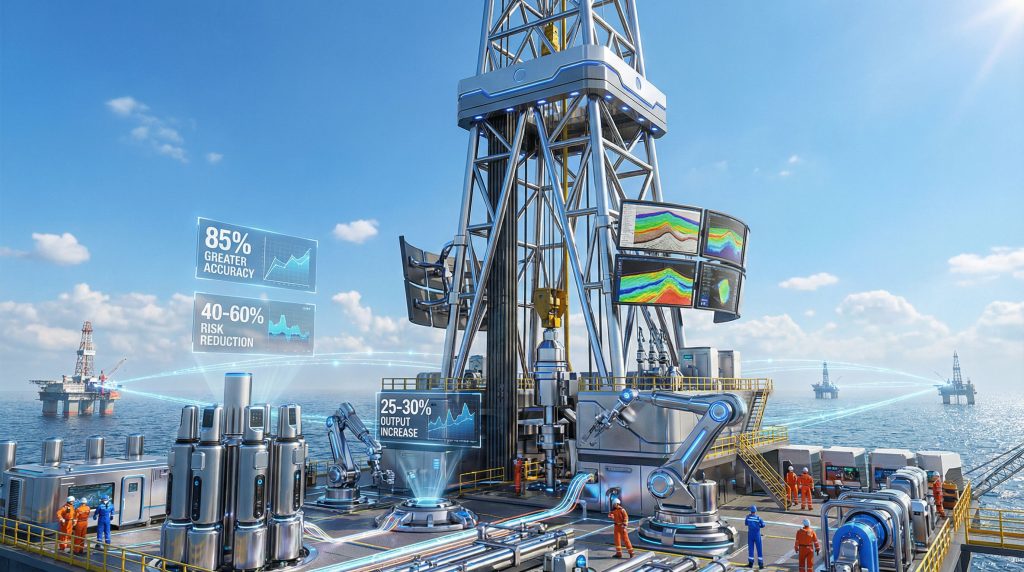
| Production optimisation | Manual adjustments | Real-time automation | 25-30% output increase |
| Exploration success rate | 35-40% | 65-75% | 75% improvement |
Note: Performance metrics shown represent industry examples and may vary significantly based on field conditions, technology implementation, and operational practices. Specific results require verification from operator case studies or peer-reviewed technical publications.
Predictive Maintenance Transforming Asset Management
Industrial Internet of Things (IIoT) sensor networks monitor critical equipment parameters continuously. Vibration analysis, temperature monitoring, pressure measurements, and fluid analysis provide early warning indicators of potential equipment failures. Furthermore, predictive maintenance strategies utilising machine learning algorithms analyse these sensor streams to predict maintenance requirements weeks before actual failures occur.
Predictive maintenance systems typically monitor:
- Pump performance characteristics
- Compressor efficiency metrics
- Pipeline integrity indicators
- Electrical system health parameters
- Rotating equipment condition assessments
The economic benefits of predictive maintenance extend beyond avoiding unplanned downtime. Maintenance schedules become more efficient, spare parts inventory requirements decrease, and worker safety improves through proactive hazard identification. However, implementing these systems requires substantial upfront investment in sensor infrastructure and data processing capabilities.
Which Technologies Are Driving the AI Revolution in Oil Fields?
Computer vision systems represent one of the fastest-growing AI applications in petroleum operations. High-resolution cameras equipped with thermal imaging capabilities continuously monitor drilling sites, production facilities, and pipeline infrastructure. These systems automatically detect equipment anomalies, safety violations, and environmental hazards without requiring constant human oversight.
Computer Vision Systems for Safety and Quality Control
Automated leak detection systems process thermal and optical imagery to identify hydrocarbon emissions before they become significant safety or environmental concerns. Machine learning models trained on thousands of leak scenarios can distinguish between normal operational variations and genuine equipment failures. This capability proves particularly valuable for offshore platforms and remote facilities where human inspection frequency may be limited.
Real-time hazard identification systems analyse video feeds from multiple cameras to detect unsafe worker behaviours, equipment malfunctions, and environmental risks. These systems generate immediate alerts to control room operators and can automatically trigger safety shutdown procedures when necessary. However, specific performance metrics regarding safety incident reduction require verification from operator-specific case studies.
Natural Language Processing for Regulatory Compliance
Environmental reporting requirements continue expanding across petroleum-producing jurisdictions worldwide. Natural language processing algorithms help companies maintain compliance by automatically processing regulatory updates, environmental impact assessments, and permit requirements. These systems track regulatory changes across multiple jurisdictions and flag potential compliance issues before they become violations.
Automated documentation systems generate environmental reports, safety assessments, and regulatory filings based on operational data streams. This reduces manual effort while improving consistency and accuracy in regulatory submissions. However, human oversight remains essential for reviewing AI-generated documents before submission to regulatory authorities.
The dual role AI plays in energy markets creates a complex paradox. While AI in oil extraction optimises extraction efficiency, the technology simultaneously drives massive electricity demand through data centre operations. This electricity requirement often necessitates additional natural gas power generation, potentially reinforcing fossil fuel dependency even as AI enables cleaner extraction processes.
Data centre energy consumption has become a significant concern for power grid operators. According to recent analysis, Norway faces potential electricity shortages due to data centre expansion driven by AI infrastructure deployment. This scenario demonstrates how AI adoption creates cascading energy demand that may require fossil fuel expansion to maintain grid reliability.
How Are Major Oil Companies Implementing AI Across Their Operations?
Industry demand fundamentals support continued investment in AI-powered extraction technologies. Wood Mackenzie analysis indicates global crude oil demand will maintain an upward trajectory until at least 2032, providing economic incentive for companies to optimise existing production assets. Recent market data shows oil demand increased sharply in September 2025, both monthly and annually, reinforcing industry confidence in long-term market prospects.
Case Study Analysis: Digital Transformation Implementation
Edge computing infrastructure forms the technological foundation for real-time AI decision making in remote oil field locations. These systems process sensor data locally rather than transmitting everything to centralised cloud facilities, reducing latency and improving response times for critical operational decisions. In addition, digital oil field trends demonstrate how specific implementation details regarding data volumes, processing capabilities, and network requirements need verification from operator technical documentation.
Machine learning models optimising hydraulic fracturing parameters analyse geological data, completion designs, and production outcomes to recommend optimal treatment strategies. These systems consider factors including:
- Formation permeability characteristics
- In-situ stress measurements
- Fracture fluid chemistry
- Proppant selection criteria
- Pumping schedule optimisation
- Economic return maximisation
Offshore Platform Automation and Remote Operations
Autonomous drilling systems now include autonomous underwater vehicles that conduct routine subsea inspections, reducing the need for expensive manned diving operations. These vehicles equipped with high-resolution cameras and sensors can identify pipeline corrosion, structural damage, and equipment wear patterns. Machine learning algorithms analyse inspection data to prioritise maintenance activities and predict equipment life cycles.
Remote drilling centres manage multiple offshore platforms simultaneously from onshore control rooms. Satellite communication systems transmit real-time drilling data, allowing experienced operators to oversee multiple wells without physical presence on drilling rigs. This approach reduces personnel exposure to offshore hazards while maintaining operational efficiency.
AI-powered weather prediction systems optimise drilling schedules by analysing meteorological forecasts, wave conditions, and equipment capabilities. These systems can predict weather windows suitable for critical operations like casing installation or equipment transfers, improving operational planning and reducing weather-related delays.
What Are the Technical Challenges and Solutions in AI Implementation?
Data integration remains one of the most significant obstacles to effective AI deployment in petroleum operations. Legacy systems often use proprietary data formats and communication protocols that don't integrate easily with modern AI platforms. Custom Application Programming Interface (API) development becomes necessary to bridge these compatibility gaps, requiring substantial software engineering resources.
Data Integration and Infrastructure Requirements
High-speed fiber optic networks provide the backbone for real-time data transmission from remote field locations to processing centres. These networks must maintain reliable connectivity despite harsh environmental conditions including extreme temperatures, corrosive atmospheres, and seismic activity. Network redundancy becomes critical for maintaining operations during communication disruptions.
Edge computing systems process time-sensitive data locally before transmitting summary information to central databases. This distributed architecture reduces bandwidth requirements while enabling rapid response to critical operational events. However, edge systems must operate reliably in challenging field environments with limited maintenance access.
Cloud infrastructure manages petabyte-scale geological databases containing decades of seismic surveys, well logs, and production histories. These systems require massive storage capacity and computing power to perform complex analytics across multiple datasets simultaneously. Data security protocols become paramount when managing sensitive exploration and production information.
Algorithm Development for Harsh Operating Environments
Machine learning models must adapt to extreme temperature variations ranging from arctic conditions to desert heat. Algorithm performance can degrade significantly when operating outside training data parameters, requiring robust model architectures and continuous retraining protocols. Model validation becomes particularly challenging in environments where ground truth data collection is difficult or expensive.
Sensor networks operating in high-pressure, corrosive downhole conditions require specialised hardware and algorithmic approaches. Sensor drift, calibration errors, and equipment failures can compromise data quality, necessitating fault-tolerant algorithms that continue operating despite incomplete information. Predictive models must account for sensor reliability when making critical operational decisions.
Communication disruptions between field locations and processing centres can interrupt AI system operation. Fail-safe protocols ensure that drilling operations continue safely even when high-speed data connections are temporarily unavailable. Local control systems maintain basic automation capabilities while prioritising safety shutdown procedures when necessary.
How Is AI Reshaping Workforce Requirements and Training Programmes?
The petroleum industry workforce is experiencing fundamental transformation as AI automation changes traditional job requirements. New technical roles emerge while conventional positions evolve to incorporate digital technologies. Companies invest heavily in reskilling programmes to help existing employees adapt to AI-enhanced work environments.
Emerging Roles in Digital Oil Field Operations
Data scientists specialising in petroleum engineering applications represent one of the fastest-growing job categories. These professionals combine statistical analysis skills with domain expertise in reservoir engineering, drilling operations, and production optimisation. They develop machine learning models tailored to specific geological conditions and operational requirements.
AI system operators manage automated drilling platforms and production facilities from remote control centres. These roles require understanding both traditional oil field operations and modern digital control systems. Operators monitor multiple wells simultaneously while intervening when automated systems require human judgement or encounter unexpected conditions.
Digital twin specialists maintain virtual reservoir models that mirror physical field behaviour in real-time. These professionals integrate geological modelling, reservoir simulation, and production optimisation to create comprehensive digital representations of oil and gas assets. They continuously calibrate virtual models against actual field performance to improve predictive accuracy.
Reskilling Programmes for Traditional Oil Field Workers
Machine learning fundamentals training helps field engineers understand AI decision-making processes and identify situations requiring human oversight. These programmes focus on practical applications rather than theoretical concepts, enabling engineers to work effectively with AI-enhanced systems while maintaining critical thinking skills.
Data interpretation courses for geologists and reservoir engineers emphasise pattern recognition in large datasets and validation of AI-generated insights. Professionals learn to combine traditional geological knowledge with machine learning outputs to make more informed exploration and development decisions.
Cybersecurity awareness programmes prepare operational personnel to recognise and respond to digital security threats. As operational technology networks become increasingly connected, workers must understand how cyber attacks could compromise safety and production systems. Training emphasises both technical security measures and behavioural protocols for maintaining system integrity.
The next major ASX story will hit our subscribers first
What Future Developments Will Define AI's Role in Oil Extraction?
Autonomous drilling systems represent the next frontier in petroleum automation technology. These systems will operate with minimal human intervention, making real-time decisions about drilling parameters, trajectory adjustments, and completion strategies. Advanced machine learning algorithms will integrate geological data, drilling mechanics, and economic optimisation to maximise well performance while minimising operational costs.
Autonomous Drilling Systems and Robotic Operations
Fully automated drilling rigs will revolutionise remote and offshore operations by reducing personnel requirements and improving safety outcomes. Robotic systems will handle pipe connections, equipment maintenance, and safety inspections without exposing workers to hazardous conditions. These systems will operate continuously, potentially reducing drilling times and costs significantly.
Robotic maintenance systems will perform routine equipment servicing, inspection, and repair tasks autonomously. Computer vision and manipulation technologies will enable robots to identify wear patterns, replace components, and conduct preventive maintenance procedures. This capability proves particularly valuable for subsea equipment and other difficult-to-access installations.
AI-controlled supply chain management will optimise material logistics, inventory management, and equipment deployment across multiple field locations. Predictive analytics will forecast material requirements, coordinate deliveries, and minimise transportation costs while ensuring adequate supplies for uninterrupted operations.
Integration with Renewable Energy and Carbon Management
Hybrid systems combining oil extraction with carbon capture technologies will become increasingly important as environmental regulations strengthen. AI optimisation algorithms in oil and gas exploration will balance production schedules with carbon management objectives, maximising economic returns while minimising environmental impact.
Predictive models will integrate renewable energy forecasts with oil field power requirements to optimise energy consumption patterns. Wind and solar generation variability will be matched with flexible oil field operations to reduce grid electricity demand during peak renewable production periods.
AI systems will optimise drilling schedules and production profiles to align with environmental objectives while maintaining economic viability. These systems will consider factors including carbon pricing, environmental regulations, and public perception in addition to traditional economic metrics.
Measuring ROI and Performance Metrics for AI Implementation
Financial impact assessment requires comprehensive analysis of implementation costs, operational savings, and productivity improvements. Initial AI infrastructure investments typically range from millions to tens of millions of dollars depending on project scope and technological complexity. However, these investments often generate substantial returns through improved operational efficiency and reduced costs.
Financial Impact Assessment Framework
Cost-benefit analysis must account for both direct and indirect benefits of AI implementation. Direct benefits include reduced drilling times, improved recovery rates, and decreased maintenance costs. Indirect benefits encompass improved safety outcomes, regulatory compliance efficiency, and enhanced decision-making capabilities.
Typical Investment Parameters:
- Initial AI infrastructure investment: $5-50 million per major project
- Annual operational savings: $10-100 million depending on scale
- Payback period: 18-36 months for comprehensive implementations
Disclaimer: Investment figures and performance metrics represent industry examples and require verification from specific operator case studies, financial reports, or technical publications. Actual results vary significantly based on field conditions, technology selection, and implementation approaches.
Key Performance Indicators:
- Well productivity improvements of 15-40%
- Exploration success rate increases from 35% to 65%
- Maintenance cost reductions of 25-45%
Environmental and Safety Performance Improvements
AI-powered systems contribute to environmental protection through optimised drilling operations that minimise waste generation and reduce emission intensity. Smart completion technologies improve recovery efficiency while reducing the number of wells required to develop reserves. Predictive maintenance prevents equipment failures that could result in environmental incidents.
Emission reduction strategies leverage AI optimisation to minimise flaring, reduce methane leakage, and improve energy efficiency across field operations. Machine learning algorithms identify opportunities to capture associated gas that might otherwise be wasted, improving both environmental performance and economic returns.
Worker safety improvements result from hazard prediction algorithms that identify potential risks before accidents occur. Automated safety systems can shutdown operations when dangerous conditions are detected, preventing injuries and equipment damage. However, specific safety performance metrics require verification from operator safety reports and industry databases.
Conclusion: AI as the Foundation of Next-Generation Oil Extraction
The integration of artificial intelligence into petroleum extraction operations represents a paradigm shift from reactive to predictive operational models. Through sophisticated analytics, automated control systems, and intelligent decision-making algorithms, the industry achieves unprecedented efficiency levels while improving safety and environmental performance.
Wood Mackenzie's analysis revealing one trillion additional barrels of recoverable oil potential through AI optimisation demonstrates the technology's transformative impact on global energy supplies. This massive resource expansion occurs without requiring new discoveries or breakthrough technologies, instead leveraging existing infrastructure more effectively through intelligent optimisation.
The dual nature of AI's energy impact creates complex market dynamics. While AI in oil extraction enables more efficient oil extraction, the technology simultaneously drives substantial electricity demand through data centre operations. This paradox reinforces fossil fuel importance in both extraction optimisation and power generation for AI infrastructure.
As global oil demand continues growing until at least 2032 according to industry forecasts, AI-driven optimisation provides essential tools for meeting this demand cost-effectively. The technology enables economic extraction from marginal reserves that might otherwise remain unproductive, extending the productive life of existing fields while improving overall industry sustainability.
Future developments in autonomous drilling, robotic operations, and integrated carbon management will further enhance AI's role in petroleum extraction. These advances position artificial intelligence as the foundational technology enabling the industry's evolution toward safer, more efficient, and environmentally responsible operations in an increasingly complex regulatory and market environment.
Investment Disclaimer: Performance metrics and financial projections discussed in this analysis represent industry examples and estimates that may not reflect actual results. Investment decisions should be based on comprehensive due diligence, verified operator data, and professional financial analysis rather than generalised industry claims.
Ready to Capitalise on the Next Major Resource Discovery?
Discovery Alert's proprietary Discovery IQ model delivers instant notifications on significant ASX mineral discoveries, empowering subscribers to identify actionable opportunities ahead of the broader market. Just as AI transforms oil extraction through predictive analytics, Discovery Alert's advanced technology transforms mineral investment decisions by converting complex geological data into clear, actionable insights for both experienced traders and long-term investors.