
May 21, 2026
The Mechanics of Benchmark Trust: Why Crude Oil Markets Demand More Than Just Price
Commodity benchmarks are not appointed. They are earned through a slow accumulation of commercial trust, physical credibility, and liquidity depth that only consistent participation can build over time. In global oil markets, the hierarchy of pricing references has remained largely unchanged for decades, with Western-centric benchmarks like Brent dominating even for barrels that never travel near the North Sea. That structural mismatch has long frustrated Asian refiners and Middle Eastern producers who trade in a fundamentally different physical reality. The growing activity in GME Oman futures record trading volume is increasingly being read by market observers as evidence that this long-standing imbalance may be shifting.
When big ASX news breaks, our subscribers know first
A Volume Milestone That Reframes the Conversation
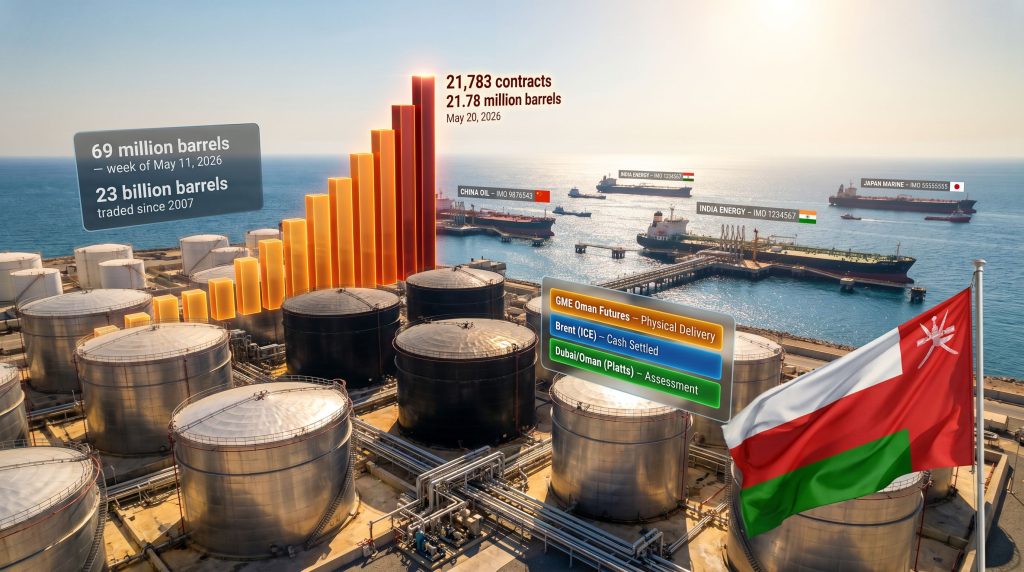
On May 20, 2026, the Gulf Mercantile Exchange recorded its highest single-day trading volume since the exchange first opened in 2007. A total of 21,783 contracts changed hands on that date, representing the equivalent of 21.78 million barrels of Oman crude oil transacted within a single trading session. The record did not arrive in isolation. During the week of May 11, 2026, the exchange also registered its highest weekly volume at 69,052 contracts, equivalent to approximately 69 million barrels. Peak open interest simultaneously reached 23,429 lots, or roughly 23.4 million barrels of notional exposure held at a single point in time.
These are not abstract numbers. Placed within the context of the exchange's cumulative history, they take on deeper significance.
| Metric | Figure |
|---|---|
| Record single-day contracts (May 20, 2026) | 21,783 contracts |
| Equivalent barrel volume | 21.78 million barrels |
| Record weekly volume (week of May 11, 2026) | 69,052 contracts |
| Weekly barrel equivalent | ~69 million barrels |
| Peak open interest record | 23,429 lots (~23.4 million barrels) |
| Total crude traded since inception (2007) | Over 23 billion barrels |
| Total physically delivered through exchange | More than 3 billion barrels |
Since the exchange launched nearly two decades ago, it has facilitated the trading of over 23 billion barrels of crude in aggregate, with more than 3 billion barrels settled through the actual physical delivery mechanism rather than cash offset. That distinction matters enormously to anyone who understands how futures markets establish long-term credibility.
How Does This Record Differ From Historical Volume Spikes?
Prior high-volume episodes, including a period in July 2011 during which approximately 88,539 contracts traded in a single week, were largely driven by isolated geopolitical events that temporarily concentrated speculative activity before subsiding. What characterises the current environment is different in kind. The progression toward sustained weekly and daily records suggests that participation is broadening across commercial hedgers, not concentrating among short-term speculative traders.
Open interest growth, which reflects the number of outstanding positions rather than just turnover, is the more telling indicator here. Rising open interest alongside rising volume signals that new participants are entering and holding positions, a hallmark of structural adoption rather than episodic speculation.
A futures contract achieves benchmark status not through institutional declaration, but through the repeated, voluntary return of commercial hedgers, producers, and price-risk managers who find it to be the most reliable tool for managing real exposure. The current trajectory of GME Oman futures record trading volume suggests that threshold is being approached with genuine momentum.
Why Physical Delivery Is the Benchmark Standard That Cannot Be Faked
One of the least appreciated distinctions in global commodity markets is the difference between a contract that can result in physical delivery and one that routinely does. Many financial oil instruments technically allow for physical settlement but are structured in ways that make cash offset far more attractive, meaning the physical delivery mechanism serves mostly as a theoretical anchor rather than an operational one.
GME Oman futures operate differently. The contract is specifically designed around physical delivery at designated Omani export terminals, and the more than 3 billion barrels delivered through the exchange mechanism since 2007 confirm that this is not a theoretical feature. It is a working operational reality.
This matters for several interconnected reasons:
- Price integrity: When physical delivery is genuinely possible and routinely exercised, convergence between futures prices and spot market reality is structurally enforced. Manipulation requires controlling actual physical supply, which is vastly more difficult than gaming a purely financial instrument.
- NOC credibility: National oil companies that anchor their Official Selling Prices to exchange-derived benchmarks need assurance that those prices reflect real supply and demand conditions, not financial flows disconnected from physical barrels.
- Counterparty confidence: Physical delivery reduces the gap between contract price and actual transaction price, giving both buyers and sellers a reference they can trust for procurement planning and revenue forecasting.
Oman's geographic position amplifies this operational credibility. The country's primary crude export infrastructure sits outside the Strait of Hormuz chokepoint, meaning that even during periods of elevated Hormuz transit risk, Omani terminal operations remain accessible. This is a logistical advantage with direct pricing implications, particularly during periods of regional instability.
The Geopolitical and Macro Backdrop Behind the Volume Surge
The timing of the May 2026 volume records is directly connected to conditions in the broader regional energy market. Furthermore, reports from major regional energy operators indicate that full normalisation of Strait of Hormuz crude flows is not expected until at least the first half of 2027, a timeline that has materially elevated the strategic value of pricing benchmarks anchored outside that transit corridor.
When physical supply routes face uncertainty, the demand for transparent, exchange-based price discovery accelerates. Buyers need to know what they are paying relative to a credible reference. Sellers need to hedge revenue exposure. Refiners need tools to lock in procurement costs across forward delivery windows. All of these requirements converge on futures liquidity, and all of them are intensified by geopolitical instability rather than dampened by it. Understanding these geopolitical trade tensions is essential context for interpreting why benchmark trust matters so acutely right now.
Several demand-side dynamics have also reinforced this pattern:
- China's ongoing crude accumulation: Despite the regional disruption environment, China commodity demand remained robust as the country continued building strategic crude stockpiles through April 2026, maintaining consistent appetite for Gulf-origin barrels and the pricing tools used to manage that exposure.
- Saudi export constraints: According to data from the Joint Organisations Data Initiative, Saudi Arabia's crude exports fell to their lowest recorded level in March 2026. Reduced availability from the region's dominant exporter creates upward pressure on competing Gulf grades, including Oman crude, and amplifies demand for the pricing mechanisms tied to those grades.
- Asian refinery alignment: Oman crude is classified as a medium-sour grade, typically carrying an API gravity in the range of 31 to 33 degrees and a sulfur content of approximately 1.0 to 1.1 percent. This profile aligns closely with the feedstock configurations of major refining complexes in China, South Korea, Japan, and India.
The NOC Pricing Ecosystem: Who Uses This Benchmark?
One of the structurally underappreciated aspects of GME Oman futures is the breadth of national oil company participation it has accumulated. Unlike purely financial benchmarks that serve trading desks rather than physical operators, this contract functions as a genuine commercial reference across multiple sovereign producers.
| Country | NOC / Entity | Role in GME Oman Ecosystem |
|---|---|---|
| Oman | OQ (formerly Oman Oil) | Primary physical delivery counterpart |
| Saudi Arabia | Saudi Aramco | Regional pricing reference alignment |
| Kuwait | Kuwait Petroleum Corp. | Export pricing benchmark for Asian cargoes |
| Bahrain | Bapco | Regional crude pricing reference |
| Dubai | ENOC / Dubai Supply Authority | Spot and term pricing reference |
The mechanism by which exchange prices influence Official Selling Prices is worth understanding in some detail. Most GCC national oil companies publish monthly OSPs for their crude grades, which are applied retroactively to term contract cargoes loaded during that month. These OSPs are expressed as differentials to a designated benchmark.
When that benchmark is anchored to exchange-derived prices rather than price reporting agency assessments, the resulting OSP carries a transparency advantage that bilateral negotiations cannot replicate. The shift toward exchange-based benchmarks also reduces the information asymmetry that has historically favoured producers over buyers in OSP negotiations. Consequently, when both parties can observe the same transparent exchange prices in real time, the negotiating dynamic changes fundamentally.
Assessment-Based vs. Exchange-Based: A Structural Debate With Real Consequences
For decades, Middle East crude pricing for Asian buyers has been dominated by assessment-based methodologies, most prominently the Dubai/Oman assessment published by S&P Global Commodity Insights through its Platts price reporting platform. These assessments are constructed through a market-on-close methodology, aggregating bids, offers, and transactions reported during a specific daily window to derive a representative price.
The structural critique of assessment-based pricing centres on several vulnerabilities:
- Participation dependency: The assessment is only as representative as the number and quality of market participants who choose to submit data during the assessment window. Thin participation can produce assessments that reflect a narrow slice of actual market activity.
- Methodology opacity: While Platts publishes its methodology guidelines, the discretionary elements involved in determining which transactions are representative are not subject to the same regulatory oversight as exchange-traded prices.
- Manipulation vulnerability: Because the window is defined and predictable, sophisticated participants can time their activity to influence assessments in ways that would be far more difficult to execute on an exchange with continuous trading and position limits.
Exchange-based prices carry none of these vulnerabilities by construction. Every transaction is executed on a central order book, timestamped, cleared through a regulated counterparty, and published in real time. The question of whether GME Oman futures record trading volume is approaching the liquidity depth needed to fully displace assessment-based benchmarks is legitimate, but the direction of travel appears increasingly clear.
The next major ASX story will hit our subscribers first
What the Record Means for Each Category of Market Participant
For oil producers and NOCs: Greater futures depth reduces the information advantage that sophisticated trading counterparties have historically held. More liquid benchmarks support more credible sovereign revenue hedging programmes and facilitate the structuring of crude-linked financial instruments. Understanding crude oil volatility is consequently increasingly important for producers designing these programmes.
For Asian refiners: Deeper futures markets directly lower the cost of hedging procurement risk. A refiner in South Korea or India managing a 90-day forward purchase programme benefits from tighter bid-ask spreads, better execution on hedge rolls, and a reduced gap between the price paid on the exchange and the price realised on physical delivery. These efficiency gains translate directly into refining margin improvement. In addition, commodity hedging strategies have become increasingly sophisticated as Asian refiners seek to reduce exposure to benchmark dislocations.
For financial institutions and trading houses: Rising open interest creates arbitrage opportunities between the exchange and Platts Dubai/Oman assessments, between front-month and deferred contracts, and between Oman crude and competing sour crude benchmarks. The physical delivery mechanism also creates structured finance opportunities that purely financial instruments cannot support. OPEC market influence furthermore plays a critical role in shaping the forward curve dynamics that these participants seek to exploit.
Frequently Asked Questions: GME Oman Futures Explained
What Is a GME Oman Futures Contract?
Each contract represents 1,000 barrels of Oman crude oil, with pricing quoted in US dollars per barrel. The contract can be settled through physical delivery at designated Omani export terminals or offset before expiry through an opposite market transaction. The exchange operates under regulatory oversight and uses a central clearing mechanism to manage counterparty risk. Full contract specifications are available directly from the exchange.
How Does Oman Crude Differ From Brent or WTI?
Brent is a light, sweet North Sea crude with an API gravity around 38 degrees and sulfur content below 0.5 percent. WTI is similarly light and sweet, serving primarily as a North American benchmark. Oman crude is medium-sour, sitting at approximately 31 to 33 degrees API with sulfur content around 1.0 percent. This heavier, higher-sulfur profile requires different refinery configurations to process economically, but aligns precisely with the hydrocracking and hydrodesulfurisation infrastructure that Asian refiners have built out specifically to handle Gulf-origin barrels.
Why Does Physical Delivery Matter for Benchmark Credibility?
Physical delivery ensures that the futures price must converge with the actual spot price as contracts approach expiry. Without this convergence mechanism, futures prices can drift from physical reality, undermining their usefulness as commercial pricing references. The more than 3 billion barrels physically delivered through the GME mechanism since 2007 establish an operational track record that gives commercial users confidence in the contract's price integrity.
What Does the Record Volume in May 2026 Actually Signal?
The combination of record single-day volume, record weekly volume, and elevated open interest occurring simultaneously suggests that the surge reflects genuine commercial participation rather than a one-day anomaly. When open interest grows alongside volume, it indicates that new participants are establishing positions and holding them, which is the pattern associated with structural benchmark adoption. The GME Oman futures record trading volume therefore represents a genuine inflection point rather than a statistical outlier.
Key Takeaways
- The 21,783 contracts traded on May 20, 2026, representing 21.78 million barrels, established a new single-day record for the exchange since its 2007 inception.
- The week of May 11, 2026 produced a record 69,052 contracts of weekly volume, while open interest peaked at 23,429 lots.
- More than 23 billion barrels traded and 3 billion barrels physically delivered since inception represent an operational foundation that few regional benchmarks can credibly match.
- Geopolitical disruption to Strait of Hormuz flows, with full normalisation not expected before the first half of 2027, is concentrating commercial hedging demand on benchmarks with physical delivery infrastructure outside that corridor.
- The long-term trajectory points toward a meaningful challenge to assessment-based pricing dominance, contingent on continued deepening of international participation and clearing accessibility.
This article is intended for informational purposes only and does not constitute financial or investment advice. Commodity market conditions, geopolitical developments, and exchange data are subject to change. Readers should conduct independent research before making any investment or commercial decisions.
Want to Track the Commodity Discoveries Driving the Next Market Shift?
Discovery Alert's proprietary Discovery IQ model scans ASX announcements in real time, translating complex commodity data across more than 30 sectors into clear, actionable insights — so investors can identify significant mineral discoveries the moment they are announced. Explore how historic discoveries have generated substantial returns on Discovery Alert's discoveries page, and begin a 14-day free trial to position yourself ahead of the broader market.