May 21, 2026
The Compounding Energy Trap: Why European Metals Were Already Vulnerable Before El Niño
Long before climate forecasters began flagging the current El Niño threat to aluminium and steel scrap in Europe as potentially one of the strongest on record, European metals markets were already operating inside a fragile energy cost architecture. The 2022 gas crisis did not simply spike production costs and then retreat. It restructured the competitive landscape permanently, and the recovery since then has been incomplete, uneven, and dangerously dependent on continued energy price stability.
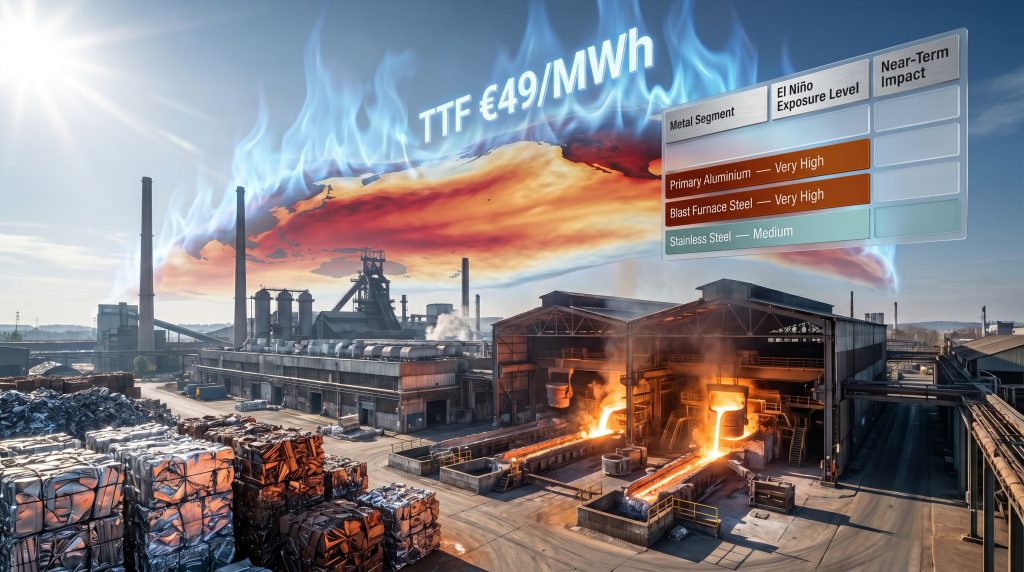
That stability is now being tested again. TTF natural gas futures, the dominant European gas pricing benchmark, have risen more than 15% over a four-week period to approximately €49 ($57) per MWh, driven in part by disruptions to LNG flows through the Strait of Hormuz. Because gas typically determines the marginal cost of electricity generation across much of the European grid, that move transmits into industrial power bills within days, not months. European gas price pressures are already compounding an already difficult operating environment for energy-intensive producers.
According to the International Energy Agency, EU electricity prices for energy-intensive manufacturers already exceed those paid by US producers by more than double, and sit roughly 50% above the tariffs faced by Chinese industrial competitors. That pre-existing disadvantage is the foundation onto which every new energy price shock is layered.
When big ASX news breaks, our subscribers know first
How El Niño Reaches European Metal Markets Without a Single European Weather Event
The most important technical detail about the El Niño threat to aluminium and steel scrap in Europe is that it does not require a European climate disruption to inflict damage. The transmission pathway runs through global LNG markets, not local weather systems. Research from PreventionWeb highlights how El Niño-driven supply chain disruptions can cascade into industrial cost structures far from the epicentre of climatic activity.
Here is how that mechanism works in practice:
-
El Niño disrupts atmospheric circulation patterns across the Pacific and Indian Ocean basins, creating water stress, logistics volatility, and production disruptions in key LNG-exporting regions including Southeast Asia and Australia.
-
Reduced LNG availability tightens global supply balances, elevating spot and futures prices at the TTF hub.
-
Higher TTF feeds into marginal electricity pricing across European power grids within days, directly inflating the cost base of energy-intensive producers.
-
Operating costs at primary aluminium smelters and electric arc furnace steelmakers escalate, compressing margins on spot power contracts.
-
Producers without long-term renewable power purchase agreements or captive generation face immediate pressure on operating rates.
-
Reduced domestic production tightens scrap availability, intensifying competition for high-quality secondary feedstock across the continent.
-
Simultaneously, Asian buyers increase their bids for European scrap, leaking feedstock that would otherwise support domestic recycling capacity.
The European Central Bank has previously documented El Niño's capacity to elevate global commodity prices during stronger events, with inflationary spillovers extending from agricultural markets into industrial input cost structures. In a scenario where the current event ranks among the strongest on record, that inflationary pressure arrives on top of Strait of Hormuz-related LNG disruptions that are already moving TTF higher.
Primary Aluminium: The Sector With the Steepest Exposure Profile
Primary aluminium smelting is among the most electricity-intensive industrial processes on the planet, with power costs representing the largest single variable in the production cost structure. European smelters without long-term power agreements are directly exposed to every movement in spot electricity pricing, with no buffer between TTF fluctuations and their operating margins.
The near-term risk profile for European primary aluminium is not characterised by mass permanent closures. Trade sources consistently describe it in terms of operating rate reductions, deferred restart decisions, and eroding investment confidence. Each of these outcomes is less dramatic than a closure headline but cumulatively more damaging, because they compound over successive energy stress events to produce a progressively smaller domestic production base.
The risk profile is inherently asymmetric. Cost spikes materialise immediately when TTF moves. Capacity recovery following curtailments takes months to years, requires capital investment in an uncertain energy environment, and depends on power price stability that the current trajectory does not support.
European secondary aluminium producers have noted that if TTF approaches the levels seen during the previous winter, smaller remelting operations would face unviable cost structures. That outcome would remove capacity from the market while simultaneously tightening the scrap availability that remaining processors depend on.
Three Scenarios: Mapping El Niño Stress Across European Aluminium
| Scenario | TTF Trajectory | Operating Rate Impact | Scrap Availability | Import Dependence |
|---|---|---|---|---|
| Moderate Event | Elevated but below 2022 peak | Selective reductions | Modest tightening | Gradual increase |
| Severe Event | Approaches prior crisis levels | Widespread reductions | Significant feedstock shortfall widens | Accelerated deepening |
| Compounding Event | Dual shock: El Niño plus Hormuz disruption | Exceeds hedging capacity | Acute competition with Asian buyers | Structural shift |
The compounding scenario deserves particular attention. European Aluminium data indicates that approximately 15% of EU recycling furnace capacity is already offline due to insufficient scrap supply, with an annual feedstock shortfall estimated at around 2 million tonnes. A dual energy shock that simultaneously reduces domestic remelting capacity and intensifies Asian competition for available scrap would widen that gap at a pace that market adjustments cannot easily absorb.
The Strategic Revaluation of Scrap as an Embedded Energy Hedge
Secondary aluminium production consumes only a fraction of the electricity required by primary smelting. That energy differential is no longer simply an operational footnote. In a structurally elevated power price environment, the value of scrap feedstock incorporates avoided energy expenditure and avoided carbon cost as well as metal content. Scrap is being repriced accordingly.
Demand for clean wrought aluminium grades and used beverage can material is expected to remain firm through the second half of 2026. The outlook for lower-grade mixed and contaminated scrap is considerably weaker.
The divergence between clean and mixed aluminium scrap grades is no longer cyclical. Industry sources describe it as a structural feature of the European market, driven by the growing energy cost of sorting and processing lower-quality material when power prices are elevated.
This quality divide has investment implications that extend beyond short-term pricing. Operations built around clean grade processing occupy a fundamentally different competitive position to those dependent on mixed streams. As energy costs remain structurally elevated, that gap widens rather than closes.
Aluminium Scrap Grade Strategic Positioning:
| Grade Category | Processing Energy Intensity | Demand Outlook H2 2026 | Price Premium Trajectory | Strategic Value Ranking |
|---|---|---|---|---|
| Clean wrought / UBC | Low | Firm | Expanding | Very High |
| New production offcuts | Low-Medium | Stable | Stable-Positive | High |
| Mixed post-consumer | Medium-High | Softening | Compressing | Medium |
| Contaminated / low-grade | High | Weak | Declining | Low |
European Ferrous Scrap and the EAF Divide
The El Niño threat to aluminium and steel scrap in Europe manifests differently across the ferrous sector depending on production route and energy contract structure. Furthermore, the broader policy backdrop — including the EU steel and metals action plan — places additional strategic weight on how energy risk is managed across production routes.
Blast furnace producers carry the most exposed cost profile: elevated gas and electricity costs, carbon obligations under the EU Emissions Trading System, and subdued downstream industrial demand from construction and automotive sectors create a compounding pressure that leaves limited room for further input cost escalation.
Electric arc furnace producers hold a structural advantage through their lower carbon intensity and scrap-based feedstock flexibility. However, the EAF sector is internally divided in a way that is not always visible in aggregate market analysis.
EAF mills that have secured long-term renewable power purchase agreements operate with a fundamentally different cost structure than those purchasing electricity on spot markets. When TTF spikes, the operating cost spread between these two groups can be significant, creating a two-tier competitive structure within European EAF steelmaking. That spread also determines which mills can afford to pay higher premiums for clean, low-residual ferrous scrap, and which cannot.
The consequence is that scrap quality and energy contract status have become linked variables in European steel competitiveness. Mills with renewable power agreements and access to clean scrap streams are insulated from El Niño-driven energy shocks in ways that structurally weaker operators are not. Consequently, the trajectory of green steel pricing will increasingly reflect this growing divide between insulated and exposed producers.
The Scrap Export Problem: A Vulnerability That Predates El Niño
The scrap availability crisis in Europe is not a product of El Niño. It is a pre-existing structural condition that El Niño risk amplifies. European aluminium scrap is being acquired by overseas buyers, processed outside the EU, and in some cases returned to European markets as finished product. The circular trade dynamic this creates weakens domestic recycling infrastructure while simultaneously tightening the feedstock supply that European secondary producers depend on.
Eurofer and European Aluminium have jointly called for action on this scrap leakage problem, framing it as a direct threat to Europe's green industrial transition. Industry voices have called for scrap to be formally classified as a strategic raw material under EU policy frameworks, with export tariffs or restrictions designed to retain high-quality material within the European circular economy. The argument is framed around both industrial sovereignty and decarbonisation: without domestic scrap retention, Europe risks losing the competitive foundation of its low-carbon metals production base at precisely the moment when that foundation matters most.
A critical but underappreciated dimension of this challenge involves alloy chemistry. Some end-use alloy specifications are incompatible with the residual element profiles found in widely available scrap grades. Expanding scrap utilisation in certain product categories therefore requires manufacturers to reformulate alloy specifications, a process involving qualification testing, customer approval cycles, and supply chain reconfiguration. This transition must accelerate if Europe's secondary metals sector is to absorb more of the scrap stream rather than losing it to export markets or seeing it downgraded.
How Does This Connect to the Broader Critical Minerals Picture?
The scrap retention challenge sits within a wider vulnerability in the European critical minerals supply chain, where dependence on imported raw materials and processing capacity outside the EU creates systemic exposure to geopolitical and climatic shocks. In addition, the aluminium industry leaders most active in European markets are increasingly factoring scrap security into their long-term investment strategies, recognising that feedstock availability is as strategically significant as energy cost management.
The next major ASX story will hit our subscribers first
Stainless Steel: Relative Resilience With Caveats
The stainless steel sector occupies a relatively more resilient position within the European metals risk framework. Its high baseline dependence on recycled feedstock provides structural insulation that primary aluminium and blast furnace steel segments cannot match. Trade sources in the stainless scrap space describe the sector as better positioned than primary metal producers under current conditions.
The caveat is that energy-intensive melt operations within stainless production carry residual electricity price exposure that would become material if power costs escalate sharply through the second half of the year. Relative resilience does not mean immunity.
Risk Matrix: El Niño Exposure Across European Metal Segments
| Metal Segment | Primary Risk Vector | El Niño Exposure | Near-Term Impact | Hedge Available |
|---|---|---|---|---|
| Primary Aluminium | Spot electricity cost | Very High | Operating rate reduction | Long-term power agreements |
| Secondary Aluminium (clean grades) | Scrap availability | High | Price premium expansion | Scrap supply contracts |
| Secondary Aluminium (mixed grades) | Processing energy cost | Medium-High | Margin compression | Grade upgrading investment |
| EAF Steel (spot power) | Electricity cost | High | Cost divergence | Renewable PPA acquisition |
| EAF Steel (renewable PPA) | Scrap availability | Medium | Competitive advantage maintained | Scrap supply security |
| Blast Furnace Steel | Gas, carbon, demand | Very High | Utilisation pressure | Limited near-term options |
| Stainless Steel | Energy and scrap retention | Medium | Relative resilience | Recycled feedstock base |
Frequently Asked Questions: El Niño and European Metals
How Does El Niño Affect European Aluminium Production?
The impact pathway runs through global LNG markets rather than European weather directly. El Niño-related production and logistics disruptions tighten global gas supply, elevating TTF futures, which transmit into European industrial electricity costs within days. The practical result is operating rate reductions, deferred investment, and accelerated dependence on secondary production.
Why Does Scrap Quality Matter More During Energy Price Spikes?
Higher electricity costs increase the processing burden of low-grade and contaminated scrap, compressing margins for operators who handle mixed material. Clean grades carry embedded energy savings because they require less sorting, pre-treatment, and quality management before entering the melt. In a high-energy-cost environment, that processing differential becomes financially material.
What Policy Tools Could Protect European Scrap Markets?
-
Strategic classification of scrap as a critical industrial raw material within EU frameworks
-
Export tariffs or volume restrictions to retain high-quality scrap within the European circular economy
-
Long-term incentives supporting renewable power purchase agreements for energy-intensive recyclers
-
Alloy specification reform programmes to expand scrap compatibility across end-use manufacturing applications
Strategic Outlook Through H2 2026
The structural transitions already under way in European metals markets would accelerate materially under a severe El Niño scenario. Secondary production's cost and carbon advantages over primary alternatives would become more pronounced, investment flows toward recycling infrastructure would face competitive urgency, and the scrap quality premium would widen beyond current levels.
Competition for high-quality ferrous and non-ferrous scrap is expected to remain firm through the second half of 2026 regardless of whether the climate event intensifies. If it does, that competitive pressure extends across all grades and geographies, narrowing the window for European producers and policymakers to establish domestic scrap supply security before the next structural shock arrives.
This article contains forward-looking assessments and scenario analysis based on publicly available market data and trade source commentary. It does not constitute financial or investment advice. Readers should conduct independent research before making any commercial or investment decisions.
Want To Stay Ahead of the Next Major Mineral Discovery on the ASX?
Discovery Alert's proprietary Discovery IQ model delivers real-time alerts on significant ASX mineral discoveries, cutting through complex market data to surface actionable opportunities the moment they are announced — explore historic examples of exceptional discovery returns or start your 14-day free trial today to position yourself ahead of the broader market.