
May 21, 2026
When Intelligence Moves Markets: Understanding the Geopolitical Risk Premium in Crude Oil
Energy markets have always functioned as a forward-looking mechanism, pricing not just current supply and demand, but the full distribution of future outcomes. When a single intelligence report can shift Brent crude by nearly two percent within hours, it reveals something important about how fragile trader confidence has become in the current geopolitical environment. Oil rises after Reuters report complicates US-Iran peace talks, and this episode unfolding across global oil markets in May 2026 is not simply a news-driven price swing. It represents a deeper, structural reassessment of Middle East supply reliability that commodity markets are still in the early stages of processing.
When big ASX news breaks, our subscribers know first
How a Single Intelligence Report Triggered a Major Risk Repricing
Understanding why oil rises after a Reuters report complicates US-Iran peace talks requires separating two distinct market forces: headline risk and structural supply risk. Most price volatility is driven by the former, resolving quickly as the news cycle moves on. What makes the current situation different is that both forces are operating simultaneously.
The Reuters report, citing two senior Iranian sources, indicated that Iran's Supreme Leader issued a directive blocking the transfer of the country's near-weapons-grade enriched uranium abroad. This directly contradicts one of Washington's core preconditions for any negotiated resolution to the conflict. The market's immediate response was decisive.
| Benchmark | Pre-Report Level | Post-Report Level | Change |
|---|---|---|---|
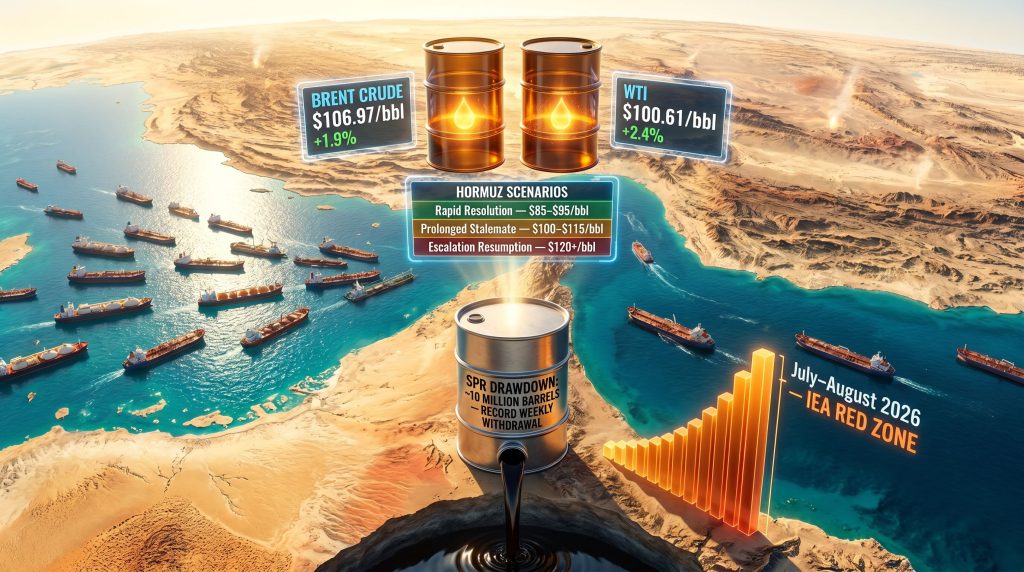
| Brent Crude ($/bbl) | ~$105.00 | $106.97 | +1.9% / +$1.95 |
| WTI Crude ($/bbl) | ~$98.26 | $100.61 | +2.4% / +$2.35 |
| Prior Day Decline | Approx. 5.6% drop | Partial recovery | WTI crossed $100 threshold |
The significance here is not just the magnitude of the move. It is the speed and source. Futures markets responded to an intelligence-level report rather than an official diplomatic statement, demonstrating how far market participants have shifted their probability weighting toward prolonged conflict. When prices can swing more than two percent on unverified sourcing, the risk premium embedded in crude is being driven by expectation architecture rather than confirmed supply data.
Furthermore, crude oil trade geopolitics has long shaped how energy benchmarks respond to regional tensions, and this episode reinforces that pattern emphatically.
The ING analyst team flagged in a research note that the market has cycled through this pattern multiple times previously, with periods of apparent progress repeatedly giving way to disappointment. Their baseline Brent forecast for the current quarter sits at $104 per barrel, reflecting an assumption that uncertainty, not resolution, remains the dominant operating condition.
The Strait of Hormuz: A Chokepoint Unlike Any Other
Why Partial Closure Creates More Uncertainty Than a Full Shutdown
Before the conflict that effectively began on February 28, the Strait of Hormuz served as the transit corridor for oil and liquefied natural gas volumes representing approximately 20% of global energy consumption. No other single maritime passage carries this concentration of energy trade.
Iran's subsequent declaration of a "Persian Gulf Strait Authority" and the designation of a controlled maritime zone transformed the strait from an open international waterway into a contested operational environment. What energy logistics professionals understand, but casual observers often miss, is that a partial closure creates more economic disruption than a clean full closure in several important ways:
- Insurance uncertainty: War risk premiums for vessels transiting partially restricted zones are often higher than for vessels choosing alternative routes entirely, because the liability exposure is ambiguous.
- Contract ambiguity: Shipping contracts typically contain force majeure provisions triggered by full closures. Partial restrictions create legal grey zones that delay cargo movements and drive up demurrage costs.
- Routing inefficiency: Rerouting around the strait adds significant voyage time and fuel cost, but the lack of clear legal status makes it difficult for operators to commit to alternative routing without risking contractual penalties.
- Crew safety uncertainty: Insurers and ship operators apply the highest risk premium when danger is probabilistic rather than certain, further compressing available shipping capacity.
The 2027 Recovery Timeline and What It Actually Means
ADNOC CEO Sultan Al Jaber stated clearly that even if the conflict concluded immediately, full oil flows through the Strait of Hormuz could not realistically resume before the first or second quarter of 2027. This assessment reflects a lesser-understood reality about post-conflict maritime infrastructure restoration: the timeline is governed not by politics, but by operational realities.
Restoring full commercial transit through a previously contested maritime zone involves:
- Mine-clearing and ordnance disposal operations across the strait's shipping lanes
- Reassessment and re-certification of navigational aids, buoy systems, and port approach infrastructure
- Reinstatement of marine insurance coverage at commercially viable rates
- Re-establishment of vessel traffic service coordination between regional authorities
- Rebuilding tanker operator confidence through several successful transits before volumes normalise
Each of these stages takes time independently. Sequentially, they create the Q1-Q2 2027 restoration window that senior energy sector leadership has identified as the realistic baseline, regardless of when a political agreement is formalised.
Three Scenarios: Diplomatic Pathways and Their Price Implications
| Scenario | Diplomatic Outcome | Hormuz Status | Brent Price Range |
|---|---|---|---|
| Rapid Resolution | Deal within 30 days | Partial reopening by Q3 2026 | $85-$95/bbl |
| Prolonged Stalemate | No deal before Q4 2026 | Restricted through 2026 | $100-$115/bbl |
| Escalation Resumption | Talks collapse | Full closure risk | $120+/bbl |
WTI and Brent futures have already begun reflecting the prolonged stalemate scenario as the probability-weighted baseline, consequently pulling the full price curve higher across deferred contracts.
The Nuclear Dimension: Why the Uranium Issue Is the Real Obstacle
Understanding Iran's Enrichment Position and Its Strategic Logic
The uranium directive attributed to Iran's Supreme Leader carries weight far beyond its immediate diplomatic implications. Iran has accumulated a stockpile of near-weapons-grade enriched uranium over several years, and the transfer of that material outside Iranian territory would represent an irreversible concession.
From Tehran's strategic perspective, the enriched uranium stockpile functions as a deterrence asset and a negotiating chip simultaneously. Surrendering it without ironclad security guarantees would be seen domestically as strategic capitulation.
Washington's demand for uranium relocation stems from a different logic: the physical removal of the material from Iranian soil is the only verifiable safeguard that prevents rapid weaponisation in the event negotiations collapse at a future date. This creates a structural deadlock where both positions are entirely rational within their respective strategic frameworks.
Pakistan's escalating role as a diplomatic intermediary reflects the absence of direct communication channels capable of bridging this gap. While Tehran indicated it was reviewing Washington's latest proposals, and the US administration signalled a willingness to pause military operations for a limited period while awaiting acceptable terms, the fundamental incompatibility on the uranium question has persisted through multiple negotiating cycles. Examining the relationship between oil prices and trade war dynamics further illustrates how geopolitical deadlocks consistently translate into sustained price pressure. Markets have learned to price this pattern accordingly.
Strategic Petroleum Reserves Under Unprecedented Pressure
The Record Drawdown and What the EIA Data Is Really Signalling
The US Energy Information Administration confirmed that approximately 10 million barrels were withdrawn from the Strategic Petroleum Reserve in a single week, the largest single-week drawdown ever recorded. Simultaneously, commercial crude inventories declined by more than market consensus anticipated.
The concurrent depletion of both reserve categories is significant because they serve different functions in energy security architecture:
- Strategic reserves are designed for major supply disruptions and are intended to provide buffer capacity for months, not weeks
- Commercial inventories reflect current market balance; unexpected drawdowns indicate genuine supply shortfalls rather than inventory management decisions
When both deplete simultaneously at elevated rates, the market faces a shrinking cushion against further disruption precisely when disruption risk remains elevated.
| Reserve Type | Current Status | Risk Assessment |
|---|---|---|
| US Strategic Petroleum Reserve | Record single-week drawdown (~10M bbl) | Critical |
| US Commercial Crude Inventories | Fell more than consensus expected | High |
| Global Commercial Stockpiles | Depleting under Middle East supply loss | Elevated |
| IEA Member State Emergency Reserves | Under coordinated deployment | Moderate to High |
The July-August 2026 Red Zone
IEA executive leadership has identified the July to August 2026 window as the period of maximum supply stress. The convergence of factors creating this risk window includes:
- Peak northern hemisphere summer fuel demand typically adds 1.5 to 2 million barrels per day to global consumption seasonally
- The continued absence of new Middle Eastern export volumes removes a significant portion of the supply base that would normally absorb this seasonal demand surge
- Strategic and commercial reserve buffers are already being depleted at record rates, reducing the market's shock-absorption capacity
- Shipping and logistics bottlenecks driven by Hormuz restrictions compound the physical distribution challenge
The "red zone" concept in oil market analysis refers to the inventory threshold below which any additional supply disruption, however minor, produces disproportionately sharp price responses. Markets operating near this threshold exhibit non-linear price behaviour that makes forecasting extremely difficult and risk management significantly more costly.
Economic Transmission: How the Oil Shock Is Spreading
The Eurozone Contraction and Its Feedback Mechanisms
Eurozone economic output contracted at its sharpest pace in more than two and a half years during May, according to purchasing managers' index survey data. The transmission mechanism runs through energy costs into real household purchasing power, compressing consumer demand for services. Firms across the eurozone have begun accelerating workforce reductions in response to weakening demand signals.
The macro feedback loop that energy economists find particularly concerning is the self-correcting but painful dynamic this creates: weaker European growth reduces global oil demand, which provides a partial offset to supply-driven price pressure, but only through the mechanism of economic contraction. It is, in other words, demand destruction rather than supply resolution.
Cross-Asset Contagion: Beyond the Crude Price
The oil shock's transmission across asset classes extends well beyond energy sector equities:
- Currency markets: The US dollar has strengthened on safe-haven flows, creating an additional cost burden for oil-importing emerging market economies that purchase crude in dollars
- Sovereign bond markets: Inflation expectations embedded in government bond yields are rising, complicating central bank decisions on interest rate trajectories
- Equity markets: Industrial, consumer discretionary, and transportation sectors face margin compression from elevated energy input costs
- Shipping and cargo insurance: War risk premiums on Middle East cargo routes have increased materially, adding a secondary cost layer that flows through into import prices globally
The next major ASX story will hit our subscribers first
LNG: The Overlooked Casualty of the Hormuz Closure
Much of the analysis surrounding Hormuz has focused on crude oil, but the liquefied natural gas dimension deserves equal attention. Qatar, the world's largest LNG exporter, depends on Hormuz access for the overwhelming majority of its export volumes. The UAE is also a significant LNG exporter through the same corridor.
Europe's structural vulnerability here is compounded by its post-Russia energy repositioning. Having significantly reduced pipeline gas dependency following the Russia-Ukraine energy decoupling, European markets increased their reliance on seaborne LNG. The disruption to global LNG supply flowing through Hormuz therefore creates a compounding vulnerability that directly targets Europe's reengineered energy security architecture.
LNG tankers face even greater rerouting challenges than crude carriers because regasification terminals are configured for specific vessel types and contractual delivery windows. Rerouting via the Cape of Good Hope adds approximately ten to fourteen days of additional voyage time per round trip, materially reducing effective LNG supply capacity even from sources physically unaffected by the conflict.
Investment and Strategic Implications: Positioning for a Multi-Year Adjustment
Near-Term Catalysts That Will Move Prices
Traders and investors tracking this situation should monitor the following specific triggers. In addition, OPEC market influence will remain a critical variable shaping how quickly supply-side responses can materialise:
- Official Iranian government statements confirming or contradicting the uranium directive reporting
- Progress indicators or breakdown signals from Pakistan-facilitated diplomatic channels
- Weekly EIA inventory data, particularly SPR drawdown rates as the July-August risk window approaches
- Any modification to the US naval blockade posture around Iranian coastal waters
- OPEC+ production policy decisions in the context of sustained elevated prices
Structural Shifts Accelerated by the Crisis
Beyond short-term price dynamics, this episode is accelerating several structural transitions in global energy. For instance, the stalled US-Iran negotiations are fast-tracking investment decisions that would otherwise have taken years to mature:
- Renewed urgency around non-Middle East oil and gas development, particularly in North American shale, West African deepwater, and offshore Southeast Asia
- Heightened policy prioritisation of strategic reserve capacity expansion among major importing nations
- Accelerated investment in LNG regasification terminal capacity in markets seeking supply source diversification
- Long-term pressure on alternative maritime corridor development, including expanded pipeline infrastructure bypassing Persian Gulf dependency
Disclaimer: This article contains forward-looking statements, scenario projections, and analyst forecasts that involve significant uncertainty. Oil price projections, diplomatic outcome scenarios, and supply restoration timelines are estimates based on information available at the time of writing and should not be construed as financial advice. Past price behaviour is not indicative of future performance. Readers should conduct their own research and consult qualified financial advisers before making investment decisions.
Key Data Reference: Market Signals and Structural Indicators
| Metric | Value | Market Significance |
|---|---|---|
| Brent Crude post-report | $106.97/bbl (+1.9%) | Diplomatic breakdown risk repriced |
| WTI Crude post-report | $100.61/bbl (+2.4%) | Crossed key psychological threshold |
| Prior day benchmark decline | ~5.6% | Reversed on brief peace optimism |
| Hormuz pre-conflict share of global energy | ~20% | Scale of structural supply disruption |
| Full Hormuz flow restoration estimate | Q1-Q2 2027 | Timeline regardless of political deal |
| US SPR weekly drawdown | ~10 million barrels (record) | Critical inventory stress indicator |
| IEA peak risk window | July-August 2026 | Demand surge meets depleted buffers |
| ING Brent price forecast (current quarter) | $104/bbl average | Uncertainty priced as baseline condition |
| Eurozone contraction pace | Sharpest in 2.5+ years | Economic transmission of energy shock confirmed |
Want to Stay Ahead of the Next Major Resource Discovery Triggered by Shifting Energy Markets?
As geopolitical shocks reshape commodity markets and accelerate investment into non-Middle East energy development, Discovery Alert's proprietary Discovery IQ model delivers real-time ASX mineral discovery alerts, turning complex market signals into actionable opportunities — begin your 14-day free trial today and ensure you're positioned before the broader market catches on, or explore historic discovery returns to understand just how significant these moments can be.