
May 21, 2026
When the State Becomes the Trader: Indonesia's Coal Export Overhaul and What It Means for Global Markets
Commodity markets have long operated on a foundational assumption: that price signals, competitive intermediaries, and decentralised contract networks are the most efficient mechanisms for allocating supply. That assumption is now being stress-tested in the world's single most important thermal coal export market. The Indonesia coal export plan represents not just a policy adjustment, but a fundamental reimagining of how the country monetises its natural resource base. For global coal buyers, trading firms, and energy utilities across Asia, the implications stretch well beyond the 2026 implementation window.
When big ASX news breaks, our subscribers know first
Understanding the Revenue Leakage Problem That Triggered Reform
The Indonesia coal export plan did not emerge in a vacuum. It is the culmination of decades of frustration within Jakarta over the perceived gap between the physical volumes Indonesia ships to global markets and the financial value that actually flows back into the domestic economy.
President Prabowo Subianto has pointed to an estimated $908 billion in cumulative revenue losses between 1991 and 2024, attributed to export under-invoicing, transfer pricing manipulation, and inadequate oversight of commodity export proceeds. To contextualise that figure: it represents a structural drain on Indonesia's national wealth that has persisted across multiple commodity cycles, several presidential administrations, and countless regulatory iterations.
Under-invoicing, in the context of commodity exports, refers to the practice of declaring a lower transaction value to customs authorities than the actual price received by the seller. The difference is typically retained offshore, bypassing Indonesian banking and tax systems entirely. Transfer pricing adds a further layer of complexity, with related-party transactions between Indonesian producers and their overseas affiliates structured to shift profits to lower-tax jurisdictions.
Together, these practices have made it structurally difficult for Jakarta to capture the full fiscal value of commodities extracted from Indonesian soil. A March 2025 government regulation already attempted to address part of this problem by requiring that 100% of foreign currency export proceeds be deposited into designated domestic bank accounts for a minimum of 12 months. The BUMN routing mandate announced in May 2026 goes considerably further, removing private intermediaries from the transaction chain entirely.
The Macroeconomic Context: Currency Pressure and Capital Outflows
The timing of this policy shift is not coincidental. Indonesia's currency has ranked among the weakest performers across Asian emerging markets in recent months, buffeted by a combination of sustained capital outflows and broad US dollar strength. The Jakarta Composite Index, which tracks 913 listed companies spanning commodities, energy, and broader industry, had declined approximately 30% from the start of 2026 prior to the announcement, reflecting investor unease about the overall direction of Indonesia's economic policy environment.
This currency and capital market weakness creates a direct fiscal incentive for the government to tighten its grip on commodity export revenues. For an economy as deeply dependent on commodity exports as Indonesia's, every dollar retained onshore through tighter export controls represents a direct contribution to foreign exchange reserves and, by extension, currency stability. Furthermore, the coal supply challenges already reshaping markets globally have made this intervention even more consequential.
Key Context: The three initial commodity categories targeted by the BUMN export routing mandate — namely coal, palm oil, and ferroalloys — collectively accounted for approximately 23% of Indonesia's total export revenues in 2025, according to analysis from Singapore's OCBC Bank. This is not a peripheral policy experiment; it targets the core of Indonesia's export earnings base.
What the BUMN Export Routing Model Actually Does
The operational mechanics of the Indonesia coal export plan deserve careful unpacking, because the terminology can obscure what is a genuinely radical restructuring of trade architecture.
Under the existing model, Indonesian coal producers negotiate and execute supply contracts directly with overseas buyers, with private trading companies frequently acting as intermediaries, managing logistics, blending operations, financing, and price risk. The new framework replaces this with a centralised state entity, classified as a Badan Usaha Milik Negara (BUMN), which assumes the role of sole authorised counterparty for international commodity sales.
The BUMN is expected to function as a centralised marketing and export facilitation agent, procuring coal from domestic producers and managing all aspects of international sales. Possible institutional linkage to Danantara Indonesia, the country's sovereign wealth fund, has been raised by market participants, though no definitive organisational structure has been confirmed publicly.
The phased rollout is structured as follows:
| Phase | Period | Scope |
|---|---|---|
| Transition Phase 1 | June 2026 | Exporters begin shifting contracts and payment flows to BUMN structure |
| Transition Phase 2 | July to August 2026 | Gradual handover while producers retain partial operational control |
| Full Implementation | From September 2026 | BUMN assumes end-to-end control: contract negotiation, documentation, shipping, and receipt of export proceeds |
Quarterly reviews are planned to assess whether the commodity scope should be expanded beyond coal, palm oil, and ferroalloys. No definitive guidance document has been issued on how existing multi-year supply contracts will migrate to the new structure — a gap that is already generating significant commercial anxiety across the market.
Seven Layers of Regulatory Accumulation Since 2022
The BUMN mandate is the most structurally significant intervention in Indonesia's coal sector in decades, but it did not arrive as a standalone measure. It represents the latest addition to an accelerating sequence of state interventions that have progressively narrowed private-sector operational autonomy since the commodity price downturn that began in 2022:
- Domestic Market Obligation (DMO) rules requiring producers to allocate a fixed output share to domestic power utilities at regulated prices
- RKAB validity period revision reducing work plan and budget approvals from three years back to one year, increasing government touchpoints and producer uncertainty
- HBA reference price adjustments modifying the domestic coal benchmark used for royalty and tax calculations
- Mandatory onshore proceeds retention requiring 100% of export revenues to be held in Indonesian banks for at least 12 months, introduced in March 2025
- Proposed coal export tax announced by Indonesia's finance ministry but subsequently delayed pending further review
- 580 million tonne production ceiling approved by the government for 2026, signalling active volume management rather than purely price-focused policy
- BUMN export routing mandate announced May 2026, the most structurally transformative measure to date
Each successive layer has progressively transferred commercial control and monitoring capability from private operators to the state. What began as pricing and volume adjustments has now evolved into a direct challenge to the fundamental architecture of how Indonesian coal reaches international markets.
Indonesia's Position in Global Seaborne Coal: Why This Matters So Much
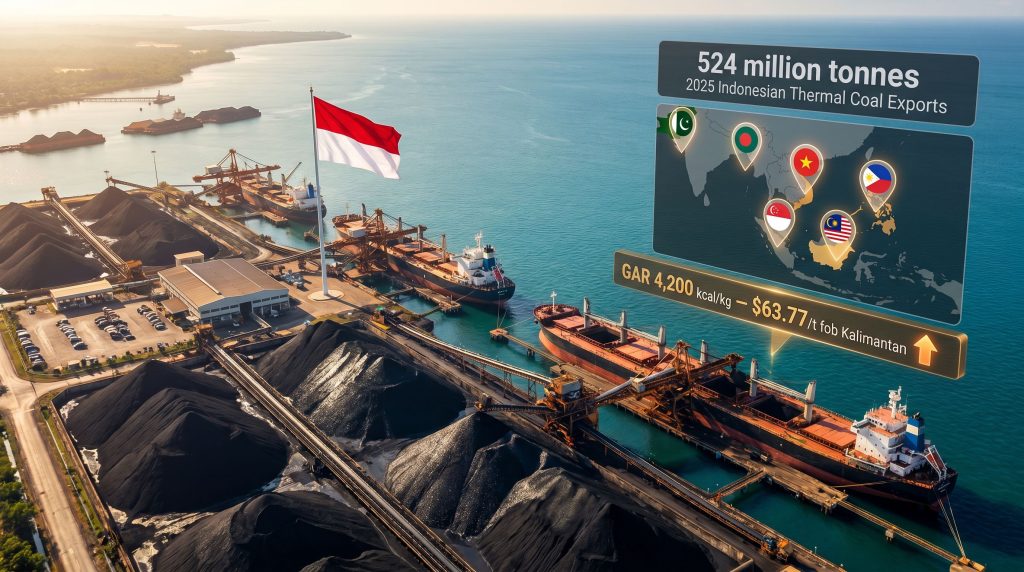
To appreciate the global significance of the Indonesia coal export plan, consider the market concentration involved. Indonesia exported approximately 524 million tonnes of thermal coal in 2025, a figure representing more than half of total global seaborne thermal coal supply. No other single country comes close to this level of export market dominance in thermal coal.
That 2025 volume actually represented a decline of roughly 6% year-on-year, marking the first annual contraction in Indonesian coal exports since 2020, when the Covid-19 pandemic simultaneously disrupted demand and supply chain logistics. The production ceiling of 580 million tonnes approved for 2026 adds a further supply-side constraint, reinforcing the government's intent to actively manage output volumes rather than allow unconstrained production.
Against this backdrop, the Argus-assessed price for Indonesian GAR 4,200 kcal/kg coal reached $63.77 per tonne fob Kalimantan on a Supramax loading basis, the highest price point recorded since May 2023. This recovery has been partly driven by supply concerns after producers faced delays in receiving their 2026 work plans and budget approvals (RKAB), creating near-term output constraints before the BUMN announcement added a further layer of uncertainty.
Technical Note: GAR 4,200 kcal/kg refers to Gross As Received calorific value, a standard measure of coal energy content reflecting the actual moisture conditions at the point of delivery. This lower-calorific value grade is the benchmark for Indonesian sub-bituminous coal and is the primary product supplied to price-sensitive buyers across South and Southeast Asia.
The next major ASX story will hit our subscribers first
Commercial Risks for Buyers, Traders, and Utilities
The practical complexities of centralising coal trade management through a single state entity are considerable. Coal is not a homogeneous commodity. Each cargo involves a specific combination of variables that experienced trading firms have spent decades developing systems to manage:
- Quality specifications: Calorific value (CV), ash content, moisture levels, sulphur content, and inherent moisture all determine the suitability of any given cargo for a specific power plant
- Logistics coordination: Mine planning schedules, river barge allocations, transshipment terminal bookings, and vessel laycan windows
- Contractual structures: Blending requirements across multiple mine sources, payment terms, letter of credit arrangements, and quality rejection clauses
- Financing arrangements: Pre-payment structures and funding arrangements embedded in existing trader-producer long-term offtake agreements
The Indonesian Coal Mining Association (APBI) has publicly cautioned that insufficient technical clarity on the contract migration process could endanger long-term offtake agreements. This concern is particularly acute for multi-year contracts that involve pre-financing by trading houses, where unwinding or reassigning positions introduces complex liability questions.
Traders holding existing positions may face pressure to invoke force majeure clauses if the BUMN transition materially disrupts their capacity to fulfil contractual obligations. Force majeure in commodity contracts typically requires demonstration that the disruption is outside the party's reasonable control — a threshold that government-mandated structural changes could potentially meet, though this would inevitably be contested through arbitration.
Spot Market Reaction and Price Signals
The market's immediate response to the announcement was unambiguous. At least one low-calorific value supplier raised spot offers for July-loading Panamax cargoes of GAR 4,200 kcal/kg coal by as much as 10% within days of the policy announcement. Broader spot offer withdrawal, with suppliers holding back cargoes pending policy clarity, has been observed by market participants and could amplify price volatility through the third quarter of 2026.
Utilities across Southeast Asia and India have been contacting Indonesian suppliers directly to seek assurance on contracted delivery schedules. The India coal trading exchange proposal now takes on added significance in this context, as Indian buyers seek alternative pricing and procurement mechanisms. China, as the single largest buyer of Indonesian coal, has responded cautiously, with some market participants questioning the practical enforceability of the policy at the operational scale required.
The risk of sustained spot offer withdrawal is not trivial. Given Indonesia's more than 50% share of global seaborne thermal coal supply, even a partial disruption to normal trade flows would have disproportionate consequences for Asian coal importers with limited alternative supply sources at comparable price points.
Market Diversification: The Strategic Repositioning Behind the Headlines
The Indonesia coal export plan is not purely a defensive fiscal measure. It also reflects a deliberate strategic effort to reduce dependence on China and India as anchor buyers, at a time when both markets have been reducing Indonesian coal import volumes. Indeed, China commodity demand trends have been a significant driver of this diversification imperative.
| Target Market | Strategic Rationale |
|---|---|
| Vietnam | Rapid industrialisation and growing coal-fired power generation capacity |
| Philippines | Rising electricity demand with limited domestic coal production |
| Malaysia | Expanding industrial base with established Indonesian coal import relationships |
| Bangladesh | Energy-deficit economy with structural thermal coal import requirements |
| Pakistan | Persistent power sector shortfalls creating sustained import demand |
These emerging Southeast and South Asian buyers are seen as structurally underpinned by long-term energy demand growth. By routing exports through a centralised state entity, the Indonesian government theoretically gains the ability to direct commodity flows to preferred markets and counterparties rather than leaving allocation decisions purely to price signals and commercial relationships.
This market diversification ambition is a less-reported dimension of the BUMN framework. While much of the immediate market commentary has focused on supply disruption risks, the longer-term strategic intent appears to be a deliberate reconfiguration of Indonesia's buyer base, reducing geopolitical concentration risk while simultaneously building leverage in price negotiations.
Investment and Private Sector Implications
OCBC Bank has specifically flagged the risk that the BUMN model could crowd out private-sector investment in Indonesia's coal mining sector unless accompanied by clear policy safeguards and sustained stakeholder engagement. The concern is grounded in investment theory: if private producers cannot independently negotiate and manage their own commercial relationships, the risk-adjusted return on new mining investment deteriorates significantly. Consequently, the commodity price impact on mining company valuations could be meaningful in the months ahead.
The structural comparison between the two models illustrates the trade-offs clearly:
| Dimension | BUMN-Led Export Model | Market-Led Export Model |
|---|---|---|
| Price discovery | Centralised, potentially less transparent | Competitive, market-driven |
| Contract flexibility | Reduced, standardised terms likely | High, customised per buyer |
| Revenue capture for state | Enhanced oversight, reduced under-invoicing | Subject to transfer pricing risks |
| Supply chain efficiency | Risk of bottlenecks and expertise gaps | Established logistics networks |
| Private investment incentive | Potentially reduced without policy clarity | Supported by competitive returns |
| Export market diversification | Strategically directed by government | Organically driven by commercial relationships |
Beyond investment capital, the employment implications are also material. Trading and services companies that currently derive revenue from Indonesian coal transactions face potential elimination under a model that consolidates all international sales through a single state entity. Industry participants have noted the possibility of significant job losses and reduced competition in the sector.
OCBC has also highlighted a self-reinforcing risk: non-tax revenues are closely correlated with commodity price levels. If the BUMN transition generates market volatility that drives Indonesian coal prices higher in the short term, this may appear fiscally positive. However, if it structurally reduces buyer confidence in Indonesian supply reliability, the longer-term consequence could be demand destruction and price erosion, undermining the very fiscal objectives the policy is designed to achieve. Furthermore, the broader trade impacts on bulk commodities suggest that such structural shifts rarely unfold in isolation from wider market forces.
Frequently Asked Questions: Indonesia Coal Export Plan
What commodities are included in Indonesia's new export routing policy?
The initial scope covers coal, palm oil, and ferroalloys — commodities that collectively represented approximately 23% of Indonesia's total export revenues in 2025. The scope is subject to quarterly review and potential expansion.
When does the Indonesia coal export policy take full effect?
Full implementation under BUMN end-to-end control is scheduled for September 2026, following a phased transition running from June through August 2026.
How much coal does Indonesia export annually?
Indonesia exported approximately 524 million tonnes of thermal coal in 2025, representing more than half of total global seaborne thermal coal supply.
Why is Indonesia introducing state control over coal exports?
The government has cited an estimated $908 billion in cumulative revenue losses between 1991 and 2024 due to export under-invoicing and transfer pricing, combined with pressure from a weakening currency and the need to strengthen foreign exchange earnings retention.
What is a BUMN in the context of Indonesian coal exports?
BUMN stands for Badan Usaha Milik Negara, referring to Indonesian state-owned enterprises. Under the new policy, a designated BUMN will act as the sole authorised counterparty for international commodity sales.
Will existing coal supply contracts be honoured?
This remains unresolved. The Indonesian Coal Mining Association has called for explicit confirmation that existing multi-year contracts will be respected. No definitive transition guidance has been issued as of the policy announcement.
How has the coal market responded?
Immediate responses include spot offer price increases of up to 10% for GAR 4,200 kcal/kg July-loading Panamax cargoes, broader spot offer withdrawal pending clarity, and heightened concern among utilities in Southeast Asia and India about contracted supply security.
Disclaimer: This article is intended for informational purposes only and does not constitute financial or investment advice. All forecasts, projections, and market commentary involve uncertainty and should not be relied upon as the sole basis for commercial or investment decisions. Readers should conduct independent due diligence before acting on any information contained herein.
Want to Stay Ahead of the Next Major Commodity Shift?
Indonesia's coal export overhaul is a stark reminder that commodity markets can be reshaped overnight by state intervention — and that investors who act on emerging signals early are best positioned to capitalise. Discovery Alert's proprietary Discovery IQ model delivers real-time alerts on significant ASX mineral discoveries, turning complex commodity data into actionable insights the moment they hit the market — explore historic discoveries that have generated extraordinary returns and begin your 14-day free trial today to ensure you're never caught off guard by the next major market shift.