May 21, 2026
The Hidden Timing Problem at the Heart of Critical Mineral Benchmarking
Price benchmarks are only as reliable as the markets they reflect. When a price assessment is published hours after the relevant market has closed for the day, it captures a snapshot of a world that no longer exists. For commodity markets where China dominates both production and consumption, this temporal misalignment is not a minor inconvenience — it is a structural flaw that can distort procurement decisions, introduce settlement risk, and erode the credibility of the benchmark itself.
This is the operational reality that underpins a significant update to Fastmarkets China technology and energy metal prices publication times, which took effect on Thursday, May 21, 2026. The change affects 31 price assessments spanning battery materials, strategically critical metals, industrial minerals, and energy-adjacent commodities — all of which are deeply anchored to Chinese market dynamics.
Understanding why this change matters requires unpacking how price reporting agencies work, why publication timing affects benchmark quality, and what the affected commodities reveal about the shifting centre of gravity in global critical mineral supply chains. Furthermore, the critical minerals demand surge now underway globally makes accurate, timely benchmarking more consequential than ever.
When big ASX news breaks, our subscribers know first
How Commodity Price Benchmarks Derive Their Authority
A price reporting agency (PRA) like Fastmarkets derives its credibility from a disciplined methodology: assessments must reflect the market at its most active, not its most dormant. The informational value of any benchmark declines sharply when it is anchored to a time zone where the primary market participants are no longer transacting.
This is a well-understood principle in financial markets. Equity indices close with the exchange. Futures settlements align with the close of the relevant trading session. Commodity benchmarks should operate on the same logic.
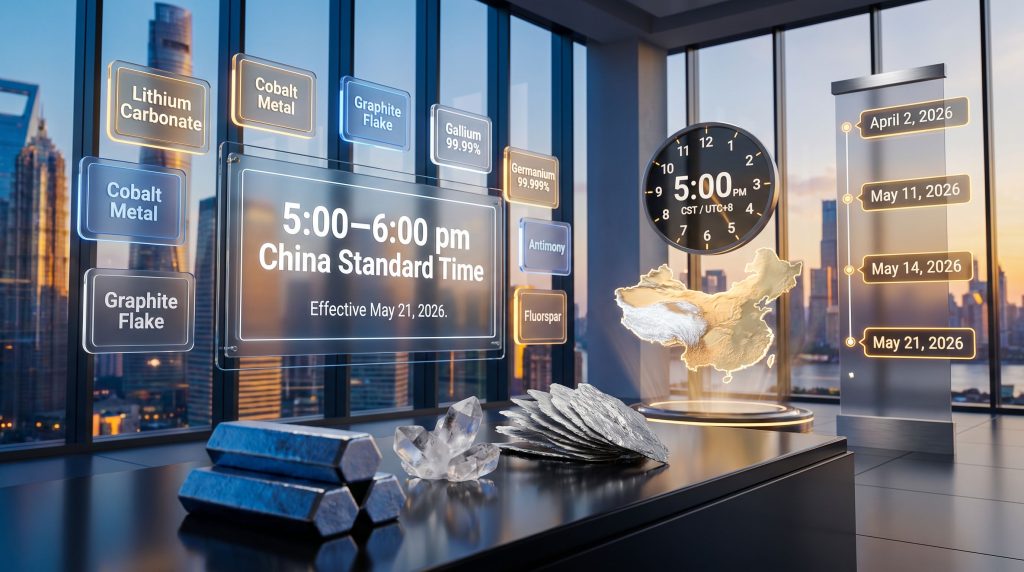
For China-origin materials, the spot and over-the-counter (OTC) market is most active during Chinese afternoon trading hours — broadly from early to mid-afternoon China Standard Time (CST, UTC+8). A publication window of 5:00–6:00 pm CST captures the tail end of this trading session, reflecting negotiated prices that represent the day's final market reality rather than a stale reading from several hours prior.
Price assessments that systematically lag the market they purport to reflect create informational asymmetries. Participants with direct access to Chinese market data gain an edge over those relying solely on the benchmark, which undermines the benchmark's core function as a neutral reference price.
The Governance Process Behind the Publication Time Changes
The revision to Fastmarkets China TEM publication times did not occur overnight. The process followed a structured, transparent governance framework consistent with international PRA standards:
- April 2, 2026 — Fastmarkets published a pricing notice formally proposing the publication time amendments.
- April 2 to May 11, 2026 — A 39-day open consultation window allowed data submitters, subscribers, and market participants to submit feedback.
- Consultation review — Fastmarkets reviewed all responses. Specific assessments, including nickel pig iron and laterite ore in related notices, had their proposed windows refined based on participant input.
- May 14, 2026 — A formal decision notice was issued confirming the amendments.
- May 21, 2026 — The revised publication schedule became operational.
This five-step process reflects Fastmarkets' obligations as a PRA operating under market integrity frameworks. It is also consistent with the broader pattern observed across Fastmarkets' methodology evolution — the same structured consultation-to-implementation model was applied concurrently to Asian base metals assessments and Chinese used cooking oil timestamps, both of which underwent parallel time zone localisation in May 2026.
Full Publication Schedule: All 31 Affected China TEM Assessments
The following table provides the complete reference for all amended Fastmarkets China technology and energy metal prices publication times, effective May 21, 2026. All times are expressed in China Standard Time.
| Price Code | Commodity / Specification | New Publication Window (CST) |
|---|---|---|
| MB-SB-0003 | Antimony MMTA standard grade II, ddp China, yuan/tonne | 4:00–5:00 pm |
| MB-SB-0011 | Antimony 99.85% Sb min, in-whs China, yuan/tonne | 5:00–6:00 pm |
| MB-GA-0002 | Gallium 99.99% Ga min, in-whs China, yuan/kg | 5:00–6:00 pm |
| MB-GER-0004 | Germanium 99.999% Ge min, in-whs China, yuan/kg | 5:00–6:00 pm |
| MB-IN-0003 | Indium 99.99%, exw China, yuan/kg | 5:00–6:00 pm |
| MB-MG-0003 | Magnesium 99.9%, exw China, yuan/tonne | 5:00–6:00 pm |
| MB-MG-0002 | Magnesium 99.9% Mg min, fob China main ports, $/tonne | 5:00–6:00 pm |
| MB-SE-0003 | Selenium 99.9% Se min, in-whs China, yuan/kg | 5:00–6:00 pm |
| MB-BI-0002 | Bismuth 99.99% Bi min, in-whs China, yuan/tonne | 5:00–6:00 pm |
| MB-TE-0002 | Tellurium 99.99% Te min, in-whs China, yuan/kg | 5:00–6:00 pm |
| MB-SI-0002 | Silicon export 98.5% Si min, fob China, $/tonne | 5:00–6:00 pm |
| MB-MN-0008 | Manganese sulfate 32% Mn min, battery grade, ex-works mainland China, yuan/tonne | 5:00–6:00 pm |
| MB-GRA-0040 | Graphite flake 94% C, +100 mesh, fob China, $/tonne | 5:00–6:00 pm |
| MB-GRA-0041 | Graphite flake 94% C, +80 mesh, fob China, $/tonne | 5:00–6:00 pm |
| MB-GRA-0042 | Graphite flake 94% C, -100 mesh, fob China, $/tonne | 5:00–6:00 pm |
| MB-LI-0034 | Lithium carbonate 99% Li2CO3 min, technical/industrial grade, spot exw domestic China, yuan/tonne | 5:00–6:00 pm |
| MB-FEP-0001 | Iron phosphate anhydrous 0.96–0.98 Fe/P, battery grade, delivered China, yuan/tonne | 5:00–6:00 pm |
| MB-MN-0007 | Electrolytic manganese flake basis 99.7%, fob China, $/tonne | 5:00–6:00 pm |
| MB-CO-0001 | Cobalt metal min 99.8%, China domestic, RMB/t | 5:00–6:00 pm |
| MB-CO-0012 | Cobalt tetroxide min 72.6% Co, delivered China, RMB/t | 5:00–6:00 pm |
| MB-CO-0017 | Cobalt sulfate min 20.5%, China ex works, RMB/t | 5:00–6:00 pm |
| MB-FLU-0023 | Lithium hexafluorophosphate (LiPF6), battery grade, ≥99.9%, $/tonne | 4:00–5:00 pm |
| MB-MAG-0002 | Magnesia, dead burned, 90% MgO, lump, fob China, $/tonne | 4:00–5:00 pm |
| MB-MAG-0005 | Magnesia, dead burned, 97.5% MgO, lump, fob China, $/tonne | 4:00–5:00 pm |
| MB-MAG-0007 | Magnesia, fused, 98% MgO, lump, fob China, $/tonne | 4:00–5:00 pm |
| MB-MAG-0009 | Magnesia, fused, 97% MgO, Ca:Si 2:1, lump, fob China, $/tonne | 4:00–5:00 pm |
| MB-FLU-0003 | Fluorspar, acidspar, 97% CaF2, wet filtercake, fob China, $/tonne | 5:00–6:00 pm |
| MB-FLU-0016 | Fluorspar, metspar, min 90% CaF2, fob China, $/tonne | 5:00–6:00 pm |
| MB-FLU-0015 | Fluorspar, metspar, min 85% CaF2, fob China, $/tonne | 5:00–6:00 pm |
| MB-GRA-0046 | Petroleum needle coke 0.5% S, exw China, yuan/tonne | 5:00–6:00 pm |
| MB-GRA-0047 | Green petroleum coke 0.5% S, exw China, yuan/tonne | 5:00–6:00 pm |
Two distinct publication windows are in use. The 4:00–5:00 pm CST slot applies to a smaller subset of assessments: antimony MMTA standard grade II, lithium hexafluorophosphate (LiPF6), and all four magnesia grades. The 5:00–6:00 pm CST window applies to the remaining 26 assessments.
What the Affected Metals Reveal About China's Structural Market Position
Battery Supply Chain Materials
Several of the most consequential assessments in this update sit directly within global battery supply chains. Their inclusion underscores how comprehensively China controls the pricing signals that govern electrification economics worldwide. The broader battery raw materials market context makes these assessments especially critical for international procurement teams.
- Lithium carbonate (MB-LI-0034): The primary pricing reference for cathode-grade lithium used in lithium-ion batteries. China processes the overwhelming majority of global lithium into battery-grade carbonate and hydroxide, making domestic Chinese spot prices the most relevant global benchmark.
- Cobalt metal, cobalt tetroxide, and cobalt sulfate (MB-CO-0001, MB-CO-0012, MB-CO-0017): These three assessments cover the full cobalt processing chain from refined metal through to cathode precursor materials. China's cobalt refining capacity far exceeds that of any other nation, making Chinese domestic prices the effective global reference.
- Manganese sulfate battery grade (MB-MN-0008): An increasingly important input as battery manufacturers accelerate the transition toward high-manganese cathode chemistries, including LMFP (lithium manganese iron phosphate), which is gaining adoption as a lower-cost alternative to NMC chemistries.
- Iron phosphate battery grade (MB-FEP-0001): The direct precursor to LFP (lithium iron phosphate) cathode active material. LFP chemistry now accounts for the majority of Chinese electric vehicle battery installations by volume, making this one of the most actively traded battery material markets globally.
- Graphite flake grades (MB-GRA-0040, MB-GRA-0041, MB-GRA-0042): Natural graphite is the dominant anode material in lithium-ion batteries, and China processes roughly 70–80% of global natural graphite into battery-ready forms. The three assessments cover different mesh sizes, reflecting distinct end-use specifications within the anode supply chain.
Strategically Critical and Export-Controlled Metals
Perhaps the most geopolitically significant cluster within the affected assessments covers metals where China has implemented formal export licensing and control regimes. In addition, China's rare earth export restrictions have intensified global scrutiny of how Chinese pricing signals are captured and disseminated.
- Gallium (MB-GA-0002): China produces the vast majority of the world's primary gallium, a byproduct of aluminium smelting. In 2023, China introduced export licensing requirements for gallium and gallium compounds, citing national security considerations. Gallium is essential for compound semiconductors used in 5G infrastructure, radar systems, and advanced electronics.
- Germanium (MB-GER-0004): Similarly subject to Chinese export controls introduced in 2023, germanium is critical for fibre optic systems, infrared optics, and certain solar cell technologies. China accounts for the dominant share of global refined germanium output.
- Antimony (MB-SB-0003, MB-SB-0011): China controls a commanding share of global antimony mine production and refining capacity. The antimony shortage risks now confronting defence and industrial sectors make accurate, timely price discovery for this metal more consequential than ever. Antimony's applications span flame retardants, lead-acid battery grids, ammunition and military pyrotechnics, and emerging grid-scale energy storage technologies.
- Bismuth (MB-BI-0002): China's export controls on bismuth have similarly elevated the importance of benchmarks that reflect genuine intraday Chinese market conditions, rather than assessments published outside active trading hours.
- Indium (MB-IN-0003): Primarily recovered as a byproduct of zinc smelting, indium is indispensable for indium tin oxide (ITO) coatings used in flat panel displays and touchscreens, as well as in CIGS thin-film solar cells and certain semiconductor applications.
The concentration of export control regimes across gallium, germanium, and antimony signals that Chinese publication windows for these assessments carry heightened strategic significance. When prices are published outside of active Chinese trading hours, the benchmark can diverge from rapidly shifting spot conditions that may be responding to regulatory developments.
Industrial Minerals: A Broader Scope Than Battery Metals Alone
The TEM category extends well beyond battery and high-tech metals. The inclusion of fluorspar, magnesia, and silicon assessments reflects the industrial breadth of materials that are both China-dominated and globally essential.
- Fluorspar is a critical flux in steel production and the primary feedstock for hydrofluoric acid manufacturing, which in turn underpins fluorochemical supply chains including the production of battery electrolyte solvents.
- Magnesia in its dead-burned and fused forms is a primary refractory material for steel, cement, and glass furnaces. China's dominance in magnesia production stems from its vast magnesite reserves in Liaoning Province, one of the world's richest magnesite deposits.
- Silicon metal (98.5% Si) is a foundational material for aluminium alloys, silicone polymers, and polysilicon production for solar panels. China accounts for roughly 60–70% of global silicon metal production.
Operational Implications for Subscribers and Contract Parties
The practical consequences of this publication time shift vary by subscriber type. The table below maps the key operational changes across different participant categories.
| Subscriber Type | Risk Under Previous UK-Hours Publication | Benefit Under New China-Hours Publication |
|---|---|---|
| Chinese domestic traders | Benchmark lagged same-day spot activity | Assessment now reflects intraday Chinese market conditions |
| International buyers of Chinese TEM | Benchmark misaligned with Chinese supplier offer prices | Improved synchronisation with supplier pricing |
| Contract settlement parties | Settlement price may diverge from market reality | Reduced basis risk in contract pricing clauses |
| Financial market participants | Potential gap between benchmark and real-time valuation | More accurate mark-to-market for derivatives and structured products |
| Procurement teams | Strategy based on stale pricing signal | Timelier intelligence for purchasing decisions |
Holiday Non-Publication: A Contractual Risk That Deserves Attention
One operational consideration that is frequently overlooked in discussions of benchmark methodology is the treatment of public holidays. Fastmarkets' standard practice for these China TEM assessments is to skip publication entirely on Chinese public holidays rather than interpolate or substitute a value.
This creates a material risk for any contract that uses these benchmarks as a settlement reference without explicitly addressing non-publication dates. Major Chinese holiday periods — including the Golden Week holiday in early October, Chinese New Year (typically spanning late January to mid-February), and the May Day holiday week — can result in multiple consecutive non-publication days. Consequently, market participants should consult the Fastmarkets non-ferrous pricing holidays calendar to plan around these gaps effectively.
Contract parties using Fastmarkets China TEM benchmarks for settlement should review their agreements carefully to ensure that non-publication provisions are clearly addressed. The absence of a published price on a settlement date can create significant legal and commercial ambiguity if the contract is silent on fallback mechanisms.
The next major ASX story will hit our subscribers first
Part of a Broader Localisation Trend Across Fastmarkets Methodology
The China TEM publication time update does not stand alone. It forms part of a discernible methodological direction at Fastmarkets toward anchoring China-origin assessments within Chinese market hours. Concurrent notices in May 2026 addressed parallel issues across:
- Asian base metals assessments — publication times and holiday pricing schedules were revised under the same governance framework.
- Antimony trioxide 99.5% Sb2O3 min, exw China — moved to a Friday 5:00–6:00 pm Shanghai time window from the previous 7:00 pm slot, explicitly aimed at better reflecting Chinese TEM market conditions.
- Chinese used cooking oil timestamps — shifted from 4:30 pm London time to 4:30 pm Singapore time for similar temporal alignment reasons.
The pattern is consistent: as Chinese commodity markets have matured and deepened in liquidity, the case for anchoring their benchmark assessments to European business hours has weakened. Fastmarkets' methodology evolution reflects that market reality.
Key Takeaways for Critical Mineral Market Participants
For those who rely on Fastmarkets China technology and energy metal prices in procurement, contract settlement, financial analysis, or supply chain planning, the following points summarise the essential operational update:
- 31 China TEM assessments had publication windows revised, effective May 21, 2026
- The majority now publish in the 5:00–6:00 pm CST window; a smaller subset publishes at 4:00–5:00 pm CST
- The change is designed to align assessments with active Chinese trading conditions, not dormant market periods
- A 39-day open consultation preceded the decision, consistent with PRA governance standards
- Assessments cover a wide commodity spectrum: battery materials, export-controlled metals, industrial minerals, and energy materials
- No assessments are published on Chinese public holidays — contract parties should review settlement provisions accordingly
- Market participants can engage directly with Fastmarkets via pricing@fastmarkets.com, industrialminerals@fastmarkets.com, or minormetals@fastmarkets.com for data submission and enquiries
- Full methodology documentation is available at fastmarkets.com/methodology
This article is intended for informational purposes only and does not constitute financial or investment advice. Commodity markets involve significant risk, and participants should conduct independent analysis before making procurement, settlement, or investment decisions based on price benchmarks or market assessments.
Want to Capitalise on ASX Critical Mineral Discoveries Before the Broader Market?
As global demand for battery materials, export-controlled metals, and industrial minerals intensifies, timing and accurate intelligence are everything — Discovery Alert's proprietary Discovery IQ model delivers real-time alerts on significant ASX mineral discoveries, transforming complex commodity data into actionable opportunities the moment they are announced. Explore historic discoveries and their exceptional market returns, then begin your 14-day free trial at Discovery Alert to position yourself ahead of the market.