July 16, 2026
The Trade Remedy Mechanism Reshaping Critical Mineral Supply Chains
When industrial supply chains become entangled with geopolitics, the tools governments reach for matter enormously. Outright sanctions are blunt instruments, capable of triggering reciprocal disruptions that harm the very industries they aim to protect. Anti-dumping and countervailing duty investigations, by contrast, offer a more surgical approach, one anchored in trade law, adjudicated through independent bodies, and technically defensible under World Trade Organization frameworks. The unfolding case involving US tariffs on Russian palladium is a textbook example of this mechanism in action, and its outcome will reverberate well beyond a single metal.
When big ASX news breaks, our subscribers know first
Why Palladium Occupies a Unique Position in Critical Mineral Trade
Palladium sits in an unusual industrial category. It is simultaneously a precious metal traded on commodities exchanges and a functional industrial input with no commercially viable substitute at scale. Its dominant application is in three-way catalytic converters for gasoline-powered vehicles, where it facilitates the chemical transformation of harmful exhaust gases, including hydrocarbons, carbon monoxide, and nitrogen oxides, into less harmful compounds.
Furthermore, beyond automotive applications, palladium serves secondary roles across a surprisingly broad industrial footprint:
- Electronics manufacturing, particularly in multilayer ceramic capacitors used in smartphones and computers
- Hydrogen purification membranes in fuel cell research and industrial gas processing
- Dental alloys, where its biocompatibility and corrosion resistance are valued
- Chemical processing catalysts for pharmaceutical and petrochemical production
What makes palladium strategically significant is the intersection of its industrial indispensability with its extreme geographic concentration of supply. Russia's Norilsk region in western Siberia hosts some of the richest platinum group metal (PGM) deposits ever discovered. This geological accident of history has given a single country, and effectively a single company, disproportionate influence over a metal embedded in nearly every gasoline vehicle manufactured globally. The broader critical minerals demand picture makes this concentration even more concerning for policymakers.
How Russian Palladium Became Embedded in US Supply Chains
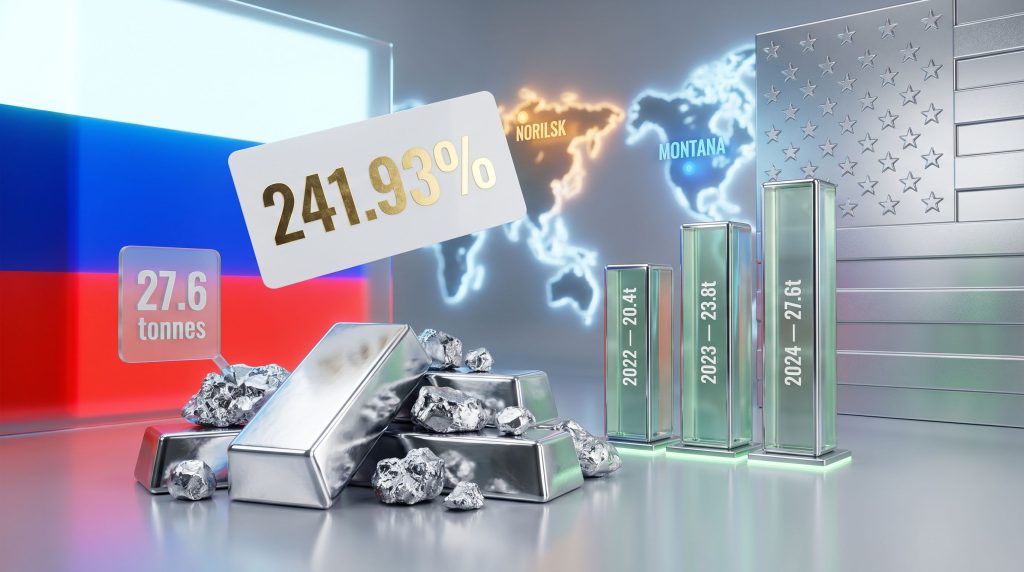
Russia's Nornickel controls approximately 40% of global palladium production, a market share concentration that would trigger regulatory scrutiny in almost any other industrial commodity context. What makes this dependency particularly striking is that US imports of Russian palladium were actually increasing in the years immediately preceding the trade investigation:
| Year | Russian Palladium Imports to US |
|---|---|
| 2022 | 20.4 tonnes |
| 2023 | 23.8 tonnes |
| 2024 | 27.6 tonnes |
This 35% volume increase over two years is counterintuitive given the broader deterioration in US-Russia relations following the 2022 invasion of Ukraine. Unlike most Russian commodity exports, palladium was never subjected to US sanctions. The metals geopolitics driving this anomaly are rooted in a clear calculation: disrupting palladium supply could damage the US automotive manufacturing sector more than it would constrain Russian state revenues. The trade remedy route being pursued now represents an attempt to achieve a similar supply-diversification objective without the legal and economic collateral damage of outright sanctions.
Dissecting the Two-Track Tariff Architecture
Understanding what US tariffs on Russian palladium actually involve requires distinguishing between two legally distinct instruments that operate through separate investigative processes.
Anti-Dumping Duties: Targeting Below-Cost Pricing
Anti-dumping duties are imposed when the Department of Commerce determines that a foreign producer is selling goods in the US market at prices below fair market value. This is typically measured against the producer's home market prices or a constructed cost-of-production benchmark. The final anti-dumping duty determination against Russian palladium has been set at 132.83%.
Countervailing Duties: Offsetting State Subsidies
Countervailing duties address a different distortion: government subsidies provided to foreign producers that give them an artificial cost advantage over private competitors. The final countervailing duty determination on Russian palladium stands at 109.10%, reflecting the Commerce Department's assessment that Russian state support constitutes a countervailable subsidy under US trade law. According to initial reporting by Reuters, the Commerce Department gave early backing to this approach following Sibanye-Stillwater's petition.
The Combined Effect
When applied simultaneously, these two instruments produce a combined potential tariff burden of 241.93%. At palladium spot prices of approximately $1,370 per ounce, this effective tariff would increase the landed cost of Russian palladium in the US market to over $4,700 per ounce, rendering it commercially noncompetitive against non-Russian supply at prevailing market prices.
Critical Threshold: Neither duty becomes permanently enforceable without an affirmative final injury determination from the International Trade Commission (ITC). The ITC independently evaluates whether US domestic industry has suffered material harm attributable to the dumped or subsidised imports. This two-body structure is a deliberate design feature of US trade remedy law, ensuring that Commerce's technical calculations are subject to an independent economic review.
The broader implications of tariffs and supply chains in the critical minerals sector suggest this case could set important precedents for how similar disputes are handled in future.
The Three-Stage Legal Pathway to Enforcement
The trade remedy process follows a structured sequence that can span 12 to 18 months from petition to final determination:
- Petition Filing – A domestic industry participant submits a formal complaint with supporting price and injury evidence to both Commerce and the ITC simultaneously
- Commerce Department Investigation – Technical teams calculate dumping margins by comparing US import prices against home market prices or constructed value benchmarks; a parallel CVD investigation assesses subsidy programmes
- ITC Injury Determination – An independent panel evaluates whether the US industry has suffered material injury, threat of material injury, or material retardation of establishment, as defined under US trade statute
The current case has cleared the first two stages with final affirmative determinations from Commerce on both ADD and CVD rates. The ITC's final ruling now represents the decisive legal gate.
Who Is Behind the Petition and What Are the Stakes?
The trade case was initiated by Sibanye-Stillwater, a Johannesburg-headquartered mining company whose US operations centre on the Stillwater Mine in Montana, one of the only significant PGM-producing assets outside South Africa and Russia. The petition was co-filed with the United Steelworkers union, giving the case both corporate and organised labour backing. Notably, MiningMX reported that Sibanye-Stillwater formally welcomed the resulting tariff determination as a vindication of its position.
Sibanye-Stillwater's strategic position is worth examining carefully. As the petitioner, it stands to benefit directly from reduced Russian competition in the US market. As a South African producer, it also operates assets in the Bushveld Igneous Complex, the world's other major PGM repository.
The Bushveld Igneous Complex in South Africa contains approximately 75-80% of the world's known platinum reserves and is a co-producer of significant palladium alongside platinum. However, Bushveld ores tend to yield higher platinum-to-palladium ratios, while Norilsk deposits are notably palladium-rich relative to platinum. Consequently, South Africa cannot simply substitute one-for-one in volume terms without also altering the global PGM product mix.
The next major ASX story will hit our subscribers first
Nornickel's Production Trajectory Adds an Independent Supply Risk
Irrespective of the tariff outcome, Nornickel's own forward guidance introduces a supply-side variable that markets cannot ignore. The company has forecast palladium production of 2.415 to 2.465 million ounces in 2026, declining from 2.725 million ounces in 2025.
| Year | Production (Million oz) | Production (Tonnes) | Context |
|---|---|---|---|
| 2025 | 2.725 | 84.8 | Recent baseline |
| 2026 (forecast) | 2.415-2.465 | 75.1-76.7 | Projected 20-year low |
This projected decline to what would represent the lowest production level in approximately two decades is being driven by mine sequencing, ore grade depletion, and capital allocation decisions under sanctions-constrained equipment access. The convergence of this organic production decline with the tariff investigation creates a compounding supply-side scenario that the palladium market is not fully pricing in.
The market's apparent complacency, reflected in a ~16% year-to-date price decline to around $1,370/oz as of May 2026, may be partly explained by EV adoption expectations suppressing long-term demand forecasts. However, this same price weakness creates conditions where sudden enforcement of combined 241.93% duties could trigger a rapid repricing event, particularly given how thin palladium liquidity can become during supply disruptions.
Palladium Price Dynamics: A Market Caught Between Competing Forces
The palladium price narrative is unusually complex because bullish and bearish structural factors are operating simultaneously across different time horizons:
| Timeframe | Key Price Driver | Directional Bias |
|---|---|---|
| Near-term (0-6 months) | ITC ruling uncertainty; trade flow disruption risk | Volatile / Upside risk |
| Medium-term (6-18 months) | Supply reallocation from South Africa and Canada | Stabilising |
| Long-term (2+ years) | EV transition reducing gasoline vehicle catalyst demand | Structural downward pressure |
One underappreciated dynamic is the autocatalyst recycling market. Palladium has among the highest recovery rates of any industrial metal through end-of-life vehicle catalyst recycling. As the global fleet of gasoline vehicles ages, secondary palladium supply from scrap has been quietly growing, providing a partial buffer against primary mine supply disruptions. This recycled supply source is geographically distributed across North America, Europe, and Japan, and is entirely insulated from Russian export policy or US tariff actions.
Supply Chain Reallocation: Scenarios and Timelines
If the ITC Rules Affirmatively
Full enforcement of 241.93% combined duties would effectively close the US market to Russian palladium on commercial terms. The critical minerals supply crisis this would create has already prompted significant debate about readiness among alternative suppliers. US buyers, primarily automotive parts manufacturers and their catalyst suppliers, would need to source from alternative jurisdictions:
- South Africa – Anglo American Platinum and Sibanye-Stillwater's South African operations are the most scalable alternative suppliers
- Zimbabwe – Zimplats and Unki mine produce meaningful PGM volumes from the Great Dyke geological formation, though total output is far smaller than Bushveld production
- Canada – Vale's Sudbury operations and North American Palladium (now part of Impala Platinum) produce palladium as a byproduct of nickel and copper mining
A genuine supply reallocation at the scale needed to replace 27.6 tonnes of annual Russian imports would realistically require 12 to 36 months to execute without significant spot market dislocation, given existing offtake commitments, logistics infrastructure, and refining capacity constraints.
If the ITC Rules Negatively
A negative injury finding would be a significant outcome for Nornickel and would leave Russian palladium with continued US market access. However, it would not resolve the underlying policy tension, and alternative legislative tools, including potential sanctions or domestic content requirements under existing federal procurement frameworks, could be deployed as follow-on measures.
The Broader Policy Precedent Being Set
This trade case is arguably more significant as a policy template than as a commodity market event. It represents the first time the US trade remedy system has been applied to a platinum group metal, establishing that anti-dumping and countervailing duty mechanisms are viable instruments for managing critical mineral supply chain dependencies, distinct from the more politically contentious sanctions route.
In addition, the case highlights a structural gap in US domestic PGM production capacity. The US critical minerals tariffs landscape is evolving rapidly, and the Stillwater Mine, despite being the only significant primary PGM producer in the country, cannot satisfy US demand independently. Any long-term supply security strategy for palladium will require expanded domestic production investment, deepened supply agreements with allied producers, or accelerated development of secondary recovery sources.
The outcome of the ITC's final injury determination will be closely watched not just by palladium market participants, but by anyone tracking how the US intends to operationalise its critical mineral supply chain strategy through the tools of trade law rather than direct industrial policy.
Frequently Asked Questions: US Tariffs on Russian Palladium
What is the current status of US tariffs on Russian palladium?
The Department of Commerce has issued final determinations setting an anti-dumping duty of 132.83% and a countervailing duty of 109.10% on Russian palladium imports. The International Trade Commission must still issue a final injury determination before these duties become permanently enforceable.
Why hasn't palladium been sanctioned like other Russian exports?
Palladium's role as a critical industrial input for automotive catalytic converters has made Western governments cautious about outright sanctions that could disrupt their own manufacturing sectors. The trade remedy route is being used as a WTO-compliant alternative.
Who benefits most if the tariffs take full effect?
South African PGM producers and US domestic producers, particularly Sibanye-Stillwater's Montana operations, stand to benefit from reduced Russian competition and potential price support in the US market.
Will tariffs cause a palladium price spike?
Markets are currently pricing in the capacity of non-Russian suppliers to reallocate supply. However, enforcement of combined 241.93% duties coinciding with Nornickel's projected 20-year production low in 2026 could trigger meaningful short-term price volatility.
How much palladium does Russia export to the US?
Russian palladium imports into the US reached 27.6 tonnes in 2024, up from 20.4 tonnes in 2022, representing a 35% increase over two years.
This article contains forward-looking statements, market projections, and scenario analysis. These reflect available information as of the date of publication and should not be construed as investment advice. Commodity markets are subject to significant volatility and readers should conduct independent research before making investment decisions.
Want to Stay Ahead of Critical Mineral Supply Shifts Before the Market Reacts?
Discovery Alert's proprietary Discovery IQ model delivers real-time alerts on significant ASX mineral discoveries, instantly transforming complex commodity data into actionable investment insights — ensuring subscribers can identify opportunities in PGM and critical mineral markets well ahead of the broader market. Explore how historic mineral discoveries have generated substantial returns and begin your 14-day free trial today to position yourself at the forefront of the next major discovery.