June 29, 2026
How AI-Powered Manufacturing is Transforming India's Aluminium Industry
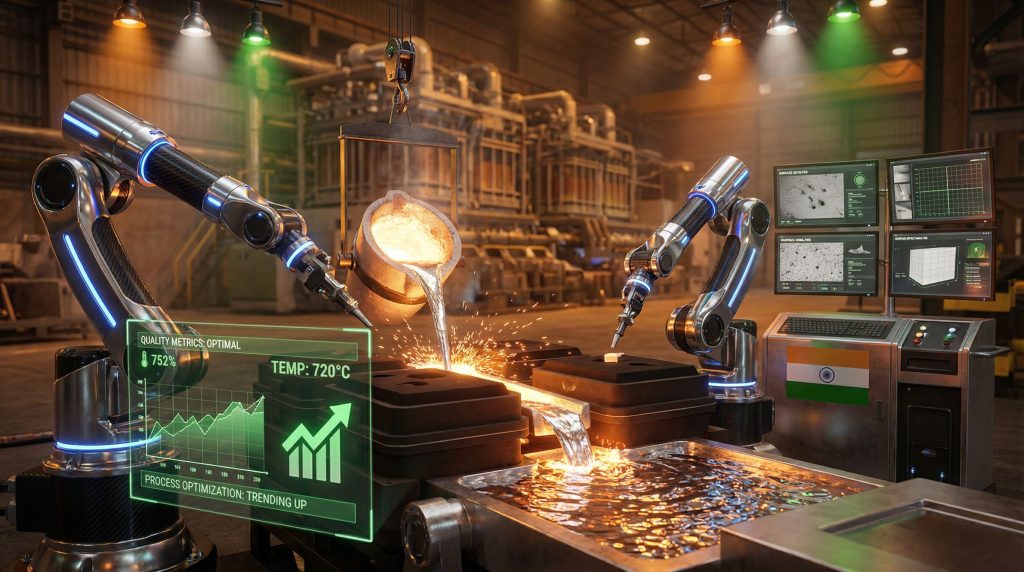
India's aluminium sector stands at the precipice of a technological revolution, where traditional manufacturing processes intersect with cutting-edge artificial intelligence systems. The integration of machine learning algorithms into metallurgical operations represents more than incremental improvement – it signals a fundamental shift toward autonomous manufacturing capabilities that could redefine global competitiveness in metal production.
This transformation extends beyond simple automation. AI-powered aluminium manufacturing in India encompasses sophisticated predictive analytics, real-time process optimization, and advanced quality control systems that learn and adapt to operational conditions. The convergence of these technologies creates opportunities for unprecedented efficiency gains while addressing critical challenges in energy consumption, material recovery, and environmental sustainability.
When big ASX news breaks, our subscribers know first
Understanding India's Smart Manufacturing Transformation in Aluminum Production
The evolution toward intelligent manufacturing systems in India's aluminum industry represents a departure from decades of import-dependent monitoring technologies. Furthermore, indigenous development of AI-powered solutions has emerged as a strategic priority, with research institutions leading efforts to create domestically-designed alternatives to traditional imported systems.
Defining AI-Powered Manufacturing in the Indian Context
Modern aluminum production relies on complex interactions between multiple process variables that demand real-time analysis and adjustment. Machine learning algorithms excel at identifying patterns within these multifaceted operational datasets, enabling predictive control that anticipates process deviations before they impact production quality or efficiency.
Core technologies driving this transformation include:
- Pattern recognition systems that analyze operational data streams for anomaly detection
- Predictive modeling frameworks that forecast equipment performance and maintenance requirements
- Computer vision applications for automated quality inspection and dimensional verification
- Neural network architectures optimized for metallurgical process control
The shift toward indigenous AI solutions addresses historical dependence on imported monitoring infrastructure. According to industry innovation trends, many advanced control systems were previously sourced from international suppliers, creating vulnerabilities in technology access and customization capabilities. Domestic alternatives now provide real-time operational analysis, process deviation prediction, and automated optimization of critical parameters including energy consumption and metal recovery rates.
Market Size and Growth Projections for AI Adoption
Investment patterns in manufacturing digitalization reflect broader government initiatives supporting technological self-reliance. The National Mission framework includes funding mechanisms that support projects with substantial financial backing, including initiatives that can receive up to INR 20 crore in development funding through specialized agencies.
Government support mechanisms include:
- Innovation funding programs targeting startups and medium enterprises developing AI manufacturing solutions
- Collaborative research frameworks connecting academic institutions with industry partners
- Technology transfer initiatives promoting knowledge sharing between research centers and manufacturers
- Critical mineral recycling incentives encouraging circular economy applications
The strategic importance of aluminum in India's industrial ecosystem continues expanding. Industry experts recognize aluminum as a vital resource supporting energy transition initiatives, infrastructure development projects, and advanced manufacturing capabilities. This recognition drives policy support for technological advancement and domestic capability building across the entire aluminum value chain.
What Technical Systems Drive AI Integration in Indian Aluminum Plants?
The architecture of AI integration in aluminum manufacturing encompasses multiple interconnected systems that collectively optimize production parameters. These technical frameworks operate at different scales, from individual equipment monitoring to plant-wide process coordination, creating comprehensive optimization environments.
Real-Time Process Monitoring and Control Architecture
Cell monitoring systems represent the foundation of AI integration in operations for aluminum production. These platforms analyze continuous data streams from electrolytic cells, identifying optimal operating parameters through machine learning algorithms that process thousands of variables simultaneously.
Key monitoring capabilities include:
| Parameter Category | Traditional Monitoring | AI-Enhanced Capability |
|---|---|---|
| Cell voltage optimization | Manual setpoint adjustment | Dynamic algorithmic control |
| Temperature regulation | Fixed heating cycles | Predictive thermal management |
| Energy consumption | Scheduled optimization | Continuous efficiency maximization |
| Bath chemistry | Periodic sampling | Real-time compositional analysis |
Process instrumentation powered by artificial intelligence enables unprecedented precision in parameter control. These systems analyze real-time operational data to anticipate process deviations, minimize anode effects, optimize energy utilization, and enhance metal recovery rates. The integration creates feedback loops that continuously refine operational parameters based on performance outcomes.
Predictive Maintenance Frameworks
Equipment reliability in aluminum production depends on sophisticated maintenance strategies that balance operational continuity with cost optimization. Consequently, AI-powered predictive maintenance systems analyze equipment behavior patterns to forecast failure modes before they occur, enabling proactive intervention strategies.
Diagnostic tools developed through machine learning provide comprehensive equipment health monitoring across critical production systems. These platforms evaluate vibration patterns, thermal signatures, electrical consumption profiles, and operational efficiency metrics to generate maintenance recommendations with precise timing predictions.
Implementation benefits include:
- Reduced unplanned downtime through early failure detection and intervention scheduling
- Optimized spare parts inventory based on predictive demand forecasting
- Extended equipment lifespan through condition-based maintenance protocols
- Improved safety outcomes via automated risk assessment and hazard identification
Quality Assurance Through Computer Vision
Visual inspection systems powered by artificial intelligence represent significant advancement over manual quality control processes. Computer vision applications analyze surface characteristics, dimensional accuracy, and compositional uniformity with consistency and precision that exceed human capabilities.
The development of ISO 17034-accredited Aluminum Certified Reference Materials (Al CRMs) demonstrates indigenous advancement in quality infrastructure. These reference materials enable accurate calibration of spectrometers and ensure compositional precision, reducing dependence on imported calibration standards while maintaining international quality benchmarks.
Previously, industries and testing laboratories relied heavily on imported reference materials for equipment calibration and accuracy verification. Indigenous Al CRMs now provide reliable quality control with enhanced traceability and confidence in metallurgical testing across both primary and secondary aluminum production sectors.
Which Manufacturing Processes Benefit Most From AI Implementation?
Different stages of aluminum production present varying opportunities for AI integration, with some processes showing greater responsiveness to machine learning optimization than others. Understanding these variations enables strategic implementation that maximizes return on technology investment.
Primary Smelting Operations Enhancement
Electrolytic aluminum production involves complex electrochemical processes where small parameter variations significantly impact efficiency and quality outcomes. AI systems excel at managing these intricate relationships through continuous analysis and adjustment of operational variables.
Critical optimization areas include:
- Anode effect minimization through pattern recognition that identifies precursor conditions
- Bath chemistry optimization using multi-variable analysis of electrolyte composition
- Metal recovery rate enhancement via process parameter tuning based on real-time performance data
- Energy consumption reduction through intelligent load management and operational scheduling
Indigenous cell monitoring systems demonstrate practical application of these principles, enabling shared local expertise in smelter process optimization. The technology transfer focus emphasizes developing capabilities in specialized alloy production and advancing metallurgical processes throughout the critical minerals sector.
Downstream Processing Automation
Post-smelting operations including extrusion, rolling, and casting benefit from AI applications that optimize process parameters for specific product requirements. These systems adapt to material properties, dimensional specifications, and quality standards to maximize yield while minimizing defects.
Extrusion parameter optimization utilizes machine learning algorithms that analyze material flow characteristics, die temperature profiles, and cooling rates to achieve consistent dimensional accuracy across complex profile geometries. In addition, rolling mill operations benefit from adaptive thickness control systems that maintain precise specifications despite material property variations.
Die casting processes integrate AI-powered systems for cycle time optimization, temperature control, and defect prevention. These applications demonstrate particular value in automotive component production where dimensional precision and surface quality requirements demand consistent process control.
Waste Stream Recovery and Circular Economy Applications
AI applications in waste stream processing represent emerging opportunities for value recovery from industrial byproducts. Machine learning systems optimize separation processes for critical mineral extraction, enhancing economic viability while supporting environmental sustainability objectives.
Critical minerals recovered from aluminum production waste streams include:
- Scandium – high-value applications in aerospace alloys and solid oxide fuel cells
- Gallium – essential for semiconductor and LED manufacturing
- Nickel – battery technology and stainless steel applications
- Niobium – superalloy production and superconducting applications
- Tantalum – electronic capacitors and medical implant materials
Recovery processes demonstrate strategic sourcing from domestic secondary streams, strengthening mineral security while supporting circular economy principles. Government incentive schemes promote critical mineral recycling through specialized agencies that support innovation projects from startups and medium enterprises.
Material sorting applications utilize computer vision and machine learning to optimize separation efficiency and purity levels. These systems identify material characteristics through spectral analysis, density measurements, and surface feature recognition to maximize recovery rates of valuable components.
How Do Indigenous AI Solutions Compare to Imported Technologies?
The development of domestic AI capabilities in aluminum manufacturing represents strategic investment in technological sovereignty that extends beyond immediate cost considerations. Indigenous solutions offer advantages in customization, maintenance, and knowledge transfer that imported systems cannot match.
Cost-Effectiveness Analysis
Local development of AI systems creates multiple cost advantages throughout the technology lifecycle. Initial development investments support domestic innovation ecosystems while reducing long-term dependence on international suppliers for system updates, maintenance, and technical support.
Economic advantages include:
- Reduced foreign exchange requirements for technology acquisition and ongoing support
- Enhanced customization capabilities for specific operational conditions and requirements
- Improved maintenance response times through local technical expertise and support infrastructure
- Technology transfer benefits that build institutional knowledge and capability
The technology transfer focus emphasizes shared local expertise in areas including smelter process optimization, waste utilization and recycling, valuable product recovery from industrial byproducts, and specialized alloy development. This knowledge base enables continuous improvement and adaptation that imported solutions often cannot provide.
Technical Performance Benchmarking
Indigenous AI systems demonstrate competitive performance across key operational metrics while providing superior integration with existing plant infrastructure. Machine learning algorithms developed for local conditions optimize performance parameters that generic imported solutions may not address effectively.
Performance comparison factors include:
| Metric Category | Indigenous Solutions | Imported Technologies |
|---|---|---|
| Process optimization response time | Faster adaptation to local conditions | Standardized global parameters |
| Integration complexity | Designed for existing infrastructure | May require system modifications |
| Technical support accessibility | Local expertise and rapid response | International support dependencies |
| Customization flexibility | High adaptability to specific needs | Limited modification capabilities |
Knowledge Transfer and Skill Development Impact
Domestic AI development creates multiplier effects in technical capability building that extend throughout the manufacturing sector. Local engineering teams gain experience in advanced system design, implementation, and optimization that benefits broader industrial applications.
Training requirements for operational staff emphasize practical skills in AI-assisted process control, predictive maintenance protocols, and quality management systems. This knowledge base supports technology adoption across multiple manufacturing sectors while building indigenous expertise in advanced manufacturing technologies.
What Are the Key Implementation Challenges and Solutions?
Successful AI integration in aluminum manufacturing requires addressing multiple technical, organizational, and infrastructure challenges that can impact implementation timelines and effectiveness. Understanding these obstacles enables development of comprehensive mitigation strategies.
Infrastructure Readiness Assessment
Manufacturing facilities often require significant infrastructure upgrades to support AI system implementation. Data-driven operations demand robust data collection networks, processing capabilities, and connectivity requirements that must be evaluated and enhanced to ensure reliable system operation.
Critical infrastructure components include:
- Sensor networks for comprehensive data collection across manufacturing processes
- Computing infrastructure capable of real-time processing and analysis
- Connectivity systems ensuring reliable data transmission and system communication
- Backup systems maintaining operational continuity during technical issues
Network connectivity requirements extend beyond basic internet access to include industrial-grade communication systems that maintain performance under harsh manufacturing conditions. Hardware specifications must account for temperature variations, electromagnetic interference, and vibration levels typical in aluminum production environments.
Change Management in Traditional Operations
Workforce adaptation represents critical success factors in AI implementation projects. Traditional manufacturing operations depend on experienced personnel whose knowledge and skills must be integrated with new AI-powered systems rather than replaced.
Gradual implementation approaches minimize operational disruption while enabling systematic evaluation of AI system effectiveness. However, phased rollouts allow operational teams to adapt to new processes while maintaining production continuity and quality standards.
Change management strategies include:
- Comprehensive training programs covering AI system operation and interpretation
- Mentorship structures pairing experienced operators with technical specialists
- Performance measurement systems demonstrating AI effectiveness and operational benefits
- Feedback mechanisms enabling continuous improvement based on operator experience
Regulatory Compliance and Safety Integration
AI-powered aluminium manufacturing in India must maintain compliance with environmental regulations, safety protocols, and quality standards while enhancing rather than compromising existing control measures. Integration strategies require careful coordination with regulatory frameworks.
Environmental monitoring enhancement through AI systems provides opportunities for improved compliance management and environmental impact reduction. Automated monitoring systems can detect parameter deviations more quickly than traditional methods while maintaining comprehensive documentation for regulatory reporting.
The next major ASX story will hit our subscribers first
Which Industry Sectors Drive Demand for AI-Enhanced Aluminum?
Market demand for precision-manufactured aluminum products increasingly drives investment in AI-powered production capabilities. Different sectors present varying requirements for dimensional accuracy, surface quality, and material properties that benefit from intelligent manufacturing systems.
Electric Vehicle Manufacturing Requirements
The electric vehicle sector demands aluminum components with exceptional dimensional precision and consistent material properties. Battery housing applications require precise tolerances for thermal management and structural integrity, while lightweight structural components must meet stringent strength-to-weight ratio specifications.
Key application areas include:
- Battery enclosure systems requiring precise dimensional control and thermal properties
- Structural chassis components demanding consistent strength characteristics across production batches
- Thermal management systems utilizing specialized alloy compositions for heat dissipation
- Motor housing applications requiring electromagnetic compatibility and thermal stability
AI-powered manufacturing systems optimize process parameters to achieve consistent material properties across production runs, reducing variability that can impact vehicle performance and safety outcomes. Predictive quality control ensures dimensional accuracy while minimizing waste and rework requirements.
Renewable Energy Infrastructure Needs
Solar mounting systems, grid infrastructure components, and energy storage applications represent growing markets for precision aluminum products. These applications demand long-term durability, corrosion resistance, and structural reliability that benefit from AI-optimized manufacturing processes.
Grid connectivity requirements include transformers, busbars, conductors, and cable systems where aluminum provides advantages in weight-to-conductivity ratios and cost-effectiveness for large-scale electrical installations. Furthermore, decarbonisation benefits from AI manufacturing systems optimize electrical and mechanical properties to meet specific application requirements.
Data Center and 5G Infrastructure Expansion
High-performance computing and advanced telecommunications infrastructure create substantial demand for specialized aluminum products optimized for thermal management applications. AI-driven computing systems require sophisticated cooling solutions where aluminum components play critical roles.
Thermal management applications include:
- Heat sink manufacturing requiring precise fin geometry and surface characteristics
- Cooling plate production demanding uniform thermal conductivity and dimensional accuracy
- Electronic housing systems combining electromagnetic shielding with thermal performance
- Structural components supporting high-density equipment installations
The advancement of 5G networks and hyperscale data centers represents sustained demand growth rather than temporary market expansion. AI manufacturing systems enable production of complex geometries and specialized alloy compositions that meet demanding thermal and electrical performance requirements.
What Does the Future Hold for AI-Powered Aluminum Manufacturing in India?
Long-term prospects for AI integration in Indian aluminum manufacturing extend beyond current applications to encompass autonomous production systems, advanced material development, and integrated supply chain optimization. These capabilities position India for leadership in next-generation manufacturing technologies.
Technology Roadmap Through 2030
Advanced machine learning models will enable increasingly sophisticated process control and optimization capabilities. Integration with Industry 4.0 frameworks and Internet of Things (IoT) systems creates opportunities for plant-wide optimization that considers multiple production variables simultaneously.
Anticipated technological developments include:
- Autonomous manufacturing cells capable of self-optimization and adaptive control
- Advanced material design using AI-powered alloy development and testing protocols
- Integrated supply chain management optimizing raw material utilization and logistics
- Predictive market analysis enabling production planning based on demand forecasting
Research and development efforts focus on critical mineral applications and specialized alloy development that support emerging technology sectors. Collaboration with international partners and technology transfer initiatives accelerate capability development while maintaining technological independence.
Market Position and Export Potential
Indigenous AI capabilities create competitive advantages in global aluminum supply chains through enhanced quality consistency, reduced production costs, and improved delivery reliability. These factors position Indian manufacturers for expanded participation in international markets requiring precision products.
Technology export opportunities emerge as domestic capabilities mature and demonstrate proven performance outcomes. For instance, other developing markets seeking manufacturing modernization represent potential customers for Indian-developed AI manufacturing systems and technical expertise.
Strategic advantages include:
- Cost-competitive precision manufacturing enabled by AI optimization systems
- Flexible production capabilities adapting to diverse customer requirements
- Technical expertise export providing consulting and implementation services
- Technology licensing opportunities monetizing indigenous development investments
Investment and Policy Support Outlook
Government recognition of aluminum's strategic importance in energy transition, infrastructure development, and advanced manufacturing drives continued policy support for technological advancement. Funding mechanisms support both research and development activities and commercial implementation projects.
Investment frameworks include:
- Research institution funding supporting advanced technology development
- Industry collaboration programs connecting manufacturers with technology developers
- International partnership facilitation enabling technology transfer and knowledge sharing
- Market development incentives encouraging adoption of advanced manufacturing technologies
The circular economy focus emphasizes waste stream recovery and critical mineral extraction as strategic priorities. Government incentive schemes promote recycling technologies while supporting domestic material security objectives through advanced processing capabilities.
Measuring Success: Key Performance Indicators for AI Implementation
Evaluation of AI system effectiveness requires comprehensive metrics that capture operational, financial, and strategic benefits across multiple dimensions. Performance measurement systems must account for both direct improvements and broader organizational capabilities.
Operational Efficiency Metrics
Quantitative assessment of AI implementation success focuses on measurable improvements in production efficiency, quality outcomes, and resource utilization. These metrics provide objective evaluation criteria for technology investment decisions.
| Performance Indicator | Traditional Operation | AI-Enhanced Result | Typical Improvement |
|---|---|---|---|
| Energy utilization efficiency | Manual parameter adjustment | Predictive optimization algorithms | 8-12% reduction in consumption |
| Metal recovery rates | Fixed operational parameters | Dynamic process adaptation | 2-4% increase in yield |
| Quality defect incidence | Manual inspection processes | Computer vision quality control | 15-25% reduction in defects |
| Equipment availability | Scheduled maintenance protocols | Predictive maintenance systems | 20-30% reduction in downtime |
| Process parameter stability | Reactive control adjustments | Proactive deviation prevention | 40-50% reduction in variability |
Financial Impact Assessment
Economic evaluation encompasses capital expenditure requirements, operational cost savings, and revenue enhancement opportunities created through AI implementation. Financial analysis must consider both immediate impacts and long-term strategic benefits.
Cost-benefit analysis components include:
- Initial investment requirements for AI system development and deployment
- Operational savings through efficiency improvements and waste reduction
- Revenue enhancement from quality improvements and premium product capabilities
- Risk mitigation value from improved predictability and control
Return on investment calculations must account for extended payback periods typical in advanced manufacturing technology implementations. Benefits often increase over time as systems learn and optimize performance based on operational experience.
Competitive Positioning Advantages
Strategic benefits extend beyond immediate operational improvements to include enhanced market positioning, customer relationships, and technology leadership capabilities. These advantages create sustainable competitive differentiation in global markets.
Strategic benefit categories include:
- Product development acceleration through AI-assisted design and testing capabilities
- Customer satisfaction enhancement via consistent quality and delivery performance
- Market expansion opportunities in precision manufacturing applications
- Technology leadership positioning supporting premium pricing and strategic partnerships
Quality consistency achieved through AI-powered aluminium manufacturing in India enables participation in high-value market segments with demanding specification requirements. As demonstrated through innovation expo insights, automotive, aerospace, and electronics applications represent growth opportunities for manufacturers capable of meeting precision standards consistently.
Investment decisions in AI-powered manufacturing systems involve significant capital commitments and technological risks that require careful evaluation. Performance projections are based on industry experience but actual results may vary depending on implementation quality, operational conditions, and market factors. Prospective investors should conduct comprehensive due diligence including technical assessment, financial analysis, and market evaluation before making investment decisions.
Ready to Capitalise on India's AI-Powered Manufacturing Revolution?
Discovery Alert's proprietary Discovery IQ model delivers real-time alerts on significant aluminium and critical mineral discoveries across the ASX, instantly empowering subscribers to identify actionable opportunities ahead of the broader market. Begin your 14-day free trial today and secure your market-leading advantage in the evolving metals and manufacturing sector.