June 19, 2026
Understanding the Technological Foundation of AI-Powered Mineral Exploration
Modern geological surveys have evolved from traditional field sampling into sophisticated digital ecosystems that process vast amounts of subsurface data. Machine learning algorithms trained on extensive geological datasets now identify subtle patterns invisible to conventional analysis methods, fundamentally changing how explorers approach AI-driven exploration for rare earth deposits. Furthermore, these advances enable AI mining efficiency across multiple mining operations.
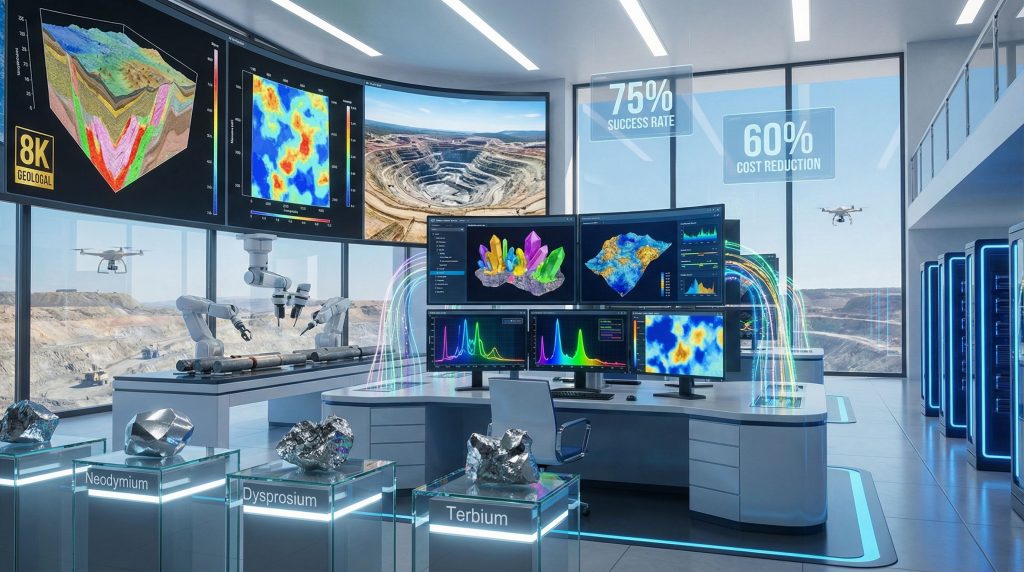
Machine learning frameworks excel at processing multi-dimensional geological information through specialised neural networks designed for geospatial analysis. These systems integrate geochemical soil data, magnetic readings, gravitational measurements, and historical drilling records to create comprehensive three-dimensional prospectivity maps. Each location receives probability values indicating the likelihood of successful mineral discovery, transforming educated guessing into data-driven targeting.
Computer vision techniques applied to satellite imagery enable identification of specific rare earth element signatures through spectral analysis. Advanced algorithms trained on spectral libraries can detect unique absorption patterns of elements like neodymium and dysprosium across vast geographical areas. This capability supports large-scale, non-invasive surveys of remote territories that would be prohibitively expensive to explore using traditional ground-based methods.
Unsupervised learning algorithms excel at anomaly detection by identifying statistical deviations in geophysical data that escape human perception. These systems can reveal blind deposits, which are ore bodies with no surface expression that traditional exploration methods would completely miss. In addition, edge AI computing enables real-time processing of geological data in remote locations.
When big ASX news breaks, our subscribers know first
What Makes AI Superior to Traditional REE Exploration Methods?
Traditional mineral exploration operates with success rates often below one percent, creating enormous financial risks for mining companies. Conventional approaches rely on surface geology, limited sampling, and intuitive interpretation of geological formations. This methodology requires extensive ground campaigns, expensive drilling programs, and lengthy assessment periods that can span multiple years before determining deposit viability.
AI-driven exploration for rare earth deposits reduces discovery cycles by up to 50 percent through precision targeting and advanced data integration capabilities. Machine learning systems process multiple data sources simultaneously, creating comprehensive geological models that guide exploration decisions with significantly higher confidence levels. This technological approach minimises unnecessary drilling and focuses resources on locations with the highest probability of success.
| Exploration Approach | Success Rate | Timeline | Environmental Impact | Cost Structure |
|---|---|---|---|---|
| Traditional Methods | <1% | 5-10 years | High surface disruption | Extensive upfront investment |
| AI-Guided Systems | Enhanced targeting | 50% faster | Minimal ground campaigns | Optimised resource allocation |
| Hybrid Technologies | Improved accuracy | 2-3 years | Controlled exploration | Balanced investment approach |
Precision targeting through advanced analytics enables geologists to identify not only where to drill but also where drilling is most likely to succeed. Machine learning models assign specific confidence intervals to potential deposit locations, allowing exploration teams to prioritise high-probability targets while avoiding areas with limited mineral potential. Consequently, 3D geological modeling plays a crucial role in visualising subsurface structures.
The technological advantage extends beyond simple pattern recognition to sophisticated predictive modelling. AI systems analyse geological relationships across multiple scales, from regional structural patterns to local geochemical variations. This comprehensive analysis identifies exploration targets that conventional methods would overlook, particularly in areas where surface geology provides limited indication of subsurface mineral potential.
Which AI Technologies Are Revolutionising REE Discovery Processes?
Hyperspectral imaging represents a breakthrough in remote sensing applications for mineral exploration. Satellite-based spectral analysis systems trained on extensive spectral libraries can identify unique absorption signatures of rare earth elements across vast geographical areas. These systems detect specific wavelength patterns associated with neodymium, dysprosium, and other critical elements, enabling comprehensive regional assessments without ground-based surveys.
Drone-mounted sensors provide high-resolution geological surveys that bridge the gap between satellite imagery and ground-based exploration. These platforms carry specialised instruments capable of collecting detailed geophysical data across challenging terrain. Advanced sensors mounted on unmanned aerial vehicles enable systematic data collection over areas that would be difficult or dangerous to access using traditional exploration methods.
Geophysical data processing innovations transform raw measurements into actionable exploration intelligence. Magnetic field analysis algorithms detect subsurface anomalies that indicate potential mineral concentrations, while gravitational modelling systems map density variations associated with rare earth deposits. Seismic data interpretation reveals geological structures that control mineral distribution, and electromagnetic survey processing identifies conductive zones associated with specific ore types.
Multi-sensor fusion protocols combine information from diverse data sources to create comprehensive geological models. These systems integrate satellite imagery, airborne geophysics, ground-based surveys, and historical exploration data into unified analytical frameworks. The resulting models provide detailed insights into subsurface geology and mineral potential that individual data sources cannot achieve independently.
Real-time monitoring systems enable continuous assessment of geological conditions and exploration progress. Advanced algorithms process incoming data streams to update geological models and refine exploration targets as new information becomes available. However, companies must also consider mining waste management strategies throughout the exploration process.
How Are Mining Companies Implementing AI-Driven Exploration Strategies?
Digital twin technologies create virtual exploration environments that enable comprehensive scenario modelling and risk assessment. These sophisticated systems simulate exploration outcomes under various geological conditions, allowing companies to evaluate different approaches before committing resources to field operations. Virtual models incorporate geological uncertainty and provide probabilistic assessments of exploration success.
Cloud-based processing platforms handle the massive computational requirements of modern geological analysis. These systems provide scalable computing resources that enable complex machine learning algorithms to process extensive geological datasets efficiently. Advanced cloud infrastructure supports real-time collaboration between geological teams and enables rapid analysis of emerging exploration data.
Mobile field applications enable real-time data collection and immediate integration with analytical systems. Field teams equipped with specialised software can capture geological observations, sample locations, and measurement data that automatically updates central geological models. This integration ensures that field observations immediately influence exploration decisions and target refinement.
Strategic Implementation Insight
Companies integrating AI exploration technologies report enhanced decision-making capabilities and improved resource allocation efficiency, fundamentally transforming traditional exploration risk profiles through data-driven targeting approaches.
Automated drilling guidance systems optimise sample collection by directing drilling operations toward the most promising subsurface targets. These systems process real-time geological data to adjust drilling parameters and ensure optimal sample recovery from critical geological intervals. Advanced guidance technologies reduce drilling costs while maximising the geological information obtained from each drill hole.
Supply chain integration systems connect exploration results directly with market demand forecasting and strategic planning processes. These platforms enable companies to align exploration investments with anticipated market requirements and optimise their resource development strategies. For instance, mining industry innovation continues to shape strategic planning across all operational phases.
What Are the Economic Implications of AI-Enhanced REE Exploration?
Capital expenditure optimisation emerges from targeted drilling programmes that focus resources on high-probability exploration targets. By reducing the financial risks of exploration failure, AI technology allows smaller and mid-sized mining companies to identify commercially viable deposits. This democratisation of exploration capability weakens established supply monopolies and supports more diversified global markets.
Operational efficiency gains result from systematic reduction of unnecessary site investigations and exploration activities. AI-driven exploration for rare earth deposits eliminates low-probability targets early in the exploration process, concentrating resources on areas with genuine mineral potential. This focused approach significantly reduces exploration timelines while maintaining or improving discovery success rates.
Risk mitigation strategies enable companies to make informed investment decisions based on quantified geological uncertainty rather than intuitive assessments. Advanced probabilistic models provide explicit confidence intervals for exploration targets, allowing companies to balance risk and potential returns systematically. This analytical approach transforms exploration from speculative ventures into calculated business investments.
Market impact assessment reveals that predictive exploration transforms supplier strategies throughout the rare earth value chain. AI enables rapid evaluation of alternative sourcing routes and identification of lower-grade deposits that can be developed quickly using optimised extraction techniques. This capability provides strategic flexibility in responding to market disruptions and supply chain challenges.
Investment confidence increases through reduced exploration uncertainty and improved success rates. Enhanced targeting accuracy attracts investment capital by demonstrating quantifiable improvements in exploration outcomes. Companies utilising advanced AI technologies can provide investors with detailed risk assessments and probabilistic return calculations based on geological analysis rather than speculative projections.
How Does AI Address Environmental Challenges in REE Exploration?
Minimal-impact surveying techniques reduce ecological disruption by enabling comprehensive geological assessment through remote sensing and targeted sampling. Advanced satellite analysis and drone-mounted sensors provide detailed geological information without extensive ground-based exploration campaigns. This approach significantly reduces habitat disruption and environmental damage associated with traditional exploration methods.
Precision drilling protocols limit surface disturbance by focusing drilling activities exclusively on high-probability targets identified through AI analysis. Rather than extensive drilling programmes across broad areas, AI-driven exploration for rare earth deposits concentrates drilling on specific locations where geological models indicate optimal mineral potential. This targeted approach reduces environmental impact while maintaining exploration effectiveness.
Environmental monitoring integration enables continuous assessment of ecosystem impacts throughout exploration programmes. Advanced sensors and monitoring systems track environmental conditions and wildlife activity in real-time, ensuring that exploration activities comply with environmental protection requirements. Integrated monitoring provides immediate feedback on environmental impacts and enables rapid response to potential issues.
Sustainable exploration methodologies emphasise long-term environmental stewardship rather than short-term resource extraction goals. AI-powered systems optimise exploration sequences to minimise cumulative environmental impact while maximising geological information recovery. These approaches balance exploration objectives with environmental protection requirements through systematic planning and impact assessment.
Regulatory compliance enhancement emerges from automated environmental reporting systems that streamline permit processes and ensure consistent adherence to environmental regulations. AI systems generate comprehensive environmental impact documentation and monitor compliance with regulatory requirements throughout exploration programmes. Furthermore, AI-powered mineral exploration tools are helping companies achieve better environmental outcomes through precision targeting.
The next major ASX story will hit our subscribers first
What Future Developments Will Shape AI-Driven REE Exploration?
Autonomous exploration systems represent the next frontier in AI-powered mineral discovery, requiring minimal human intervention while maintaining exploration effectiveness. Integrating autonomous drilling and AI-led prospecting will likely establish closed-loop exploration systems, enabling machines to find, test, and map deposits with minimal human involvement. These systems combine advanced robotics with sophisticated geological analysis to conduct comprehensive exploration programmes independently.
Quantum computing applications promise revolutionary advances in geological modelling and data processing capabilities. Quantum systems could process complex geological relationships and uncertainty calculations that exceed current computational capabilities. These advances may enable real-time processing of continental-scale geological models and sophisticated probability calculations that guide exploration decisions.
Real-time market integration connects exploration results directly with demand forecasting and strategic planning systems. Advanced platforms analyse market conditions, supply chain requirements, and exploration results simultaneously to optimise resource development strategies. This integration enables companies to align exploration investments with anticipated market opportunities and maximise strategic value.
Collaborative AI platforms enable sharing of exploration insights and geological knowledge across organisations while protecting proprietary information. These systems facilitate industry-wide improvements in exploration techniques while maintaining competitive advantages for individual companies. Collaborative approaches accelerate technological development and improve overall industry exploration success rates.
Global resource mapping initiatives aim to create comprehensive databases of rare earth availability and geological potential worldwide. These systems integrate geological data, exploration results, and resource assessments into unified global models that guide strategic resource planning. Moreover, advanced AI tools are accelerating critical mineral discovery processes across multiple mining jurisdictions.
Strategic Questions for REE Exploration Implementation
What accuracy levels do modern AI exploration systems achieve?
Current AI-powered exploration systems demonstrate significant improvements over traditional methods, with some applications achieving enhanced targeting accuracy compared to conventional approaches that typically succeed in less than one percent of exploration attempts. The specific accuracy depends on geological complexity, data quality, and the sophistication of analytical algorithms employed.
Which data sources drive AI exploration effectiveness?
AI exploration platforms process geological surveys, satellite imagery, geochemical samples, magnetic and gravitational measurements, historical drilling records, and topographical data. The integration of multiple data sources through advanced machine learning algorithms enables comprehensive geological modelling that exceeds the capabilities of individual analytical approaches.
How do AI systems minimise exploration environmental impact?
AI-driven targeting systems reduce unnecessary drilling and ground-based exploration by focusing activities exclusively on high-probability locations identified through remote sensing and data analysis. This precision approach significantly minimises habitat disruption while maintaining exploration effectiveness through advanced geological modelling and predictive analytics.
What implementation timelines characterise AI-assisted exploration programmes?
AI-guided exploration typically reduces discovery cycles by up to 50 percent compared to traditional methods, completing initial assessments in significantly shorter timeframes than conventional approaches. The specific timeline depends on geological complexity, data availability, and the scope of exploration objectives, but AI systems consistently demonstrate faster target identification and assessment capabilities.
The Evolution of Strategic Resource Discovery
The integration of artificial intelligence into rare earth element exploration fundamentally transforms how companies approach mineral discovery, shifting from resource-intensive traditional methods to precision-targeted analytical systems. This technological revolution addresses critical challenges including supply chain security, environmental sustainability, and exploration efficiency while enabling previously impossible levels of geological insight and predictive accuracy.
Predictive exploration transforms the focus from resource scarcity to resource visibility, with data-driven certainty replacing traditional exploration risks and contributing to market stability. As global demand for rare earth elements continues expanding across renewable energy, electric vehicle, and advanced technology sectors, AI-driven exploration for rare earth deposits provides essential tools for meeting strategic resource requirements in an increasingly competitive and environmentally conscious marketplace.
Organisations investing in advanced exploration technologies position themselves strategically for the evolving critical minerals landscape, where success depends less on resource abundance and more on the ability to apply sophisticated algorithms effectively. Companies that develop proprietary AI datasets and machine learning capabilities will lead the green energy transition while securing materials essential for the digital future through innovative geological discovery methods.
Ready to Discover the Next Major Mineral Breakthrough?
Discovery Alert's proprietary Discovery IQ model delivers instant alerts on significant ASX mineral discoveries, transforming complex geological data into actionable insights for both traders and long-term investors. Experience why major mineral discoveries have historically generated exceptional returns and begin your 30-day free trial today to position yourself ahead of the market with real-time discovery notifications.