August 6, 2026
How AI is Reshaping Natural Gas Markets for the Next Decade
The convergence of artificial intelligence and energy infrastructure represents one of the most significant market transformations in decades. As computational demands surge beyond traditional forecasting models, AI and gas in the long term become inextricably linked, creating unprecedented pressure on energy markets to scale rapidly and reliably. This fundamental shift challenges existing assumptions about demand growth patterns, infrastructure capacity, and fuel source selection across the power generation sector.
Energy planners who previously relied on gradual, predictable growth trajectories now confront exponential scaling requirements that compress typical development timelines from decades to years. Furthermore, the implications extend far beyond immediate capacity needs, reshaping long-term investment strategies, regional development patterns, and competitive dynamics within energy markets. These data-driven operations are fundamentally altering how energy companies approach infrastructure planning.
When big ASX news breaks, our subscribers know first
What Makes Natural Gas the Preferred Energy Source for AI Infrastructure?
The Reliability Advantage in Critical Computing Operations
Natural gas has emerged as the dominant fuel choice for AI-driven power generation due to its unique combination of reliability characteristics and deployment flexibility. Unlike intermittent renewable sources, natural gas plants deliver consistent baseload power with rapid ramp-up capabilities essential for 24/7 data center operations.
The technical requirements for AI infrastructure create demanding specifications for power quality and availability. Data centers require 99.99% uptime or higher, making power interruptions potentially catastrophic for training operations that can cost millions of dollars per hour. Moreover, natural gas turbines can achieve capacity factors exceeding 85% whilst maintaining grid stability through their ability to adjust output within minutes.
Key reliability factors include:
• Dispatchability: Gas plants can increase or decrease output to match real-time demand fluctuations
• Grid stability services: Natural gas facilities provide essential frequency regulation and voltage support
• Weather independence: Unlike solar and wind, gas generation remains unaffected by meteorological conditions
• Fuel security: Established pipeline networks ensure continuous fuel delivery even during extreme weather events
Economic Fundamentals Driving Gas Selection
The economic case for natural gas extends beyond fuel costs to encompass total system economics. When evaluating power generation options for large-scale AI operations, technology companies analyse multiple cost components that favour gas-fired generation.
Capital Expenditure Comparison by Technology Type:
| Generation Technology | Capital Cost ($/kW) | Construction Timeline | Capacity Factor |
|---|---|---|---|
| Natural Gas Combined Cycle | $1,200-1,800 | 2-3 years | 50-85% |
| Nuclear | $6,000-12,000 | 8-15 years | 85-95% |
| Solar + Storage | $2,500-4,000 | 1-2 years | 25-35% |
| Wind + Storage | $3,000-4,500 | 2-4 years | 30-45% |
Natural gas facilities offer the optimal balance of capital efficiency, construction speed, and operational flexibility. For AI applications requiring immediate capacity deployment, the 2-3 year construction timeline for gas plants compared to 8-15 years for nuclear represents a critical advantage.
The fuel cost stability of natural gas relative to oil-based alternatives provides additional economic benefits. While oil price rally insights demonstrate dramatic fluctuations due to geopolitical tensions, natural gas markets demonstrate lower volatility due to abundant domestic reserves and established transportation infrastructure.
Technology Integration and Grid Compatibility
Modern natural gas facilities integrate seamlessly with existing electrical grid infrastructure, avoiding the substantial transmission upgrades required for remote renewable installations. This compatibility reduces total project costs whilst accelerating deployment timelines.
Advanced gas turbine technologies offer efficiency improvements that enhance economic competitiveness:
• Combined cycle efficiency: Latest turbines achieve 60-65% thermal efficiency
• Fast-start capabilities: Modern units can reach full output within 30 minutes
• Load following: Efficient operation across 40-100% of rated capacity
• Emissions control: Advanced systems reduce nitrogen oxide and particulate emissions
Consequently, the ability to site gas plants near demand centres eliminates transmission losses that can exceed 8-12% for long-distance power delivery from remote renewable installations.
How Much Additional Gas Demand Will AI Create by 2035?
Quantifying the Data Center Energy Surge
The scale of AI and gas in the long term represents a fundamental discontinuity in power sector planning. Industry analysis suggests that AI and data center growth could drive natural gas demand increases far exceeding historical growth patterns.
Projected AI-Related Gas Demand Growth:
| Timeframe | Additional Daily Demand (Bcf) | Percentage Increase | Equivalent Homes Powered |
|---|---|---|---|
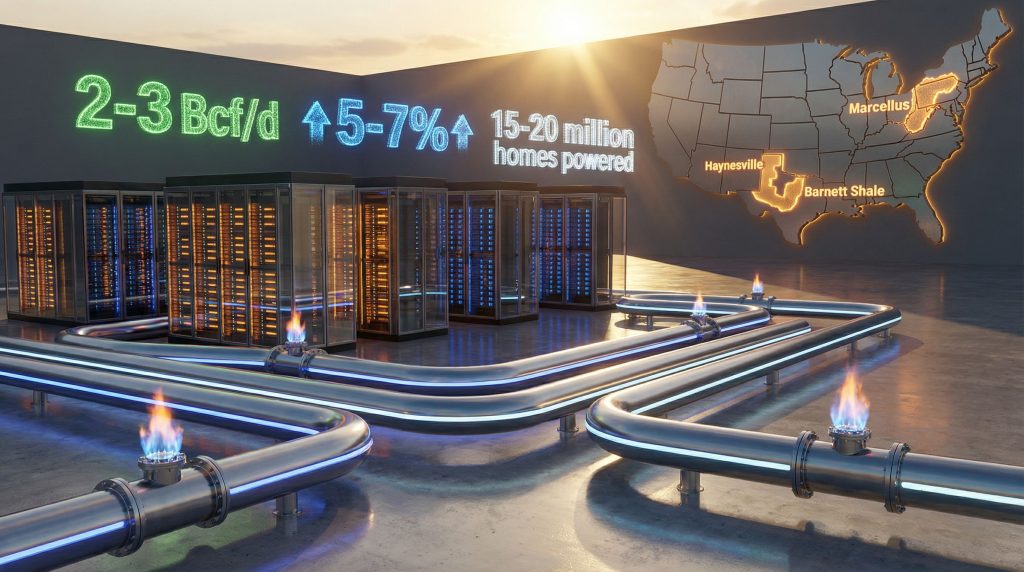
| 2025-2027 | 2-3 Bcf/d | 5-7% | 15-20 million |
| 2028-2030 | 5-7 Bcf/d | 12-15% | 35-45 million |
| 2031-2035 | 8-12 Bcf/d | 18-25% | 60-80 million |
Note: Projections based on current AI deployment trends and assume continued reliance on natural gas for incremental power generation. Actual demand may vary based on efficiency improvements, alternative energy deployment, and policy changes.
These projections reflect the transition from traditional data center loads measured in hundreds of megawatts to AI facilities requiring multiple gigawatts of capacity. The step-change in scale challenges existing infrastructure planning assumptions and demands accelerated investment in generation and transmission capacity.
Current U.S. natural gas consumption for electricity generation averages approximately 40-45 billion cubic feet per day (Bcf/d). The projected AI-driven increases of 8-12 Bcf/d by 2035 represent roughly 20-25% additional demand above baseline consumption levels. Furthermore, this growth trajectory aligns with broader US natural gas forecast trends that incorporate technological demand shifts.
Regional Distribution of New Gas Infrastructure
AI-related gas demand will concentrate in specific geographic corridors where technology companies cluster data center investments. These regions require substantial infrastructure expansion to accommodate projected growth.
Primary Growth Corridors:
• Virginia: Northern Virginia data center alley requires 3-4 Bcf/d additional capacity
• Texas: Dallas-Austin corridor and West Texas developments need 2-3 Bcf/d expansion
• North Carolina: Research Triangle and surrounding areas require 1-2 Bcf/d growth
Secondary Markets:
• Ohio: Columbus and Cincinnati regions targeting 1-1.5 Bcf/d capacity additions
• Illinois: Chicago metropolitan area requires 0.8-1.2 Bcf/d infrastructure expansion
• Georgia: Atlanta corridor needs 0.5-1 Bcf/d additional pipeline capacity
The concentrated nature of this demand growth creates regional bottlenecks requiring $50-80 billion in pipeline infrastructure investments over the next decade. Interstate coordination challenges compound development complexity, as cross-border capacity expansion requires multi-state regulatory approval processes.
Infrastructure Bottlenecks and Capacity Constraints
Meeting projected AI-related gas demand requires addressing multiple infrastructure constraints that could limit growth potential. Current pipeline networks lack sufficient capacity to support the magnitude of additional demand concentrated in specific regions.
Critical bottleneck areas include:
• Interstate transmission capacity: Existing pipelines cannot accommodate projected demand increases without major expansion
• Regional distribution networks: Local pipeline systems require upgrading to handle concentrated loads
• Storage infrastructure: Seasonal demand management needs additional underground storage capacity
• Compression stations: Pipeline throughput requires new compression facilities at 50-100 mile intervals
Consequently, regulatory permitting for interstate pipeline projects typically requires 3-7 years, creating potential supply-demand imbalances if infrastructure development lags behind data center construction timelines.
Which Gas Production Regions Will Benefit Most from AI Growth?
Beyond the Permian: Diversified Supply Sources
While the Permian Basin dominates current U.S. gas production, meeting AI-driven demand growth requires developing additional production regions. Industry experts emphasise that Permian gas alone cannot satisfy projected increases, necessitating expansion across multiple shale formations.
Key Production Regions for AI-Related Demand:
Haynesville Shale (Louisiana/Texas):
• Geographic proximity to Southeast data center corridors
• High BTU content suitable for power generation
• Existing pipeline infrastructure to major demand centres
• Production potential: 15-20 Bcf/d incremental capacity
Marcellus Formation (Pennsylvania/West Virginia):
• Strategic location for Mid-Atlantic technology hubs
• Abundant reserves with low production costs
• Established takeaway capacity to population centres
• Production potential: 10-15 Bcf/d additional output
Barnett Shale (Texas):
• Proximity to Dallas-Fort Worth data center developments
• Mature field with optimisation opportunities
• Integrated midstream infrastructure
• Production potential: 5-8 Bcf/d incremental capacity
Woodford Shale (Oklahoma):
• Central U.S. distribution advantages
• Gas-rich intervals in underdeveloped areas
• Lower competition for acreage
• Production potential: 3-5 Bcf/d additional output
Production Economics Under Higher Demand Scenarios
Sustained AI-driven gas demand could fundamentally alter production economics across different shale formations. Higher long-term prices would improve project returns and justify development of previously marginal acreage.
Break-Even Price Analysis by Formation:
| Formation | Current Break-Even | Break-Even with AI Demand | Reserve Life |
|---|---|---|---|
| Permian | $2.25/MMBtu | $2.00/MMBtu | 15-20 years |
| Haynesville | $2.75/MMBtu | $2.40/MMBtu | 12-18 years |
| Marcellus | $2.50/MMBtu | $2.20/MMBtu | 20-25 years |
| Barnett | $3.25/MMBtu | $2.80/MMBtu | 8-12 years |
Higher demand scenarios enable producers to develop Tier 2 acreage previously considered uneconomic. This expansion could extend reserve life and provide additional supply flexibility during periods of peak demand.
Technology Deployment for Enhanced Recovery
Meeting AI-related demand growth requires optimising production from existing wells whilst developing new drilling targets. Enhanced recovery techniques become economically viable under higher price scenarios driven by sustained demand increases.
Advanced production technologies include:
• Refracturing operations: Stimulating existing wells to increase output
• Infill drilling: Optimising well spacing in developed areas
• Enhanced completion techniques: Improved hydraulic fracturing designs
• Artificial lift systems: Maintaining production in mature wells
These technologies could increase recoverable reserves by 15-25% across major shale formations, providing additional supply without requiring new acreage development.
What Infrastructure Investments Will AI Demand Require?
Grid Modernisation vs. Private Island Development
The infrastructure response to AI energy demands presents two fundamentally different approaches: upgrading existing electrical grid systems or developing private "islanded" power networks dedicated to data center operations.
Infrastructure Development Comparison:
| Approach | Capital Requirements | Timeline | Risk Profile | Efficiency Rating |
|---|---|---|---|---|
| Grid Upgrades | $200-300B nationally | 8-12 years | Shared costs | 85-90% |
| Private Islands | $50-100B per region | 3-5 years | Single entity | 70-80% |
| Hybrid Model | $150-200B | 5-8 years | Mixed | 80-85% |
Risk ratings reflect capital recovery certainty and regulatory approval probability
Traditional grid upgrades offer higher efficiency through shared infrastructure but require extensive coordination across multiple utilities, regulators, and stakeholders. Private island systems provide faster deployment but require over-building generation capacity to ensure reliability.
The trade-offs between approaches reflect fundamental questions about electricity system architecture. Grid upgrades benefit all consumers by spreading fixed costs across broader user bases, whilst private systems allow technology companies to control timing and specifications but at higher unit costs.
Critical Bottleneck Analysis
Infrastructure development faces multiple constraints that could delay or limit AI-related capacity expansion. Understanding these bottlenecks helps identify investment priorities and potential solutions.
Permitting Timeline Challenges:
• Federal environmental review: 2-4 years for interstate transmission projects
• State regulatory approval: 1-3 years for generation facilities
• Local zoning compliance: 6-18 months for construction permits
• Grid interconnection studies: 1-2 years for transmission analysis
Workforce and Supply Chain Constraints:
• Skilled trades shortage: Limited availability of electrical workers and pipeline welders
• Equipment lead times: 12-24 months for major turbines and transformers
• Steel and concrete supplies: Material availability for simultaneous construction projects
• Engineering capacity: Design and project management resources for multiple developments
These constraints suggest that meeting projected AI demand timelines requires parallel development across multiple fronts rather than sequential project implementation. However, effective energy security strategies can help mitigate some of these challenges.
Integration Requirements for Gas-Fired Generation
Natural gas facilities serving AI loads require specialised design considerations beyond traditional power plants. The demanding reliability requirements of data center operations drive enhanced redundancy and performance specifications.
Enhanced system requirements include:
• Dual-fuel capability: Backup oil storage for extended gas supply interruptions
• Black start capacity: Ability to restart without external power sources
• Enhanced maintenance scheduling: Coordinated outages to maintain continuous availability
• Advanced monitoring systems: Real-time performance optimisation and predictive maintenance
These specifications increase capital costs by 15-25% compared to standard gas plants but provide the reliability levels required for critical AI infrastructure.
How Will AI Efficiency Gains Offset Growing Energy Demands?
Technology-Driven Consumption Optimisation
While AI applications drive substantial energy demand increases, parallel efficiency improvements in computing technology may moderate total consumption growth. Understanding these offsetting trends helps project net energy requirements over the next decade.
Efficiency Improvement Trajectories:
Next-Generation Chip Architectures:
• Current AI chips: 300-500 watts per inference
• 2027 target performance: 150-250 watts per inference
• 2030 projection: 75-125 watts per inference
• Potential demand reduction: 40-60% per operation
Cooling System Advances:
• Traditional air cooling: 30-40% overhead energy consumption
• Liquid cooling systems: 15-25% overhead consumption
• Immersion cooling technology: 8-15% overhead consumption
• Advanced heat recovery: 5-12% overhead consumption
Algorithmic Optimisation:
• Model compression techniques reducing computational requirements
• Sparse computing eliminating unnecessary calculations
• Edge computing distribution reducing centralised processing loads
• Quantum-classical hybrid approaches for specific applications
Predictive Analytics in Gas Operations
AI applications within natural gas operations could improve system efficiency and reduce waste, partially offsetting demand increases from data center growth. These operational improvements demonstrate AI's dual role as both energy consumer and efficiency enabler.
Gas Operations Optimisation Applications:
• Drilling optimisation: AI-guided drilling reduces time and energy per well by 15-25%
• Production forecasting: Enhanced reservoir modelling improves extraction efficiency
• Pipeline management: Predictive maintenance reduces system downtime and methane emissions
• Demand prediction: Improved load forecasting optimises generation dispatch and reduces fuel waste
These efficiency gains could reduce overall gas consumption for electricity generation by 3-8% whilst supporting higher overall output levels required for AI applications. Industry experts from major gas industry conferences highlight these optimisation potential.
Edge Computing and Distributed Processing
The evolution toward edge computing architectures may significantly alter energy demand patterns by distributing processing closer to data sources rather than concentrating operations in centralised facilities.
Edge computing benefits include:
• Reduced transmission energy: Processing data locally eliminates long-distance network transfers
• Lower cooling requirements: Smaller facilities achieve better thermal management
• Improved efficiency: Specialised processors optimised for specific applications
• Geographic distribution: Reduced peak demand at any single location
However, edge computing also creates challenges for energy planning, as demand becomes distributed across thousands of smaller facilities rather than concentrated in manageable numbers of large data centers.
The next major ASX story will hit our subscribers first
What Are the Long-Term Market Structure Implications?
Contract Evolution in the AI Era
The relationship between AI and gas in the long term extends beyond immediate supply-demand dynamics to reshape fundamental commercial structures. Long-term contracts become increasingly important as technology companies seek supply certainty for multi-billion dollar infrastructure investments.
Emerging Contract Structures:
Technology Company Direct Investment:
• Equity participation in upstream gas production
• Long-term supply agreements linked to specific wells or fields
• Integrated development of power generation and gas supply
• Risk-sharing arrangements between producers and consumers
Power Purchase Agreement Evolution:
• 15-25 year terms replacing traditional 3-5 year contracts
• Fixed-price components providing cost certainty
• Performance guarantees ensuring reliability standards
• Flexibility mechanisms for demand variability
Dedicated Infrastructure Development:
• Pipeline capacity reserved for specific end-users
• Gas processing facilities tailored to power generation specifications
• Storage capacity allocation for seasonal demand management
• Transmission priority during system constraints
Competitive Dynamics Reshaping
AI-driven gas demand creates new competitive dynamics within traditional energy markets. Technology companies emerge as major market participants with different priorities and capabilities than traditional utilities.
New Market Participant Characteristics:
| Participant Type | Capital Capacity | Risk Tolerance | Timeline Requirements | Price Sensitivity |
|---|---|---|---|---|
| Traditional Utilities | Moderate | Low | Flexible | High |
| Technology Companies | High | Moderate | Urgent | Moderate |
| Independent Producers | Limited | High | Opportunistic | Very High |
| Financial Investors | Very High | Low | Long-term | Low |
Technology companies' substantial financial resources and urgent timeline requirements drive premium pricing for expedited project development, potentially disrupting traditional utility planning processes.
Integration Opportunities and Challenges
The convergence of AI and gas markets creates opportunities for vertical integration across the energy value chain. Companies may seek to control multiple segments to ensure supply security and cost optimisation.
Potential Integration Strategies:
• Upstream-Midstream: Gas producers investing in pipeline and processing capacity
• Midstream-Generation: Pipeline companies developing dedicated power facilities
• Generation-Consumption: Technology companies building captive power plants
• Full Integration: End-to-end control from wellhead to data center
These integration trends could concentrate market power whilst providing supply chain control and cost optimisation benefits for participants with sufficient capital resources.
How Might Regulatory Changes Impact AI-Gas Market Development?
Federal Policy Scenario Planning
Regulatory frameworks governing natural gas development and electricity markets will significantly influence how AI-driven demand growth materialises. Policy changes could accelerate or constrain infrastructure development timelines.
Carbon Pricing Implementation Effects:
Under various carbon pricing scenarios, natural gas maintains competitiveness relative to coal whilst facing increased competition from renewable sources:
• $25/ton CO2: Natural gas retains 90-95% of current competitiveness
• $50/ton CO2: Gas competitiveness decreases 15-20% versus renewables
• $100/ton CO2: Significant advantage shifts toward renewable plus storage combinations
Infrastructure Permitting Reform:
Proposed changes to federal permitting processes could reduce project timelines by 30-50%, enabling faster response to AI-related demand growth. Conversely, enhanced environmental review requirements could extend development periods by 2-4 years.
Energy Security Considerations:
National security implications of AI development may drive policy support for domestic energy infrastructure, potentially accelerating approval processes for critical projects whilst maintaining environmental safeguards.
State-Level Regulatory Divergence
Different state approaches to energy development create varying investment environments that could influence where AI infrastructure develops. Understanding these regulatory differences helps predict regional growth patterns.
Pro-Development Environment States:
• Texas: Streamlined permitting and minimal regulatory barriers
• Oklahoma: Supportive framework for gas development and power generation
• Louisiana: Integrated approach to industrial development
• West Virginia: Priority support for natural gas infrastructure
Restrictive Framework States:
• New York: Limitations on gas pipeline development and power plant construction
• California: Strict environmental requirements and renewable energy mandates
• Massachusetts: Moratorium on new gas infrastructure development
• Washington: Carbon reduction requirements limiting fossil fuel expansion
These regulatory differences may drive AI infrastructure development toward states with supportive energy policies, potentially reshaping regional economic development patterns. Countries with substantial energy transition challenges face similar regulatory complexities.
Environmental Justice and Community Impact Considerations
Large-scale infrastructure development for AI-related gas demand raises environmental justice concerns that could influence project approval processes and community acceptance.
Key considerations include:
• Air quality impacts: Cumulative effects of multiple power plants in specific regions
• Water resource utilisation: Cooling water requirements for gas-fired generation
• Noise and traffic: Community impacts from construction and ongoing operations
• Economic benefits distribution: Ensuring local communities benefit from development
Addressing these concerns requires comprehensive planning approaches that balance rapid infrastructure deployment with community protection and environmental stewardship.
What Alternative Scenarios Could Disrupt This AI-Gas Relationship?
Technology Breakthrough Scenarios
Several emerging technologies could fundamentally alter AI and gas in the long term by providing alternative energy sources or dramatically reducing consumption requirements. Understanding these potential disruptions helps assess investment risks and opportunities.
Small Modular Reactor Deployment:
Advanced nuclear technologies could challenge natural gas dominance in AI applications:
• Deployment timeline acceleration: Potential 5-7 year construction versus current 10-15 years
• Factory manufacturing: Standardised production reducing costs and complexity
• Enhanced safety systems: Passive safety features addressing public concerns
• Competitive economics: Potential cost parity with gas-fired generation
However, nuclear deployment still faces regulatory challenges, public acceptance issues, and supply chain constraints that may limit near-term impact.
Battery Storage Cost Trajectories:
Continued battery cost reductions could enable renewable energy plus storage systems to provide reliable baseload power for AI applications:
• Current costs: $300-400/kWh for utility-scale battery storage
• 2030 projection: $100-150/kWh with improved energy density
• 2035 potential: $50-100/kWh with next-generation chemistry
At these cost levels, renewable plus storage combinations become increasingly competitive with gas-fired generation for many applications. According to recent analysis from the International Energy Agency, these technological shifts could significantly impact energy demand patterns.
Market Disruption Possibilities
Changes in AI development patterns or computational requirements could significantly alter projected energy demand growth, potentially reducing natural gas market opportunities.
AI Development Plateau Scenarios:
• Computational efficiency breakthroughs: Quantum computing reducing classical computation requirements
• Model optimisation advances: Achieving similar performance with lower energy consumption
• Alternative architectures: Neuromorphic chips mimicking brain efficiency
• Application maturity: Slower growth as AI applications reach market saturation
Distributed Computing Evolution:
Shift toward distributed rather than centralised computing could reduce peak demand at individual facilities:
• Edge computing expansion: Processing closer to data sources
• Peer-to-peer networks: Distributed processing across multiple locations
• Hybrid architectures: Combining centralised and distributed approaches
• 5G/6G connectivity: Enabling efficient distributed processing networks
International Competition and Development Location Shifts
AI development increasingly operates as a global competitive landscape where energy costs and availability influence location decisions. Changes in international energy markets could affect domestic natural gas demand.
Competitive Location Factors:
• Energy costs: Comparative electricity prices across different countries
• Infrastructure availability: Existing grid capacity and generation resources
• Regulatory environment: Permitting speed and environmental requirements
• Political stability: Long-term investment security considerations
Countries offering lower-cost renewable energy or more favourable regulatory environments could attract AI development away from U.S. markets, reducing domestic gas demand projections.
What Investment Strategies Should Consider This AI-Gas Convergence?
Portfolio Positioning for the Energy Transition
The intersection of AI growth and natural gas demand creates specific investment opportunities whilst introducing new risk factors that require careful analysis. Successful strategies must balance exposure to growth opportunities with protection against technological and regulatory disruption.
Gas Infrastructure Investments with AI-Specific Capacity:
• Interstate pipeline operators: Companies with expansion capacity in AI growth corridors
• Gas processing facilities: Midstream infrastructure serving power generation markets
• Storage operators: Underground storage in regions with seasonal demand variability
• Gathering and production: Upstream investments in formations serving AI demand centres
Technology-Energy Integration Opportunities:
• Utility companies with data center exposure: Regulated utilities serving major AI development regions
• Independent power producers: Generation companies developing AI-dedicated facilities
• Integrated energy services: Companies providing comprehensive energy solutions
• Smart grid technology: Infrastructure supporting advanced demand management
Risk Management Considerations
AI-gas convergence investments face multiple risk factors that require active monitoring and mitigation strategies. Understanding these risks helps inform position sizing and portfolio construction decisions.
Technology Disruption Risks:
• Energy efficiency improvements: Rapid advances reducing per-unit consumption
• Alternative energy breakthroughs: Competitive technologies displacing gas demand
• AI development changes: Shifts in computational requirements or architectures
• Quantum computing: Potential paradigm shift reducing classical computing needs
Regulatory and Policy Risks:
• Carbon pricing implementation: Policies affecting gas competitiveness
• Environmental regulations: Restrictions limiting infrastructure development
• Utility regulation changes: Modified frameworks affecting investment returns
• Energy security policies: Government intervention in market development
Market Structure Risks:
• Demand concentration: Over-reliance on limited number of large consumers
• Technology company strategy changes: Shifts in energy procurement approaches
• Infrastructure over-build: Excess capacity creation reducing utilisation rates
• Price volatility: Market disruptions affecting project economics
Long-Term Investment Horizon Analysis
The AI-gas relationship requires investment strategies that consider both near-term opportunities and long-term structural changes. Different time horizons present varying risk-return profiles that inform strategic positioning.
Near-Term Opportunities (2025-2030):
• Infrastructure bottleneck relief investments
• Existing capacity expansion projects
• Regional pipeline development
• Gas-fired generation additions
Medium-Term Positioning (2030-2035):
• Technology integration investments
• Advanced efficiency projects
• Hybrid energy system development
• Storage and grid modernisation
Long-Term Considerations (2035+):
• Alternative energy transition planning
• Asset obsolescence risk management
• Technology disruption protection
• Regulatory evolution adaptation
Successful investment strategies require flexibility to adapt as AI and gas in the long term evolves whilst maintaining exposure to fundamental growth drivers that transcend specific technological or policy scenarios.
Investment Disclaimer: This analysis is for informational purposes only and does not constitute investment advice. Energy infrastructure investments involve significant risks including regulatory changes, technology disruption, and market volatility. Investors should conduct independent research and consult qualified professionals before making investment decisions. Past performance does not guarantee future results, and projections are subject to substantial uncertainty.
The convergence of AI and gas markets represents a defining trend for the next decade of energy development. While substantial opportunities exist for infrastructure investment and capacity expansion, success requires careful attention to technological evolution, regulatory changes, and market structure shifts that could significantly alter projected demand patterns. Investors and industry participants must balance exposure to growth opportunities with protection against disruption risks in this rapidly evolving landscape.
Looking to Position Yourself in Tomorrow's Energy Markets?
The convergence of AI and natural gas markets creates unprecedented investment opportunities that demand immediate attention. Discovery Alert's proprietary Discovery IQ model delivers real-time alerts on significant ASX mineral discoveries, including energy-critical commodities that fuel technological advancement, empowering investors to identify actionable opportunities before broader market recognition. Begin your 14-day free trial today and secure your market-leading advantage in the sectors driving tomorrow's energy transformation.