August 6, 2026
The Geological Imperative Driving AI Adoption Across South Africa's Mining Sector
Every mature mining jurisdiction eventually confronts the same structural reality: the easiest deposits have already been found. What remains lies deeper, within more geologically complex host rocks, and demands far greater capital to evaluate. South Africa reached this inflection point years ago, and the sector's long-term viability now depends on whether it can leverage modern technology to do what traditional methods cannot. AI in South Africa mining exploration is no longer a speculative concept. It is rapidly becoming the most credible answer to a compounding discovery problem that threatens the country's single most important industrial sector.
When big ASX news breaks, our subscribers know first
Why South Africa's Exploration Pipeline Is Under Strain
South Africa's mining sector contributes approximately 7% to 8% of GDP when indirect activity is included, supports hundreds of thousands of formal jobs, and generates a substantial share of the country's export earnings through commodities including platinum group metals (PGMs), gold, coal, and iron ore. The industry is not merely economically significant. It is foundational to national fiscal stability.
Yet the exploration pipeline feeding this engine has been deteriorating for decades. New greenfield discoveries have become progressively rarer. The orebodies that remain are deeper, structurally more complex, and increasingly difficult to characterise with conventional drilling alone. The deeper a target lies, the more drill holes are required to define it with confidence, and the more speculative capital gets allocated to programs that may yield nothing commercially viable.
This creates a compounding problem. Rising drilling costs intersect with shrinking discovery probabilities, making junior explorers particularly vulnerable. Meanwhile, the reserve replacement ratios at several of South Africa's flagship gold and PGM operations have been declining, meaning mines are extracting resources faster than new ones are being identified. Without intervention, this trajectory leads to a material contraction of the country's mining base over the coming decades.
The structural challenge facing South African exploration is not primarily one of geological scarcity. It is one of interpretive capacity. The data exists across decades of surveys, drill logs, and geophysical measurements. The challenge lies in integrating and analysing it at a scale that human teams cannot achieve manually.
How AI-Powered Exploration Actually Works: A Technical Framework
Understanding why AI exploration is gaining traction requires clarity on what it actually does differently from conventional geological interpretation. Furthermore, the role of AI in mineral exploration is expanding rapidly across multiple fronts, reshaping how geoscientists approach target generation and data synthesis.
Traditional exploration relies heavily on individual geological expertise, sequential data review, and linear hypothesis testing. A geologist examines survey data, develops a conceptual model, designs a drilling program, and refines the model based on results. This process is rigorous but slow, and its effectiveness is constrained by how much data a human team can meaningfully synthesise.
AI exploration systems, however, operate on a fundamentally different architecture. They ingest and cross-reference multiple simultaneous data streams, including:
- Airborne and ground-based geophysical surveys (magnetic, gravity, electromagnetic, and seismic)
- Geochemical sampling results across soil, rock, and stream sediment
- Historical drilling records and assay databases
- Satellite and multispectral aerial imagery
- Topographic and structural geology maps
- Legacy exploration reports and paper-based geological logs converted to digital formats
Machine learning algorithms are then trained on datasets from known mineralised systems to learn the geochemical and geophysical signatures associated with economic deposits. Once trained, these models are applied to under-explored areas to identify analogous patterns, generating ranked probabilistic targets for follow-up work.
The Six-Stage AI Exploration Workflow
- Data digitisation and standardisation – Legacy analogue records, historical drill logs, and paper surveys are converted into machine-readable formats and normalised for consistency.
- Multi-source data integration – Geological, geophysical, geochemical, remote sensing, and drilling datasets are merged into a unified analytical environment.
- Model training on known mineralisation – Supervised learning algorithms are trained on confirmed deposit signatures to identify comparable patterns elsewhere.
- Probabilistic target generation – The model ranks unexplored areas by their statistical similarity to productive mineralised systems.
- Drill program optimisation – Exploration capital is allocated to the highest-ranked targets, reducing the proportion of speculative holes.
- Iterative model refinement – New drilling results feed back into the model, continuously improving predictive accuracy.
A critical distinction is that AI functions as a decision-support layer, not a replacement for geological expertise. Techniques such as downhole geophysics remain essential for validating subsurface interpretations that AI models generate. Field geologists validate AI-generated targets, apply contextual judgement about local structural controls, and make the final calls on drill placement. Industry practitioners consistently emphasise that algorithms cannot replicate the interpretive nuance that experienced geoscientists bring to ambiguous geological settings.
The Mingomba Precedent: A $2.3-Billion Argument for AI Adoption
Perhaps the most compelling evidence for AI exploration's transformative potential comes not from South Africa itself, but from a major copper system discovery that has reshaped how the entire African mining community thinks about data-driven target generation.
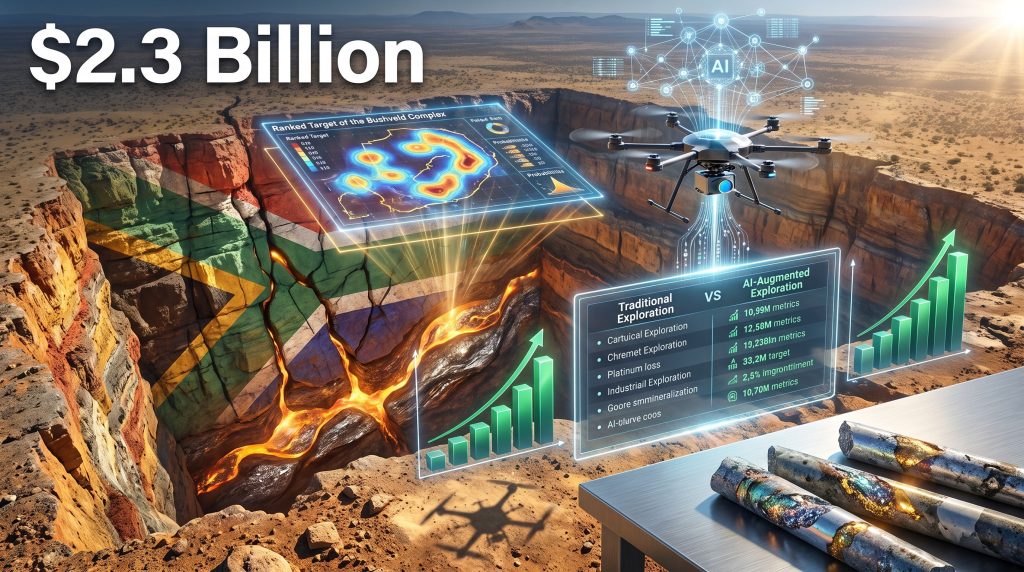
The Mingomba copper project represents a landmark outcome for AI-assisted mineral discovery. The project emerged from a systematic application of AI to vast volumes of geological, geophysical, drilling, and historical exploration data across the Zambian Copperbelt. The result was the identification of a high-grade copper deposit now valued at approximately $2.3 billion, with construction of the mine already underway.
What makes this case instructive is not just the discovery itself, but the speed and precision with which AI analysed datasets that would have taken traditional teams years to work through. The technology compressed interpretive timelines dramatically, surfacing a high-conviction target in a region that had already seen substantial prior exploration activity. In other words, AI found what conventional methods had missed, within an area that had not been dismissed as unexplored but had simply not been analysed at the data integration scale that machine learning enables.
| Feature | Traditional Exploration | AI-Augmented Exploration |
|---|---|---|
| Data processing speed | Weeks to months | Hours to days |
| Target generation method | Manual geological interpretation | Algorithmic pattern recognition |
| Drilling efficiency | Higher speculative drilling rates | Reduced unnecessary drilling |
| Discovery probability | Lower in mature, data-rich basins | Higher with integrated historical datasets |
| Geologist role | Primary interpreter | Strategic validator and field expert |
The direct relevance for AI in South Africa mining exploration is significant. South Africa's geological databases are among the richest on the African continent, accumulated over more than a century of intensive exploration and mining activity. If AI could unlock a $2.3-billion discovery in Zambia by interrogating existing data at scale, the potential for comparable outcomes across South Africa's PGM belts, goldfields, and base metal provinces is substantial.
AI Applications Already Operating Across the South African Mining Value Chain
While exploration target generation attracts the most attention, AI is already being deployed across multiple stages of South African mining operations.
Predictive Maintenance and Equipment Reliability
Underground and surface mining equipment failure carries enormous cost implications, particularly in deep-level operations where access for repairs is time-consuming and hazardous. AI-powered condition monitoring systems continuously analyse sensor data from haul trucks, conveyor systems, hoists, and processing plant equipment to detect early-stage failure signatures. Operators report meaningful reductions in unplanned downtime as predictive models replace reactive maintenance scheduling.
Safety Monitoring and Hazard Detection
Deep-level gold and platinum mining in South Africa involves seismic risks that have historically resulted in fatalities and production disruptions. AI-driven seismic monitoring systems now process real-time data from underground sensor networks, identifying precursor patterns that precede rock-burst events and enabling proactive evacuation protocols. Computer vision systems are additionally being deployed to detect unsafe worker behaviours and proximity hazards near moving machinery.
Ore Processing and Grade Control Optimisation
Processing plant performance is acutely sensitive to variability in feed grade and mineralogy. Machine learning models are being applied to dynamically adjust processing parameters in real time, maximising metal recovery while minimising reagent consumption. AI-assisted grade control at the ore-face level also reduces dilution, improving the consistency of mill feed and protecting downstream recovery rates.
The Data Readiness Problem: South Africa's Critical Bottleneck
Despite the clear technological opportunity, the deployment of AI in South Africa mining exploration faces a structural constraint that cannot be resolved by simply purchasing software. The quality of AI outputs is entirely dependent on the quality, completeness, and standardisation of input data. Historically fragmented, poorly standardised, and partially analogue geological records represent a significant barrier to effective model training.
| Barrier | Description | Impact Level |
|---|---|---|
| Data fragmentation | Historical records held in incompatible formats across multiple operators | High |
| Digitisation backlog | Large volumes of legacy paper-based geological logs not yet converted | High |
| Talent gap | Shortage of geoscientists with combined geology and data science skills | Medium-High |
| Capital constraints | Junior explorers lack budgets for AI platform investment | Medium |
| Regulatory data sharing | Limited frameworks for cross-operator geological data pooling | Medium |
| Technology awareness | Uneven understanding of AI capabilities among exploration decision-makers | Low-Medium |
The talent dimension is particularly important and often underappreciated. Deploying AI exploration effectively requires professionals who understand both subsurface geology and machine learning methodology. This hybrid skill set is scarce globally, and South Africa's university system has not yet produced it at the scale required. Addressing this gap demands deliberate curriculum development at mining and geology faculties, alongside industry-funded training initiatives.
The Council for Geoscience holds a substantial archive of historical exploration data that represents an underutilised national asset. Accelerating the digitisation and standardisation of these records, and establishing frameworks that allow commercial operators to access and contribute to shared geological databases without compromising competitive sensitivity, could materially accelerate AI readiness across the sector.
South Africa holds decades of accumulated geological data that represents a significant competitive asset for AI-driven exploration. Failure to digitise and deploy this data at scale risks ceding discovery opportunities to jurisdictions with less geological history but more advanced data infrastructure.
The next major ASX story will hit our subscribers first
South Africa's Competitive Position in the Global AI Exploration Race
Canada, Australia, and the United States have moved earliest in adopting AI exploration platforms at commercial scale. These jurisdictions benefit from well-digitised geological databases, strong university-industry research pipelines, and a venture capital ecosystem oriented toward mineral technology investment. The Zambia Mingomba discovery has elevated Africa's profile in this space, demonstrating that the continent's geological endowment can generate world-class AI-assisted outcomes when the methodology is applied correctly.
South Africa's relative position is one of significant latent potential but lagging deployment. The country possesses geological data assets that surpass most peer jurisdictions in volume and historical depth. What it lacks, relative to Canada or Australia, is the digitisation infrastructure and institutional frameworks needed to make that data machine-readable and analytically accessible.
This gap is a strategic risk. Exploration capital is mobile and increasingly sophisticated. Investors and major miners are directing capital toward jurisdictions where AI reduces target uncertainty and shortens discovery timelines. If South Africa does not accelerate its data infrastructure modernisation, it risks being deprioritised in global exploration budgets despite holding world-class mineral endowments. Organisations such as the Minerals Council South Africa have begun advocating for greater investment in digital geological infrastructure to address precisely this challenge.
Near-Term and Long-Term Value Creation Pathways
Near-Term Opportunities (0 to 3 Years)
- Drill target ranking across brownfield districts to immediately reduce speculative drilling costs
- Legacy data monetisation through digitisation of existing archives held by operators and government bodies
- Orebody extension identification in mature mining districts using AI pattern matching against adjacent unexplored ground
- Processing optimisation deployments to improve recovery rates at existing operations without major capital expenditure
Long-Term Structural Impact (3 to 10 Years)
- Extending productive mine life across South Africa's gold and PGM belts through AI-identified deeper targets
- Unlocking new deposit discoveries in areas previously de-prioritised by conventional exploration methods
- Reducing capital intensity of exploration programs, making junior exploration economics more viable
- Positioning South Africa as a regional centre of excellence for AI-driven mineral discovery across sub-Saharan Africa
Frequently Asked Questions: AI in South Africa Mining Exploration
What types of data does AI use in mining exploration?
AI exploration systems integrate geological survey data, geophysical measurements including magnetic, gravity, and seismic readings, geochemical sampling results, historical drilling records, satellite and aerial imagery, and topographic datasets. In addition, tools such as 3D geological modelling are increasingly used alongside AI to visualise and communicate subsurface interpretations. Model accuracy improves significantly as dataset completeness and standardisation increases.
Can AI replace geologists in South African mines?
No. AI functions as a decision-support system that enhances the speed and analytical depth of geological interpretation. Field expertise, physical sampling, and contextual geological judgement remain indispensable for validating AI-generated targets before capital is committed to drilling.
How much can AI reduce exploration costs?
While outcomes vary by project, AI-driven target prioritisation can substantially reduce speculative drilling. Industry estimates suggest that well-implemented AI programs can reduce unnecessary drill holes by between 20% and 50%, representing meaningful capital savings across multi-year exploration campaigns. Furthermore, interpreting drill results accurately remains essential to ensuring that AI-guided programs deliver maximum value for exploration budgets.
Which South African commodities are most suited to AI exploration?
PGMs, gold, and copper are considered the highest-priority targets for AI-assisted exploration in South Africa, given the depth and structural complexity of existing orebodies and the volume of historical exploration data available for model training.
What is the biggest obstacle to AI adoption in South African mining exploration?
Data quality and readiness is consistently identified as the primary constraint. Significant volumes of South African exploration data remain in analogue or non-standardised digital formats, requiring substantial upfront digitisation investment before AI models can be trained effectively.
Disclaimer: This article contains forward-looking statements and projections relating to AI adoption timelines, exploration outcomes, and economic impacts. These statements involve inherent uncertainty and should not be construed as investment advice. Past exploration outcomes, including the Mingomba discovery in Zambia, do not guarantee comparable results in other geological settings or jurisdictions. Readers should conduct independent research before making investment decisions related to mining exploration.
Further coverage of South Africa's mining modernisation agenda and exploration technology developments is available through Mining Weekly at miningweekly.com.
Want to Catch the Next Major Mineral Discovery Before the Broader Market Does?
Discovery Alert's proprietary Discovery IQ model delivers real-time alerts on significant ASX mineral discoveries, transforming complex geological data into actionable investment insights for both short-term traders and long-term investors — explore historic discoveries and their extraordinary returns to understand the potential, then begin your 14-day free trial at Discovery Alert to position yourself ahead of the market.