June 26, 2026
The Geopolitical Architecture Rewiring the Global AI Supply Chain
Every major technological revolution eventually collides with physical reality. The AI buildout is no exception. Behind every large language model, every GPU cluster, and every hyperscale data centre sits a surprisingly tangible foundation: copper wiring, lithium battery storage, rare earth magnets, and semiconductor-grade chemicals. The race to control artificial intelligence is therefore not purely a software contest. It is, at its deepest layer, a contest over geology.
That geological reality is why a coalition of nations spanning four continents has been quietly assembling one of the most consequential supply chain alliances of the decade. And it is why Argentina and Chile joining the U.S. initiative to secure the AI supply chain represents far more than a diplomatic formality.
When big ASX news breaks, our subscribers know first
What the Pax Silica Initiative Actually Does
Launched in December 2025, the Pax Silica initiative is a U.S.-coordinated multilateral framework designed to insulate Western AI infrastructure from single-source dependencies, particularly those concentrated in geopolitically adversarial nations. The founding membership drew from Asia-Pacific, Europe, and the Middle East, including Japan, South Korea, Singapore, the United Kingdom, Israel, the UAE, and Australia.
The coalition is not organised around a single issue. It operates across five interconnected strategic domains:
| Strategic Pillar | Core Function |
|---|---|
| Energy Infrastructure | Powering data centres and AI manufacturing at scale |
| Critical Minerals Extraction | Securing lithium, cobalt, graphite, nickel, and REEs |
| Advanced Semiconductor Manufacturing | Reducing chip dependency on adversarial suppliers |
| AI Computational Infrastructure | Building allied data centre capacity |
| Transportation and Logistics Networks | Maintaining resilient physical supply corridors |
This architecture matters because it treats AI supply chain security as a systems problem, not a single-commodity problem. Securing lithium without securing the shipping routes to move it, or the energy to process it, solves only a fraction of the vulnerability. Furthermore, the broader context of critical minerals and semiconductors reinforces why this multi-pillar approach has gained such rapid international traction.
From 8 Nations to 24: Understanding the Coalition's Expansion Logic
The coalition has grown from its founding eight members to 24 participating nations, with new entrants including the European Union, Germany, Greece, the Netherlands, Argentina, Chile, Costa Rica, Panama, and Kazakhstan. According to reporting from Firstpost, this expansion trajectory reveals something important about how Pax Silica has evolved.
The original membership was technology-heavy, dominated by semiconductor manufacturers and digital infrastructure powers. The second wave of expansion has been deliberately resource-heavy, pulling in nations that control raw material inputs rather than finished technology outputs.
This shift from a technology bloc to a full-stack resource-plus-manufacturing alliance is the defining strategic evolution of Pax Silica's first year. It signals that coalition architects understand AI supply chain risk at the mineral layer, not just the chip layer.
Why Argentina and Chile Were Strategically Inevitable Additions
The Lithium Triangle as a Geopolitical Asset
The high-altitude salt flats straddling Argentina, Chile, and Bolivia contain the largest known concentration of lithium brine deposits on Earth. Argentina lithium brines alone account for an estimated 20 million tonnes of reserves, while Chile sits atop reserves of roughly 9.3 million tonnes and is the world's second-largest lithium producer by volume, according to the U.S. Geological Survey.
What makes these deposits particularly valuable within the Pax Silica framework is not their size alone. It is their brine chemistry. Argentinian and Chilean salar deposits typically yield lithium concentrations ranging from 200 to over 1,000 milligrams per litre, with some premier assets in the Atacama region exceeding 1,500 mg/L. These grades are among the highest commercially viable concentrations globally, reducing processing energy requirements and per-tonne production costs relative to lower-grade spodumene hard rock deposits mined in Australia.
Critically, the Pax Silica framework positions both nations not as raw brine exporters but as midstream chemical processors, expected to produce lithium hydroxide and lithium carbonate, the refined forms used directly in battery cell manufacturing. This distinction is commercially transformative. Battery-grade lithium hydroxide commands a significant price premium over unprocessed brine, and value-added processing keeps more economic return within the producing country.
Direct Lithium Extraction: The Technology Changing the Processing Equation
Traditional lithium brine extraction relies on solar evaporation ponds, a process that takes 12 to 24 months to concentrate brine to processable levels and consumes enormous land areas. It also draws criticism for water competition in arid ecosystems.
Direct lithium extraction, or DLE, bypasses evaporation entirely. Using sorbent materials, ion exchange membranes, or solvent extraction systems, DLE selectively removes lithium from brine in a matter of hours, achieving lithium recovery rates of 80 to 90 percent compared to roughly 40 to 50 percent for conventional evaporation methods. Water consumption is also substantially reduced, as the depleted brine can be reinjected into the aquifer rather than lost to evaporation.
The Pax Silica framework explicitly incorporates DLE deployment with verified environmental safeguards, addressing the social licensing challenges that have historically delayed lithium development in indigenous and water-stressed communities across the Puna plateau regions of Argentina.
The $250 Million Pax Silica Fund: Capital Targeting the Midstream Gap
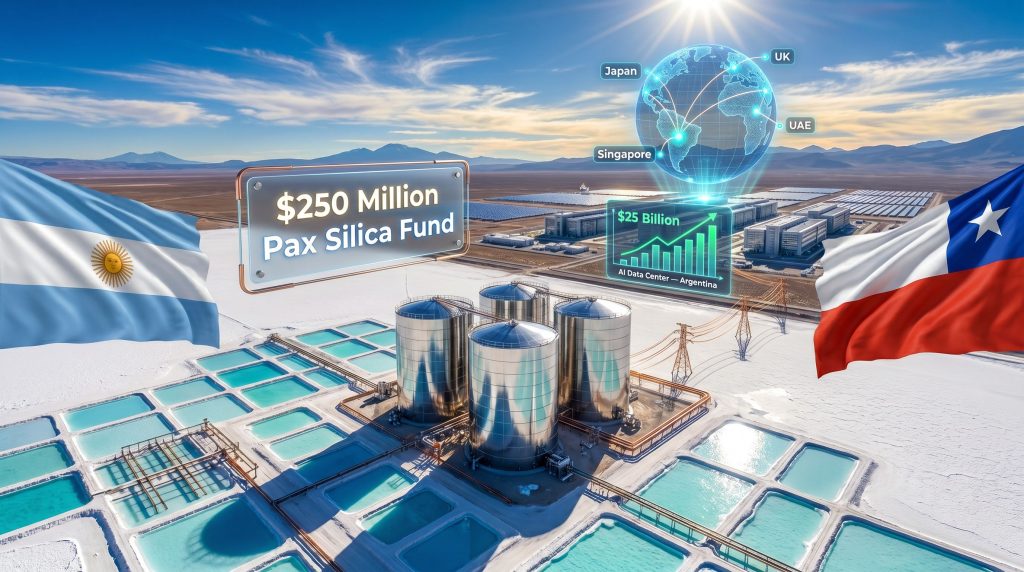
The U.S. has established a $250 million Pax Silica Fund specifically targeting critical minerals extraction, processing, and manufacturing asset development within coalition member nations. The fund's explicit focus on midstream infrastructure is strategically deliberate.
China currently processes an estimated 60 to 70 percent of the world's lithium into battery-grade chemicals, regardless of where the raw material originates. Australian spodumene, Chilean brine, and Argentinian brine all flow through Chinese converters before reaching battery cell manufacturers in South Korea, Japan, and the United States. The Pax Silica Fund is designed to break this processing chokehold by financing the refinery and converter infrastructure that allied nations currently lack.
For Argentina and Chile, fund access represents a structural opportunity to capture the refining margin, the per-tonne value added between raw mineral and battery-ready chemical, that currently accrues almost entirely to Chinese processors.
Latin America's Dual Role: Resource Provider and Compute Destination
The $25 Billion Data Centre Signal
A landmark $25 billion agreement between OpenAI and Sur Energy to construct a high-capacity AI data centre in Argentina has fundamentally reframed the country's strategic profile within the coalition. Argentina is no longer simply a mineral supplier to the AI economy. It is becoming a compute infrastructure destination.
This dual positioning is unusual among emerging market economies and amplifies Argentina's negotiating leverage within Pax Silica considerably. Nations that host both the raw material inputs and the computational infrastructure of AI development occupy a uniquely embedded position in the supply chain, one that is significantly harder to displace than a single-function commodity exporter.
How Latin America's Pax Silica Members Compare
| Country | Primary Contribution | Key Resource or Capability | Strategic Advantage |
|---|---|---|---|
| Argentina | Critical minerals and compute | Lithium brine, AI data centres | Lithium Triangle access, DLE deployment, compute hosting |
| Chile | Critical minerals | Lithium, copper | World's largest copper producer, established mining infrastructure |
| Costa Rica | Digital and energy infrastructure | Renewable-powered data routing | Green energy connectivity hub |
| Panama | Transportation logistics | Canal shipping corridor | Global freight routing control |
Chile's lithium strategy and its copper reserves deserve particular attention. As the world's largest copper producer, accounting for roughly 27 percent of global mine supply, Chile supplies the mineral that underpins virtually all electrical wiring, printed circuit board manufacturing, and data centre cooling systems. AI infrastructure is copper-intensive at every layer, from the transmission cables feeding a facility to the internal interconnects within GPU server racks.
The State Department Architecture Behind the Coalition
Friend-Shoring Meets Near-Shoring
The Pax Silica initiative is coordinated under Under Secretary Jacob Helberg of the U.S. Department of State, a placement that elevates AI supply chain security from a commercial policy issue to a core foreign policy priority. This institutionalises R&D cooperation, data centre development agreements, and critical mineral supplier verification within a diplomatic framework that creates more durable commitments than bilateral trade contracts alone.
The U.S. procurement logic driving Pax Silica membership combines two distinct strategic preferences:
- Friend-shoring directs investment toward politically aligned nations regardless of geographic proximity.
- Near-shoring prioritises geographic closeness to reduce logistics costs and transit times.
Latin America satisfies both criteria simultaneously. The region's political alignment with Western institutions, combined with its geographic proximity to U.S. manufacturing and consumption centres, creates a procurement advantage that no other mineral-rich region can fully replicate. Central Asian producers may offer large reserves but face significant transit complexity. African producers offer scale but political risk profiles that complicate long-term supply contracts.
Critical Minerals Powering the AI Stack
The surge in critical minerals demand is reshaping how nations approach AI infrastructure planning. AI hardware draws on a broader mineral basket than most observers appreciate, and the dependency extends well beyond lithium:
| Mineral | AI Hardware Application | Latin American Significance |
|---|---|---|
| Lithium | Battery storage for data centres and devices | Argentina and Chile: Tier-1 global producers |
| Copper | Wiring, cooling systems, PCB manufacturing | Chile: world's largest producer |
| Graphite | Battery anode material | Early-stage regional exploration underway |
| Cobalt | Battery cathode chemistry | Limited current production |
| Rare Earth Elements | Magnets, sensors, AI chip components | Early-stage exploration across the region |
| Nickel | Battery chemistry, structural infrastructure | Argentina and Brazil hold significant deposits |
One frequently overlooked dynamic is the anode problem. While lithium commands the most public attention in battery supply chain discussions, graphite composes roughly 95 percent of the anode in a standard lithium-ion cell by weight. China controls approximately 70 percent of global natural graphite production and an even larger share of processed anode-grade graphite. Latin America's emerging graphite exploration activity is therefore of growing strategic interest, though it remains early-stage relative to its lithium positioning.
The next major ASX story will hit our subscribers first
Scenario Analysis: Three Trajectories for Latin America's AI Supply Chain Role
Scenario 1: Accelerated Integration (Base Case)
Latin American nations successfully develop midstream lithium processing capacity using Pax Silica Fund capital, attract downstream battery component manufacturing, and become structurally embedded in allied AI hardware supply chains. Argentina's data centre investment deepens, reinforcing its dual-layer strategic value.
Scenario 2: Partial Capture (Moderate Case)
Resource extraction scales but midstream processing stalls due to infrastructure gaps, permitting delays, or competing Chinese offtake offers. Both nations remain primarily raw material exporters, capturing a smaller share of the value chain than Pax Silica architects intended.
Scenario 3: Geopolitical Fragmentation (Risk Case)
Political transitions in Argentina or Chile shift foreign policy orientation, creating friction within the coalition. The $250 million fund is redirected toward alternative supplier nations in Africa or Central Asia, and the dual-layer infrastructure investment thesis unravels.
Strategic Warning: Resource endowment is necessary but not sufficient for supply chain centrality. The long-term value of Pax Silica membership for Argentina and Chile depends on domestic policy continuity, the pace of midstream infrastructure development, and the ability to maintain social licensing in lithium-producing regions.
The Structural Risks That Could Derail the Thesis
Several structural risks deserve serious attention from investors and policy analysts monitoring this space:
- Infrastructure deficits: Argentina in particular lacks the industrial processing infrastructure required to convert brine at the scale Pax Silica envisions. Building this capacity requires years of capital deployment and technical capacity building.
- Chinese counter-investment pressure: Beijing has deep commercial relationships across Latin American resource sectors, built through decades of infrastructure financing and offtake agreements. Pax Silica membership creates tension with these existing arrangements that could trigger retaliatory financing or pricing strategies.
- Water and social licensing: Large-scale lithium extraction in the Puna and Atacama ecosystems requires navigating complex indigenous community rights frameworks. Projects that fail to secure genuine community consent face significant delays and reputational risk.
- Currency and fiscal instability: Argentina's historical pattern of currency crises and sovereign debt restructurings creates contract enforceability risks that sophisticated institutional investors must price into long-term supply agreements.
Moreover, as Science Business has reported, the early formation of Pax Silica raised questions about the coherence of allied coordination, underscoring that the coalition's expansion into Latin America must be matched by equally deliberate institutional architecture if it is to deliver durable outcomes.
The Decade-Long Opportunity in Perspective
The Pax Silica expansion into Latin America should be understood as a multi-year structural repositioning, not a single diplomatic event. Nations that successfully execute the transition from raw material exporter to value-added midstream processor and, ultimately, to integrated AI economy participant, will capture substantially greater economic returns from the global AI buildout than those that remain at the extraction layer.
The convergence of world-class lithium brine deposits, emerging DLE technology deployment, a U.S.-administered capital fund targeting the midstream processing gap, and landmark compute infrastructure investment in Argentina creates a genuinely unusual alignment of forces. Whether Latin America converts that alignment into durable supply chain centrality will depend on execution at the domestic level as much as on geopolitical architecture at the international level.
The opening moves have been made. The next decade will determine whether Latin America becomes a structurally embedded backbone of the Western AI economy, or whether it remains, as so often before, a resource-rich region that watched its geological endowment create value somewhere else.
Disclaimer: This article contains forward-looking analysis, scenario modelling, and market observations that involve assumptions, estimates, and inherent uncertainties. Nothing in this article constitutes financial, investment, or legal advice. Readers should conduct independent due diligence before making any investment decisions related to the sectors, companies, or regions discussed.
Want to Capitalise on the Critical Minerals Driving the AI Supply Chain?
Discovery Alert's proprietary Discovery IQ model delivers real-time alerts the moment significant ASX mineral discoveries are announced — instantly identifying actionable opportunities in lithium, copper, and the full basket of critical minerals underpinning AI infrastructure growth. Explore Discovery Alert's dedicated discoveries page to see how historic mineral discoveries have generated substantial returns, and begin your 14-day free trial today to position yourself ahead of the broader market.