June 26, 2026
How Commodity Markets Price Geopolitical Risk Before Diplomacy Delivers Results
Every experienced energy trader understands a fundamental truth about crude oil markets: prices rarely wait for confirmation. They anticipate, overshoot, and then correct once clarity replaces uncertainty. This forward-pricing mechanism is nowhere more visible than in the relationship between Middle East diplomacy and Brent crude benchmarks, where the mere suggestion of conflict resolution can strip tens of dollars from a barrel within a single trading session.
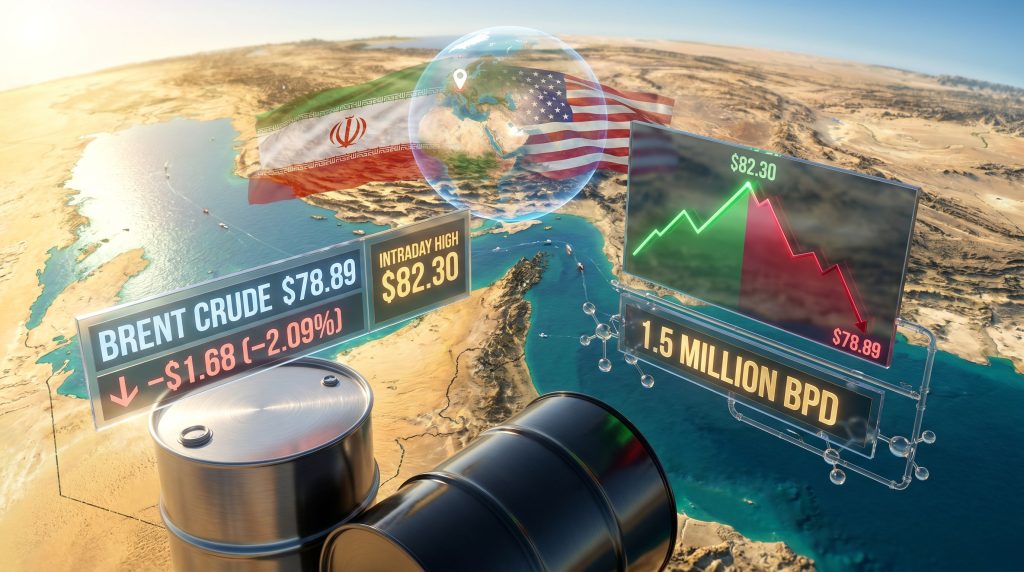
The events of Monday, June 22, 2026, provided a textbook illustration of this dynamic. As Brent falls after US-Iran talks conclude in Switzerland became the defining headline of the session, traders witnessed a swing from an intraday high of $82.30 per barrel down to $78.89, a compressed but consequential price arc that reflected shifting geopolitical sentiment in real time.
Understanding why this happened, and what it means going forward, requires unpacking several interconnected layers: the mechanics of geopolitical risk premiums, the structural significance of Iranian crude, and the fragile diplomatic architecture now governing one of the world's most consequential oil corridors. For broader context, the crude oil market overview for 2025 provides useful background on the forces shaping benchmark pricing.
When big ASX news breaks, our subscribers know first
The Risk Premium Mechanism: How Fear Gets Priced Into Oil
Crude oil prices are rarely determined by pure supply and demand mathematics alone. Layered on top of fundamental balances is what traders call the geopolitical risk premium, an inflation of benchmark prices that compensates for the probability of supply disruption before any actual disruption occurs.
This premium is particularly acute for Brent crude, which serves as the global pricing benchmark and is disproportionately sensitive to Persian Gulf signals. When tensions rise in the Middle East, Brent typically reacts faster and more dramatically than its US counterpart, West Texas Intermediate (WTI), because the Gulf accounts for such a significant share of internationally traded crude.
Historically, this pattern has repeated across decades of Middle Eastern geopolitical cycles. Tensions spike, prices surge, diplomatic signals emerge, and prices correct, often faster than most retail investors anticipate. The challenge for market participants is that the premium builds gradually as uncertainty compounds, but unwinds rapidly once a credible de-escalation signal appears.
Furthermore, geopolitical tensions reshaping trade patterns globally have added additional layers of complexity to how risk premiums behave in modern energy markets. On June 22, the de-escalation signal came in two forms: the conclusion of formal talks between senior US and Iranian delegations in Switzerland, and Tehran's announcement that it had secured tangible near-term concessions, including oil and petrochemical export waivers.
The Strait of Hormuz: A Chokepoint That Shapes Global Energy Logic
To appreciate the scale of market sensitivity to Iran-related developments, it is essential to understand the Strait of Hormuz not simply as a geographic feature, but as a structural vulnerability embedded in the architecture of global energy supply.
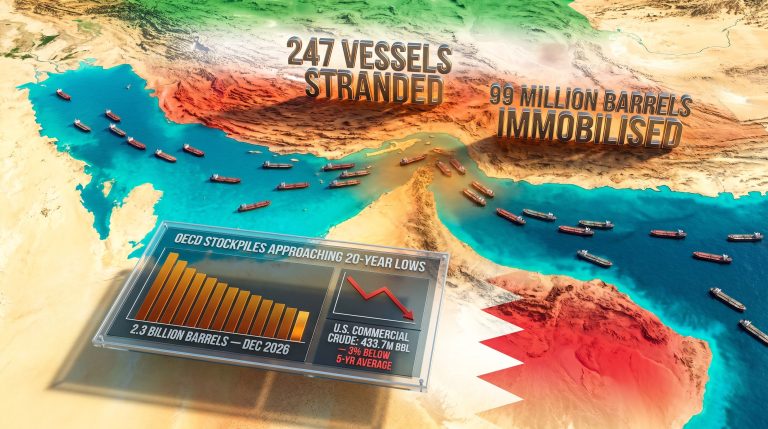
Approximately 20% of global oil supply transits this narrow passage daily, connecting the Persian Gulf to the Gulf of Oman and onward to international markets. Its width at the narrowest navigable point is only around 33 kilometres, yet through this corridor flows crude from Saudi Arabia, Iraq, Kuwait, the UAE, Iran, and Qatar.
When Iran announced a renewed closure of the Strait on Sunday, citing violations of the interim peace agreement, the market response was immediate. Brent surged to $82.30 per barrel in early trading. Shipping data confirmed that vessel transits through the waterway dropped sharply on Sunday, a real-world operational signal that compounded the price reaction.
US Vice President JD Vance's subsequent confirmation that the Strait remained navigable served as a critical circuit-breaker for that early momentum, stabilising sentiment ahead of the formal conclusion of talks.
What this episode reveals is something less commonly discussed in mainstream energy commentary: the Strait of Hormuz functions as a price amplifier in both directions. Closure threats inflate prices faster than most other geopolitical catalysts, but equally, credible assurances of navigability remove that premium with equal speed.
What the Switzerland Talks Produced: Outcomes and Implications
The first formal round of US-Iran negotiations in Switzerland concluded on Monday, June 22, 2026, structured under the terms of a memorandum of understanding reached the prior week. That agreement extended a ceasefire, originally established in April, by a minimum of 60 additional days, creating a defined diplomatic window for further negotiations.
Iranian Foreign Minister Abbas Araqchi confirmed that Tehran secured the following from the initial round:
- Export waivers specifically covering Iranian oil and petrochemical products
- The release of a portion of previously frozen Iranian financial assets
- Agreement to launch a framework for a reconstruction and development plan for Iran
These outcomes carry direct supply-side implications for global crude markets. Sugandha Sachdeva, founder of SS WealthStreet, a New Delhi-based research firm, noted that improving prospects for a diplomatic resolution were reviving market expectations that sanctions on Iranian crude could eventually be eased, with those expectations being the primary driver of the price decline on the day.
Sachdeva further observed that a meaningful easing of sanctions could allow approximately 1.5 million barrels per day (bpd) of Iranian crude to return to international markets, a volume significant enough to reshape supply balances at a time when global demand growth is characterised as moderate rather than robust.
Key data point: Over 25 million barrels of Iranian oil passed through the virtual blockade line in the week preceding the Switzerland talks, according to Hamid Bovard, head of the National Iranian Oil Company, speaking to state television on Sunday.
The 1.5 Million Barrels Per Day Variable: Why This Number Matters
The potential re-entry of 1.5 million bpd of Iranian crude into international markets is not merely a large number in isolation. Its significance is contextual, and understanding that context requires appreciating what moderate demand growth actually means in practical terms.
When analysts describe global oil demand growth as moderate, they are generally referring to annual incremental demand increases in the range of 1 to 1.5 million bpd on a global basis. This means that the Iranian crude volume that could potentially re-enter markets is roughly equivalent to an entire year of incremental global demand growth, absorbed in a single supply-side addition.
In an environment where OPEC's market influence is already carefully calibrated to maintain price support, the introduction of this volume without compensating cuts from existing producers would represent a meaningful downward pressure on prices.
Key Price Movements: June 22, 2026
| Benchmark | Movement | Price Level |
|---|---|---|
| Brent Crude (intraday high) | Surge on geopolitical tension | $82.30/barrel |
| Brent Crude (post-talks, 06:33 GMT) | Down $1.68 (2.09%) | $78.89/barrel |
| Brent Crude (07:16 Saudi time) | Down $1.19 (1.48%) | $79.38/barrel |
| WTI Crude (front-month) | Up $0.13 | $76.73/barrel |
| WTI Crude (August contract) | Down $0.21 | $75.64/barrel |
Note: No US market settlement occurred on Friday due to a public holiday, amplifying Monday's opening volatility as accumulated weekend sentiment entered the market simultaneously.
Regional Supply Response: More Volume Coming From Multiple Directions
Iran's potential re-entry into global oil markets does not exist in isolation. In the week surrounding the Switzerland talks, several other regional producers moved to increase available supply, compounding the bearish price signal.
Regional Producer Actions and Volume Impact
| Producer | Action | Volume Impact |
|---|---|---|
| Iran | Secured export waivers; 25M+ barrels cleared blockade line | Up to 1.5M bpd potential re-entry |
| Iraq | Announced gradual production restoration | Target: 4.2M to 4.3M bpd |
| UAE | Offered additional crude volumes to customers | Incremental, unspecified |
| Kuwait | Offered additional crude volumes to customers | Incremental, unspecified |
Iraq's deputy oil minister for upstream affairs confirmed plans to restore national production gradually to between 4.2 million and 4.3 million bpd, a significant signal from OPEC's second-largest producer. The UAE and Kuwait both independently moved to offer additional crude to customers during the same period, further softening the supply outlook that had briefly supported prices above $82.
A less commonly discussed dynamic here is the coordination signal embedded in these simultaneous moves. When multiple Gulf producers expand availability within the same week, it typically indicates a degree of informal alignment on the desire to prevent sustained price spikes, even when no formal OPEC+ resolution adjustment has been announced. Consequently, understanding oil markets and trade wars becomes essential for interpreting how these coordinated signals interact with broader geopolitical pressures.
The next major ASX story will hit our subscribers first
Prior Week Context: How Markets Pre-Priced the Diplomatic Pathway
The Monday session did not occur in a vacuum. Brent crude had already declined more than 8% in the week prior to the Switzerland talks, driven by growing market conviction that supply normalisation was becoming probable following the initial US-Iran ceasefire agreement. That ceasefire had itself pushed oil prices to a 3.5-month low, establishing a lower baseline from which Monday's intraday spike and subsequent retreat played out.
This sequential compression illustrates a nuanced dynamic in commodity market psychology: by the time a diplomatic event officially concludes, much of its price impact has already been absorbed. Traders who positioned for a bearish outcome ahead of the talks profited from the pre-conclusion drift lower. Those who bought the early spike on geopolitical fear faced rapid reversal.
This is the operational reality of what market participants call event risk trading, where the direction of price movement often runs counter to the intuitive expectation that a positive diplomatic outcome would be priced only after confirmation.
Why the Ceasefire Framework Leaves Significant Risk Intact
Despite the constructive tone of the Switzerland talks, energy market participants should not interpret the outcomes as a pathway to stable, lower oil prices without risk. Several structural vulnerabilities remain embedded in the current diplomatic framework.
ING analysts, writing ahead of the formal conclusion of the talks, stated that moving toward a permanent deal would be challenging, citing very real risks of a flare-up in hostilities during the 60-day ceasefire period itself. That assessment reflects a sophisticated understanding of how temporary diplomatic frameworks function: they create breathing room, but they do not resolve the underlying disagreements that generated conflict in the first place.
The key risk factors currently in play include:
- The 60-day ceasefire creates a defined expiry date for reduced geopolitical risk premiums, after which uncertainty could rapidly rebuild
- The memorandum of understanding is not a binding sanctions relief agreement, meaning Iranian export waivers remain provisional rather than permanent
- Technical-level follow-on talks are confirmed to continue, but their success is not guaranteed and any breakdown could reverse market sentiment sharply
- Lebanon represents a parallel and independent conflict escalation risk, with Israeli strikes killing at least 20 people on Saturday, one day after a Hezbollah ceasefire took effect
Mediators subsequently announced a new de-conflicting mechanism aimed specifically at containing violence in Lebanon, a development that itself signals the region-wide fragility of the current stabilisation effort.
Three Scenarios for Brent Crude Under Different Diplomatic Outcomes
Given the provisional nature of current arrangements, forward-looking price scenarios depend heavily on the trajectory of technical-level negotiations over the coming weeks.
| Scenario | Diplomatic Outcome | Expected Brent Direction |
|---|---|---|
| Bullish (supply shock) | Talks collapse; Strait closure confirmed; sanctions reimposed | Rally toward $85 to $90+ range |
| Base case (managed diplomacy) | Ceasefire holds; partial sanctions relief maintained | Consolidation in $75 to $82 range |
| Bearish (full normalisation) | Comprehensive deal; full Iranian crude re-entry | Downward pressure toward $70 to $74 range |
Disclaimer: These scenarios represent analytical frameworks based on publicly available information and market dynamics. They do not constitute financial advice. Oil prices are influenced by a wide range of variables, and actual outcomes may differ materially from projections.
OPEC+ and the Iranian Re-Entry Calculation
One of the less publicly discussed dimensions of the Iranian crude re-entry question is how OPEC+ would respond to a sustained increase in Iranian volumes. The cartel has historically accommodated Iranian supply changes through informal quota adjustments, but a full-scale return of 1.5 million bpd would represent a challenge to the alliance's production management discipline.
Saudi Arabia, as both the dominant swing producer and a geopolitical stakeholder with its own exposure to regional stability, occupies a uniquely complex position. A lower oil price environment driven by Iranian crude normalisation would directly impact Saudi fiscal calculations, given the kingdom's continued reliance on hydrocarbon revenues to fund its ambitious domestic transformation agenda.
Whether OPEC+ responds with coordinated cuts to absorb Iranian volume, or whether individual member states prioritise market share over price support, will be the defining supply-side variable for Brent crude pricing through the remainder of 2026. In addition, the broader context of oil trade geopolitics will continue to shape how these decisions are interpreted by international markets.
Frequently Asked Questions: Brent Crude and the US-Iran Talks
Why did Brent fall after the US-Iran talks concluded in Switzerland?
Prices declined because the conclusion of talks eased fears of sustained supply disruption. Tehran's confirmation that it had secured oil and petrochemical export waivers signalled that Iranian crude could return to international markets, reducing the geopolitical risk premium that had been embedded in prices. Reuters reported that Brent falls after US-Iran talks conclude in Switzerland reflected this immediate market repricing.
What is the Strait of Hormuz and why does it matter to oil traders?
The Strait of Hormuz is a narrow maritime passage through which approximately one-fifth of global daily oil supply transits. Any confirmed or threatened closure creates an immediate supply shock signal that moves Brent crude prices rapidly.
How much Iranian oil could return to global markets?
Analysts estimate that a meaningful easing of US sanctions could allow approximately 1.5 million barrels per day of Iranian crude to re-enter international markets, a volume equivalent to roughly one full year of incremental global demand growth.
What happens to oil prices if the ceasefire collapses before 60 days?
A breakdown in the ceasefire framework would likely trigger a rapid reversal of the current risk premium removal, with Brent potentially returning to or exceeding the $82.30 intraday high recorded on June 22, depending on the severity of any renewed hostilities.
Why was Monday's trading session particularly volatile?
The absence of a US market settlement on the preceding Friday, due to a public holiday, meant that accumulated weekend sentiment, including Iran's Strait of Hormuz closure announcement and Trump's renewed military threat, entered the market simultaneously at Monday's open, amplifying intraday price swings. This underscores precisely why Brent falls after US-Iran talks conclude in Switzerland registered with such force across global trading desks.
Want to Stay Ahead of Major Commodity-Driven Market Moves?
Discovery Alert's proprietary Discovery IQ model delivers real-time alerts on significant ASX mineral discoveries, translating complex market data into actionable investment insights for both short-term traders and long-term investors. Explore historic examples of exceptional discovery returns and begin your 14-day free trial today to position yourself ahead of the next major market opportunity.