June 26, 2026
When Procurement Logic Hits Its Ceiling: The Mechanics Behind Asia's Crude Slowdown
Global energy markets have long operated on the assumption that price drives volume. Cut the price of a commodity sufficiently and buyers will absorb whatever quantity is offered. The Strait of Hormuz crisis of 2026 has tested that assumption in ways that expose a more complex reality: when geopolitical risk inflates the cost of physically moving a commodity, price discounts alone cannot sustain demand. The Asia Middle East crude buying spree slows not because refiners have lost appetite for Middle Eastern oil, but because the total landed cost of acquiring it has made continued purchasing economically irrational.
Understanding why requires moving beyond the headlines and examining the interlocking mechanics of arbitrage economics, refinery inventory strategy, and the structural risk calculus that governs procurement decisions across the world's largest oil-consuming region. These crude market dynamics are reshaping how Asian buyers approach their supply chains.
When big ASX news breaks, our subscribers know first
The Procurement Shock That Started Everything
When the Strait of Hormuz experienced its most severe navigational disruption in decades, the consequences cascaded through global supply chains at speed. The strait is the world's most critical oil chokepoint, with roughly 20% of global petroleum liquids passing through it annually according to the U.S. Energy Information Administration. A near-closure lasting seven weeks did not merely inconvenience exporters. It severed supply pipelines that Asian refineries had spent decades treating as reliable.
Iraq, OPEC's second-largest producer, bore the most severe impact. With its primary southern export terminals near Basrah dependent on Hormuz access, the country was forced to curtail more than half its output during the closure period. Target restoration levels above 3 million barrels per day from southern fields are expected to take up to two months to achieve, according to Iraqi officials cited by Reuters.
Kuwait's situation was similarly acute. The country's production dropped from a pre-crisis ceiling of approximately 2 million barrels per day to an average of just 573,000 bpd in May, according to data reported by Kuwait News Agency. The Kuwait Petroleum Corporation has indicated it expects to restore output to 2 million bpd within roughly one week of resuming normal international commercial shipping to its ports.
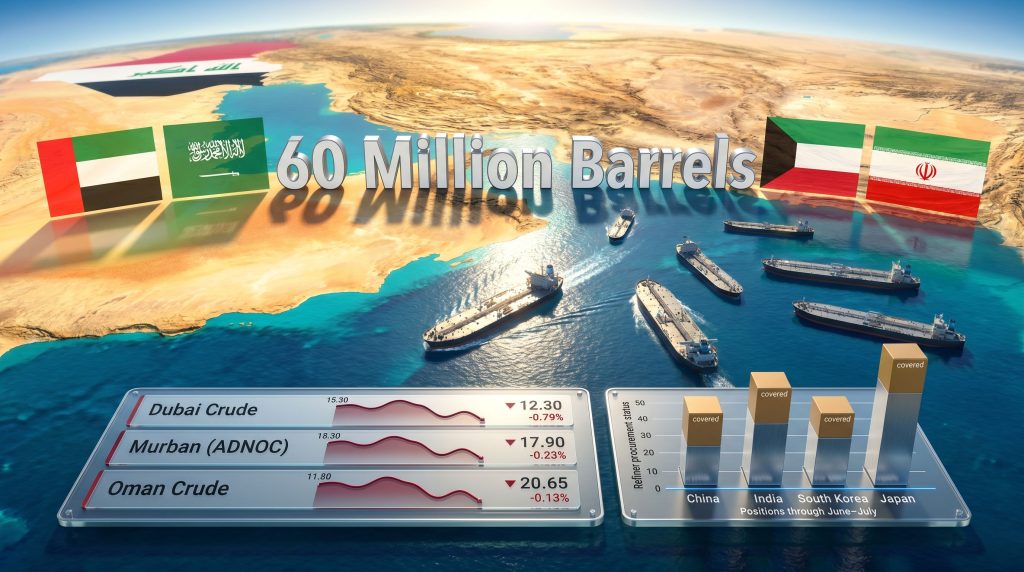
When Persian Gulf loading programmes were suspended, Asian refiners faced an immediate feedstock problem. The scramble to source replacement crude from the Americas, West Africa, and domestic alternatives consumed the better part of four months. Approximately 60 million barrels of US Gulf Coast crude grades were procured for near-term delivery, representing one of the most significant single-cycle diversification exercises by Asian buyers on record.
The Three Benchmarks That Define Asian Crude Pricing
To understand why the buying spree lost momentum, it is necessary to understand how Middle Eastern crude is priced for Asian delivery. Three benchmarks dominate the market.
| Benchmark Grade | Primary Function | Recent Structural Shift |
|---|---|---|
| Dubai Crude | Core sour crude benchmark for Asian spot pricing | Moved from premium to discount versus swaps |
| Murban (ADNOC) | UAE flagship export grade; ICE-listed futures contract | Entered bearish contango structure; ADNOC cut official price to $101.48 |
| Oman Crude | Indian Ocean trade reference; underpins many Asian term contracts | Followed Dubai into discount territory |
When the US-Iran memorandum of understanding raised expectations of supply recovery, forward prices for these benchmarks fell sharply. The spot premiums that had characterised Middle Eastern crude pricing during the peak disruption phase collapsed into discounts relative to swap contracts. Theoretically, this should have accelerated buying. In practice, it opened arbitrage windows toward Europe and the United States rather than sustaining Asian demand, because the cost of freight and war-risk insurance had simultaneously risen to levels that neutralised the discount benefit for Asian buyers. Furthermore, WTI and Brent futures responded to these developments with their own volatility, adding further complexity to the pricing landscape.
Why Arbitrage Economics Collapsed for Asian Buyers
Crude oil arbitrage operates on a straightforward principle: if the price discount on a given grade exceeds the combined cost of freight and insurance to deliver it to a refinery, a profitable trade exists. When that differential inverts, the trade disappears.
The critical variable that most market commentators underweight is war-risk insurance. During periods of heightened Strait of Hormuz tension, the insurance premium applied to vessels transiting the strait can multiply several times over. This single cost component can eliminate the economic case for spot purchasing entirely, even when crude prices are falling.
Very Large Crude Carrier earnings reached nearly $470,000 per day during the peak of the Hormuz crisis, according to reporting by OilPrice.com. Even as tensions have tentatively eased, freight costs remain substantially elevated. The combination of high tanker rates and intensifying competition for vessel capacity has also made floating storage economically unviable, removing what would normally be an additional demand catalyst during a contango market.
Contango, the condition in which forward crude prices trade below near-term spot prices, normally incentivises buyers to purchase crude immediately and store it on vessels for future delivery at a profit. However, with freight costs elevated and tanker availability constrained, the economics of floating storage have turned negative, eliminating this demand mechanism entirely.
Demand Saturation: The Cargo Coverage Problem Explained
Beyond the arbitrage calculus, a more fundamental constraint has halted the buying spree. Most major Asian refiners have fully covered their cargo requirements for June and July. This is not a coincidence. It reflects four months of intensive procurement activity during the crisis period, during which refiners aggressively sourced alternative supply to compensate for constrained Middle Eastern deliveries.
The consequence is that any additional Middle Eastern barrels now arrive into a supply environment where buyers have no immediate need for incremental volume. For those barrels to clear, Middle Eastern producers would need to offer discounts substantial enough to make it economic to either displace already-contracted alternative supply or build inventory beyond operational requirements. Given the freight and insurance cost environment, the discount required would need to be exceptional.
Where Asian Refiners Stand on Procurement Coverage
| Market | Current Procurement Status | Key Alternative Supply Acquired |
|---|---|---|
| China (Independent Teapots) | Covered through July; utilisation at lowest since 2017 | Domestic crude; Russian supply |
| India | June-July cargo requirements met; testing Hormuz vessel access | US LPG at record import volumes; West African grades |
| South Korea | June-July orders finalised | US Gulf Coast crude grades |
| Japan | Monitoring Iranian waiver with caution | Diversified Atlantic Basin sources |
China's independent refining sector warrants particular attention. Teapot refineries in Shandong province, which have historically served as Iran's primary crude buyer, are operating at their lowest utilisation rates since 2017. This structural fragility reflects not just the current crisis but the longer-term vulnerability of a refining model built on discounted sanctioned crude. The China demand outlook adds a further dimension to understanding how these pressures interact with broader commodity consumption trends.
Iran's Sanctions Waiver and the Limits of a Two-Month Window
The US-Iran 14-point memorandum of understanding included a temporary general licence lifting oil sanctions until August 21, creating a theoretical procurement window for Indian, South Korean, and Japanese refiners to import Iranian crude for the first time in years. Iran has actively contacted all three markets, according to reporting by Bloomberg.
In practice, adoption has been cautious and limited. Several structural barriers explain the hesitation:
- The two-month duration is insufficient for refiners to reconfigure crude slates, shipping logistics, and banking arrangements, all of which carry significant lead times
- Policy reversal risk is substantial. If US-Iran nuclear talks stall, the general licence may not be renewed, leaving any refiner that has reconfigured supply chains exposed to abrupt interruption
- South Korean and Japanese refiners operate within US-aligned regulatory frameworks and maintain compliance postures that make importing Iranian crude reputationally and legally complex, even under a temporary waiver
- Most Asian refiners already hold adequate near-term inventory, reducing the urgency that might otherwise override these barriers
For refiners weighing whether to import Iranian crude under the waiver, the fundamental question is not whether the price is attractive. It is whether the supply chain reconfiguration required to access that crude can be justified for a two-month window that may not be renewed.
China remains the dominant destination for Iranian crude, a trade relationship that has operated through a well-established network of independent refiners, intermediary traders, and alternative payment mechanisms that sidestep dollar-based banking systems. This architecture took years to build and is not easily replicated by refiners in other markets within a two-month window.
The next major ASX story will hit our subscribers first
Middle Eastern Producers: The Race to Recapture Market Share
The recovery timeline across the region's major producers varies significantly, creating an uneven restoration dynamic. Consequently, OPEC's market influence over pricing and production coordination is being tested in ways not seen in recent memory.
| Producer | Output Target | Recovery Timeline | Key Constraint |
|---|---|---|---|
| Kuwait | 2 million bpd | Within approximately one week | Resumption of commercial shipping to Kuwaiti ports |
| Iraq | Above 3 million bpd (southern fields) | Within two months | Hormuz navigability for Basrah loadings |
| Saudi Arabia | Partial restoration | Near-term | Continuing to route exports via East-West pipeline to Yanbu on the Red Sea |
| Iran | Export ramp-up under sanctions waiver | Two-month window | US policy continuity; Asian refiner adoption barriers |
| UAE (ADNOC) | Resuming term contract volumes | Immediate | Transitioning from spot supply back to term contract framework |
ADNOC's position is particularly instructive. During the peak disruption phase, the Abu Dhabi national oil company served as the primary spot supplier across at least three consecutive tender rounds, with a fourth underway. This spot market activity generated significant revenue but has now created a strategic tension: as ADNOC instructs its long-term contract customers to immediately resume loading schedules, spot market demand from Asia is naturally reduced. Some ADNOC tender barrels are reportedly being redirected toward European buyers, a signal that the rebalancing of Middle Eastern crude flows is already underway.
The US Crude Procurement Surge and Its Structural Ceiling
The approximately 60 million barrels of US Gulf Coast crude procured by Asian buyers during the crisis period represents a remarkable single-cycle mobilisation. Alaska North Slope crude has attracted particular interest because its sulphur profile makes it a functional substitute for the medium-sour Persian Gulf grades that form the backbone of many Asian refinery configurations.
However, US crude delivered to Asia has approached or in some cases exceeded Middle Eastern pricing once freight is incorporated, creating a natural ceiling on continued American supply purchases. This cost dynamic means US crude will likely revert to a supplementary rather than primary role in Asian procurement once Hormuz access normalises. In addition, the broader oil market trade shocks triggered by this crisis have reinforced how quickly trade flows can be redirected under supply pressure.
West African grades, including Nigeria's Bonny Light, have served as a third procurement pillar. Atlantic Basin diversification has been a recurring theme across all major Asian import markets, reflecting both the crisis-driven necessity of the moment and the longer-term strategic logic of reducing Persian Gulf concentration.
Three Scenarios for How This Resolves
The trajectory of the Asia Middle East crude buying spree slowdown depends heavily on how the Hormuz situation evolves over the next 30 to 90 days.
Scenario A: Full Hormuz Reopening Within 30 Days
Middle Eastern term supply resumes at pre-crisis volumes. Asian refiners revert to established procurement patterns. US and West African crude flows to Asia normalise downward. Contango structures unwind as supply expectations solidify.
Scenario B: Partial Restriction for 60 to 90 Days
Asian refiners maintain diversified procurement at elevated levels. The Iranian waiver expires without renewal. Kuwait and Iraq restoration targets slip relative to announced timelines. Floating storage economics remain negative. Price volatility persists across benchmark grades.
Scenario C: Prolonged Uncertainty Beyond 90 Days
Structural realignment of Asian crude supply chains accelerates permanently. Long-term contracts with US, West African, and Latin American producers increase at the expense of Persian Gulf spot exposure. Middle Eastern producers face sustained market share erosion in Asia, potentially accelerating discussions around pricing mechanism reform for Asian benchmark contracts.
The Permanent Procurement Recalibration Thesis
Regardless of which scenario materialises in the near term, the crisis has exposed a concentration risk in Asian energy security that procurement teams are unlikely to ignore once normal conditions resume. Qatar's new crude supply agreement with Taiwan represents a concrete example of how the disruption is accelerating bilateral arrangements that bypass traditional spot market structures.
India's dual-track approach is instructive: importing US LPG at record volumes while simultaneously testing vessel access to the Persian Gulf represents a deliberate hedging strategy rather than a binary supply choice. This model of structured diversification is likely to become the template for Asian energy procurement strategy in a world where Hormuz closure is no longer a theoretical risk but a demonstrated reality. The Asia Middle East crude buying spree slows, but its legacy is a permanently more cautious approach to Persian Gulf concentration.
For South Korea and Japan, the compliance and reputational dimensions of supply diversification add an additional layer to the strategic calculus. Both countries have strong institutional incentives to favour US-aligned supply sources, a preference that the crisis has reinforced rather than weakened. Furthermore, as the Asia Middle East crude buying spree slows across the region, the structural shift toward diversified supply chains appears increasingly irreversible.
Disclaimer: This article is intended for informational and educational purposes only. Nothing contained herein constitutes financial, investment, or trading advice. Forecasts, scenario projections, and market analyses represent analytical perspectives based on publicly available information and are subject to change. Readers should conduct their own due diligence before making any investment or procurement decisions.
Want To Stay Ahead of the Next Major Resource Discovery?
While Asian crude procurement strategies are being rapidly reshaped by geopolitical disruption, astute investors understand that commodity market volatility also creates compelling opportunities in resource exploration — Discovery Alert's proprietary Discovery IQ model scans ASX announcements in real time, delivering instant alerts on significant mineral discoveries and turning complex data into actionable investment insights. Explore historic discoveries and their market returns to understand the potential scale of opportunity, and begin your 14-day free trial today to position yourself ahead of the broader market.