July 18, 2026

The Macro Forces Quietly Repositioning Gold as the AI Trade Matures
Investor cycles have a predictable rhythm. Capital floods into a dominant theme, valuations expand well beyond fundamentals, and eventually the market demands proof. What began as a broad-based euphoria around artificial intelligence has now entered precisely that accountability phase, where the question is no longer whether AI matters, but whether the economics justify the extraordinary capital deployed. Understanding the AI tech trade inflection point and gold outlook requires examining this shift carefully, as the answer carries consequences that extend well beyond Silicon Valley, into currency markets, sovereign bond dynamics, and ultimately into the gold price.
Understanding this shift, and where gold sits within it, requires stepping back from individual stock narratives and examining the architecture of capital allocation that has quietly been reshaping global financial markets.
When big ASX news breaks, our subscribers know first
From Blanket Exposure to Selective Accountability: The AI Trade Splits
For roughly two years between 2022 and 2024, participation in the AI investment theme required almost no discrimination. Infrastructure builders, chip designers, cloud providers, and companies that simply rebranded themselves around AI-adjacent terminology all attracted capital. The operating assumption was straightforward: anything connected to artificial intelligence would benefit from the wave.
That assumption has now fractured. Capital markets have entered a second phase defined by a single demand: show the revenue.
The clearest signal of this shift came when investors began scrutinising capital expenditure ratios at major enterprise software and cloud infrastructure firms. When one prominent technology company's capex spending approached parity with its total revenue, institutional allocators began asking questions that had not previously been asked. Shortly after, even firms reporting strong quarterly results were penalised by markets that chose to focus on the sheer scale of forward spending commitments rather than current earnings.
"The transition from indiscriminate AI enthusiasm to selective monetisation scrutiny represents a structural change in how this trade is priced, not merely a sentiment correction."
The five largest hyperscalers collectively committed more than $630 billion in AI-related infrastructure spending for 2026 alone, representing a year-over-year increase of approximately 40%. The question now facing markets is whether downstream revenue growth can plausibly justify this level of capital intensity, or whether the cycle has entered a phase of diminishing marginal returns on AI infrastructure investment.
Chinese AI Development and the Commoditisation Threat
Compounding the monetisation question is a competitive dynamic that few fully appreciated until recently. Chinese AI developers have been producing increasingly capable models at a fraction of the cost required by their Western counterparts. The strategic consequence of this is significant: US technology companies that invested trillions constructing proprietary AI infrastructure now face the prospect that the outputs of that infrastructure are being commoditised by lower-cost alternatives.
This dynamic echoes a competitive principle famously applied in the early days of e-commerce, where dominant incumbents with high-margin businesses found those margins targeted by leaner competitors with structurally lower cost bases. The same logic is now operating at the frontier of artificial intelligence.
The semiconductor memory sector illustrates this pressure with particular clarity. DRAM and NAND flash memory producers had been among the primary beneficiaries of hyperscaler AI spending. Now a Chinese DRAM manufacturer holds approximately 8% of global market share and is actively working to redirect Chinese AI hyperscaler demand away from South Korean and American suppliers.
The Memory Market Cascade
The implications extend outward in a chain reaction:
- If Samsung and SK Hynix lose meaningful Chinese market share, margin pressure flows downstream to US memory producers
- Companies including Micron, SanDisk, and Western Digital are all competing in a fundamentally commodity product category
- Commodity product categories are structurally vulnerable to price-based competition, which Chinese producers are explicitly pursuing
- The loss of a captive customer base in China removes a meaningful volume cushion that had previously supported pricing across the sector
| Segment | Phase 1 Dynamic (2022-2024) | Phase 2 Risk (2025-2026) |
|---|---|---|
| US AI Model Developers | Valuation expansion on AI narrative | Commoditisation from lower-cost Chinese alternatives |
| DRAM/NAND Memory Suppliers | Core beneficiaries of hyperscaler spend | Chinese domestic alternatives capturing share |
| AI Infrastructure Builders | Data center construction boom | Capex moderation cycle approaching |
| South Korean Chipmakers | Global supply dominance | State-backed Chinese competition intensifying |
| Application-Layer AI Companies | Rewarded alongside infrastructure | Now receiving premium multiples vs. infrastructure peers |
The Capex Ceiling and What Comes After the Buildout
One of the more underappreciated aspects of the current AI infrastructure cycle is that its physical constraints have shifted. The binding limitation is no longer GPU availability. It is now electric power, grid capacity, and transformer supply. This shift has practical consequences for capital allocation.
Companies across server hardware, construction, and data center management that rode the buildout wave face asymmetric downside risk if major hyperscalers begin moderating their capital expenditure guidance. This is not speculative: when capex approaches 100% of revenue, as has occurred at some major cloud providers, the arithmetic of sustaining that spend becomes untenable.
The buildout is not ending. However, it is approaching a moderation point, and the distinction matters enormously for investors positioned in the infrastructure beneficiary trade.
The Agentic AI Layer: The First Credible Monetisation Path
Beyond the infrastructure phase, the next evolution in AI development centres on agentic systems: autonomous AI capable of executing multi-step tasks and functioning as what some in the industry have described as digital employees. This represents a fundamentally different revenue model, shifting from seat-based software subscriptions to outcome-based pricing structures.
For investors, this transition matters because it is the first architecture that could plausibly generate the recurring, scalable revenue needed to justify the capital already deployed. Application-layer companies with demonstrable monetisation pathways are now being priced with premium multiples while infrastructure-facing peers face compression. Furthermore, this AI bubble and gold price consolidation dynamic is increasingly relevant to how precious metals are being repositioned within diversified portfolios.
How a Tech Trade Rotation Creates a Gold Catalyst
The connection between an AI tech trade inflection point and the gold outlook is not intuitive on its surface, but the mechanism is traceable through global capital flows.
US technology stocks are not exclusively held by North American investors. Major sovereign wealth funds, including the Swiss National Bank and the Norwegian Government Pension Fund, hold the largest US mega-cap technology names among their top portfolio positions. These are institutions managing national reserves, not speculative trading accounts.
If the AI tech trade undergoes a sustained correction, the capital repatriation dynamic becomes meaningful. Money flows back to home markets rather than rotating within US asset classes. At scale, this creates selling pressure on US dollars and reduces demand for dollar-denominated assets more broadly.
"The dollar's limited recovery despite significant monetary policy repricing is itself a signal. The US Dollar Index reaching approximately 100 to 101 after a period of aggressive hawkish repricing suggests the dollar's structural upside may already be exhausted."
Sovereign Bond Markets Are Sending Additional Signals
Simultaneously, developed market sovereign bond yields have been rising in ways that compound this dollar vulnerability. Understanding gold and bond dynamics is consequently essential context for interpreting these movements:
- French 10-year yields recently reached a 17-year high
- Japanese 10-year government bond yields touched a 30-year high
- The US 10-year nominal yield has risen approximately 60 basis points in the recent period, while 10-year inflation breakeven expectations have remained largely unchanged, representing a genuine real rate increase of 60 basis points
Japan's position in this dynamic deserves particular attention. Japan holds the status of the largest foreign holder of US Treasuries and is the world's largest net creditor nation, with approximately $3.5 trillion in net foreign assets. If Japanese domestic bond yields become sufficiently attractive that institutional investors no longer need to seek yield through US Treasury holdings, the resulting repatriation flow would represent a structurally significant source of dollar selling pressure.
The combination of tech equity repatriation and sovereign bond repatriation creates what can be described as a compounding dollar weakness scenario, historically one of the most reliable environments for gold appreciation.
The Two-Factor Model for Gold's Next Move
Reducing the gold outlook to its essential mechanics, two variables dominate the near-term trajectory.
Factor One: Real Interest Rates
Real interest rates represent the primary opportunity cost of holding gold. When real rates rise, the relative attractiveness of non-yielding assets like gold diminishes. The approximately 60 basis point increase in real 10-year US yields in the current cycle has functioned as a meaningful headwind.
For gold to establish a durable floor and resume an uptrend, real rates need to stabilise or decline. This can occur through two pathways:
- Nominal yields fall, reducing the real rate directly
- Inflation expectations rise, compressing real rates without requiring nominal yield movement
Rising energy prices, if sustained, would push inflation breakeven expectations higher, mechanically reducing real rates without any Federal Reserve action required.
Factor Two: US Dollar Direction
Dollar strength compresses gold prices in non-dollar terms and reduces international demand. Dollar weakness operates as the inverse. Given the structural argument that dollar upside is already constrained, and that tech equity or sovereign bond repatriation could actively accelerate dollar weakness, this factor is increasingly aligned with the gold bull case.
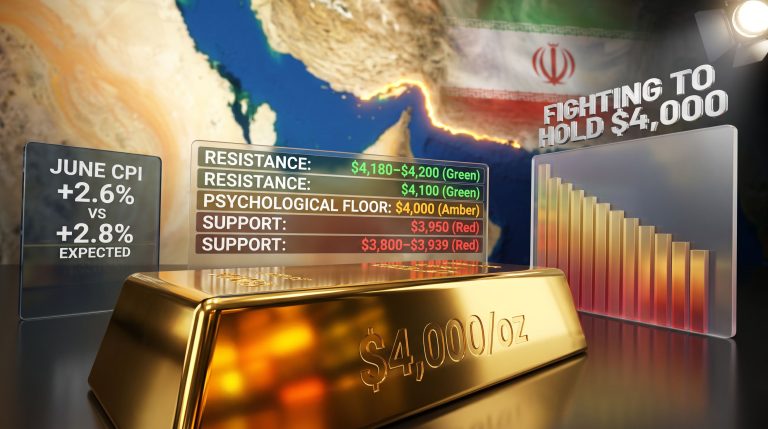
The $4,000 per ounce level has functioned as a psychological and technical support zone, with multiple tests holding in recent weeks. According to gold price forecast analysis, this is a level where buyers have consistently appeared. Gold's safe-haven role continues to underpin this demand floor, particularly as geopolitical fragmentation persists across multiple regions.
| Indicator | Current Signal | Gold Implication |
|---|---|---|
| Real 10-Year US Yield | Elevated (headwind active) | Needs stabilisation or decline |
| US Dollar Index | Structurally weak despite repricing | Potential acceleration if repatriation intensifies |
| Central Bank Gold Buying | Ongoing structural demand | Long-term price floor support |
| Global Sovereign Bond Yields | Multi-decade highs in multiple markets | Repatriation risk creates dollar pressure |
| AI Capex Cycle | Approaching moderation inflection | Capital rotation potential increasing |
The next major ASX story will hit our subscribers first
What Major Banks Are Forecasting for Gold in 2026 and 2027
Institutional price targets for gold have diverged considerably, reflecting genuine uncertainty about the macroeconomic path ahead.
| Institution | 2026 Price Target | Additional Notes |
|---|---|---|
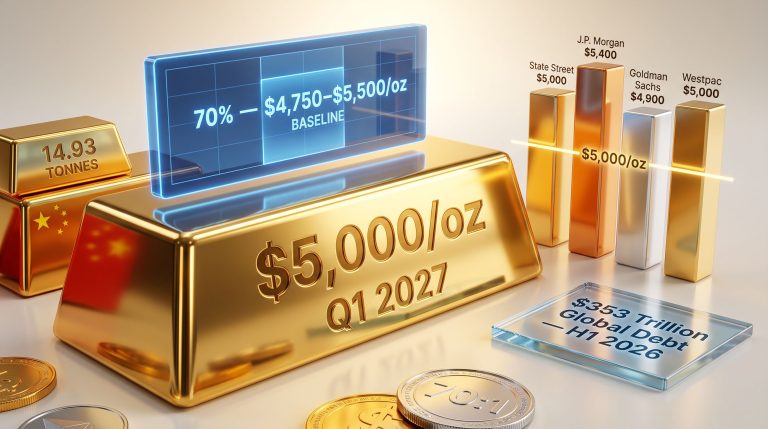
| J.P. Morgan | $6,000/oz Q4 average | Most bullish major bank; projects $6,300/oz by end-2027 |
| UBS | $5,500/oz | Revised down from $5,900; sees $6,200 if geopolitical risks escalate |
| Goldman Sachs | $4,900/oz | Most conservative among major forecasters |
| Reuters Analyst Survey Median | $5,746/oz | Consensus view across broader analyst community |
The key demand drivers supporting these forecasts include continued central bank gold demand, geopolitical risk premiums, currency diversification by emerging market central banks, and the indirect commodity demand generated by the physical AI infrastructure buildout. In addition, strategic gold investment frameworks increasingly incorporate these macro variables as central inputs to long-term positioning decisions.
The Federal Reserve Under New Leadership: Hawkish in Intent, Constrained in Practice
New Federal Reserve leadership has signalled a clear intolerance for above-target inflation and positioned vigilance as the defining characteristic of the current monetary policy stance. On its face, this presents a headwind for gold through sustained real rate elevation.
However, the structural constraints facing the Fed remain unchanged regardless of the preferences of any individual chair.
The US federal budget deficit is running at approximately 6% of GDP. If the AI tech trade contracts significantly and the broader wealth effect on consumer spending and corporate tax revenues weakens, fiscal deterioration could accelerate toward 10 to 14% of GDP, creating a fiscal crisis scenario that would override hawkish monetary preferences.
Critically, monetary policy is set by committee. Some regional Federal Reserve presidents have expressed willingness to hike rates if inflation data warrants, while others remain oriented toward easing. The new chair's known preference against forward guidance also sits in tension with the communication styles of several voting colleagues who have historically provided explicit forward guidance to markets.
"For gold investors, policy uncertainty itself is a bullish factor. A Fed that cannot clearly signal its direction is a Fed that is effectively unable to suppress the store-of-value demand for gold through verbal intervention alone."
On the question of balance sheet policy, new leadership has expressed a preference for a smaller central bank footprint in financial markets. However, the balance sheet has been explicitly acknowledged as remaining an emergency tool. The practical implication is more judicious deployment rather than renunciation of the instrument. This matters because it removes one of the cleaner hawkish signals the market might otherwise have priced.
Housing: The Overlooked Fault Line Connecting to Inflation and Gold
The US housing market represents one of the most structurally significant and underappreciated risks in the current macro environment. Housing and its interconnected industries, including construction, real estate services, insurance, legal services, and materials, collectively account for approximately 15 to 18% of US GDP by some estimates. That sector remains effectively in recession by several measures.
Existing home sales are running near 30-year lows. Home prices have appreciated roughly 50% over the past six years while mortgage rates remain elevated, suppressing both transaction volume and new construction starts. The affordability constraint has created a locked market where potential sellers are disincentivised from listing because replacing their low-rate mortgage with a current-rate mortgage is economically punitive.
This creates a persistent inflation paradox. Shelter costs remain one of the stickiest components of measured consumer price inflation, even as actual transaction volumes have collapsed. The Federal Reserve cannot easily reduce rates to relieve housing affordability without risking a re-acceleration of shelter inflation, the very category that has proven most resistant to monetary tightening.
For gold investors, this paradox reinforces the thesis that structurally elevated inflation, even at moderate levels, provides a persistent tailwind for precious metals. Research published in applied economic journals further supports gold's role as a durable hedge against precisely these kinds of persistent inflationary pressures.
The Second-Order Effects of Price Controls
The housing affordability crisis has generated political pressure for rent control and stabilisation measures in major urban markets. The economics of these interventions illustrate a broader principle relevant to evaluating any policy response to structural market failures.
When rents are capped in some units within a building, landlords redirect cost recovery toward uncontrolled units, raising effective rents for non-stabilised tenants. An estimated 60,000 to 70,000 apartments in New York City alone sit uninhabited because landlords find vacancy economically preferable to operating under regulated economics. The failure to trace second and third-order effects is a recurring feature of economic policy interventions, and understanding this pattern is valuable context for evaluating the credibility of any government response to inflation broadly.
Three Scenarios for Gold in the Second Half of 2026
| Scenario | Primary Trigger | Gold Price Implication |
|---|---|---|
| Base Case | AI capex moderates; dollar weakens gradually; real rates stabilise | Consolidation above support; gradual appreciation toward $5,500 to $6,000 |
| Bull Case | Tech equity selloff triggers repatriation; dollar declines sharply; geopolitical escalation | Acceleration toward $6,000 to $6,300; central bank buying intensifies |
| Bear Case | Fed hikes materialise; dollar strengthens; AI monetisation surprises to the upside | Gold tests lower support; consolidation extends; bull case delayed not abandoned |
The structural argument that transcends short-term scenario analysis rests on three durable pillars: ongoing central bank accumulation that continues regardless of price volatility, emerging market reserve diversification away from dollar assets as a decade-long trend, and the intersection of fiscal expansion, monetary uncertainty, and geopolitical fragmentation that collectively create a permanently elevated floor for gold demand.
Furthermore, broader market commentary from institutional analysts consistently highlights these structural forces as likely to remain intact through the latter part of this decade. The AI tech trade inflection point and gold outlook are consequently not separate stories. They are connected through the plumbing of global capital allocation, and investors who understand that connection are better positioned to navigate what may prove to be one of the more consequential macro rotations of the decade.
This article is intended for informational purposes only and does not constitute financial advice. All price forecasts referenced are sourced from publicly available institutional research and are subject to change. Investors should conduct their own due diligence before making any investment decisions.
Want to Capitalise on the Next Major Mineral Discovery Before the Broader Market?
As macro forces continue repositioning gold within global portfolios, Discovery Alert's proprietary Discovery IQ model delivers real-time alerts on significant ASX mineral discoveries, instantly translating complex mineral data into actionable investment insights for both short-term traders and long-term investors. Explore historic examples of extraordinary discovery returns and begin your 14-day free trial today to ensure you're positioned ahead of the market.