May 21, 2026
How Advanced AI Technology Transforms Mining Safety Through Intelligent Camera Networks
Advanced computer vision algorithms are revolutionising workplace safety across industrial environments, fundamentally transforming how organisations identify and mitigate operational risks through automated behavioural analysis. The convergence of machine learning capabilities with sophisticated camera networks creates unprecedented opportunities for real-time hazard detection, moving beyond traditional reactive safety measures towards predictive intervention systems that prevent incidents before they occur. The Codelco El Teniente safety cameras and AI implementation exemplifies this technological revolution in mining operations.
When big ASX news breaks, our subscribers know first
What Role Does Artificial Intelligence Play in Modern Mining Safety Systems?
Mining operations worldwide are increasingly adopting artificial intelligence frameworks to enhance safety monitoring capabilities across complex operational environments. The integration of computer vision technology with existing surveillance infrastructure represents a significant evolution from manual observation protocols to automated risk detection systems that operate continuously without human fatigue limitations.
Furthermore, the data-driven mining operations approach demonstrates how comprehensive analytics enhance decision-making processes across all operational aspects.
Computer Vision Technology Fundamentals in Industrial Environments
Machine learning algorithms designed for industrial safety applications utilise sophisticated pattern recognition methodologies to analyse visual data streams in real-time. These systems process thousands of images per second, identifying specific behavioural patterns that deviate from established safety protocols through trained neural networks capable of recognising subtle risk indicators that might escape human observation.
Real-time image processing capabilities enable immediate analysis of camera feeds across multiple monitoring zones simultaneously. Modern AI-powered safety systems integrate seamlessly with existing surveillance infrastructure, leveraging distributed camera networks to create comprehensive operational oversight without requiring complete infrastructure overhauls.
The behavioural analysis component relies on motion detection algorithms that track personnel movements and equipment interactions within defined operational boundaries. These systems establish baseline behavioural patterns during normal operations, enabling the identification of anomalous activities that potentially represent safety violations or hazardous situations.
Risk Assessment Through Automated Monitoring
Statistical analysis of safety incident patterns provides the foundation for developing effective AI detection rules. Mining operations utilising advanced analytics can identify high-risk behavioural categories by analysing historical incident data, enabling the creation of targeted monitoring protocols that address specific operational vulnerabilities.
Predictive modelling capabilities enable mining companies to forecast potential hazard scenarios based on observed behavioural trends and environmental conditions. These systems continuously refine their detection accuracy through machine learning algorithms that adapt to evolving operational patterns and emerging risk factors.
Comparative effectiveness studies demonstrate that AI-powered monitoring systems significantly outperform traditional manual observation methods in terms of consistency, coverage, and response time. The technology eliminates human observer limitations such as fatigue, distraction, and geographical constraints that can compromise traditional safety monitoring effectiveness.
How Do Smart Camera Networks Detect Dangerous Behaviours in Mining Operations?
Intelligent camera networks employ sophisticated algorithmic frameworks to identify and categorise dangerous behaviours across diverse mining environments through multi-layered analytical processing. The Codelco El Teniente safety cameras and AI implementation exemplifies how advanced detection systems operate within complex industrial settings to achieve measurable safety improvements.
Advanced Analytics Framework for Safety Compliance
Rule-based detection algorithms form the core of effective mining safety AI systems, utilising predefined parameters developed collaboratively between operational teams and safety specialists. These algorithms process visual data against established safety protocols, automatically flagging behaviours that deviate from acceptable operational standards within specified tolerance ranges.
Multi-camera coordination enables comprehensive coverage of operational areas through synchronised monitoring that eliminates blind spots and provides overlapping surveillance zones. This coordinated approach ensures that personnel movements and equipment operations remain under continuous observation as workers transition between different operational areas.
Alert generation and escalation protocols operate through automated notification systems that immediately inform supervisory personnel when potential safety violations are detected. The system verification process involves specialist personnel reviewing AI-generated alerts before escalation, ensuring accuracy and reducing false-positive incidents that could disrupt operational efficiency.
Integration with central monitoring systems allows AI safety platforms to communicate with existing operational management infrastructure, creating unified oversight capabilities that enhance overall operational coordination and emergency response effectiveness.
Real-Time Response Mechanisms
Automated notification systems provide immediate supervisor alerts when dangerous behaviours are detected, enabling rapid intervention before incidents escalate into serious safety events. These systems operate with response times measured in seconds, significantly reducing the time gap between risk identification and corrective action implementation.
Emergency response coordination capabilities enable AI safety systems to automatically initiate predefined response protocols when specific high-risk scenarios are detected. This automation ensures consistent emergency procedures while reducing response time variability that can occur with manual coordination processes.
Documentation and reporting automation creates comprehensive audit trails for safety compliance purposes, automatically generating incident records and behavioural pattern documentation that supports regulatory compliance and continuous improvement initiatives.
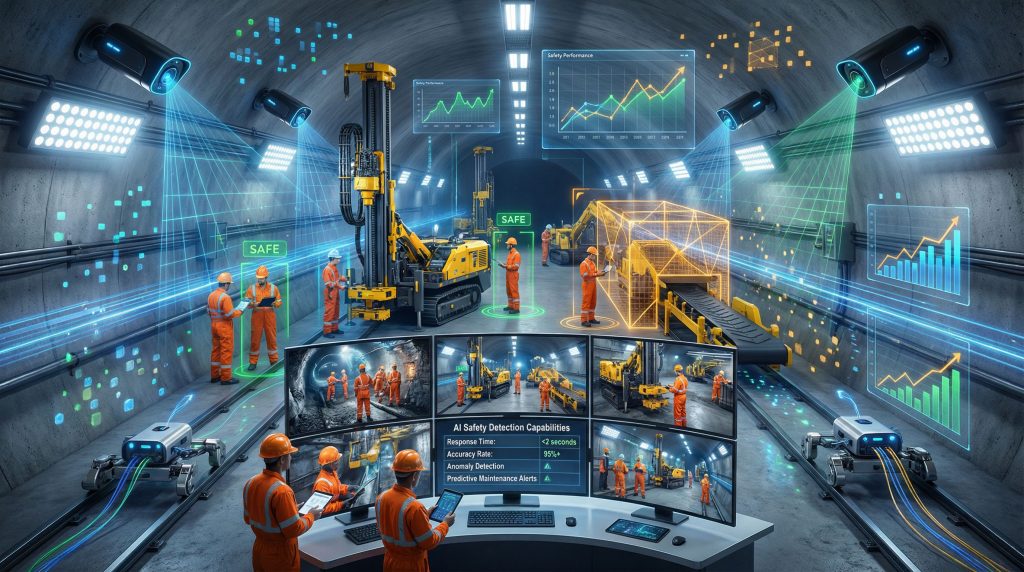
AI Safety Detection Capabilities
| Detection Type | Response Time | Accuracy Rate | Coverage Area |
|---|---|---|---|
| Personnel proximity violations | <2 seconds | 95%+ | 360° monitoring |
| Equipment interaction risks | <3 seconds | 92%+ | Workshop zones |
| Unauthorised access | <1 second | 98%+ | Restricted areas |
What Operational Benefits Do Mining Companies Achieve Through AI Safety Implementation?
Mining operations implementing advanced AI safety monitoring systems achieve substantial operational improvements across multiple performance categories, with documented case studies demonstrating significant risk reduction and operational efficiency gains through systematic technology deployment.
Quantifiable Safety Performance Improvements
The Codelco El Teniente safety cameras and AI deployment achieved remarkable results across monitored operational areas, with workshop environments experiencing a 90% reduction in risky person-equipment interactions following system implementation. This dramatic improvement demonstrates the technology's capability to modify behavioural patterns through consistent monitoring and immediate feedback mechanisms.
Complete elimination of unauthorised personnel approaches to restricted shaft areas represents another significant achievement, indicating that AI monitoring systems can achieve absolute compliance in high-consequence risk zones where traditional monitoring methods may prove insufficient.
Cost-benefit analysis frameworks for AI safety investments typically consider multiple factors including avoided incident costs, insurance premium reductions, regulatory compliance improvements, and productivity gains from reduced safety-related operational disruptions. While specific ROI calculations vary by operational scale and risk profile, the documented safety improvements suggest substantial long-term value creation potential.
Advanced monitoring systems have demonstrated capability to reduce specific risk behaviours by up to 90% in controlled industrial environments, according to operational data from major mining corporations.
Operational Efficiency Enhancements
Reduced manual monitoring requirements enable mining operations to reallocate specialist personnel towards higher-value safety activities rather than continuous observation tasks. The El Teniente implementation allows seven SOMS specialists to manage 1,200 total cameras more effectively by focusing attention on alert verification and high-risk area supervision rather than comprehensive manual scanning.
Improved compliance documentation results from automated incident recording and behavioural pattern tracking, creating comprehensive audit trails that support regulatory reporting requirements while reducing administrative burden on safety personnel. This automation ensures consistent documentation standards and reduces human error in compliance record-keeping.
Enhanced training programme effectiveness occurs when AI safety systems provide detailed behavioural data that identifies specific training needs and measures improvement progress over time. This data-driven approach enables targeted safety education programmes that address actual observed risk behaviours rather than generic safety protocols.
Which Technical Specifications Define Effective Mining Safety AI Systems?
Effective mining safety AI systems require sophisticated hardware and software architectures capable of operating reliably within challenging underground environments whilst maintaining high-performance analytical capabilities across distributed monitoring networks.
Hardware Requirements and Infrastructure
Camera specifications for underground environments must address unique operational challenges including dust exposure, humidity variations, temperature fluctuations, and vibration from heavy equipment operations. Industrial-grade camera systems require specialised housing and sensor technologies designed specifically for harsh mining conditions to ensure consistent performance and longevity.
Processing power requirements for real-time analysis demand high-performance computing infrastructure capable of simultaneously analysing multiple video streams whilst executing complex machine learning algorithms. The computational intensity of behavioural analysis requires dedicated GPU resources and optimised software architectures to achieve sub-second response times across large camera networks.
Network connectivity and data transmission infrastructure must support high-bandwidth video streaming from distributed camera locations to centralised processing facilities. The El Teniente implementation demonstrates successful integration of 40 AI-enabled cameras with existing infrastructure, requiring robust networking capabilities to maintain consistent data flow and system responsiveness.
Environmental durability standards for mining applications exceed typical industrial requirements due to extreme operational conditions. Equipment must withstand chemical exposure, physical impacts, and extreme temperature ranges whilst maintaining calibration accuracy and operational reliability over extended deployment periods.
Software Architecture and Integration
Machine learning model training requirements involve developing comprehensive datasets that represent diverse operational scenarios and risk behaviours specific to mining environments. These models require continuous refinement through operational feedback to maintain accuracy as operational conditions and procedures evolve over time.
Database management systems for incident tracking must handle large volumes of video data, alert records, and behavioural analytics whilst providing rapid query capabilities for compliance reporting and trend analysis. Scalable storage architectures ensure system performance remains consistent as data volumes grow over extended operational periods.
API integration capabilities enable AI safety systems to communicate effectively with existing operational management platforms, creating unified monitoring environments that enhance overall operational coordination. The integration with SOMS (Sistema Operativo de Monitoreo y Seguridad) infrastructure at El Teniente exemplifies successful platform integration strategies.
How Do Mining Operations Implement Comprehensive AI Safety Monitoring?
Successful implementation of AI safety monitoring systems requires systematic deployment strategies that address technical integration challenges whilst managing organisational change processes to ensure workforce acceptance and operational effectiveness.
Phased Deployment Strategy
Pilot programme development typically begins in high-risk operational areas where safety improvements can be most readily measured and validated. The El Teniente implementation commenced in underground workshops, enabling the evaluation of system performance in controlled environments before expansion to additional operational zones.
Gradual expansion protocols ensure system stability and performance optimisation as monitoring coverage increases across diverse operational environments. The two-year consolidation period employed by El Teniente demonstrates the importance of thorough system validation before large-scale deployment across complex mining operations.
Staff training and change management protocols address workforce concerns about monitoring technology whilst ensuring personnel understand system objectives and operational procedures. Effective training programmes emphasise safety enhancement rather than surveillance, promoting acceptance and cooperation from operational teams.
Integration with Existing Safety Protocols
Coordination with traditional safety measures ensures AI monitoring systems complement rather than replace established safety protocols, creating layered defence strategies that leverage both technological and human safety expertise. This integrated approach maximises overall safety effectiveness whilst maintaining proven traditional safety practices.
Compliance with regulatory requirements demands careful attention to data privacy, worker rights, and safety reporting obligations throughout system implementation. Mining operations must ensure AI monitoring systems support rather than complicate regulatory compliance efforts whilst maintaining transparency with regulatory authorities.
The mining industry evolution demonstrates how technological advancement transforms operational practices across multiple sectors, providing valuable insights for implementation strategies.
The next major ASX story will hit our subscribers first
What Challenges Must Mining Companies Address When Deploying AI Safety Systems?
Mining companies implementing AI safety monitoring systems encounter various technical and organisational challenges that require careful planning and systematic resolution to achieve successful deployment and sustained operational benefits.
Technical Implementation Obstacles
Environmental conditions in underground mining operations create unique challenges for electronic equipment deployment, including extreme humidity, corrosive chemical exposure, and constant vibration from heavy machinery operations. These conditions require specialised equipment specifications and protective measures to ensure consistent system performance over extended operational periods.
Data quality and algorithm training requirements demand substantial initial investment in creating comprehensive behavioural datasets that accurately represent diverse operational scenarios and risk patterns. The quality of training data directly impacts system effectiveness, requiring careful attention to data collection protocols and annotation accuracy.
System reliability and maintenance considerations become critical factors in operational environments where equipment failure can compromise safety monitoring capabilities. The AI-powered GMD copilot implementation showcases how advanced systems maintain operational integrity through robust design principles.
Organisational Change Management
Workforce adaptation to new monitoring technologies requires comprehensive change management strategies that address employee concerns about privacy, job security, and operational impacts. Successful implementation depends on transparent communication about system objectives and benefits whilst addressing legitimate workforce concerns.
Privacy considerations and employee acceptance become critical factors in system deployment success, requiring careful balance between safety monitoring needs and worker privacy rights. Clear policies governing data use and access help build workforce trust and cooperation with monitoring systems.
Training requirements for technical staff encompass both system operation and maintenance procedures, ensuring personnel can effectively manage AI safety systems whilst understanding their capabilities and limitations. Comprehensive training programmes reduce operational risks and maximise system effectiveness.
What Future Developments Will Shape AI Safety Technology in Mining?
The evolution of AI safety technology in mining operations continues advancing through emerging technological capabilities and expanding industry adoption patterns that promise even greater safety improvements and operational benefits.
Emerging Technologies and Capabilities
Enhanced machine learning algorithms incorporating deep learning methodologies promise improved accuracy in behavioural recognition and risk prediction capabilities. These advances will enable more sophisticated analysis of complex operational scenarios whilst reducing false-positive alert rates that can impact operational efficiency.
Improved sensor integration possibilities include thermal imaging, audio analysis, and environmental monitoring capabilities that expand detection beyond visual observation alone. Multi-sensor fusion approaches create more comprehensive risk assessment capabilities whilst providing redundant detection methodologies for critical safety applications.
Predictive analytics advancement enables proactive risk management through pattern recognition that identifies emerging safety trends before incidents occur. These capabilities transform safety monitoring from reactive detection towards predictive intervention strategies that prevent safety events rather than responding to them.
Industry-Wide Adoption Trends
Regulatory framework evolution increasingly recognises AI safety monitoring as valuable tools for compliance and risk management, potentially leading to formal standards and requirements that accelerate industry adoption. Epiroc's groundbreaking partnership with Codelco demonstrates the scale of technological transformation occurring across the industry.
Technology standardisation efforts aim to create interoperable systems and common performance metrics that simplify vendor selection and system integration processes. Advanced robotics implementations showcase the expanding scope of automation possibilities in mining environments.
Cross-industry knowledge sharing accelerates best practice development through collaborative learning between mining companies implementing similar technologies. Industry associations and resources innovation expo events facilitate knowledge transfer that benefits all adopting organisations.
How Can Mining Operations Measure the Success of AI Safety Implementations?
Comprehensive measurement frameworks enable mining operations to evaluate AI safety system effectiveness through quantitative performance indicators and qualitative operational benefits that demonstrate technology value and guide optimisation efforts.
Key Performance Indicators for Safety Technology
Incident reduction percentages across different risk categories provide primary metrics for evaluating AI safety system effectiveness. The documented 90% reduction in risky person-equipment interactions at El Teniente demonstrates the potential for dramatic behavioural improvement through consistent monitoring and intervention.
Response time improvements measure the acceleration of intervention capabilities compared to traditional manual monitoring approaches. Systems achieving sub-second detection and alert generation represent substantial improvements over human observation capabilities, enabling faster corrective action implementation.
Cost savings calculations from prevented accidents include direct costs such as medical expenses and lost production time, as well as indirect costs including regulatory penalties and reputation impacts. Furthermore, boosting safety enhancements across different operational contexts demonstrates the widespread benefits of comprehensive safety technology deployment.
Long-term Strategic Benefits
Insurance premium reduction opportunities emerge as AI safety systems demonstrate sustained risk reduction and incident prevention capabilities. Insurance providers increasingly recognise advanced safety technologies as risk mitigation factors that justify reduced premium calculations.
Regulatory compliance improvements result from comprehensive monitoring documentation and consistent safety protocol enforcement that AI systems enable. Enhanced compliance capabilities reduce regulatory scrutiny and provide competitive advantages in permit applications and operational approvals.
Workforce confidence and retention benefits occur as employees recognise genuine safety improvements and reduced operational risks in their working environments. The Codelco El Teniente safety cameras and AI system exemplifies how technology implementation creates positive workplace transformation that benefits both safety and operational outcomes.
Frequently Asked Questions
What types of mining operations benefit most from AI safety cameras?
Underground operations with high personnel-equipment interaction, confined spaces, and complex workflow patterns typically see the greatest safety improvements from AI monitoring systems. The technology proves particularly valuable in environments where comprehensive human observation is challenging due to geographical constraints or operational complexity.
How quickly can AI safety systems be deployed in existing mining operations?
Implementation timelines vary from 3-12 months depending on infrastructure requirements and operational complexity, with pilot programmes often operational within 6-8 weeks. The El Teniente implementation required a two-year consolidation period before expansion, demonstrating the importance of thorough validation in complex operational environments.
What privacy considerations apply to AI monitoring in mining workplaces?
Mining companies must balance safety objectives with employee privacy rights through transparent policies, data protection protocols, and focused monitoring on safety-critical behaviours rather than general surveillance. Clear communication about system objectives and data use helps build workforce acceptance whilst maintaining effective safety monitoring.
Disclaimer: This article contains analysis and projections based on available industry data and case studies. Performance results may vary depending on specific operational conditions, implementation approaches, and technological configurations. Mining companies should conduct thorough assessments of their specific operational requirements and constraints before implementing AI safety monitoring systems.
Ready to Capitalise on the Next Major Mining Discovery?
Discovery Alert's proprietary Discovery IQ model delivers real-time alerts on significant ASX mineral discoveries, instantly empowering subscribers to identify actionable opportunities ahead of the broader market. Understand why major mineral discoveries can lead to substantial market returns by exploring Discovery Alert's dedicated discoveries page, showcasing historic examples of exceptional outcomes, and begin your 14-day free trial today to position yourself ahead of the market.