July 9, 2026
From Rock to Revolution: How Egypt's Ain Sokhna Phosphate Industries Complex Is Rewriting North Africa's Industrial Playbook
The global fertilizer industry is undergoing one of its most significant structural realignments in decades. Geopolitical disruptions to traditional supply chains, the accelerating demand for food security infrastructure across the Global South, and the unexpected intersection of agricultural chemistry with electric vehicle battery technology have collectively created conditions where phosphate — long regarded as a mundane commodity — is now being treated as a strategic industrial asset. Against this backdrop, Egypt's Ain Sokhna phosphate industries complex is not simply another mining project. It is a calculated industrial wager on the future of the entire phosphate value chain.
When big ASX news breaks, our subscribers know first
Why Ain Sokhna? The Geography of Competitive Advantage
Location in resource-based manufacturing is rarely incidental. The selection of Ain Sokhna as Egypt's flagship phosphate processing hub reflects a logistics-first industrial philosophy that prioritises export efficiency over extraction proximity.
Situated approximately 100 kilometres southeast of Cairo within the Red Sea Governorate, Ain Sokhna occupies a uniquely advantageous position along the Suez Canal corridor. This placement creates a near-seamless industrial pipeline: phosphate rock extracted from Red Sea mining operations travels a comparatively short distance to the processing complex, which then dispatches finished products through port infrastructure with direct access to European, Asian, African, and South American shipping lanes. Few phosphate processing locations anywhere in the world can claim equivalent connectivity to such a diverse range of import markets from a single industrial site.
Egypt's phosphate resource base underpins the entire logic of the complex. The country holds substantial deposits concentrated across the Red Sea Governorate and the Western Desert's Abu Tartour basin. Egypt's phosphate extraction programme is targeting an annual run-of-mine output of 7 million tonnes — the upstream volume necessary to justify integrated downstream processing at the scale Ain Sokhna demands. Historically, raw phosphate rock exports have captured only a fraction of the commodity's realisable value. The Ain Sokhna complex is engineered to close that gap systematically.
Furthermore, the rising critical minerals demand globally has elevated phosphate's strategic importance well beyond its traditional agricultural applications, reinforcing the economic rationale for integrated downstream processing at this scale.
The decision to co-locate processing infrastructure at Ain Sokhna rather than at mining sites reflects a deliberate logistics-first strategy, optimising for export efficiency over extraction proximity and maximising access to global shipping routes through the Suez Canal corridor.
Project Fundamentals: What the Ain Sokhna Complex Actually Is
At-a-Glance Overview
| Attribute | Detail |
|---|---|
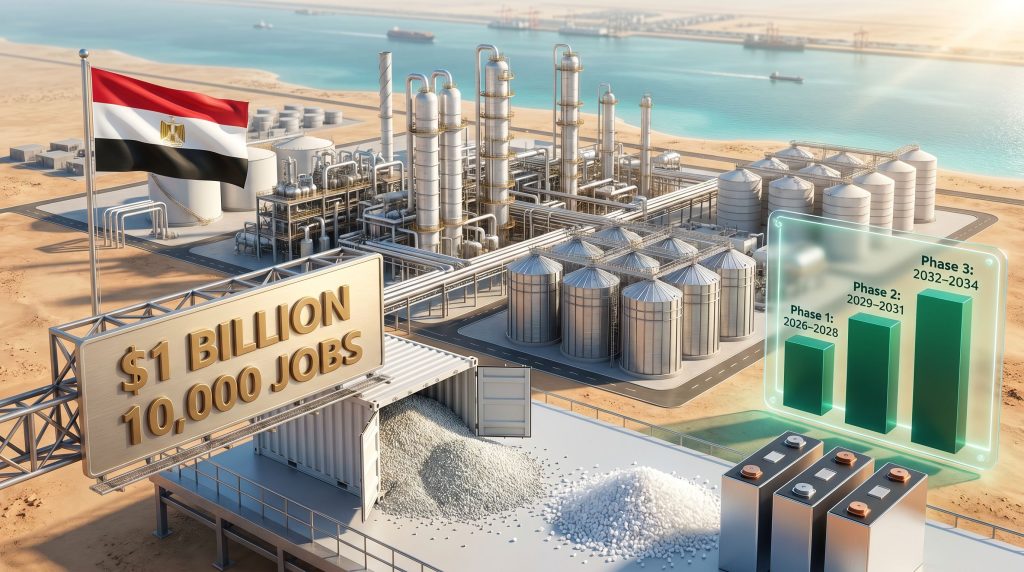
| Total Capital Commitment | $1 billion |
| Location | Ain Sokhna Industrial Zone, Red Sea Governorate, Egypt |
| Development Structure | Three sequential phases (2026–2034) |
| Consortium Partners | Elsewedy Electric Group, Wadico (Al Wadi Al Gadid Co.), MRMIA |
| Phase 1 Construction Start | Q2 2026 |
| First Commercial Operations | 2028 (projected) |
| Employment Target | 10,000 jobs across all phases |
| Regional Positioning | Largest phosphate chemical industrial park in the Middle East |
The complex is structured as a tripartite public-private partnership combining state mining authority oversight through the Mineral Resources and Mining Industries Authority (MRMIA), domestic private capital through Elsewedy Electric Group, and state-affiliated commercial participation through Wadico. This architecture is deliberately constructed to balance sovereign resource control with private sector operational efficiency — a governance model gaining traction across resource-rich emerging economies seeking to extract more domestic value from their mineral endowments.
What distinguishes the Ain Sokhna phosphate industries complex from Egypt's prior mining ventures is its ambition across the full value chain. Earlier Egyptian phosphate projects focused predominantly on extraction and raw material export, capturing limited domestic value. This complex is the first in Egypt's mining history to integrate fertilizer manufacturing, specialty chemical production, and next-generation battery material processing within a single industrial park.
The inclusion of a dedicated research and development centre within Phase 1 signals an intent to develop not just industrial capacity, but embedded technological knowledge — transitioning Egypt from a resource exporter to a knowledge-integrated industrial producer. For additional context, the Ammaroo phosphate project in Australia offers a useful comparison of how large-scale phosphate resource development is being structured globally.
The Three-Phase Development Roadmap
Phase Progression Summary
| Phase | Timeline | Core Products | Strategic Objective |
|---|---|---|---|
| Phase 1 | 2026–2028 | Phosphoric acid, DAP, TSP fertilizers | Establish commercial-scale fertilizer production and export revenue |
| Phase 2 | 2029–2031 | Purified phosphoric acid, potassium dihydrogen phosphate | Capture premium specialty chemical markets |
| Phase 3 | 2032–2034 | Lithium iron phosphate (LFP), lithium dihydrogen phosphate | Enter the global EV battery materials supply chain |
Phase 1: Building the Industrial Foundation (2026–2028)
Phase 1 establishes the commercial and technical bedrock upon which the entire complex depends. Three primary outputs will anchor early production:
-
Diammonium Phosphate (DAP): Targeted at 300,000 tonnes per year, DAP is the world's most widely traded phosphate fertiliser, commanding consistent demand across South Asia and Sub-Saharan Africa. India alone accounts for a substantial portion of global DAP imports, making it a natural primary export target.
-
Triple Superphosphate (TSP): Also at 300,000 tonnes per year, TSP serves soil correction programmes in phosphorus-deficient agricultural regions and complements DAP in diversified fertiliser export portfolios.
-
Phosphoric Acid: At 300,000 tonnes per year, this intermediate chemical is the critical link between raw phosphate rock and both fertiliser and downstream specialty chemical production. Its production in Phase 1 essentially pre-positions the entire downstream Phase 2 and Phase 3 manufacturing chain.
The integrated Misr Phosphate Fertiliser Plant embedded within Phase 1 carries its own substantial production specifications:
| Product | Annual Capacity | Primary Application |
|---|---|---|
| Diammonium Phosphate (DAP) | 600,000 tonnes | Nitrogen-phosphorus crop nutrition |
| Phosphoric Acid Solution | 320,000 tonnes | Chemical processing feedstock |
| Sulphuric Acid | 1,023,000 tonnes | Industrial process catalyst |
| Phosphate Rock Input Required | 1,250,000 tonnes | Sourced from Red Sea mining operations |
The sulphuric acid production figure deserves particular attention. Sulphuric acid is the primary reagent in wet-process phosphoric acid production — the dominant industrial method for converting phosphate rock into usable phosphoric acid. Producing over one million tonnes per year of sulphuric acid on-site eliminates a significant external reagent dependency and provides a meaningful cost and logistics advantage over phosphate processors who must source this input externally.
Phase 2: The Specialty Chemicals Pivot (2029–2031)
Phase 2 represents a deliberate margin-expansion strategy. Purified phosphoric acid commands substantially higher market prices than fertiliser-grade equivalents, with applications spanning electronics manufacturing, food processing, and pharmaceutical production. Potassium dihydrogen phosphate (MKP) targets the premium water-soluble fertiliser segment used in precision agriculture and hydroponic systems — both markets growing at above-average rates globally as controlled-environment agriculture scales.
The transition from Phase 1 commodity production to Phase 2 specialty chemicals is a classic industrial upgrading sequence. Early cash flows from DAP and TSP exports fund the more capital-intensive purification infrastructure required for higher-grade outputs, while simultaneously establishing customer relationships with fertiliser importers who may later become buyers of specialty chemical products. Similarly, a phosphate project in Estonia has demonstrated how integrated downstream processing strategies can meaningfully enhance returns beyond raw material extraction alone.
Phase 3: Entering the Battery Materials Race (2032–2034)
Phase 3 represents one of the most strategically ambitious industrial pivots in North African manufacturing history. If executed on schedule, Egypt could emerge as a meaningful non-Chinese supplier of lithium iron phosphate battery materials to European and African manufacturers before the end of the decade.
Lithium iron phosphate (LFP) is the dominant cathode chemistry in entry-level and commercial electric vehicles, as well as grid-scale stationary energy storage systems. The rapid growth of battery storage expansion globally has intensified competition for LFP cathode materials, particularly as manufacturers seek to reduce dependence on Chinese production.
Egypt does not hold significant lithium reserves, meaning Phase 3 will require imported lithium feedstock combined with domestically produced phosphate intermediates. However, innovations in direct lithium extraction technology are reshaping global lithium supply chains in ways that could ultimately benefit Egypt's feedstock procurement strategy. The strategic logic remains compelling: Egypt's phosphate abundance provides a structural cost advantage within the LFP cathode supply chain, with the Suez Canal corridor enabling efficient lithium imports from Australian and South American producers while finished LFP outputs reach European customers through the same logistics infrastructure.
Mining Reform as an Enabler: The MRMIA Transformation
Understanding why this project is possible now, rather than five or ten years ago, requires examining the institutional changes within Egypt's mining governance architecture.
The Egyptian Mineral Resources Authority (EMRA) was restructured into the Mineral Resources and Mining Industries Authority (MRMIA) — a fundamental shift from a regulatory and licensing body to a commercially empowered economic authority capable of functioning as a direct project co-investor. This transformation enables MRMIA to take an equity stake in ventures like the Ain Sokhna complex rather than merely overseeing them from a distance.
Concurrent amendments to the executive regulations of Egypt's Mineral Resources Law have created a more transparent and competitive investment framework, reducing the bureaucratic friction that historically deterred large-scale private capital from Egyptian mining partnerships. These reforms represent the first concrete institutional outputs of Egypt's broader mining sector modernisation programme.
Egypt's Minister of Petroleum and Mineral Resources, Karim Badawi, has described the complex as a key step in the country's strategy to maximise the economic value of its mineral resources by transitioning from raw material exports to integrated industrial production that generates greater domestic value. The minister has also characterised the project as an advanced model of public-private partnership in integrated mining industries — one explicitly designed to attract additional local and foreign investment and increase the mining sector's contribution to national GDP.
Egypt's Net International Reserves reaching $55 billion by end-June 2026 provides important macroeconomic context. A strengthening reserve position reduces currency risk for foreign investors evaluating Egyptian industrial exposure and signals the broader monetary stability that long-duration capital commitments require.
Consortium Partners: Who Is Delivering This Project?
Elsewedy Electric Group
Elsewedy Electric is one of Egypt's largest and most diversified industrial conglomerates, with operations spanning power cables, energy transformers, industrial infrastructure, and integrated energy solutions. The group brings domestic engineering, procurement, and construction capabilities that meaningfully reduce reliance on foreign contractors for complex industrial facilities — itself a cost and logistics advantage. CEO Ahmed El Sewedy's direct participation in finalising implementation plans with the Minister of Petroleum and Mineral Resources signals executive-level ownership of delivery timelines.
Wadico (Al Wadi Al Gadid Company)
Wadico is a state-affiliated commercial entity with historical involvement in Egypt's Western Desert development programmes. Within the Ain Sokhna consortium, it functions as the institutional bridge between sovereign resource rights and commercial project execution, providing land access, resource connectivity, and integration within Egypt's state-owned enterprise ecosystem.
MRMIA (Mineral Resources and Mining Industries Authority)
MRMIA provides the sovereign resource allocation rights, regulatory certainty, and institutional co-investment that de-risks the project for private partners. Critically, MRMIA also oversees the upstream phosphate rock supply chain from Red Sea mining operations — creating vertical integration between the authority's resource management mandate and the complex's raw material requirements.
The next major ASX story will hit our subscribers first
Target Export Markets and Commercial Positioning
| Region | Primary Products | Strategic Rationale |
|---|---|---|
| South Asia | DAP, TSP fertilizers | India is the world's largest DAP importer; strong structural demand |
| Sub-Saharan Africa | DAP, TSP, phosphoric acid | Geographic proximity advantage; growing fertiliser demand tied to food security programmes |
| Middle East | Specialty phosphates, fertilisers | Regional food security investment driving sustained fertiliser demand |
| South America | DAP, phosphoric acid | Brazil's large-scale agriculture creates deep and consistent import demand |
| Europe (Phase 3) | LFP battery materials | EV supply chain diversification away from Chinese production dominance |
Africa's fertiliser consumption per cultivated hectare remains among the lowest of any region globally, representing a structural demand growth opportunity of considerable scale. Ain Sokhna's port infrastructure positions Egypt to serve not only as a direct fertiliser producer but potentially as a regional re-export and blending hub for African and Middle Eastern markets — generating additional revenue streams beyond direct manufacturing output.
Competitive Benchmarking: Where Egypt Stands
| Country/Region | Key Hubs | Competitive Advantage | Limitation vs. Ain Sokhna |
|---|---|---|---|
| Morocco (OCP Group) | Jorf Lasfar, Safi | World's largest phosphate reserves; global export network | Higher cost base; more distant from Asian markets |
| China | Yunnan, Guizhou | Domestic demand scale; integrated supply chains | Export restrictions; rising production costs |
| Saudi Arabia | Ras Al-Khair | Petrochemical synergies; capital depth | Limited domestic rock; import-dependent feedstock |
| Egypt (Ain Sokhna) | Ain Sokhna Industrial Zone | Domestic rock supply; Suez logistics; PPP cost structure | Newer industrial base; still under construction |
Egypt is not pursuing a replication of Morocco's OCP strategy of global phosphate market volume dominance. The Ain Sokhna approach is differentiated: integrating domestic upstream rock with downstream specialty chemical and battery material production to capture higher-margin segments that commodity exporters cannot access.
Risk Factors Investors Should Understand
No industrial project at this scale is without material execution and market risks. Several deserve specific attention:
-
Construction execution risk: Phase 1 construction commencing in Q2 2026 requires sustained multi-party coordination. Egypt's infrastructure delivery track record includes historical gaps between announced and actual commissioning timelines that investors should weigh carefully.
-
Raw material supply continuity: The complex requires 1.25 million tonnes annually of phosphate rock from Red Sea mining operations. Any geological variability, output disruption, or Red Sea port logistics constraint could materially delay production ramp-up.
-
Fertiliser price cyclicality: DAP and TSP prices are subject to significant volatility driven by agricultural commodity cycles, natural gas price movements affecting ammonia input costs, and geopolitical supply disruptions. The price environment at Phase 1's 2028 production launch will substantially shape early commercial viability.
-
Phase 3 lithium feedstock dependency: Egypt's LFP ambitions require reliable, competitively priced lithium imports. Securing long-term supply agreements with Australian or South American lithium producers will be a critical pre-condition for Phase 3 to proceed on schedule and at projected economics.
-
Specialty chemical market development: Phase 2 products like purified phosphoric acid and MKP require different customer relationships and quality certifications than commodity fertilisers. Building these market connections in parallel with Phase 1 operations will determine whether Phase 2 can launch on schedule.
This article is intended for informational purposes only and does not constitute financial or investment advice. Projected timelines, production capacities, and market outcomes are forward-looking in nature and subject to material risks and uncertainties. Readers should conduct independent due diligence before making any investment decisions.
Want to Track the Next Major Mineral Discovery Before the Market Moves?
Discovery Alert's proprietary Discovery IQ model delivers real-time alerts on significant ASX mineral discoveries — turning complex mineral data into actionable insights for traders and investors alike. Explore historic discoveries and their remarkable returns or visit the Discovery Alert home page to begin your 14-day free trial and position yourself ahead of the market.