July 9, 2026
When a Chokepoint Becomes a Crisis: The Market Mechanics Behind Middle East Oil Volatility
Every few years, a single geographic feature reasserts its dominance over the global economy with unsettling speed. The Strait of Hormuz, a narrow maritime corridor separating Iran from Oman at its widest point of roughly 39 kilometres, has repeatedly demonstrated that geography can override monetary policy, diplomatic frameworks, and even the most sophisticated risk models energy traders can build. When conflict returns to its shores, the world's oil markets respond not with measured analysis, but with immediate repricing.
The latest escalation in the U.S.-Iran conflict brought that reality back into sharp relief. Oil rises after US launches fresh strikes on Iran had become a familiar headline pattern, but the underlying crude market dynamics at work deserve far more analytical scrutiny than a single-session price move would suggest.
When big ASX news breaks, our subscribers know first
The Strait of Hormuz: Architecture of a Structural Vulnerability
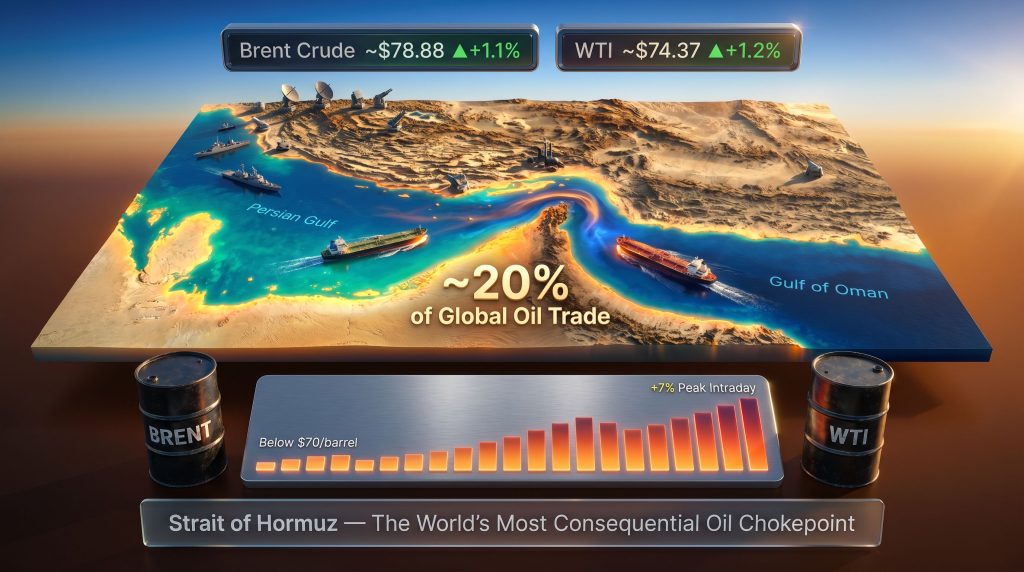
Understanding why crude benchmarks move so sharply on Middle East military news requires examining what the Strait of Hormuz actually represents in the architecture of global energy supply. This is not simply a trade route. It is the single point through which approximately one-fifth of all globally traded oil and liquefied natural gas must pass under normal operating conditions.
The numbers frame the vulnerability precisely:
- Roughly 20% of global oil trade transits the strait during peacetime conditions
- Both crude oil tankers and LNG carriers depend on unobstructed access to this corridor
- No commercially scalable alternative routing exists for Persian Gulf producers to redirect equivalent volumes at comparable speed or cost
- Any credible threat to passage triggers immediate repricing across Brent crude, WTI, and regional benchmark contracts
What makes this chokepoint uniquely dangerous from a market-structure perspective is the absence of a meaningful substitute. The East-West crude pipeline across Saudi Arabia, the Petroline, carries a fraction of what the strait handles, and other overland alternatives face capacity ceilings that make full diversion operationally impossible in the short term. This irreplaceability is precisely what gives Iran structural leverage over global energy pricing that no other single actor can replicate.
Furthermore, the geopolitical and logistical factors surrounding this corridor continue to amplify market sensitivity well beyond what physical supply data alone would justify.
The Strait of Hormuz is not merely a geographic feature. It functions as a systemic vulnerability embedded into the architecture of global energy supply chains, and any military activity that threatens its operability acts as a direct price catalyst across crude markets worldwide.
How the Geopolitical Risk Premium Is Built Into Crude Prices
Three Transmission Channels From Conflict to Price
Commodity markets do not wait for physical supply disruptions before repricing. The mechanism through which military conflict translates into higher oil prices operates through three distinct but interconnected channels:
-
Physical supply threat — Strikes targeting coastal surveillance systems, air defence infrastructure, naval assets, and missile storage facilities along Iran's coastline directly compromise the operational security of shipping lanes. According to Reuters, U.S. Central Command confirmed that approximately 90 Iranian military targets were struck, encompassing this full range of coastal defence capabilities.
-
Shipping confidence deterioration — Even without confirmed vessel losses, shipowners recalibrate risk assessments rapidly. Marine war risk insurance premiums surge, voyage routing shifts toward longer alternative paths, and cargo throughput declines even before any physical barrier is established. Analysis from IG market analysts noted that the cautious stance adopted by shipowners following renewed hostilities effectively ended the accelerated oil flow that had characterised the preceding weeks of relative calm.
-
Futures market repricing — Traders do not price current supply; they price expected future supply probability distributions. Escalation scenarios drive speculative demand for crude futures contracts well ahead of any confirmed shortage, creating price pressure that self-reinforces through algorithmic and momentum-driven trading systems.
Benchmark Movements: The Numbers in Context
| Crude Benchmark | Price Level | Movement | Market Context |
|---|---|---|---|
| Brent Crude | ~$78.88/barrel | +1.1% intraday | Multi-week high post-escalation |
| WTI Crude | ~$74.37/barrel | +1.2% intraday | Parallel repricing confirming broad market shift |
| Peak Post-Settlement Surge | Up to +7% | Immediate reaction | Confirmation of fresh U.S. military strikes |
| Pre-Escalation Range | Below $70/barrel | Declining trend | Prior to renewed hostilities |
The simultaneous movement of both Brent and WTI confirms that this was not a regional anomaly but a broad-based market repricing event. The more than one dollar rise in post-settlement trading on both benchmarks following confirmation of fresh U.S. strikes illustrates how quickly geopolitical information flows into futures markets. These oil price movements are consistent with patterns observed during earlier phases of U.S.-Iran tensions, where oil price movements tracked escalation signals with remarkable precision.
A Conflict Chronology: From Ceasefire Optimism to Renewed Volatility
The current price environment cannot be understood in isolation from the sequence of events that preceded it. Each phase of the conflict left distinct footprints in crude pricing psychology.
Phase 1 — Conflict Initiation (February 28): U.S. and Israeli airstrikes against Iran marked the opening of active hostilities. Tehran responded by asserting operational control over the Strait of Hormuz, deploying it explicitly as economic leverage rather than simply a defensive position.
Phase 2 — Interim Agreement and Market Relief: A fragile ceasefire arrangement reduced the immediate war risk premium. Crude benchmarks retreated toward pre-conflict levels, shipping resumed at higher throughput rates, and market participants began pricing in the possibility of full Hormuz reopening. This was the period during which the strategic petroleum reserve deployments from earlier in the conflict provided temporary buffer capacity.
Phase 3 — Ceasefire Collapse and Escalation: The interim framework was declared finished. Fresh U.S. strikes targeted approximately 90 Iranian military installations. Iran conducted retaliatory operations against U.S. military sites in Bahrain and Kuwait. ING analysts communicated to clients that this latest escalation fundamentally undermined confidence in the ceasefire structure, confirming that market expectations of a near-term diplomatic solution were no longer supportable.
Why Ceasefire Announcements Provide Only Temporary Price Relief
One of the less widely appreciated dynamics in geopolitical oil pricing is the asymmetric durability of fear versus hope signals. When conflict escalates, markets reprice almost instantaneously. When ceasefires are announced, markets reprice partially — and with good reason.
DBS Bank's head of energy research observed that despite the interim diplomatic framework between Washington and Tehran, material geopolitical risks remained embedded in the market structure. The analytical reasoning was particularly important: Iran possesses structural incentives to prolong diplomatic discussions rather than reach rapid resolution.
Extended uncertainty maintains Tehran's leverage over global energy markets in a way that a concluded peace agreement would eliminate entirely. This creates a rational strategic calculus for Iran to extend negotiations, which in turn sustains the war risk premium in crude prices even during apparent diplomatic progress. The interplay between trade and geopolitics in this context is a critical lens for understanding why price normalisation timelines consistently disappoint optimistic forecasts.
This insight carries significant implications for traders and analysts attempting to model price normalisation timelines. The war risk premium is not simply a fear discount that evaporates when shooting stops. It is a structurally embedded feature of the price landscape that persists until diplomatic resolution is not merely announced, but demonstrated through sustained unobstructed maritime passage over an extended period.
Analysts broadly project that the conflict-related premium in crude prices may remain elevated for several months even if a formal ceasefire is reached, with Iran's strategic incentive structure and shipping industry behavioural recalibration combining to sustain volatility within what may nonetheless be a broadly declining medium-term price trend.
Sanctions as a Compounding Supply Shock
The July 17 Sanctions Enforcement Threshold
The military dimension of this conflict is only one half of the supply reduction equation. The revocation of the 60-day Iranian oil transaction waiver, with full prohibition effective from July 17, introduces a parallel mechanism that compounds the physical disruption rather than operating independently of it.
The sanctions impact on oil markets, however, extends well beyond the Iranian context. Precedents established through Russian sanctions enforcement have fundamentally altered how market participants model the probability and speed of future sanctions regimes.
The practical effect of simultaneous physical disruption and sanctions enforcement is to remove Iranian crude volumes from accessible global supply through two separate channels at the same time. Iranian production, while operating below pre-sanctions historical peaks, nonetheless represents a meaningful contribution to regional supply that cannot simply be replaced from spare capacity held elsewhere. When sanctions divert Iranian crude toward non-Western buyers at steep discounts, the effective supply available to price-setting international markets shrinks, even if the molecules themselves continue moving.
This compounding structure is one of the key reasons why energy market analysts view the current price environment as more durable than a single-factor disruption would typically produce.
The next major ASX story will hit our subscribers first
Asymmetric Risk: Why Hormuz Closure Scenarios Are Different
Unlike demand-side contractions that unfold gradually and allow for policy adjustment, a physical blockage of the Strait of Hormuz produces a supply cliff with no equivalent shock-absorption mechanism:
- No scalable alternative routing exists for Gulf producers at the volumes required to maintain global supply balance
- Strategic petroleum reserve depletion from earlier phases of the conflict reduces the buffer available for subsequent disruption events
- Marine insurance recalibration creates persistent throughput reduction even after active military operations cease, as underwriters require extended periods of demonstrated security before normalising premiums
- Compounding sanctions enforcement removes Iranian supply through a policy channel that operates independently of physical access
Disruption Scenarios and Estimated Price Impacts
| Disruption Scenario | Duration | Estimated Price Impact | Historical Reference Point |
|---|---|---|---|
| Brief military incident | Days | +3% to +7% | Gulf of Oman tanker incidents (2019) |
| Partial operational disruption | Weeks | +10% to +20% | Iran-Iraq War tanker attacks (1980s) |
| Extended strait closure | Months | +30% to +50%+ | No full modern precedent |
| Post-conflict normalisation | 6 to 12 months | Gradual decline | Post-Gulf War recovery (1991) |
Disclaimer: Price impact estimates are based on historical precedents and analyst modelling. Actual outcomes depend on the duration, intensity, and diplomatic resolution of the conflict, and should not be treated as financial forecasts or investment advice.
Macro-Economic Transmission: From Energy Markets to the Broader Economy
A supply-shock-driven oil price surge carries different macro-economic characteristics than demand-driven price cycles. Central banks face a particularly difficult policy environment because supply-shock inflation is structurally resistant to interest rate tools. Raising rates to suppress inflation caused by an energy supply interruption risks suppressing demand and economic activity without addressing the underlying supply constraint.
The differential impact across economy types illustrates why this conflict has genuinely global consequences:
| Economy Category | Primary Impact | Key Vulnerability |
|---|---|---|
| Major oil importers (Asia, Europe) | Inflation and trade deficit pressure | High energy import dependency |
| GCC oil exporters | Revenue windfall offset by regional instability | Proximity to conflict zone |
| U.S. economy | Mixed — producers benefit, consumers face higher prices | Net exporter but price-sensitive consumer base |
| Emerging market importers | Severe — currency depreciation plus inflation | Limited fiscal buffer capacity |
The inflationary transmission pathway from energy markets to consumer prices operates across transport and logistics costs, manufacturing inputs, and household energy expenditure simultaneously. These are not sequential effects. They compound within weeks of a sustained price rise, creating inflationary pressure that feeds through to core inflation measures even when central bank mandates are narrowly focused on demand-side variables.
An often-overlooked secondary effect is the U.S. dollar strengthening dynamic that accompanies Gulf oil price surges. As a safe-haven asset and the currency in which oil is globally priced, the dollar typically appreciates during periods of Middle East energy disruption. Al Jazeera's reporting on the most recent price surge highlighted this dynamic clearly, noting how emerging market oil importers face additional currency depreciation pressure as they must purchase dollar-denominated crude with weakening local currencies.
What Market Participants Need to Understand Going Forward
Several structural lessons emerge from the current conflict cycle that are applicable beyond this specific episode:
- The concentration of approximately 20% of global oil trade through a single maritime chokepoint is a systemic risk that cannot be fully hedged through financial instruments or policy buffers
- Markets correctly apply discounts to ceasefire announcements in active conflict zones, because diplomatic frameworks involving strategic leverage do not resolve instantaneously
- The combination of physical disruption and sanctions enforcement generates compounding supply shocks more severe than either mechanism acting alone
- Shipping industry behavioural shifts sustain supply disruption effects for periods significantly exceeding the duration of active military operations
- The war risk premium embedded in crude prices is better understood as a probability-weighted structural feature than as a temporary volatility spike, and its normalisation will follow demonstrated operational reality rather than diplomatic announcements
For investors monitoring crude exposure, energy equities, or inflation-sensitive asset classes, the key analytical variable is not whether a ceasefire is reached, but whether unobstructed maritime passage through the Strait of Hormuz is sustained long enough to rebuild shipowner and insurer confidence. Until that threshold is crossed, oil rises after US launches fresh strikes on Iran will remain the dominant market narrative, and prices will continue to carry a premium that reflects the credible probability of future disruption.
This article is intended for informational purposes only and does not constitute financial, investment, or trading advice. Energy price forecasts and scenario estimates reflect analyst projections and historical precedents and are subject to significant uncertainty. Readers should conduct independent research and consult qualified financial advisers before making investment decisions.
Want to Position Yourself Ahead of the Next Major Resource Discovery?
While geopolitical volatility continues to reshape energy markets, Discovery Alert's proprietary Discovery IQ model scans ASX announcements in real time, delivering instant alerts on significant mineral discoveries across more than 30 commodities — explore historic discovery returns to understand the potential, then begin your 14-day free trial at Discovery Alert to gain an immediate market-leading edge.