
August 4, 2026
When the Ground Moves, So Does the Bottom Line
Deep underground gold mining operates at the intersection of geology, engineering, and probability. Unlike surface operations where weather or equipment failures dominate the risk register, hard-rock underground mines contend with an entirely different class of hazard: the rock itself. As ore bodies are extracted from deep within the earth's crust, the surrounding rock mass undergoes continuous stress redistribution. At sufficient depths, that stress can release suddenly and without warning, producing seismic events that range from barely detectable microseismic tremors to damaging rockbursts capable of collapsing mine headings and blocking ore access for months.
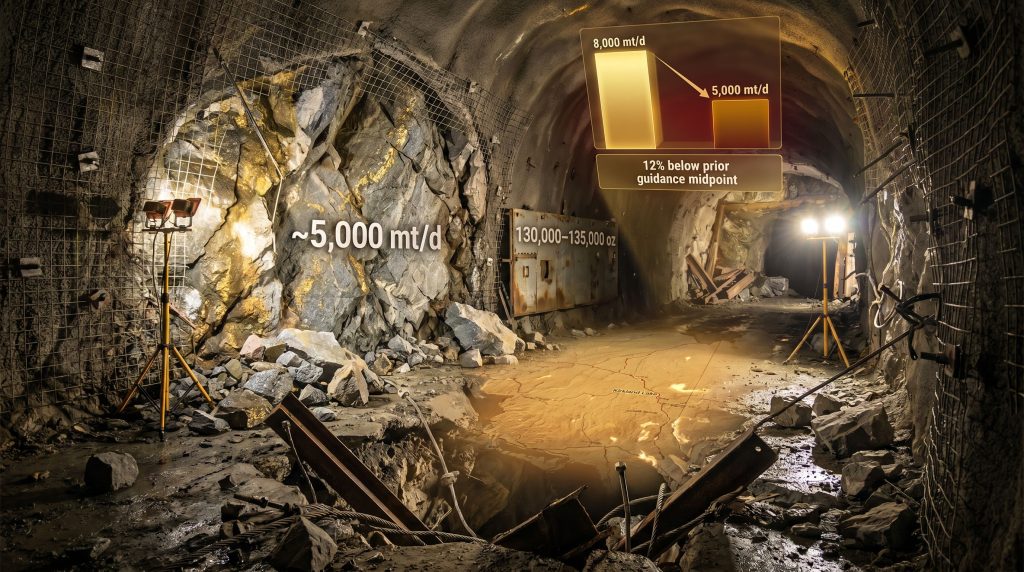
This is the operational reality that Alamos Gold Young-Davidson seismic events brought sharply into focus in mid-June 2026, when two seismic events struck within the same week, one of them directly at an active mining front. The consequences have cascaded well beyond a single quarter, reshaping the company's full-year production outlook and placing renewed scrutiny on the inherent geomechanical risks embedded in deep bulk-tonnage underground gold mining.
When big ASX news breaks, our subscribers know first
What Actually Happened Underground at Young-Davidson
Two Events, One Critical Location
In underground hard-rock mining, a seismic event refers to a sudden release of energy stored within the rock mass surrounding excavations. These events can be triggered by the mining process itself, a phenomenon known as mining-induced seismicity, which encompasses rockbursts and fault-slip events caused by stress changes as ore is removed.
What made the June 2026 events at Young-Davidson particularly damaging from an operational standpoint was not their magnitude alone but their location. One of the two events occurred directly at an active mining front, which in underground stoping operations represents the most sensitive possible location. Active mining fronts are precisely where ore extraction is occurring, where ground support systems are freshest and most exposed, and where workforce and equipment are concentrated.
Zero injuries were reported from either event, a meaningful safety outcome given the circumstances. However, underground infrastructure sustained confirmed damage that restricted access to two higher-grade stopes that had been scheduled for extraction during the second quarter of 2026.
Key Insight: Seismic events in underground gold mines do not need to be catastrophic in magnitude to cause major operational disruptions. Even moderate events near active headings can block access to entire ore zones for extended periods, triggering grade dilution, throughput reductions, and costly rehabilitation timelines.
Why Location in the Mine Matters More Than Magnitude
The proximity of a seismic event to active stopes carries disproportionate operational consequences compared to events in previously mined or unworked zones. Stopes in deep underground gold mines are carefully sequenced extraction chambers. When access to a stope is blocked, the downstream effects compound rapidly:
- Planned ore tonnes become unavailable, forcing miners to draw from lower-priority or lower-grade areas
- The average grade of ore processed drops as higher-grade material becomes inaccessible
- Rehabilitation of damaged access drives and ore passes is time-intensive and must be completed before normal extraction can resume
- The overall mining sequence must be reconfigured around the blocked areas, sometimes introducing additional geomechanical risks in adjacent zones
At Young-Davidson, the two inaccessible stopes had been identified as higher-grade ore sources specifically scheduled for Q2 extraction. Losing access to those zones did not simply reduce tonnes mined; it altered the grade profile of what could be mined, compressing output value simultaneously on two dimensions.
Young-Davidson's Role in the Alamos Gold Portfolio
A Long-Life Bulk-Tonnage Asset in a Critical Region
Young-Davidson is located near Kirkland Lake in northern Ontario, one of Canada's most historically productive gold mining districts. The operation is a deep underground hard-rock gold mine that has established itself as a high-throughput, long-life asset within Alamos Gold's production base. It functions as a mature bulk-tonnage producer, meaning its economics depend heavily on maintaining consistent, high-volume ore flow through a continuous mining and processing cycle.
Unlike narrower, higher-grade underground mines — where narrow reef mining technology can enable greater selectivity to compensate for lower volumes — bulk-tonnage operations at Young-Davidson require sustained mining rates to generate acceptable unit economics. This structural dependency on throughput is precisely what makes seismic disruptions so damaging: any meaningful reduction in the daily mining rate flows directly and immediately into quarterly ounce production.
Pre-Disruption Performance and the Q2 Setup
The operational context going into Q2 2026 was one of measured optimism. During Q1 2026, Young-Davidson averaged 7,205 metric tonnes per day, a rate achieved after completing rehabilitation work on one of three existing ore passes. The planned commissioning of a fourth ore pass was expected to lift throughput to approximately 8,000 mt/d across Q2, representing a meaningful capacity step-up.
| Metric | Q1 2026 Actual | Pre-Disruption Q2 Target | Post-Seismic Revised Rate |
|---|---|---|---|
| Mining Rate (mt/d) | 7,205 | ~8,000 | ~5,000 |
| Ore Passes Operational | 3 of 4 | 4 of 4 | Under review |
| Q2 Production Guidance | Prior guidance | Prior guidance | 130,000–135,000 oz |
The mine was, therefore, already operating slightly below its design-capacity ceiling when the seismic events occurred. The fourth ore pass had not yet been fully commissioned, meaning the Q2 throughput target had not been achieved before the June disruptions compounded the constraint.
The Mechanics of Underground Seismic Disruption
How Ground Movement Damages Mine Infrastructure
Seismic energy released underground travels through the rock mass and interacts violently with excavated voids, development drives, ore passes, and support systems. In stoping operations, the damage typically manifests as:
- Collapse or partial collapse of access drives leading to active stopes
- Displacement or blockage of ore passes, which are vertical or inclined openings used to transfer broken rock from underground levels to surface processing circuits
- Failure or dislodgement of rock support elements including bolts, mesh, and shotcrete linings
- Ejection of loose material from stope walls and backs (roofs), creating safety hazards that require detailed geotechnical assessment before re-entry
Rehabilitation of seismically damaged workings is not a rapid process. Each affected heading must be assessed by geotechnical engineers, additional ground support installed, and damaged infrastructure repaired or reconstructed before ore flow can resume. In some cases, entire stope access sequences must be redesigned.
Mining Sequence as a Seismicity Management Tool
One of the less widely understood aspects of deep underground mining is that seismicity management begins not with monitoring equipment but with the mine plan itself. The extraction sequence — meaning the order in which stopes are mined across a deposit — is one of the most powerful geomechanical control tools available to operators.
Techniques routinely employed in high-stress underground environments include:
- Destress mining: Intentionally mining smaller, sacrificial openings ahead of primary extraction to relieve stress concentrations before they can accumulate to dangerous levels
- Sequenced retreat mining: Extracting stopes in a planned retreat pattern to control the geometry of the remaining rock mass and reduce the likelihood of large-scale stress release
- Pillar management: Designing and preserving remnant rock pillars that absorb and redistribute stress away from active mining areas
Alamos Gold has confirmed that a formal review and optimisation of Young-Davidson's mining sequence is underway in response to the June events. This is not an admission of a design flaw; in deep underground mining, seismicity can occur even within well-designed extraction sequences because geomechanical models carry inherent uncertainty at depth. What matters is how rapidly and effectively operators can adapt.
Technical Note: In deep underground mines, seismicity management is not reactive by design. It is embedded in the mine plan from the outset. When events occur despite planned sequencing, operators must reassess geomechanical models, ground condition data, and extraction geometry before resuming full production rates.
Compounding Factors: What Else Went Wrong in 2026
Storm Damage and the Remote Infrastructure Problem
The seismic events did not occur in operational isolation. In late May 2026, regional storm activity damaged a power line servicing the corridor between Kirkland Lake and the Young-Davidson mine. The geographic remoteness of this infrastructure, combined with the length of the power line route, extended the utility company's response timeline significantly.
The result was approximately three days of unplanned production downtime, a figure that may appear modest in isolation but compounded meaningfully against a quarter already under strain from the ore pass commissioning delay and pre-existing throughput constraints.
Remote northern Ontario mining operations carry a structurally higher exposure to external utility disruptions than operations located near established industrial infrastructure. The Young-Davidson experience illustrates how a single weather event can add a layer of production loss that, stacked on top of geological challenges, becomes difficult to offset within a quarterly reporting window.
The Ore Pass Commissioning Delay: A Pre-Existing Constraint
Young-Davidson relies on a vertical ore pass system to move broken rock from underground mining levels to surface processing facilities. During Q1 2026, only three of four ore passes were fully operational, which capped the maximum achievable mining rate below the 8,000 mt/d target. The fourth ore pass was in the process of being commissioned, a prerequisite for unlocking the full throughput potential of the operation.
This pre-existing constraint meant the mine entered Q2 already short of its throughput ceiling. The June seismic events then struck before the fourth ore pass came fully online, meaning Young-Davidson experienced its most significant geological disruption while simultaneously operating with constrained ore handling infrastructure.
Quantifying the Damage: Guidance Revisions and What They Signal
Q2 2026 Production Guidance Revised Sharply Lower
Alamos Gold revised its Q2 2026 gold production guidance to a range of 130,000 to 135,000 ounces, representing approximately a 12% reduction from the prior guidance midpoint. The primary driver of this shortfall is Young-Davidson's reduced throughput and restricted stope access. Secondary contributors include the storm-related downtime.
Costs for Q2 are also expected to run above prior guidance levels, a direct consequence of lower production leverage. In gold mining, cost-per-ounce metrics are highly sensitive to production volumes because a significant portion of operating costs are fixed or semi-fixed. When ounces produced fall, the fixed cost base spreads across fewer units, mechanically inflating reported all-in sustaining costs. Furthermore, investors tracking gold mining equities will recognise how swiftly production-cost compression can reprice a stock even when the underlying gold price remains favourable.
Full-Year 2026 Outlook: Below the Low End of Guidance
The more significant signal for investors is Alamos Gold's full-year outlook. According to Alamos Gold's operational update, 2026 consolidated gold production is expected to fall below the low end of its full-year guidance range, with costs expected to exceed previously guided levels. A formal revised full-year guidance update is scheduled for release alongside Q2 2026 financial results in late July 2026.
Investor Alert: When a gold producer signals that full-year output will fall below the low end of guidance rather than merely the midpoint, this typically indicates a more substantial operational deterioration than standard quarterly variance. The distinction matters because it implies even conservative planning assumptions have been exceeded on the downside. Investors should monitor the late July update closely for revised all-in sustaining cost figures and any changes to capital allocation priorities.
The next major ASX story will hit our subscribers first
The Recovery Path and What It Requires
Young-Davidson's Revised Rate and the Road to Normalisation
Alamos Gold expects Young-Davidson's average mining rate to settle at approximately 5,000 mt/d for the remainder of 2026. This represents a reduction of roughly 30% below the pre-disruption Q2 target of 8,000 mt/d and is meaningfully below even the Q1 2026 actual rate of 7,205 mt/d.
Returning to higher rates depends on the outcome of the ongoing mining sequence review. Operators must balance the desire to increase throughput against the risk of inducing further seismic events in a rock mass that has already demonstrated elevated stress conditions. There is no guaranteed timeline for when the sequence optimisation will enable a safe return to higher rates.
Island Gold District as the Primary Offset
Alamos Gold's management has identified the Island Gold District as the central operational counterweight to Young-Davidson's underperformance in the second half of 2026. The Island Gold ramp-up is described as progressing in line with internal expectations, providing a degree of portfolio resilience that partially mitigates the Young-Davidson shortfall.
Two major capital projects underway at Island Gold underpin the longer-term growth narrative:
- Shaft development: A critical infrastructure investment enabling access to deeper, higher-grade ore zones and supporting higher-volume extraction in future periods
- Mill expansion: Designed to increase processing capacity and support a sustained production growth profile over multiple years
Both projects are positioned as multi-year growth catalysts for Alamos Gold's consolidated output. However, they are infrastructure investments with construction timelines, meaning their contribution to addressing the 2026 production shortfall is limited.
What a Stronger Second Half Actually Requires
A meaningful H2 2026 production recovery at Alamos Gold is contingent on several conditions occurring simultaneously:
- Successful seismic sequence optimisation at Young-Davidson that allows a safe and sustained increase in mining rates above 5,000 mt/d
- Continued ramp-up momentum at Island Gold without further delays or operational disruptions
- Stable power infrastructure and improved utility response capabilities for the remote northern Ontario corridor
None of these conditions is guaranteed, and the compounding nature of the challenges already experienced in 2026 suggests investors should approach H2 recovery expectations with measured scepticism rather than assuming a clean operational rebound.
Seismicity as a Structural Risk in Deep Underground Gold Mining
The Geomechanics of Depth
Young-Davidson's challenges are not unique to that specific operation. As underground mines extend to greater depths, in-situ rock stress increases at a rate that varies depending on the local geological regime but is broadly correlated with the weight of the overlying rock column. At the depths at which Young-Davidson operates, stress magnitudes are sufficient to make seismicity a continuous, managed discipline rather than an exceptional event.
The Abitibi Greenstone Belt, which hosts Young-Davidson and numerous other major Canadian gold operations, is a geologically ancient and structurally complex terrane. The presence of deep-seated fault systems, high-strength rock types that store elastic energy efficiently, and decades of historical mining-induced stress changes all contribute to the elevated seismic environment that deep operations in this region must navigate.
| Mine Type | Seismic Risk Level | Common Mitigation Strategies |
|---|---|---|
| Shallow open-pit | Low | Blast vibration monitoring |
| Moderate-depth underground | Medium | Sequential retreat mining |
| Deep hard-rock underground | High | Destress blasting, real-time microseismic monitoring, modified extraction sequences |
Ground Support Systems and Their Limits
Modern deep underground mines deploy layered ground support systems designed to absorb and redistribute the dynamic energy released during seismic events:
- Rock bolts and cable bolts anchor the rock mass to prevent progressive unravelling of loosened material
- Welded wire mesh and straps retain fractured rock between bolting points, preventing ejection during dynamic loading
- Shotcrete linings provide a continuous, load-bearing shell around excavations that helps maintain opening geometry
- Engineered paste fill placed in mined-out stopes stabilises the surrounding rock mass and reduces the volume of open void that can act as a stress concentration point
Even with comprehensive ground support, seismic events of sufficient energy at close range can overcome these systems. The challenge for mine operators is not simply deploying the right support types but correctly anticipating where and when elevated dynamic loading will occur, which requires continuously updated geomechanical models and real-time microseismic monitoring networks. In addition, mining and drilling programs that extend into higher-stress zones must incorporate seismic risk assessments as a standard component of their planning framework.
Frequently Asked Questions: Alamos Gold Young-Davidson Seismic Events
Were there any injuries from the Young-Davidson seismic events?
No injuries were reported from either of the two seismic events that occurred at Young-Davidson in mid-June 2026. Underground infrastructure sustained damage that restricted access to two higher-grade stopes.
How much has Young-Davidson's mining rate been reduced?
Following the Alamos Gold Young-Davidson seismic events, the company expects Young-Davidson's average mining rate to be approximately 5,000 metric tonnes per day for the remainder of 2026, down from a Q1 2026 average of 7,205 mt/d and a pre-disruption Q2 target of approximately 8,000 mt/d.
What is Alamos Gold's revised Q2 2026 production guidance?
Alamos Gold revised its Q2 2026 gold production guidance to between 130,000 and 135,000 ounces, representing approximately a 12% reduction from the prior guidance midpoint.
Will Alamos Gold miss its full-year 2026 production guidance?
Yes. Alamos Gold has indicated that 2026 consolidated gold production is expected to fall below the low end of its full-year guidance range, with costs expected to exceed previously guided levels. A formal revised full-year guidance update is expected alongside Q2 2026 financial results in late July 2026. Consequently, interpreting drill results and updated resource estimates released alongside that guidance revision will be critical for investors reassessing their positions.
What is driving the seismicity at Young-Davidson?
Seismicity at deep underground mines like Young-Davidson is primarily driven by stress redistribution in the rock mass as ore is extracted. Alamos Gold is reviewing and optimising its mining sequence to reduce the likelihood of further significant seismic events. The review encompasses extraction geometry, stope sequencing, and geomechanical modelling updates.
What other disruptions affected Young-Davidson in 2026?
In addition to the June seismic events, Young-Davidson experienced late-May storm damage to a regional power line that caused approximately three days of unplanned downtime. The mine also faced delays in commissioning a fourth ore pass, which had already constrained throughput during Q1 2026 before the seismic events occurred. Thoughtful mine lifecycle planning from the outset can help operators anticipate and buffer against precisely these kinds of compounding infrastructure vulnerabilities.
Key Takeaways for Investors and Industry Observers
The Alamos Gold Young-Davidson seismic events of mid-June 2026 offer a concentrated case study in how deep underground mining risk differs fundamentally from surface operations, and how quickly a single geological event can transform a quarter of measured progress into a year-long recovery challenge. As industry analysts have noted, the compounding nature of these disruptions warrants careful attention from investors reassessing their exposure to deep underground gold producers.
- Operational complexity at depth is non-discretionary: Young-Davidson's experience illustrates that seismicity is a structural feature of deep underground bulk mining, not an exceptional outlier
- Portfolio diversification provides partial, not complete, protection: Island Gold's on-track ramp-up cushions some of the blow, but cannot fully substitute for a mine of Young-Davidson's scale within the Alamos portfolio
- Guidance credibility warrants scrutiny: Missing below the low end of full-year guidance, rather than the midpoint, signals that operational headwinds exceeded even the more conservative planning scenarios built into original guidance assumptions
- Remote infrastructure vulnerability is a genuine risk factor: The power line incident highlights an underappreciated exposure that remote northern Ontario operations carry, one that may not be fully reflected in standard risk disclosures
- Recovery is scenario-dependent, not guaranteed: The H2 2026 production improvement thesis relies on simultaneous progress across seismicity management, Island Gold execution, and infrastructure stability
Disclaimer: This article contains forward-looking analysis and does not constitute financial advice. Investors should conduct independent due diligence and consult a qualified financial adviser before making investment decisions. Production guidance, cost forecasts, and operational timelines are subject to change based on ongoing conditions at Young-Davidson and across Alamos Gold's broader asset portfolio.
Want to Be Ahead of the Next Major ASX Gold Discovery?
While Alamos Gold navigates the operational complexities of deep underground mining, Discovery Alert's proprietary Discovery IQ model scans ASX announcements in real time, instantly identifying significant mineral discoveries — including gold — and delivering actionable alerts before the broader market has time to react. Explore historic examples of what major mineral discoveries can return and begin your 14-day free trial today to position yourself at the forefront of the next significant find.