June 20, 2026
When the Ground Moves, So Does the Share Price: Understanding Seismic Risk in Underground Gold Mining
Every underground gold mine carries a risk profile that surface operations simply do not face. The deeper a mine extends into hard-rock geology, the more it enters a world shaped by residual tectonic stress, fracture networks, and a rock mass that responds dynamically to excavation. This is not a theoretical concern. The Alamos Gold output cut after earthquake at Young-Davidson mine demonstrated precisely how seismic events at depth can compromise tunnel integrity, block ore access, and force operators into costly remediation programs that reshape production forecasts across multiple quarters.
When big ASX news breaks, our subscribers know first
The Geotechnical Reality Beneath Hard-Rock Mining Operations
Understanding why a seismic event can translate so rapidly into a production guidance cut requires a working knowledge of how underground gold mines actually function. Unlike open-pit operations, which excavate downward in broad benches, hard-rock underground mines access ore through a carefully engineered network of shafts, drifts, and stopes. A stope is the excavated chamber where ore is blasted and extracted, and it sits at the heart of every production schedule.
The challenge is that creating these voids changes the mechanical equilibrium of the surrounding rock mass. Mining engineers design extraction sequences specifically to manage the redistribution of stress as each stope is removed. When a seismic event introduces sudden energy into this carefully balanced system, it can collapse access headings, shear bolt anchors, and destabilize the backs (ceilings) and ribs (walls) of active workings. The ore does not disappear, but the pathway to it can become inaccessible and unsafe within minutes.
The tunnel collapse impact on operations is well documented across the global mining industry, and Young-Davidson is a further reminder of how rapidly underground infrastructure can be compromised. Furthermore, standard remediation responses include:
- Cable bolting: Long-strand steel cables grouted into drilled holes to stitch fractured rock together across greater distances than conventional rock bolts allow.
- Shotcrete reinforcement: Sprayed concrete applied to exposed rock surfaces to provide immediate skin support and prevent progressive unravelling.
- Mesh installation: Steel mesh panels pinned to walls and backs to contain smaller fragmented material.
- Re-sequencing extraction: Temporarily diverting mining activity to stable, accessible zones while ground support is installed in damaged areas.
Each of these responses takes time, and in a high-grade underground operation, time directly translates into ounces deferred.
Ground conditions in deep underground mines are not a static variable. They are a dynamic system that responds to every blast, every excavation, and every tremor. Managing that system is as technically demanding as the metallurgy itself.
What Happened at Young-Davidson in June 2026?
The Alamos Gold output cut after earthquake activity at Young-Davidson in Ontario became a defining event for the company in mid-2026. Two separate seismic events occurred within a single week at the operation in Matachewan, Ontario, damaging underground infrastructure and severing physical access to high-grade ore zones scheduled for extraction during the second quarter of 2026.
Compounding the disruption, an unrelated storm-related power outage in late May resulted in approximately three additional days of unplanned downtime, stacking further pressure on quarterly output totals. The convergence of these two independent disruption categories — geotechnical and weather-related — produced a combined shortfall that the company could not absorb within existing operational flexibility.
Young-Davidson Mine: Operational Profile
| Metric | Detail |
|---|---|
| Location | Matachewan, Ontario, Canada |
| Mine Type | Underground hard-rock gold mine |
| Portfolio Ranking | Second-largest producing mine |
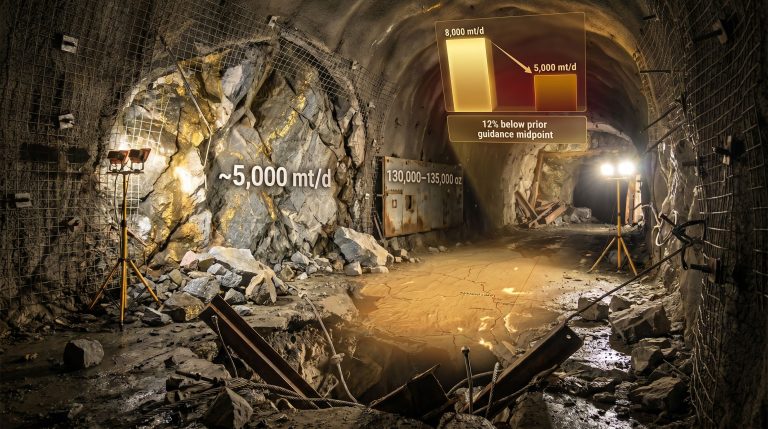
| Revised Mining Rate (H2 2026) | ~5,000 tonnes per day |
| Broader Portfolio Output | ~550,000 oz/year (2025 total) |
The Young-Davidson mine is not a peripheral asset. It sits as the second-largest contributor to Alamos Gold's annual production base, meaning disruptions there carry proportionate weight in corporate-level guidance metrics.
Breaking Down the Revised Production Numbers
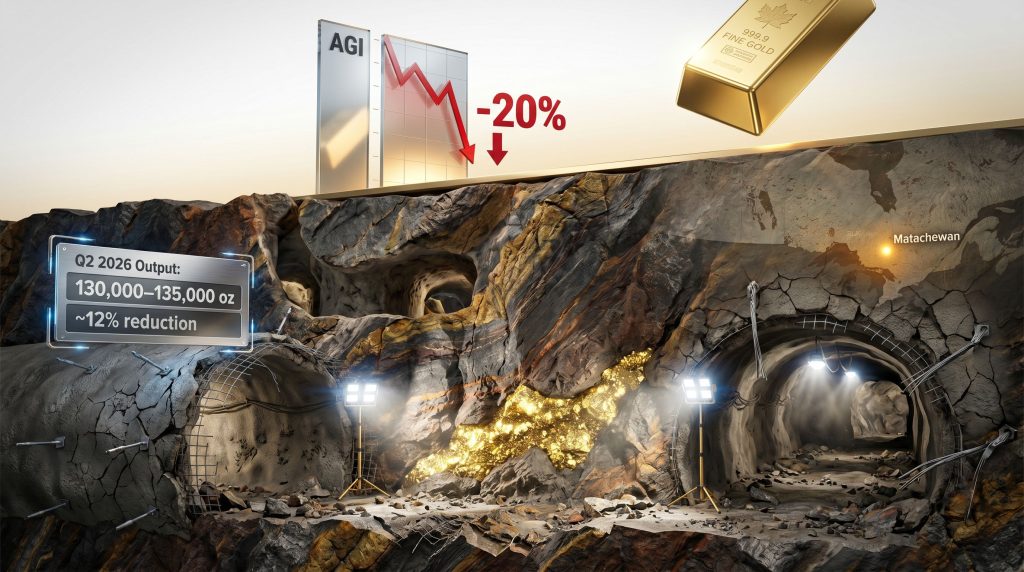
Alamos Gold revised its Q2 2026 gold production guidance to between 130,000 and 135,000 ounces, representing approximately a 12% reduction from the prior midpoint estimate. The company simultaneously flagged that full-year 2026 output would fall below previously issued guidance, with revised annual figures to be published alongside Q2 financial results in late July 2026.
| Guidance Metric | Previous Position | Revised Position | Change |
|---|---|---|---|
| Q2 2026 Production | ~148,000-150,000 oz (implied midpoint) | 130,000-135,000 oz | ~12% reduction |
| Mining Rate at Young-Davidson | Pre-seismic target | ~5,000 tpd (H2 2026) | Material step-down |
| Full-Year 2026 Production | Previously issued | Below prior guidance | Update due late July 2026 |
| All-In Sustaining Costs | Previously guided | Expected to rise | Volume-driven inflation |
Why Production Cuts Mechanically Inflate Unit Costs
The relationship between output volume and cost-per-ounce is one of the most important dynamics in gold mining economics, and one that is frequently underappreciated by investors outside the sector. The majority of an underground gold mine's cost base is fixed in the near term. Labour rosters, energy contracts, site maintenance, administration, and equipment lease commitments do not scale down proportionally when production volumes fall.
This means that when a seismic event reduces the number of ounces produced in a quarter, the same fixed cost pool is divided across fewer ounces, mechanically driving up the All-In Sustaining Cost (AISC) per ounce. A 12% production reduction does not produce a 12% AISC increase. Depending on the fixed-cost leverage within a given operation, the AISC impact can be significantly larger on a percentage basis. Understanding cut-off grade economics is equally important here, as grade thresholds directly influence which ore zones remain economically viable during periods of elevated unit costs.
In underground gold mining, the most dangerous cost environment is not high gold prices or low gold prices. It is a production shortfall at a mine with high fixed-cost exposure, because the arithmetic of cost-per-ounce deteriorates faster than the revenue line.
This dynamic helps explain why guidance cuts at single operations can produce share price reactions that appear disproportionate to the tonnage involved.
Alamos Gold's Remediation Strategy for the Second Half of 2026
The company has outlined a two-pronged operational response to restore production performance at Young-Davidson across the remainder of 2026.
1. Additional Ground Support Installation
Throughout the second half of the year, Alamos intends to install incremental ground support within the affected underground workings. This work involves reinforcing tunnel structures with mechanical bolting, mesh, and sprayed concrete to stabilise the rock mass surrounding damaged access corridors. While this is standard remediation practice in the industry, it is not instantaneous. Each supported section must be inspected and certified before mining crews and equipment can safely re-enter.
2. Mining Sequence Optimisation
Where direct access to high-grade zones remains restricted during remediation, the operation is being reconfigured to prioritise accessible lower-grade areas. This approach maintains bulk throughput close to the revised 5,000-tonne-per-day rate but sacrifices average ore grade in the process. More tonnes must be processed through the mill to generate each ounce of gold output, adding processing cost on a per-ounce basis even as volume is nominally maintained.
This trade-off between grade and throughput is a common feature of disrupted underground mining schedules. Consequently, analysts focus closely on head grade alongside raw tonnage figures when evaluating recovery performance — a practice that extends naturally into interpreting drilling results from adjacent resource areas that may be called upon during a disruption period.
The Market Reaction: Anatomy of a 20% Single-Day Decline
Alamos Gold shares fell by as much as 20% in Toronto on the trading day following the announcement, marking the steepest single-day decline the company had experienced since 2020. Understanding why a 12% production guidance cut can trigger a 20% share price decline requires unpacking how mining equity investors process layered uncertainty.
Three Layers of Risk in a Seismic Event Announcement
When a gold producer announces seismic-related infrastructure damage, the market is not simply repricing the lost ounces. It is simultaneously pricing three overlapping risk categories:
- Quantified production loss: The disclosed guidance range of 130,000–135,000 ounces establishes a known near-term shortfall, which the market can model directly.
- Cost inflation uncertainty: The AISC impact is directionally confirmed but not yet quantified. Until Q2 results are released, the precise cost increase is unknown, and markets tend to assume a wider distribution of outcomes under uncertainty.
- Structural integrity ambiguity: The most difficult variable to price is whether the seismic damage represents an isolated event or indicates a broader deterioration in ground conditions at depth. Without published geotechnical assessment data, investors apply a precautionary discount to reflect the possibility of recurring disruptions.
Historical experience across the gold mining sector provides useful context for calibrating these reactions.
| Disruption Type | Typical Share Price Impact | Recovery Timeline |
|---|---|---|
| Weather or power outage (short-term) | 3–8% decline | Days to weeks |
| Seismic event with infrastructure damage | 10–25% decline | Weeks to months |
| Structural mine failure (severe) | 30–60%+ decline | Months to years |
| Guidance cut without physical damage | 5–15% decline | Weeks |
The 20% decline at Alamos sits at the upper end of the seismic disruption range, suggesting markets applied meaningful structural uncertainty discount on top of the quantified production loss. This is consistent with the fact that full-year guidance remained open-ended at the time of the announcement, leaving analysts unable to model a complete impact scenario.
Importantly, this pattern — where shares overshoot on the downside immediately after a seismic event announcement, followed by partial recovery once remediation timelines are confirmed — has precedent across the Canadian hard-rock mining sector. The degree of recovery tends to correlate with how clearly and quickly management communicates the geotechnical response plan.
The next major ASX story will hit our subscribers first
What Broader Industry Trends Does This Event Illuminate?
The timing of the Young-Davidson disruption was notable in a wider context. Within days of the Alamos announcement, Newmont's Cadia operation in Australia was also halted following earthquake activity, representing the second suspension at that mine in nine weeks. While geographically unrelated, the two events occurring in close proximity drew investor attention to seismic risk as a portfolio-level concern for underground gold mining generally, not just a company-specific issue.
This matters because institutional investors holding diversified gold mining portfolios may begin applying a broader sector discount to underground operations when clustered seismic events occur, even where individual mines are geologically unrelated. For deeper underground operations specifically, seismic risk tends to increase with depth, as rock stress levels build with overburden pressure. Young-Davidson operates at significant depth, which means ground conditions management is a permanent feature of operational planning rather than an occasional challenge.
Long-Term Strategic Implications for the Path to One Million Ounces
Alamos Gold has publicly outlined an ambition to reach 1,000,000 ounces of annual gold production by 2030, roughly double the approximately 550,000 ounces produced in 2025. The Young-Davidson disruption affects near-term output within a single operational year but does not alter the geological resource in the ground or the structural logic of the long-term mine plan.
When a project of this scale undergoes disruption, investors often revisit the underlying definitive feasibility study to reassess whether base-case assumptions remain intact — particularly regarding ground conditions, cost structures, and production rates. Several factors will determine whether the 2026 disruption creates lasting drag on the growth trajectory:
- Whether ground support work in H2 2026 restores full access to the affected high-grade zones ahead of schedule, or whether remediation extends into 2027.
- How much unplanned sustaining capital is required for the ground support programme, and whether it competes with budgeted growth expenditure elsewhere in the portfolio.
- Whether the operating rate at Young-Davidson can return to above 5,000 tonnes per day in 2027, or whether geological caution keeps throughput suppressed for longer.
The multi-asset nature of Alamos Gold's portfolio provides a degree of insulation. Other producing operations can partially offset the Young-Davidson shortfall in full-year terms, which is one reason why diversification within a gold producer's asset base carries genuine operational value beyond the balance sheet arguments typically made in its favour.
Frequently Asked Questions
What caused the Alamos Gold output cut after the earthquake at Young-Davidson?
Two underground seismic events within a single week in mid-June 2026 damaged infrastructure at the Young-Davidson mine in Ontario, blocking access to high-grade ore stopes scheduled for Q2 extraction. A separate late-May power outage caused approximately three additional days of downtime.
How much was the Q2 2026 production guidance reduced?
The revised guidance of 130,000 to 135,000 ounces represents approximately a 12% reduction from the prior midpoint estimate.
What does the 5,000 tonnes per day mining rate for H2 2026 represent?
This revised rate reflects an operational recalibration that prioritises accessible ore zones while ground support remediation proceeds in damaged areas. It is lower than the pre-seismic target and indicates a deliberate, conservative approach to re-establishing production momentum.
When will full-year 2026 guidance be updated?
Alamos has confirmed that revised annual production and cost guidance will be released alongside Q2 2026 financial results in late July 2026.
How should investors approach drill results for investors during a disruption period?
Understanding drill results for investors from adjacent resource zones becomes particularly relevant when a disruption forces operators to consider alternative ore sources. Results from exploration drilling can indicate whether nearby zones could supplement output during an extended remediation period.
Does the disruption threaten the company's 2030 production target?
The one million ounce per year target is a portfolio-level objective supported by multiple assets and growth projects. The Young-Davidson disruption creates near-term pressure but does not eliminate the geological resource or invalidate the mine plan. The critical variable is whether the remediation timeline resolves within 2026 or extends further into subsequent years.
Disclaimer: This article contains forward-looking assessments based on publicly available information and historical industry precedent. It does not constitute financial advice. Investors should conduct independent due diligence and consult qualified advisers before making investment decisions. Production forecasts, cost estimates, and share price projections are subject to material change based on operational developments, geological conditions, and market factors.
Want to Stay Ahead of Significant ASX Mineral Discoveries Before the Broader Market Reacts?
Discovery Alert's proprietary Discovery IQ model delivers real-time alerts on significant ASX mineral discoveries, transforming complex geological and market data into actionable investment insights for both short-term traders and long-term investors — explore historic examples of major discovery returns to understand the opportunity, then begin your 14-day free trial at Discovery Alert to position yourself ahead of the market.