June 20, 2026
The Anatomy of a Clean-Title Mine Deal: Why the Goldgroup San Francisco Transaction Is Being Watched Across the Sector
When a freeze on new mining concessions reshapes the competitive landscape of an entire country, the most valuable assets are no longer those yet to be discovered. They are the ones already permitted, already drilled, and legally transferable without the burden of inherited debt. This structural reality is precisely what makes the Goldgroup San Francisco Mine deal in Sonora one of the more closely studied transactions in Mexican junior mining in 2026.
Understanding what happened here requires moving beyond the headline and examining the legal mechanism used, the resource scale involved, the infrastructure already in the ground, and the district logic that connects this asset to Goldgroup's existing operations. Each layer reveals a different dimension of why this deal matters, both for the company and for investors trying to read the broader capital cycle now underway across Sonora, Durango, and Guerrero.
When big ASX news breaks, our subscribers know first
Acquiring Through Insolvency: The Concurso Mercantil Mechanism
The Goldgroup San Francisco Mine deal in Sonora was not structured as a conventional bilateral acquisition. Instead, the transaction was executed through Mexico's Concurso Mercantil process, a court-supervised commercial restructuring framework that functions similarly to Chapter 11 bankruptcy proceedings in the United States.
This distinction carries significant practical consequences for the buyer. In a standard asset purchase, inherited liabilities, legacy environmental obligations, or title disputes can attach to the acquiring entity unless explicitly carved out through negotiation and contractual protection. The Concurso Mercantil pathway eliminates this risk by design.
Under judicial oversight, the Mexican court effectively adjudicates the transfer, ensuring the asset passes to the acquirer with a clean title. No prior encumbrances, no legacy debt, no historic creditor claims survive the process. The acquiring entity starts with a legally unencumbered asset.
This matters enormously in a jurisdiction where title history can be complex. Mexico's mining claims framework involves overlapping layers of federal, state, and municipal engagement, and past-producing mines frequently carry residual obligations tied to earlier operators. By using the Concurso Mercantil route, Goldgroup effectively bypassed this risk entirely.
Goldgroup Mining completed the acquisition of Molimentales del Noroeste, S.A. de C.V., the Mexican entity holding the San Francisco Mine, on June 15, 2026, following approval from the TSX Venture Exchange. That exchange approval is not merely procedural. TSX Venture Exchange standards require disclosure of arm's-length valuations, material property assessments, and confirmation that the transaction meets Canadian securities regulations applicable to junior mining issuers. For market participants, it functions as a third-party validation layer on top of the Mexican judicial process.
What the Resource Numbers Actually Mean for a Restart Scenario
Breaking Down the Gold Inventory at San Francisco
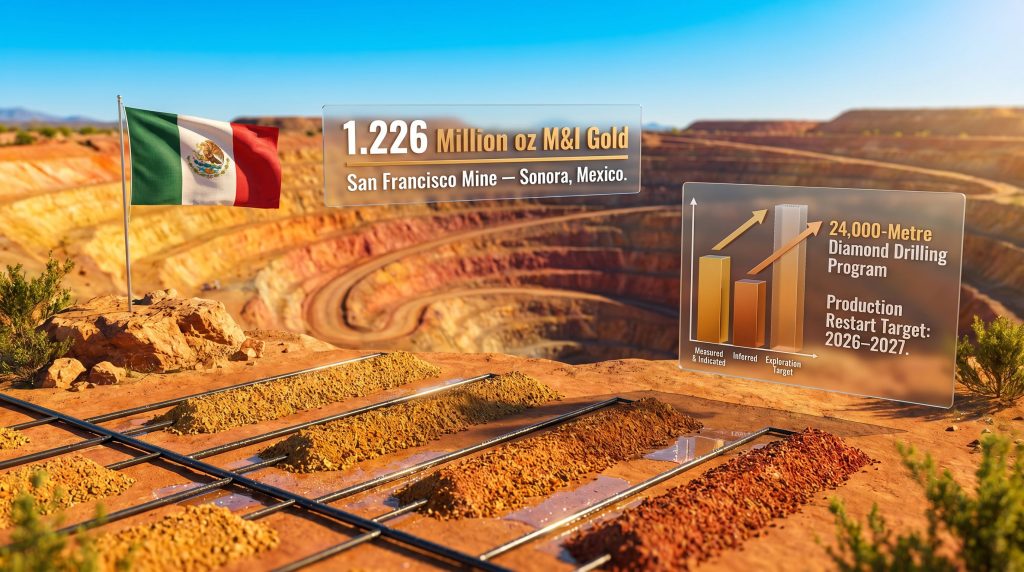
The scale of the San Francisco Mine's resource base is the first thing that anchors the investment thesis. The asset carries 1.226 million ounces of measured and indicated (M&I) gold resources, with an additional 178,000 ounces in the inferred category.
| Resource Category | Estimated Gold Ounces |
|---|---|
| Measured and Indicated (M&I) | 1,226,000 oz |
| Inferred Resources | 178,000 oz |
| Exploration Target (Low Case) | ~788,000 oz |
| Exploration Target (High Case) | ~960,000 oz |
| Total Potential Resource Upside | ~2.16 to 2.36 million oz |
For investors less familiar with resource classification terminology, the distinction between these categories is critical. Measured and indicated resources have been defined through sufficient drilling density that a qualified person can assign a reasonable level of geological confidence to their continuity and grade. They form the foundation of any mine plan and are the ounces most likely to be converted into mineable reserves following a feasibility study requirements process.
Inferred resources sit at a lower confidence threshold. They are defined by fewer drill intersections and carry more geological uncertainty, meaning they cannot yet be used in economic mine planning. However, they represent a real exploration opportunity. With targeted drilling, inferred ounces can be upgraded into the indicated category, expanding the resource base available to support mine scheduling.
The exploration target range of 788,000 to 960,000 additional ounces is speculative by nature and should not be read as a confirmed resource. These figures represent the geological potential of underdrilled portions of the system, based on structural interpretation and historical data. They are a directional indicator, not a bankable number.
Why Heap Leach Infrastructure Changes the Economics
San Francisco is a past-producing open-pit gold mine, and this status fundamentally alters the capital equation for any restart scenario. Heap leach operations involve crushing ore, stacking it on engineered pads lined with impermeable membranes, and applying a dilute cyanide solution that percolates through the ore pile and dissolves gold. The pregnant solution is then processed through a carbon adsorption circuit to recover the metal.
The critical point for investors is that this infrastructure already exists at San Francisco. Existing heap leach pads, processing circuits, access roads, and power connections represent sunk capital that a new operator does not need to replicate. In a greenfield scenario, building this infrastructure from scratch could cost tens of millions of dollars and take two to three years. At San Francisco, that timeline compression is a tangible advantage.
Heap leach operations in Sonora's semi-arid climate do face one material operational consideration: water balance. Cyanide solution management requires careful monitoring of solution inventory, evaporation rates, and pad drainage to maintain leach efficiency and meet environmental compliance thresholds. Sonora's low annual rainfall reduces dilution risk but increases the importance of solution recirculation systems to conserve water. This is a manageable technical challenge for an experienced operator, but it is a variable that influences operating cost models.
The 24,000-Metre Drilling Program: Technical Design and Strategic Intent
Within three days of closing the acquisition on June 15, 2026, Goldgroup announced a 24,000-metre diamond drilling program on June 18, 2026. The rapid sequencing of this announcement carries its own signal.
Pre-positioning a drilling contractor, mobilising equipment, and finalising drill targets does not happen in seventy-two hours. The speed with which Goldgroup deployed this program suggests technical preparation began well in advance of the transaction's formal closing, indicating a high degree of operational confidence in the asset. Furthermore, understanding the nuances of interpreting drill results will be essential for investors tracking this program as data begins to emerge.
Diamond core drilling was selected as the methodology, which is the industry's preferred technique when structural geology interpretation is a priority. Unlike reverse circulation drilling, which pulverises the rock and recovers chips, diamond core drilling extracts a continuous cylinder of intact rock. This allows geologists to measure orientation, identify fault planes, map mineralisation contacts, and build three-dimensional structural models with a precision that chip samples cannot provide.
Consequently, when results are released, investors should also be mindful of true widths vs apparent widths when evaluating the significance of any intersections reported. The program has four primary objectives:
- Expand the existing M&I resource base by testing mineralisation along strike extensions
- Upgrade inferred ounces to indicated status through infill drilling at defined confidence intervals
- Test mineralisation continuity at depth below current resource limits
- Generate the data required for an updated technical study capable of supporting a feasibility-level mine plan
All four objectives feed directly into the targeted production restart window of 2026 to 2027. In addition, the drilling program design at San Francisco reflects a disciplined approach to maximising the conversion of inferred to indicated ounces within the tightest possible timeframe.
Geographic District Logic: Why Cerro Prieto Proximity Matters
The San Francisco Mine sits in Sonora, Mexico, in close geographic proximity to Goldgroup's operating Cerro Prieto gold mine. This district-level relationship is not incidental. It is central to the economic rationale for the acquisition.
District consolidation in mining creates what operators refer to as shared infrastructure economics. When two mines operate within the same geographic corridor, the per-ounce cost of maintaining access roads, power infrastructure, administrative functions, and processing capacity can be distributed across a larger production base. Workforce management also becomes more efficient, as skilled labour, supervisory staff, and technical specialists can serve multiple operations within a practical commuting radius.
Sonora's established mining labour market is a structural advantage that is often underappreciated by investors focused purely on resource numbers. The state has decades of continuous mining activity, producing a skilled workforce trained in open-pit methods, heap leach operations, and heavy equipment maintenance. Recruiting for a restart in Sonora carries substantially lower risk than mobilising a workforce in a jurisdiction without this institutional knowledge base.
The Regulatory Premium: Why Permitted Assets Now Trade at a Structural Discount to Their Value
Mexico's freeze on new mining concession issuance has created a two-tier market that is reshaping how capital is allocated across the sector. Projects with existing concessions and full permitting are increasingly scarce relative to exploration-stage ideas seeking title.
The San Francisco Mine's fully permitted status eliminates the single most time-consuming and uncertain phase of Mexican mining development. Environmental impact statements, known as Manifestaciones de Impacto Ambiental or MIAs, can take eighteen months to three years to process under normal regulatory timelines. If an operator expands the scope of an approved project, triggering a new environmental review, that timeline can reset. For a restart scenario, the existence of prior permits covering the mine footprint is a material risk reduction.
The concession freeze has effectively turned Mexico's permitted mining asset pool into a fixed inventory. As exploration-stage projects struggle to advance without new titles, permitted past-producers with clean legal status become progressively harder to replicate and therefore progressively more valuable.
This regulatory dynamic also explains why the Concurso Mercantil acquisition route is attracting attention beyond this specific transaction. Distressed mining entities holding valid, permitted concessions represent a finite opportunity set that cannot be replenished under current policy conditions.
The next major ASX story will hit our subscribers first
Milestone Timeline: From Court Process to Drill Program
| Date | Event |
|---|---|
| Pre-June 2026 | Concurso Mercantil proceedings initiated for Molimentales del Noroeste |
| June 15, 2026 | Acquisition closes; TSX Venture Exchange approval confirmed |
| June 18, 2026 | 24,000-metre diamond drilling program announced |
| 2026 to 2027 (Target) | Production restart at San Francisco Mine |
The timeline compression between transaction close and drill program launch is operationally unusual. Standard practice in junior mining involves a period of technical review and contractor procurement following a deal close. The fact that Goldgroup bypassed this gap signals a level of pre-deal diligence and contractor relationship management that distinguishes this from a speculative acquisition.
Mexico's Broader Mining Capital Cycle: Where San Francisco Fits
The Goldgroup San Francisco Mine deal in Sonora is not an isolated event. It is occurring within a measurable acceleration of mining exploration and development activity across multiple Mexican states simultaneously.
| Project | Company | State | Stage | Key Detail |
|---|---|---|---|---|
| San Francisco Mine | Goldgroup Mining | Sonora | Acquisition and Restart | 1.226 Moz M&I gold; 24,000m drill program |
| Adelita Project | Algo Grande Copper | Sonora | Phase II Drilling | 8,000m program; 2.5km magnetic anomaly corridor |
| Cruz de Plata | Capitan Silver | Durango | Active Drilling | Fourth drill rig deployed; three core rigs operational |
| La Parrilla Complex | Silver Storm Mining | Durango | Production Restart | First doré pour completed; mine idle for approximately seven years |
| Sierra Plata | J2 Metals | Guerrero | Early Exploration | Six historic mine workings identified; 53 rock samples collected |
Beyond gold and silver, the broader copper pipeline in Mexico adds further context to the capital cycle. According to data from BNamericas and CAMIMEX, at least eight copper and polymetallic projects representing an estimated US$5.161 billion in combined investment are advancing across Mexico, with most operations expected to commence by 2029. This pipeline continues to move forward despite the concession freeze and ongoing permitting delays, reflecting the depth of institutional capital committed to Mexican resource development.
Production Restart Prerequisites: What Must Happen Before First Pour
Targeting a 2026 to 2027 production restart is an ambitious timeline. Meeting it requires sequential completion of several technical and regulatory steps:
- Heap leach pad structural assessment: existing pads must be evaluated for liner integrity, drainage system functionality, and residual gold in solution that may affect new leach cycle economics
- Updated block model: drilling results from the 24,000-metre program will be used to construct a revised three-dimensional resource model reflecting current geological interpretation
- Open-pit optimisation study: using the updated block model, engineers will run pit shell optimisations under current gold price assumptions to define the economically viable mine shell, strip ratios, and bench configurations
- Updated technical report: a National Instrument 43-101 compliant report will be required to formalise mineral reserve estimates and support any production decision
- Water and reagent supply planning: cyanide procurement, solution balance management, and water sourcing agreements need to be in place before leach operations commence
- Workforce and contractor mobilisation: mine operations, equipment maintenance, and processing require structured staffing plans with lead times for training and deployment
The most significant schedule risk is the possibility that any operational scope change relative to the original approved environmental permit triggers a new MIA review requirement. This is not a certainty, but it is a variable that Goldgroup's environmental and legal teams will need to navigate carefully to protect the 2026 to 2027 timeline.
Frequently Asked Questions: Goldgroup San Francisco Mine Deal in Sonora
What exactly did Goldgroup acquire through this deal?
Goldgroup Mining acquired 100% ownership of Molimentales del Noroeste, S.A. de C.V., the Mexican corporate entity that holds the mining concessions and operating permits for the San Francisco Mine in Sonora. The acquisition was executed through a Mexican court-supervised insolvency process, with the asset transferring free of prior liens, debts, and encumbrances.
How much gold does the San Francisco Mine contain?
The mine holds 1.226 million ounces of measured and indicated gold resources and 178,000 ounces in the inferred category. An exploration target based on geological interpretation suggests an additional 788,000 to 960,000 ounces of potential mineralisation, bringing total upside to approximately 2.16 to 2.36 million ounces. The exploration target range is not a confirmed resource and requires further drilling to validate.
Why was a Concurso Mercantil used instead of a direct purchase?
The Concurso Mercantil mechanism is Mexico's court-supervised equivalent of a Chapter 11 restructuring. Its use in this transaction allowed Goldgroup to acquire the asset through a judicially validated process that extinguished prior claims and transferred a clean title. This is particularly valuable in mining, where past operators may have left unresolved creditor obligations or title disputes that would otherwise attach to any buyer.
What is the significance of the TSX Venture Exchange approval?
TSX-V approval confirms the transaction met Canadian securities disclosure requirements applicable to junior mining issuers. This includes verification of arm's-length dealing, material property assessment standards, and public disclosure obligations. For investors tracking the company's equity, it represents an independent procedural confirmation that the deal structure was sound.
What could delay the 2026 to 2027 restart target?
The primary risk factors include drilling results that require additional infill work before a resource update can be finalised, environmental review timelines if operational changes trigger a new permit assessment, and gold price movements that could alter the economic viability of the mine plan. According to reporting on the transaction, Mexican regulatory timelines for environmental amendments can extend twelve to twenty-four months under some circumstances.
What the San Francisco Template Signals for Distressed Asset Acquisitions in Mexico
The structural conditions that made the Goldgroup San Francisco Mine deal in Sonora possible are not disappearing. Mexico's concession freeze continues to constrain the supply of new developable assets. Distressed mining entities holding valid, permitted concessions represent a finite pool of opportunities that the Concurso Mercantil mechanism can unlock.
For junior mining operators with the technical capacity to evaluate these assets and the capital to pursue court-supervised acquisitions, this creates a potential pipeline of transactions that conventional M&A processes cannot access. The San Francisco deal demonstrates that the mechanism works, that TSX-V approval can be obtained, and that a technically prepared acquirer can move from deal close to active drilling within days.
Whether Goldgroup achieves its 2026 to 2027 production restart will depend on drilling results, regulatory navigation, and gold market conditions at the time an operational decision is required. What the transaction already demonstrates, independent of that outcome, is that legally clean, infrastructure-rich, fully permitted gold assets in Sonora carry a value proposition that is genuinely difficult to replicate in Mexico's current regulatory environment.
This article contains forward-looking statements and references to exploration targets and production timelines that are subject to significant uncertainty. Exploration targets are not mineral resources or mineral reserves, and there is no guarantee that further exploration will result in the delineation of additional resources. Readers should not make investment decisions based solely on the information contained in this article and are encouraged to conduct independent due diligence.
Want to Track the Next Major ASX Mineral Discovery Before the Market Does?
Discovery Alert's proprietary Discovery IQ model delivers real-time alerts on significant ASX mineral discoveries, transforming complex geological data into actionable insights for investors at every experience level — explore historic discoveries and the returns they generated, then begin your 14-day free trial at Discovery Alert to position yourself ahead of the market.