
June 19, 2026
Underground Mining's Hidden Vulnerability: When Geology and Weather Collide
Deep underground gold mining operates at the intersection of geological complexity and physical infrastructure, where the margin between a productive quarter and a disappointing one can be measured in metres of rock stability. The Canadian Shield, one of the world's oldest and most geologically stable cratons, nonetheless harbours fault systems and stress regimes capable of producing sudden, disruptive seismic events. When those events coincide with surface-level infrastructure failures, the compounding effect on production can be swift and significant. The Alamos Young-Davidson mine disruptions of mid-2026 are a precise case study in how underground mining's inherent geological risks interact with above-ground vulnerabilities to reshape quarterly output and full-year guidance in a matter of days.
When big ASX news breaks, our subscribers know first
Understanding Young-Davidson's Strategic Weight Within Alamos Gold
A Century-Old Deposit With Modern Ambitions
The Young-Davidson deposit, situated approximately 60 kilometres west of Kirkland Lake in Northern Ontario, carries a production lineage stretching back to the 1930s. While the orebody's historical roots are well-documented, what is less commonly understood is the significance of its modern reinvention. Commercial production under contemporary bulk underground mining methods began in 2013, initially under AuRico Gold before that company merged with Alamos Gold. The transition brought large-scale mechanised longhole stoping to a deposit that had previously been worked through older, more selective methods.
Young-Davidson's current ore extraction relies on a combination of longhole open stoping and paste fill, a technique that uses processed tailings mixed with cement to backfill mined-out voids. This approach maintains ground stability while allowing adjacent stopes to be mined, which is critical in a seismically sensitive hard-rock environment. The Young-Davidson mine infrastructure includes an internal shaft system capable of moving both personnel and ore at depth, with the operation targeting an approximate 5,000 tonnes per day mining rate for the remainder of 2026.
Portfolio Positioning: More Than Just Tonnage
Within Alamos Gold's multi-asset structure, Young-Davidson contributes not only raw gold ounces but also geographic and geological diversification across the company's Canadian operations. In prior periods, the combined output of Young-Davidson and the Mulatos complex in Mexico broadly matched the contribution of the Island Gold District alone. That balance has shifted materially following the Island Gold District's expansion trajectory, but Young-Davidson remains a meaningful throughput contributor with a relatively lower grade profile compared to the high-grade Island Gold underground workings.
This grade differential is important for investors to understand. Lower-grade bulk underground mines like Young-Davidson depend on high throughput consistency to generate competitive per-ounce economics. Any disruption to mining rates, particularly one that simultaneously removes access to higher-grade stopes, creates a double-compounding effect on production output and cost efficiency. Understanding how to interpret these operational impacts is essential, and reading drill results carefully can provide additional context for grade reconciliation and mine performance.
The Mechanics Behind the Q2 2026 Production Shortfall
Seismic Events: What Actually Happens Underground
The two seismic events recorded at Young-Davidson in mid-June 2026 represent a geotechnical category known in the mining industry as a rockburst or seismic slip event, depending on their origin mechanism. In the hard granitic and metamorphic rocks of the Canadian Shield, stored elastic strain energy can be released suddenly along geological structures, producing ground motion capable of damaging mine openings, displacing rock from excavation walls, and destroying installed ground support elements such as mesh, rebar, and friction bolts.
When one of these events occurs directly at an active mining front, as confirmed in this case, the consequences extend beyond physical damage. The affected stope must be placed off-limits until a geotechnical assessment is completed, additional ground support is rehabilitated or installed, and the mining sequence is redesigned to route production around the damaged zone. This process is not measured in hours but in weeks, which explains why the loss of access to just two higher-grade stopes translated into a production guidance revision of approximately 12% for the quarter.
The Stope Access Problem: A Technical Explanation
A stope is the void created when ore is extracted from an underground excavation. In longhole stoping, multiple stopes are developed simultaneously across different levels of the mine to maintain a steady ore feed to the processing plant. Higher-grade stopes are typically sequenced strategically to blend ore grades and maintain target mill feed quality. Losing access to two pre-scheduled high-grade stopes does not simply reduce volume; it lowers the average grade of ore being processed from the remaining stopes, further reducing recovered gold ounces even when tonnage throughput remains partially maintained.
This is why underground mine planners speak of grade reconciliation risk as one of the most operationally sensitive variables in quarterly production. The Alamos Young-Davidson mine disruptions created exactly this scenario: lower tonnage combined with grade dilution from an unplanned shift in stope sequencing. Furthermore, automation in modern mining has improved response times in these situations, though it cannot eliminate the fundamental geotechnical constraints that underpin such events.
Storm-Related Power Outage: The Compounding Variable
Approximately three weeks before the seismic events, a severe storm damaged the regional power transmission infrastructure serving the Young-Davidson area, triggering an unplanned three-day operational shutdown in late May 2026. Underground mines are heavily dependent on continuous electrical supply for ventilation fans, hoisting systems, dewatering pumps, and ore crushing circuits. A multi-day power interruption does not simply pause production; it initiates a complex restart sequence once power is restored, as ventilation systems must re-establish safe atmospheric conditions before personnel can re-enter working areas.
| Disruption Type | Timing in Q2 2026 | Operational Impact |
|---|---|---|
| Storm-related power outage | Late May 2026 | 3 days of full operational shutdown |
| Seismic event at active mining front | Mid-June 2026 | Infrastructure damage, two stopes inaccessible |
| Secondary seismic event | Mid-June 2026 | Additional geotechnical review required |
Remote northern Ontario mining operations face a structural vulnerability that is underappreciated in standard risk assessments: reliance on regional transmission grids that traverse vast geographic areas subject to extreme weather. Unlike operations near urban centres where grid redundancy is higher, mines in remote boreal environments often have limited alternative power routing options. The increasing frequency of severe weather events in northern Canada elevates this risk profile for operations across the region, not just at Young-Davidson.
Quantifying the Damage: Guidance Revision and Financial Implications
Q2 2026 Production Revision in Detail
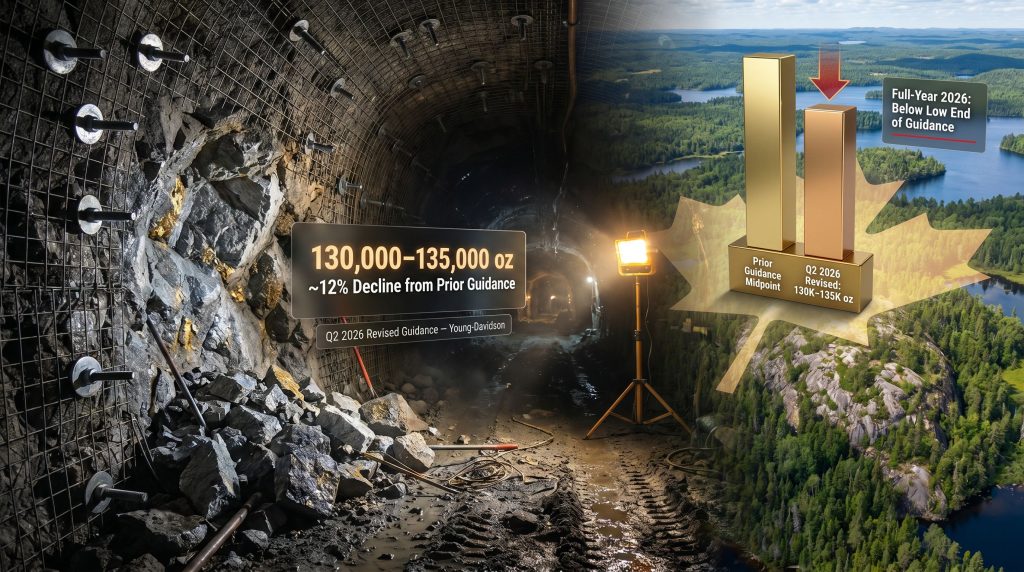
Alamos Gold revised its Young-Davidson Q2 2026 production guidance to a range of 130,000 to 135,000 ounces, representing a decline of roughly 12% from the midpoint of the operation's previous quarterly guidance. Critically, this revised figure aligns Q2 output with Q1 2026 levels, effectively erasing any anticipated sequential production growth for the half-year period.
For investors tracking quarter-on-quarter momentum, this flat trajectory carries a specific implication: the production growth story that management had been building toward is pushed entirely into H2 2026. That deferred growth narrative introduces uncertainty, as it compresses the recovery timeline and leaves less room for any further operational interruptions before year-end. The Alamos 2025 production shortfall analysis provides useful precedent context for understanding how management has historically navigated similar guidance revisions.
Full-Year Consolidated Guidance: Below the Floor
Beyond the quarterly revision, Alamos confirmed that consolidated group gold production for the full year 2026 is now expected to land below the low end of its previously stated guidance range, with group-level all-in sustaining costs projected to exceed prior guidance thresholds. A formal revised guidance update is scheduled for release alongside Q2 results in July 2026.
Cost Leverage Mechanics: In underground gold mining, operating costs including labour, ventilation, ground support maintenance, and dewatering are largely fixed in nature. When production volumes decline due to disruptions, these fixed costs are absorbed across fewer recovered ounces, mechanically driving per-ounce metrics such as AISC higher. The Young-Davidson Q2 scenario is a textbook example of negative operating leverage in a fixed-cost intensive industry.
The market's initial reaction reflected this uncertainty. Alamos Gold shares closed the session following the announcement down 2.5%, with the company's market capitalisation standing at approximately C$21.6 billion at the time. However, it is worth noting that gold prices at record highs have provided a partial buffer to the revenue impact of lower production volumes, softening the financial blow to some degree.
Island Gold District: Carrying the Weight in 2026
High-Grade Counterbalance to Young-Davidson's Shortfall
The Island Gold District, widely recognised as one of the highest-grade underground gold mines currently operating in Canada, has taken on increased strategic importance within Alamos's 2026 production framework following the Young-Davidson disruptions. In the prior year, the Island Gold District contributed nearly half of Alamos's total gold production, a figure that equalled the combined output of Young-Davidson and the Mulatos operations in Mexico.
The grade advantage at Island Gold is substantial. High-grade underground operations benefit from a fundamentally different cost structure, where each tonne of ore processed recovers significantly more gold, spreading fixed costs across a larger ounce base and generating superior margin outcomes compared to bulk lower-grade operations. As Young-Davidson's contribution is temporarily impaired, Island Gold's grade premium becomes even more valuable to the consolidated portfolio.
Expansion Milestones Underway
Alamos is actively advancing two parallel throughput expansions within the Island Gold District that are central to its H2 2026 recovery narrative:
-
The Island Gold underground mining rate is being increased from 1,500 tonnes per day to 2,000 tonnes per day, targeted for completion by year-end 2026.
-
The Magino open pit mill ramp-up is progressing according to internal plans, with management targeting an average throughput rate of 10,000 tonnes per day by Q3 2026.
Together, these expansions represent a meaningful incremental increase in processing capacity that can partially absorb the production gap created by Young-Davidson's operational challenges. However, investors should note that mill ramp-ups in open pit operations carry their own execution risk, particularly in achieving consistent throughput targets across varying ore hardness and seasonal operating conditions.
The Broader Operational Risk Framework in Deep Underground Gold Mining
Seismic Risk as a Structural Feature, Not an Anomaly
The Young-Davidson seismic events are not isolated incidents within the context of Canadian hard-rock mining. The Canadian Shield geology, while broadly stable at a tectonic scale, hosts numerous fault and shear zone systems that can respond dynamically to stress redistribution as mining progresses deeper. As underground operations extend to greater depths, the in-situ stress regime intensifies, increasing the probability of stress-induced seismicity around excavations.
Modern mining operations manage this risk through microseismic monitoring networks, which use arrays of sensitive geophones placed throughout the mine to detect, locate, and characterise seismic events in near-real time. These systems allow geotechnical engineers to identify areas of elevated seismic activity and adjust mining sequences proactively. The effectiveness of these systems, however, depends on the speed with which management acts on the data, and not all seismic events can be predicted with sufficient lead time to prevent infrastructure damage.
Why Power Resilience Is Becoming a Board-Level Conversation
The storm-related outage at Young-Davidson highlights a resilience gap that extends across the northern Ontario mining sector. Several mines in the Kirkland Lake and Timmins corridors depend on aging regional transmission infrastructure originally designed for a different industrial era. The combination of climate-driven weather intensification and infrastructure age creates a compound risk that mine operators are increasingly addressing through:
- Investment in on-site diesel generation capacity as backup power for critical systems.
- Negotiated agreements with utilities for priority restoration protocols.
- Engineering studies examining the feasibility of microgrids or distributed energy resources at remote sites.
- Scenario planning that incorporates multi-day outage durations into operational risk models.
The three-day duration of the Young-Davidson outage, while significant, sits within a range that most modern mines can manage through backup systems. The more insidious risk is a prolonged outage exceeding five to seven days, which would require dewatering systems to be reactivated after water ingress accumulates, adding weeks to the full restart sequence. In addition, mining sustainability practices increasingly incorporate energy resilience planning as a core operational consideration, particularly for remote northern operations.
The next major ASX story will hit our subscribers first
Recovery Pathway and Key Variables for H2 2026
Management's Thesis and Its Underlying Assumptions
Alamos management has indicated that stronger production performance is anticipated in the second half of 2026, anchored by ground support rehabilitation at Young-Davidson, mining sequence optimisation to maximise access to available ore zones, and the continued ramp-up of Island Gold District capacity. The company has set a target mining rate of approximately 5,000 tonnes per day at Young-Davidson for the remainder of the year.
The recovery thesis rests on several assumptions that carry varying degrees of execution certainty:
- Geotechnical conditions must remain stable enough to allow rehabilitation work to proceed on schedule.
- The redesigned mining sequence must successfully access grades sufficient to rebuild average mill feed quality.
- No further unplanned disruptions, seismic or otherwise, interrupt the H2 2026 operating period.
- Island Gold District throughput expansions reach their targeted rates on schedule.
Each of these variables introduces uncertainty into the recovery narrative. Investors and analysts modelling Alamos's H2 2026 performance should incorporate a range of scenarios rather than anchoring to the management guidance midpoint, given the demonstrated volatility in operating conditions at Young-Davidson through the first half of the year. For additional context on how in-situ uranium production methods compare to gold's operational risk profile, ISR production techniques offer a useful industry contrast.
Guidance Credibility: A Less-Discussed Risk Factor
Beyond the immediate production impact, full-year guidance downgrades carry a secondary consequence that is often underweighted in analyst commentary: the erosion of forecasting credibility. When a mid-year guidance revision is required due to operational factors that were partially foreseeable, such as the known presence of seismic risk in the mining environment, it raises questions about the robustness of the original guidance assumptions. Investors who apply a guidance discount to Alamos's revised H2 2026 outlook are not being unreasonable, and this dynamic may contribute to a sustained valuation overhang until Q2 results and revised full-year guidance are published in July 2026. For context, Seeking Alpha's coverage of the guidance cut provides further detail on the market's initial response to the announcement.
Key Takeaways for Investors Monitoring Alamos Gold in 2026
-
Dual disruption dynamic: The simultaneous occurrence of seismic damage and a storm-related power outage in Q2 2026 represents a convergence of geological and infrastructure risks that individually would have been manageable but together created a material production shortfall.
-
Grade sensitivity compounded losses: The loss of access to higher-grade stopes amplified the volume impact of throughput disruptions, reducing both recovered ounces and average mill feed grade simultaneously.
-
Island Gold's strategic buffer: The Island Gold District's strong grade profile and active throughput expansion provide a meaningful offset to Young-Davidson's weakness, demonstrating the risk management value of a diversified multi-asset portfolio.
-
Fixed-cost leverage watches AISC closely: Rising per-ounce costs at Young-Davidson will be a critical metric in the Q2 2026 results release, with AISC exceeding prior guidance likely across the consolidated group.
-
H2 2026 is the credibility test: Management's ability to deliver on its recovery narrative through the second half of the year will be the defining factor for investor confidence heading into 2027 planning cycles.
This article is intended for informational purposes only and does not constitute financial or investment advice. Forward-looking statements regarding production guidance, cost forecasts, and operational recovery timelines involve known and unknown risks and uncertainties. Readers should conduct their own due diligence and consult a licensed financial adviser before making investment decisions. For ongoing coverage of Canadian gold mining operations, the Canadian Mining Journal provides regular reporting on operational developments across the sector.
Want to Identify the Next Major ASX Mineral Discovery Before the Broader Market Does?
Discovery Alert's proprietary Discovery IQ model delivers real-time alerts on significant ASX mineral discoveries, transforming complex geological and commodity data into actionable investment insights for both short-term traders and long-term investors — explore historic examples of exceptional discovery outcomes to understand the scale of opportunity, and begin your 14-day free trial at Discovery Alert to position yourself ahead of the market.