June 19, 2026
Sovereign Ambitions and the $4,700 Gold Price: Why Africa's Mining Lease Agreements Are Being Rewritten
Across the African continent, a structural shift is underway in how resource-rich nations relate to the extractive industries operating within their borders. The conditions that shaped mining agreements in the 1990s, when commodity prices were modest and capital was scarce, look entirely different through the lens of a gold market trading above $4,700 per troy ounce. Governments that once competed aggressively for foreign investment are now asking harder questions about what share of the value their citizens actually capture. Nowhere is that question more pointed in 2026 than in Ghana, where the question of Ghana local control of Gold Fields Tarkwa mine sits at the intersection of resource nationalism, diplomatic tension, and one of the most consequential lease decisions in West African mining history.
When big ASX news breaks, our subscribers know first
The Tarkwa Mine: Scale, Ownership, and the April 2027 Deadline
Why Does Tarkwa Command Global Attention?
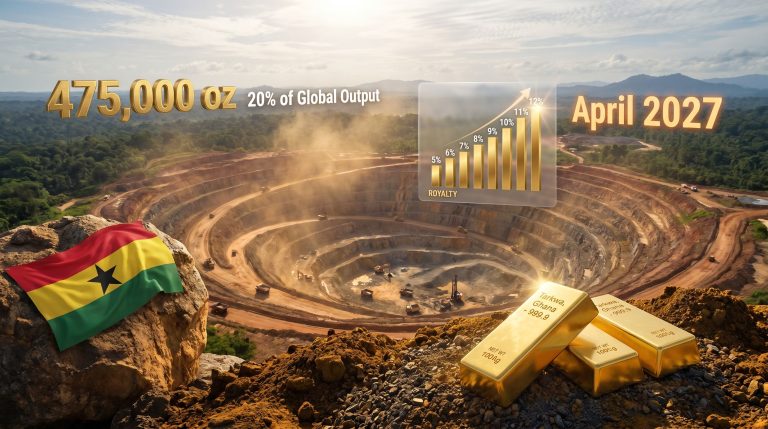
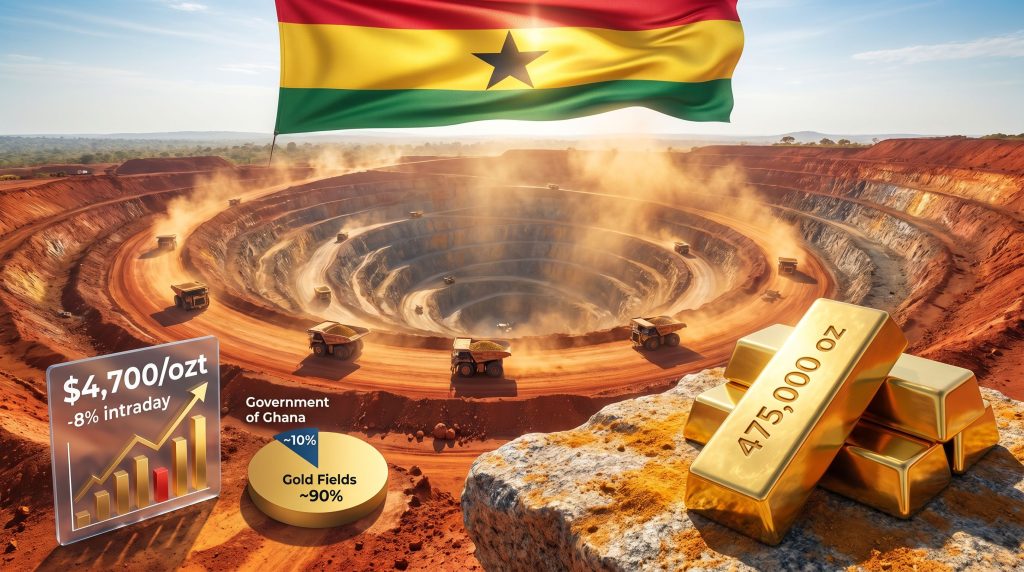
Understanding why the question of Ghana local control of Gold Fields Tarkwa mine commands global attention begins with appreciating Tarkwa's scale. The open-pit operation produced approximately 475,000 ounces of gold in the most recent reporting year, placing it firmly among the most productive single gold assets in West Africa. More critically, that output represents roughly one-fifth of Gold Fields' entire global production, with the South African major reporting total output of approximately 2.5 million ounces annually across its portfolio spanning Africa, Australia, and South America.
The current ownership architecture reflects the deal terms negotiated when Gold Fields assumed management from the State Gold Mining Company in 1993:
| Stakeholder | Ownership Share | Nature of Interest |
|---|---|---|
| Gold Fields Ltd. (South Africa) | ~90% | Operational control and capital deployment |
| Government of Ghana | ~10% | Free-carry interest, non-operational |
A free-carry interest means Ghana receives its equity share without having contributed capital to the mine's development, a common concession made by governments in earlier resource agreements when attracting foreign operators was the priority. The arrangement, while functional, gives Ghana limited operational leverage. The lease expiration in April 2027 now offers the government a structural opportunity to renegotiate the terms of that relationship entirely.
Two Policy Pathways, One Irreversible Deadline
Ghana's government has communicated through multiple channels that it will not automatically extend Gold Fields' operating rights at Tarkwa. That policy position, while stopping short of a firm commitment to transfer ownership, removes the historical default that most mining operators rely upon: the assumption that incumbency confers preferential renewal rights.
Two distinct pathways are under active deliberation:
-
Negotiated lease renewal with enhanced fiscal and social commitments attached, allowing Gold Fields to retain operational control under revised terms including higher royalties, local employment targets, and community infrastructure obligations.
-
Restricted competitive tender open exclusively to Ghanaian-owned firms, mirroring the process applied to the Damang mine earlier in 2026, where Gold Fields transferred its other Ghanaian operation to the state upon lease expiry.
When assessing bids, the government has indicated it will prioritise three categories of commitment from prospective operators:
- Environmental rehabilitation responsibilities and demonstrated financial capacity to fulfil them
- Local employment generation, specifically for Ghanaian engineers and technical professionals
- Infrastructure investment in the communities surrounding the mine site
The government's explicit criteria reveal a sophisticated understanding of what past agreements failed to deliver. The shift from passive royalty collection toward demanding operational accountability represents a meaningful evolution in how Ghana conceptualises resource stewardship.
The Damang Precedent: A Policy Template Already Proven
The most important piece of analytical context for understanding the Tarkwa situation is what already happened at Damang. Earlier in 2026, Ghana's government declined to extend Gold Fields' lease on the Damang operation, instead conducting a restricted tender open only to locally owned companies. The winning bid was awarded to Engineers and Planners Co. Ltd., a Ghanaian firm with prior mining service contract experience at both the Damang and Tarkwa operations.
The Damang outcome is not a hypothetical scenario or a negotiating threat. It is a completed administrative process that demonstrates Ghana possesses both the policy will and the institutional machinery to execute a full operational transfer of a major gold mine.
For Gold Fields and the broader international mining investment community, this is the critical distinction. Prior to Damang, the restricted tender model was theoretical. It is now operational precedent.
It is worth noting that Engineers and Planners Co. Ltd. is reportedly connected to the family of President John Mahama, a detail that has attracted commentary regarding governance and transparency in the tender process. This adds a layer of political complexity to an already sensitive situation and raises questions about how future tenders would be structured and scrutinised.
Ghana's Royalty Architecture: From 5% to 12% and the Logic Behind It
Ghana's approach to revenue capture has not been limited to ownership restructuring. Furthermore, the country has progressively increased its gold royalty rates, lifting the ceiling from 5% to as high as 12%, a deliberate fiscal strategy calibrated to the elevated bullion price environment. The broader gold price outlook for 2025 and beyond reinforces why such escalation clauses are becoming standard policy across the continent.
In comparative terms, Ghana's royalty escalation positions it at the assertive end of the African spectrum:
| Country | Standard Gold Royalty Rate | Escalation Mechanism |
|---|---|---|
| Ghana | Up to 12% | Price-linked escalation |
| Tanzania | 6% | Fixed rate |
| Mali | 6% | Fixed rate |
| Burkina Faso | 5-7% | Tiered by production volume |
Price-linked royalty escalation is technically sophisticated. Rather than fixing the government's take at a static rate, it ties fiscal returns directly to market conditions, ensuring that when gold trades at extraordinary levels, the host nation captures a proportionally larger share of the windfall. With gold futures above $4,700/ozt in mid-2026, the difference between a 5% and a 12% royalty rate on 475,000 ounces of annual production represents an enormous fiscal gap.
The Geopolitical Dimension: South Africa, Xenophobia, and the Mahama Administration
The Tarkwa decision does not exist in a diplomatic vacuum. President Mahama's administration is navigating significant domestic political pressure arising from the treatment of Ghanaian nationals in South Africa. Reports indicate that more than 2,700 individuals from Ghana, Nigeria, Mozambique, and Malawi were assisted in returning home from South Africa amid escalating anti-immigrant tensions and xenophobic demonstrations.
These geopolitical mining risks extend well beyond Ghana's borders, shaping how governments across Africa assess the political costs of maintaining agreements with foreign-headquartered operators. For a South African-headquartered company seeking lease renewal from a Ghanaian government facing this political environment, the bilateral context creates measurable headwinds that operate entirely separately from the economic merits of the case.
The next major ASX story will hit our subscribers first
What the 8% Share Price Decline Actually Tells Investors
Gold Fields' Johannesburg-listed shares fell as much as 8% intraday following reports of the government's deliberations, marking the steepest single-session decline in more than three months. That reaction deserves careful interpretation.
An 8% equity decline on preliminary, unconfirmed policy discussions illustrates with precision how capital markets price sovereign intervention risk when the asset in question represents approximately one-fifth of a company's total global production. The market is not pricing certainty, it is pricing the asymmetric downside of losing an irreplaceable asset.
Is the Market Overreacting?
From an investor psychology perspective, the reaction reflects a well-established pattern: markets tend to overprice near-term political risk relative to the probability-weighted expected value of the outcome. Gold Fields has submitted an early application for lease renewal and described its engagement with the Ghanaian government as constructive. The company is also developing a 20-year operations and investment plan for Tarkwa, a credible signal that it intends to compete seriously for continued operational rights rather than preparing for exit.
This creates a scenario where the current share price may be discounting a probability of total asset loss that is higher than the actual likelihood, which is precisely the kind of dislocation that risk-tolerant investors examine when sovereign regulatory stories unfold. Indeed, understanding gold's impact on miners is essential context for interpreting share price movements of this nature.
The Operational Complexity of Transferring a 475,000-Ounce Mine
Any analysis of the local control question must grapple honestly with what a full ownership transfer would actually require from a Ghanaian successor entity. The Tarkwa operation is a large-scale open-pit mine deploying industrial-grade processing infrastructure, complex metallurgical systems, and a technically skilled workforce.
A credible transition would need to address each of the following in sequence:
- Technical capacity verification — Does the acquiring entity have qualified metallurgists, mining engineers, and operational managers to maintain production continuity?
- Capital adequacy — Sustaining a mine of this scale requires significant ongoing capital expenditure for equipment maintenance, ore body development, and processing efficiency.
- Environmental liability assumption — Rehabilitation obligations at a mine that has operated for over three decades represent a substantial long-term financial commitment that any acquiring entity must be capable of funding.
- Workforce retention — The skilled Ghanaian engineers and technical workers currently employed under Gold Fields need assurance of employment continuity through any ownership change.
- Offtake and financing arrangements — A local operator without the balance sheet of a multinational must secure gold sales agreements and project finance from counterparties who will scrutinise creditworthiness carefully.
The historical context here is instructive and frequently overlooked. Gold Fields assumed control of Tarkwa from the State Gold Mining Company in 1993 because state-operated mining was underperforming. That transfer occurred not as an act of political preference for foreign capital, but as an operational necessity. Any government contemplating a reversal of that arrangement must account for what structural conditions have changed in the intervening three decades to ensure a different outcome.
Scenario Analysis: Three Plausible Outcomes Before April 2027
Scenario 1: Negotiated Renewal with Enhanced Local Commitments
Gold Fields retains operational control under a revised lease incorporating higher royalties, expanded local employment targets, and community infrastructure obligations. This outcome preserves production continuity and avoids the execution risks of an ownership transition. For Ghana, it delivers incremental fiscal gains without operational disruption. The company's 20-year investment plan and its characterisation of engagements as constructive both point toward this scenario as a live possibility.
Scenario 2: Restricted Competitive Tender Mirroring the Damang Model
The lease expires in April 2027, the government conducts a restricted tender open exclusively to Ghanaian-owned companies, and a local firm assumes operational control, potentially with technical partnership arrangements to address capacity gaps. This delivers maximum sovereignty but carries significant production continuity risk in the transition period. Given Damang's precedent, this cannot be dismissed as politically improbable.
Scenario 3: Hybrid Ownership Restructure
Ghana increases its equity stake substantially, from the current 10% free-carry to a position of perhaps 30% to 51%, while Gold Fields retains operational management responsibility under a revised agreement. This model mirrors structures deployed in other African jurisdictions and balances the twin objectives of meaningful local ownership expansion with preservation of the technical and capital continuity that a mine of this complexity demands.
The Broader Signal for African Mining Investment
The deliberation over Ghana local control of Gold Fields Tarkwa mine is not a bilateral dispute between a single company and a single government. It is, however, a visible expression of a continent-wide reassessment of the terms on which foreign mining capital operates in resource-rich African nations.
Mali and Burkina Faso have renegotiated or voided mining agreements with Western operators. Tanzania has pushed for expanded state equity in mineral projects. Zambia's copper sector has undergone structural reorganisation. In each case, the catalyst is the same: record gold prices that transform the economic calculation of how much value is being captured locally versus how much is flowing offshore.
The investment climate paradox this creates is real and unresolved. African nations require foreign capital and technical expertise to develop large-scale mineral deposits, yet increasingly assertive resource nationalism introduces the sovereign risk premium that makes long-term capital allocation more expensive for all parties. Consequently, gold M&A activity in comparable markets is already reflecting this repricing of sovereign risk in deal structures and valuations. How Ghana resolves the Tarkwa decision will send a signal that extends well beyond West Africa, informing how international mining capital assesses operating agreement reliability across the continent for years to come.
The Tarkwa lease decision will function as a reference point for sovereign risk pricing in African mining. A negotiated renewal signals that Ghana can be a stable long-term partner for foreign capital. A forced transfer signals something fundamentally different about the durability of operating agreements across the region.
For further context on the broader trajectory of Ghana's mining sector, independent analysis continues to highlight Tarkwa as a bellwether asset for West African resource policy.
This article is intended for informational purposes only and does not constitute financial or investment advice. Mining lease decisions involve complex regulatory, political, and operational variables. Readers should conduct independent due diligence before making any investment decisions related to companies or assets discussed herein.
Want to Stay Ahead of Significant Mineral Discoveries Before the Broader Market Reacts?
As sovereign risk reshapes the valuation of major mining assets across Africa, Discovery Alert's proprietary Discovery IQ model delivers real-time alerts on significant ASX mineral discoveries, translating complex mineral data into actionable insights for both short-term traders and long-term investors. Explore how historic discoveries have generated substantial returns on Discovery Alert's dedicated discoveries page, and begin your 14-day free trial today to secure a market-leading edge.