June 19, 2026
How Gold Asset Consolidation Works in Russia's Post-Sanction Economy
When resource-rich nations reconfigure ownership of their most strategically sensitive assets, the process rarely unfolds in a vacuum. The mechanics of nationalisation, competitive bidding, and conglomerate absorption reveal something deeper than a single transaction: they expose the underlying logic of how a state-aligned economy recycles capital, concentrates operational control, and insulates critical production from external disruption. Russia's gold mining sector has become one of the clearest windows into this dynamic, and the recent transfer of Uzhuralzoloto's controlling stake to BTS-Most buys stake in UGC offers a detailed case study worth examining closely.
When big ASX news breaks, our subscribers know first
The Architecture of the Transaction
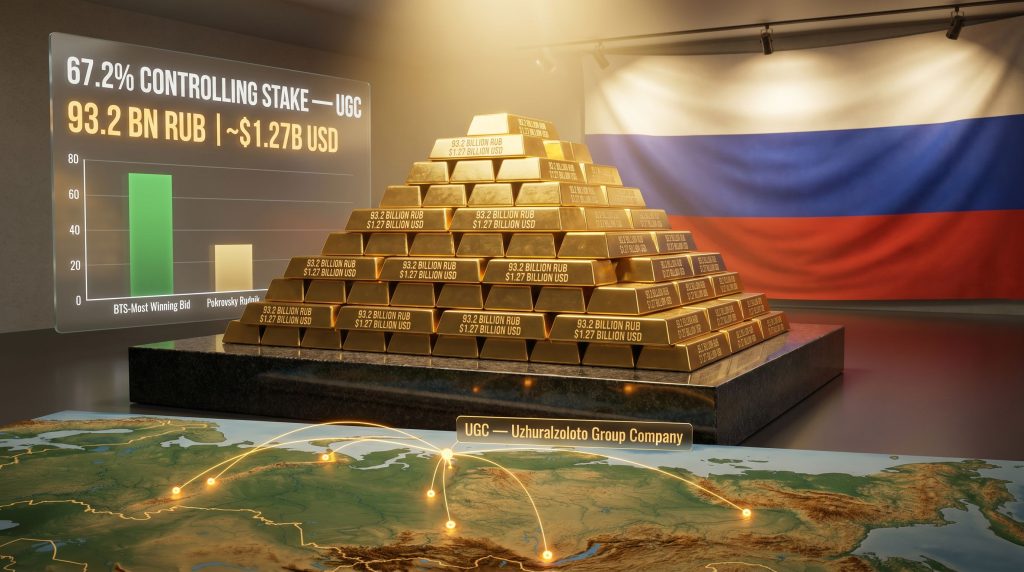
On June 19, 2026, auction data confirmed that BTS-Most Holding had secured a 67.2% controlling stake in Uzhuralzoloto Group Company (UGC) through a state-administered competitive process. The winning bid was recorded at 93.2 billion roubles, equivalent to approximately $1.27 billion USD at the prevailing exchange rate of 73.5 roubles per dollar. Based on the stake acquired, this transaction implies a total enterprise valuation for UGC of approximately $1.89 billion USD on a 100% equity basis.
Four bidders were formally admitted to the auction. Pokrovsky Rudnik, an established Russian mining operator, submitted the closest competing offer, though the precise margin between the two bids has not been made public. The assets being transferred were originally held by businessman Konstantin Strukov and had been subject to state confiscation prior to this sale process. Notably, this represented at least the fourth attempt by Russian authorities to successfully auction these assets, indicating the procedural complexity that has characterised this particular disposition.
The scale of this transfer positions it among the most significant domestic gold asset transactions in Russia's recent history, with the $1.27 billion price tag reflecting the premium attached to controlling-interest positions in established, producing operations.
Understanding the Competitive Auction Mechanism
Russia's framework for disposing of nationalised assets follows a structured pathway that is worth understanding in detail, particularly for those monitoring state-aligned capital flows in resource economies.
- Asset confiscation occurs through federal court proceedings or regulatory action targeting individuals found to have violated specific legal obligations. Mining licences and equity positions are treated as attachable property under Russian law.
- Transfer to state custody follows confiscation, with assets typically falling under the management of Rosimushchestvo, the Federal Property Management Agency responsible for state-held property.
- Qualification screening is conducted to determine which prospective buyers meet the operational, financial, and legal criteria to participate in a formal auction process.
- Competitive bidding proceeds among admitted parties, with the highest conforming offer winning the asset package.
- Award confirmation formally concludes the process, with auction registry data serving as the official record of the outcome.
The multi-bidder format, even within Russia's constrained domestic investment environment, provides a degree of price discovery that serves both fiscal recovery objectives for the state and legitimacy signalling to the broader market. Furthermore, the fact that four qualified bidders competed for the UGC stake demonstrates that domestic appetite for high-quality gold production assets remains robust.
UGC's Operational Significance in Russia's Gold Landscape
Uzhuralzoloto Group Company is not a marginal producer. The company operates across the Chelyabinsk region and broader Ural belt, with additional assets extending into Siberian gold territories. Historically, UGC has ranked among Russia's top-tier gold producers by annual output volume, operating a combination of open-pit and underground extraction methods supported by integrated processing infrastructure.
To appreciate why this asset attracted such intense domestic competition, it helps to understand Russia's overall position in global gold production:
| Metric | Context |
|---|---|
| Russia's global gold ranking | Consistently among the world's top 3 producers |
| Approximate national annual output | ~330 tonnes per year |
| UGC's operational footprint | Active across Ural and Siberian deposits |
| Auction valuation basis | 67.2% stake at ~$1.27 billion USD |
| Implied 100% enterprise value | ~$1.89 billion USD |
One aspect of this transaction that is often overlooked in standard coverage is the geological significance of the Ural gold belt itself. The Southern Urals region, where UGC's core assets are concentrated, hosts structurally complex gold deposits associated with Paleozoic volcanic arc systems. These deposits frequently exhibit characteristics of both orogenic and epithermal mineralisation styles, meaning they can present high-grade zones within broader lower-grade envelopes.
This geological complexity requires experienced operational management to extract value efficiently, which partly explains why the Russian state sought buyers with genuine operational credibility rather than purely financial acquirers.
Why Does Geological Complexity Matter for Buyers?
In practical terms, it means that the acquiring party must possess not just capital, but genuine technical capability. Conglomerates without mining experience face significant operational risk when managing such assets, which is precisely why Russia's qualification screening process favours established operators over purely financial participants.
Why a 67.2% Stake and Not Full Ownership?
A detail that merits closer examination is why the auctioned parcel represented 67.2% of UGC's equity rather than the entirety of the company. The answer lies in the structure of the original confiscation: the nationalised package reflected Strukov's personal shareholding position within UGC, not the totality of issued equity. Minority shareholders and co-investors retain the remaining approximately 32.8% of the company's equity.
However, this distinction matters less operationally than it might appear on the surface. Under Russian corporate law and standard governance frameworks, a controlling stake exceeding 50% confers full operational governance authority. BTS-Most's position at 67.2% ownership provides additional strategic leverage:
- Full control over board composition and executive appointments
- Authority over strategic capital allocation and expansion decisions
- Control of dividend policy and profit distribution
- The ability to pass ordinary resolutions without minority consent
- Near-complete sovereignty over UGC's strategic direction, given that extraordinary resolutions in Russian mining entities typically require a supermajority threshold that a 67%+ holder can achieve unilaterally
In practical terms, BTS-Most has acquired not just a financial position in UGC, but the complete operational and strategic apparatus of one of Russia's established gold producers.
Profiling BTS-Most: Infrastructure Origins, Resource Ambitions
BTS-Most Holding has historically been associated with large-scale infrastructure construction in Russia, including bridge and civil transport projects. The company's willingness and capacity to commit 93.2 billion roubles in a competitive auction environment signals a meaningful strategic pivot toward hard-asset accumulation.
This transition from infrastructure services to resource sector ownership is not unusual among Russian conglomerates operating in the current economic environment. Several structural factors drive this behaviour:
- Currency volatility protection: Physical gold production assets provide natural hedging against rouble depreciation in a way that service contracts do not
- Sanctions-insulated value stores: With Russian corporate access to international capital markets severely constrained since 2022, domestic resource assets represent one of the few avenues for deploying large capital sums into appreciating, liquid-adjacent holdings
- State relationship alignment: Participation in state-administered asset redistribution processes signals political reliability and typically strengthens a conglomerate's positioning for future contract and licensing opportunities
- Inflation resilience: Gold production cash flows maintain purchasing power in high-inflation environments, providing a balance sheet hedge that financial instruments cannot easily replicate under Russia's current conditions
The competitive dynamics of this particular auction also reveal something about BTS-Most's relative financial depth. Outbidding Pokrovsky Rudnik, an established mining operator with presumably strong sector knowledge and existing infrastructure, required both the financial capacity and the strategic conviction to justify the premium. In addition, the gold safe-haven demand environment has reinforced the strategic logic of acquiring producing assets at scale.
The next major ASX story will hit our subscribers first
Valuation Analysis: What Does $1.89 Billion Actually Mean?
Examining the transaction price through a comparative lens reveals important insights about Russia-specific risk discounting in mining valuations.
| Financial Indicator | Derived Figure |
|---|---|
| Winning bid (roubles) | 93.2 billion RUB |
| USD equivalent | ~$1.27 billion |
| Exchange rate applied | 73.5 RUB per USD |
| Stake percentage | 67.2% |
| Implied 100% equity value | ~$1.89 billion USD |
| Closest competing bidder | Pokrovsky Rudnik |
At an implied enterprise value of approximately $1.89 billion for 100% of UGC, the asset trades at a notable discount relative to comparable gold producers listed on Western exchanges, particularly when evaluated on a per-ounce-of-reserve or per-ounce-of-annual-production basis. Senior Western-listed gold producers with comparable output profiles have historically commanded enterprise value multiples of $400 to $700 per ounce of annual production.
Russia-domiciled assets in the current geopolitical environment carry substantially compressed multiples, reflecting:
- Sanctions exposure risk: Ownership of Russian-domiciled assets exposes holders to secondary sanctions considerations that depress international buyer demand
- Currency conversion risk: Rouble-denominated revenues face structurally higher conversion risk than USD or AUD-denominated equivalents
- Geopolitical discount: Elevated uncertainty around the operational continuity of Russian mining assets in conflict-adjacent regulatory environments
- Capital repatriation restrictions: Profits generated by Russian resource operations face restrictions on international transfer that reduce the effective yield for any owner with global capital needs
For domestic Russian buyers like BTS-Most, however, none of these discount factors apply in the same way. The geopolitical risk premium that excludes international capital becomes an acquisition opportunity for domestic conglomerates with rouble-denominated liabilities and state-aligned operational frameworks. Consequently, the mining geopolitics shaping this transaction are inseparable from the valuation logic underpinning it.
The Broader Consolidation Pattern in Russian Gold Mining
The BTS-Most buys stake in UGC transaction is not an isolated event. It accelerates a visible consolidation pattern that has been reshaping Russian gold sector ownership since 2022. Several structural themes are converging simultaneously.
Conglomerate absorption of artisanal and mid-tier producers: Smaller Russian gold producers that previously operated with international financing or joint venture structures have increasingly been absorbed into domestic conglomerate portfolios as external capital sources dried up.
State-orchestrated redistribution favouring operationally capable buyers: Unlike purely financial privatisations, Russia's current asset redistribution framework actively screens for buyers with demonstrated capacity to sustain production. This reflects a state preference for operational continuity over maximum fiscal recovery.
Gold as a strategic reserve building mechanism: Central bank gold reserves strategy, which has prioritised domestic gold accumulation over the past decade, creates an implicit alignment between domestic gold producers and state monetary objectives. Conglomerates acquiring gold production capacity are consequently participating in a broader national economic architecture.
Pokrovsky Rudnik's strategic position post-auction: The company's participation as the second-highest bidder for UGC confirms its growth-by-acquisition ambitions. Having failed to secure this particular asset, Pokrovsky Rudnik is likely to redirect acquisition activity toward other available targets within Russia's ongoing asset restructuring landscape. Furthermore, broader gold M&A activity trends globally suggest that appetite for consolidation in the sector remains elevated.
Three Structural Themes Defining This Transaction
- Domestic capital recycling at scale: Nationalised assets are being redistributed to conglomerates with the balance sheet depth and operational credibility to prevent production disruptions. This represents an economically rational mechanism for maintaining output continuity while achieving political objectives simultaneously.
- Gold as a geopolitical hedge within Russia's corporate sector: Russian conglomerates are increasingly treating gold production ownership as a store of value in an environment characterised by currency volatility, limited international investment options, and restricted access to global financial systems.
- Competitive auction mechanics as a legitimacy instrument: Even within a constrained domestic market, the multi-bidder format creates price discovery that serves both fiscal and reputational functions for the state, while signalling to domestic capital that resource sector acquisitions remain governed by recognisable market-adjacent rules.
The $1.27 billion price achieved for a 67.2% stake in UGC confirms that domestic Russian appetite for quality gold production assets is not diminished by geopolitical complexity. For buyers operating entirely within Russia's economic perimeter, the risk discounts that exclude foreign capital translate directly into acquisition value.
Disclaimer: This article contains forward-looking analysis and market commentary based on publicly available information as of June 2026. Financial figures, valuations, and strategic assessments involve inherent uncertainty and should not be construed as investment advice. All USD conversions are based on the reported exchange rate of 73.5 roubles per dollar at the time of the transaction. Readers should conduct independent due diligence before drawing investment conclusions from the information presented.
Want to Stay Ahead of Significant Mineral Discoveries Before the Broader Market?
Discovery Alert's proprietary Discovery IQ model delivers real-time alerts on significant ASX mineral discoveries, instantly translating complex geological and market data into actionable investment insights — explore historic examples of exceptional discovery returns to understand the scale of opportunity, then begin your 14-day free trial at Discovery Alert to position yourself ahead of the market.